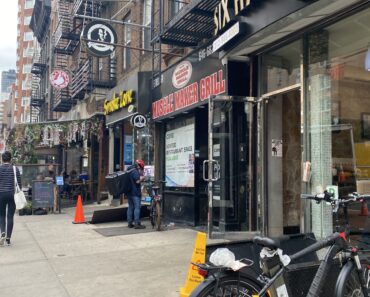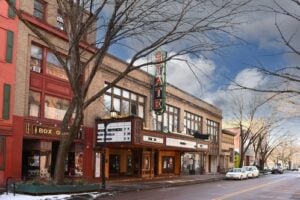
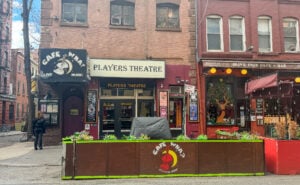
Cafe Wha? on MacDougal Street in Greenwich Village. Photo by Brian Kachejian, 2026
If the history of rock and roll was forged on electric guitars, much of New York City’s contribution was made inside dark clubs, converted theaters, ballrooms, and arenas where new sounds found an audience. From the Bowery punk scene to Bill Graham’s Fillmore East and the enormous stage at Madison Square Garden, New York venues did more than host famous performers. They helped shape the careers, scenes, and live albums that became part of rock history.
Some of these rooms disappeared decades ago. Others survived by changing names or uses, and a few are still presenting concerts today. Their addresses tell a second story about New York itself, where a punk club can become a fashion store, a legendary concert hall can become university space, and a ballroom can disappear beneath a luxury apartment tower.
These are 10 of the most iconic rock venues in New York City history, the artists and moments that made them famous, and what remains at their locations today.
1. CBGB, The Bowery
Location: 315 Bowery
Rock Venue Years: 1973 to 2006
Claim to Fame: The downtown incubator of punk, new wave, and original New York rock
When Hilly Kristal opened CBGB in 1973, the letters stood for Country, Bluegrass, and Blues, while OMFUG meant “Other Music for Uplifting Gormandizers.” The name suggested one kind of club, but the room soon became famous for something very different.
Kristal’s willingness to book bands playing their own material gave an emerging downtown scene a place to grow. Television, Patti Smith, the Ramones, Blondie, Talking Heads, Richard Hell, and other artists associated with New York punk and new wave found an audience in a room that became almost as famous for its graffiti, stickers, cramped stage, and notorious bathrooms as for the music.
CBGB closed on October 15, 2006, after a final concert by Patti Smith. The address did not disappear with the club. The former CBGB space is now occupied by the John Varvatos Bowery store, and 315 Bowery remains a destination for music fans who want to stand at one of the most important addresses in American rock history.
Legacy Today: The building survives at 315 Bowery, and the former club space operates as the John Varvatos Bowery store. The CBGB site was added to the National Register of Historic Places in 2013.
A Final Evening at CBGB’s
2. Fillmore East, East Village
Location: 105 Second Avenue at East 6th Street
Rock Venue Years: March 8, 1968 to June 27, 1971
Claim to Fame: Bill Graham’s East Coast rock palace and one of the great live-recording rooms in rock history
Promoter Bill Graham opened the Fillmore East in a former theater on Second Avenue in March 1968. The approximately 2,600-seat room became known as the “Church of Rock and Roll,” a reputation earned through strong acoustics, psychedelic light shows, carefully assembled bills, and performances by many of the most important artists of the era.
Jimi Hendrix, the Who, Led Zeppelin, Jefferson Airplane, Crosby, Stills, Nash & Young, Frank Zappa, the Grateful Dead, and many others appeared there. The venue’s greatest recording legacy may be the Allman Brothers Band’s At Fillmore East, created from the group’s March 12 and 13, 1971 performances and still regarded as one of rock’s defining live albums.
The Fillmore East closed in June 1971 after only a little more than three years under Graham, but its short life gave it an almost mythic reputation. The old auditorium no longer survives intact. Much of the rear portion was demolished and replaced by apartments, while portions of the historic Second Avenue frontage and former lobby remain.
Legacy Today: Visit 105 Second Avenue to see the surviving exterior connected to the Fillmore East. The corner of East 6th Street and Second Avenue also carries the honorary name Bill Graham Way.
3. Max’s Kansas City, Union Square
Location: 213 Park Avenue South
Active Years: 1965 to 1974; reopened 1975 to 1981
Claim to Fame: The meeting place where New York art, glam, punk, fashion, and rock collided
Mickey Ruskin opened Max’s Kansas City in 1965 as a restaurant and nightclub just north of Union Square. What developed there was difficult to categorize. Artists, writers, musicians, fashion figures, and members of Andy Warhol’s circle mixed in the restaurant and legendary back room while music increasingly became part of the club’s identity.
The Velvet Underground had a particularly important connection to Max’s, and a 1970 performance recorded there became the album Live at Max’s Kansas City. David Bowie, Iggy Pop, the New York Dolls, Alice Cooper, Blondie, the Ramones, and many others became part of the venue’s history as the downtown scene moved from the late 1960s into glam, punk, and new wave.
One of the most remarkable bills came in July 1973, when Bob Marley and the Wailers opened for Bruce Springsteen and the E Street Band during a run at Max’s. Springsteen was no longer an unsigned artist at that point; he had already signed with Columbia Records and released his debut album earlier that year.
Legacy Today: Unlike many vanished clubs, the five-story building at 213 Park Avenue South still stands. The former Max’s Kansas City address is now a mixed-use building with residential lofts and ground-floor retail.
4. The Bottom Line, Greenwich Village
Location: 15 West 4th Street at Mercer Street
Active Years: 1974 to 2004
Claim to Fame: An intimate 400-seat showcase room where major artists played at close range
Allan Pepper and Stanley Snadowsky opened The Bottom Line in February 1974. With roughly 400 seats and audiences gathered close to the stage, the club offered the kind of intimacy that could make a major artist feel as if he or she were playing in someone’s oversized living room.
Bruce Springsteen and the E Street Band played one of the most important engagements in the club’s history in August 1975. Their five-night, ten-show stand came just before the release of Born to Run and became one of the performances that helped transform Springsteen from a highly regarded young artist into a national rock star.
The Bottom Line also hosted Lou Reed, Eric Clapton, Prince, Miles Davis, Hall & Oates, Van Morrison, Peter Gabriel, the Ramones, Billy Joel, and generations of other performers. The club closed in 2004 after a long dispute involving rent and its landlord, New York University.
Legacy Today: The former Bottom Line space is part of New York University’s property at West 4th Street and has been used for university classroom and lecture space.
5. Cafe Wha?, Greenwich Village
Location: 115 MacDougal Street
Active Years: 1959 to the present, with changes in ownership and operation over the decades
Claim to Fame: An early New York stage for Bob Dylan and Jimi Hendrix
Unlike most venues on this list, Cafe Wha? is still operating at the address that made it famous. Manny Roth founded the basement coffeehouse in 1959, when Greenwich Village was filled with folk singers, comedians, poets, beatniks, and young performers looking for a place to work.
Bob Dylan arrived in New York in January 1961 and performed at Cafe Wha? on January 24, one of the earliest appearances of his New York career. A few years later, Jimi Hendrix performed there under the name Jimmy James with the Blue Flames.
Former Animals bassist Chas Chandler saw Hendrix perform at Cafe Wha? in 1966. Chandler was impressed enough to return, sign Hendrix to an agreement, and bring him to London, where the Jimi Hendrix Experience would soon be formed.
Legacy Today: Cafe Wha? remains open at 115 MacDougal Street and continues to present live music in Greenwich Village.
6. The Ritz, East Village and Midtown
Original Location: 119 to 125 East 11th Street
Second Location: 254 West 54th Street
Active Years: 1980 through the early 1990s
Claim to Fame: A defining 1980s rock room known for live music, large video screens, and MTV-era concert broadcasts
The Ritz opened in 1980 inside the historic East 11th Street building now known again as Webster Hall. The club became one of New York’s essential 1980s concert rooms, booking artists who were too big for small clubs but still benefited from the intensity of a standing-room rock audience.
U2, Prince, Iggy Pop, Tina Turner, Depeche Mode, Ozzy Osbourne, Run-DMC, Duran Duran, and many others played the Ritz. Guns N’ Roses delivered one of the venue’s most famous performances in February 1988, a concert broadcast by MTV that captured the band during the explosive rise of Appetite for Destruction.
In 1989, the Ritz moved from East 11th Street to 254 West 54th Street, the former home of the legendary Studio 54 nightclub. The second location first operated as the New Ritz before returning to the Ritz name and continued presenting concerts into the early 1990s.
Legacy Today: The original Ritz building on East 11th Street survives as Webster Hall, once again one of New York City’s major live-music venues. The second Ritz location at 254 West 54th Street is now the Broadway venue Studio 54.
7. The Palladium, East 14th Street
Location: 126 East 14th Street
Palladium Years: 1976 to 1997
Claim to Fame: A great 1970s and 1980s concert hall that later became one of New York’s defining nightclubs
The building that became the Palladium opened in 1927 as the Academy of Music, a Thomas W. Lamb-designed movie palace that increasingly hosted rock concerts during the 1960s and early 1970s. After the Fillmore East closed, the Academy became even more important as a large downtown concert venue.
In September 1976, the theater was rechristened the Palladium under concert promoter Ron Delsener, beginning with a performance by The Band. Kiss, Frank Zappa, Bruce Springsteen, the Ramones, Patti Smith, Iggy Pop, Blondie, Judas Priest, Iron Maiden, and many other artists performed there.
On September 21, 1979, photographer Pennie Smith captured Clash bassist Paul Simonon smashing his bass on the Palladium stage. The photograph became the cover of the Clash’s London Calling, one of the most recognizable album covers in rock history.
The Palladium’s story changed again in 1985, when former Studio 54 partners Steve Rubell and Ian Schrager transformed the building into a massive nightclub designed by architect Arata Isozaki. The club remained a major part of New York nightlife until closing in 1997.
Legacy Today: The original Palladium building was demolished in 1998. New York University’s Palladium Hall residence and athletic complex now occupies the East 14th Street site.
8. Beacon Theatre, Upper West Side
Location: 2124 Broadway near West 74th Street
Opened: 1929
Claim to Fame: One of New York’s great surviving rock theaters and the longtime New York home of the Allman Brothers Band
The Beacon Theatre opened in 1929 as an ornate movie palace designed by Walter W. Ahlschlager. The 2,600-seat theater gradually became one of New York’s most admired concert rooms, particularly as rock performers discovered the intimacy and acoustics of the Upper West Side venue.
No band became more closely associated with the Beacon than the Allman Brothers Band. The group began playing there in 1989 and ultimately performed 238 shows at the theater. Their October 28, 2014 appearance at the Beacon became the final concert of the Allman Brothers Band.
The Rolling Stones also filmed performances at the Beacon for Martin Scorsese’s concert film Shine a Light. Tom Petty and the Heartbreakers, Steely Dan, Bob Dylan, Coldplay, Eddie Vedder, and many other artists have played the room.
Madison Square Garden Entertainment acquired the Beacon in 2006 and completed a major restoration in 2009.
Legacy Today: The Beacon Theatre remains open and continues operating as a major concert and special-event venue.
9. Roseland Ballroom, Midtown
Former Location: 239 West 52nd Street
Years at the 52nd Street Site: 1956 to 2014
Claim to Fame: A ballroom that survived multiple musical eras and eventually became a major rock, alternative, and pop concert hall
Roseland’s New York history began in 1919 at an earlier Broadway location, where big bands and ballroom dancing defined its identity. When the original building was demolished in 1956, Roseland moved to a former skating rink at 239 West 52nd Street.
The second Roseland survived changes that would have destroyed the identity of many older venues. Big-band dancing gave way to rock, disco, pop, alternative music, boxing, and large standing-room concerts. The Rolling Stones, Madonna, Nirvana, Radiohead, Metallica, Beyoncé, Red Hot Chili Peppers, and countless other performers appeared there.
Lady Gaga closed the venue in April 2014 with a seven-show residency. The old ballroom was demolished for redevelopment.
Legacy Today: The Roseland Ballroom site is now occupied by ARO, a large residential tower. The development incorporated photographs, signs, and other references to Roseland’s history into portions of the new building.
10. Madison Square Garden, Midtown
Location: 4 Pennsylvania Plaza
Current Arena Opened: February 11, 1968
Claim to Fame: The arena where playing New York became a measure of rock superstardom
Madison Square Garden is far larger than the clubs and theaters that dominate most of this list, but no history of New York rock venues would be complete without it. For generations of artists, selling out the Garden has represented one of the clearest signs that a career had reached the highest level.
Led Zeppelin played three famous concerts at the Garden in July 1973, with footage later used in the film The Song Remains the Same. On November 28, 1974, John Lennon joined Elton John onstage at Madison Square Garden, an appearance that became Lennon’s final public concert performance.
Elvis Presley, the Rolling Stones, the Who, Bruce Springsteen, U2, Elton John, David Bowie, Queen, Madonna, and generations of other artists have played the building. Billy Joel developed a relationship with the Garden unlike any other musician. His record-setting monthly residency began in 2014 and concluded on July 25, 2024, with his 150th lifetime performance at Madison Square Garden.
Legacy Today: Madison Square Garden remains open above Penn Station and continues to operate as one of the world’s best-known sports and concert arenas.
More New York Music Venue History
For deeper histories of several venues on this list, continue with our features on Cafe Wha?, the Beacon Theatre, and Madison Square Garden. Readers interested in the Ritz’s second home can also explore our History of the Studio 54 Theater on Broadway.
10 Iconic NYC Rock Venues at a Glance
| Venue | Historic Location | Key Rock Era | What Is There Today? |
|---|---|---|---|
| CBGB | 315 Bowery | 1973 to 2006 | John Varvatos Bowery store in the historic space |
| Fillmore East | 105 Second Avenue | 1968 to 1971 | Historic frontage survives; former auditorium area redeveloped as apartments |
| Max’s Kansas City | 213 Park Avenue South | 1965 to 1981 | Original building survives with lofts and retail |
| The Bottom Line | 15 West 4th Street | 1974 to 2004 | NYU classroom and university space |
| Cafe Wha? | 115 MacDougal Street | 1959 to present | Still operating as Cafe Wha? |
| The Ritz | East 11th Street; later West 54th Street | 1980s to early 1990s | Original site is Webster Hall; second site is Studio 54 |
| The Palladium | 126 East 14th Street | 1976 to 1997 | NYU Palladium Hall |
| Beacon Theatre | 2124 Broadway | 1970s to present as a major rock room | Still operating as the Beacon Theatre |
| Roseland Ballroom | 239 West 52nd Street | 1956 to 2014 at this location | ARO residential tower |
| Madison Square Garden | 4 Pennsylvania Plaza | 1968 to present | Still operating as Madison Square Garden |
Published August 9, 2026.
10 Iconic Rock Venues in NYC History and What Stands There Today article published on ClassicNewYorkHistory.com © 2026