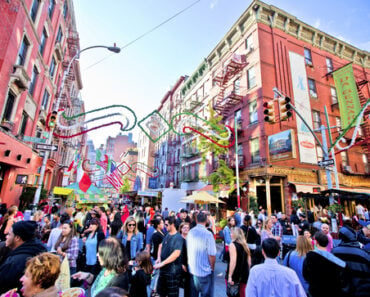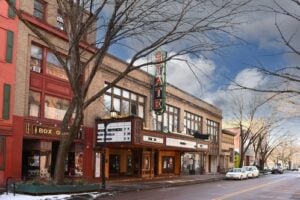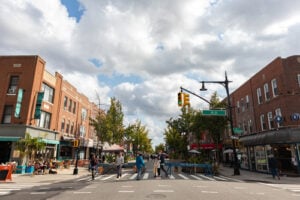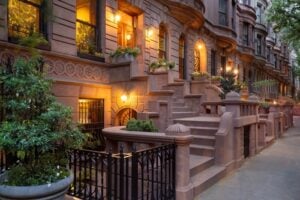
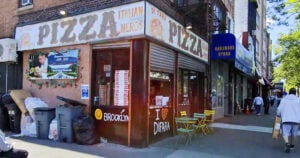
A Brooklyn neighborhood street scene outside Di Fara Pizza. Photo by Brian Kachejian © 2026
Brooklyn’s neighborhood names carry more than four centuries of history. Some reach back to Dutch and English colonial settlements, others preserve Native place-names, family estates, old farms, military landmarks, railroads, seaside resorts, industrial districts, and the real estate developments that reshaped the borough.
This guide looks at the stories behind 55 Brooklyn neighborhood and historic place-names, from Flatbush and Gowanus to DUMBO, Coney Island, Weeksville, and Wingate.
1. Flatbush
Origin: Derived from the Dutch name Vlackebos, generally translated as “wooded plain” or “flat woodland.”
The Story: Dutch settlers established the village known as Midwout and Vlackebos in the 17th century, and the Dutch granted it a patent in 1652. Under English rule the name evolved into Flatbush. The town later served as the Kings County seat from roughly 1685 until 1832 and remained an independent municipality until it was annexed to the City of Brooklyn in 1894.
2. Gowanus
Origin: An old Brooklyn place-name traditionally connected to a Native leader recorded as Gowanes or Gouwane.
The Story: The name appeared in early descriptions of the tidal creek and marshland that once occupied this part of Brooklyn. Historical sources have long associated it with a local Native leader, although the precise origin is not completely settled. The natural creek was later transformed into the Gowanus Canal, authorized by the New York State Legislature in 1849 and completed in the 19th century as an industrial waterway.
3. Bushwick
Origin: From the Dutch Boswijck or Boswyck, commonly interpreted as “town in the woods” or “refuge in the woods.”
The Story: The area that includes modern Bushwick, Williamsburg, and Greenpoint was once part of the Dutch Town of Bushwick. Peter Stuyvesant formally recognized the settlement around 1660 and gave it the name Boswyck. For generations the inland portion remained largely rural woodland and farmland before rapid urban development transformed Bushwick during the 19th century.
4. Greenpoint
Origin: A descriptive waterfront name referring to a green point of land projecting toward the East River.
The Story: Scandinavian settler Dirck Volckertsen, known as “Dirck the Norman,” received a patent for land here in 1645. Greenpoint remained largely agricultural for generations. Its modern street grid emerged after Neziah Bliss began acquiring property in the 1830s and had the area surveyed and divided into streets and lots. The old descriptive waterfront name remained attached to the neighborhood.
5. Red Hook
Origin: From the Dutch Roode Hoek, meaning “Red Point” or “Red Hook.”
The Story: Dutch settlers used the name for the reddish soil and the shape of the peninsula projecting into New York Harbor. Red Hook remained marshy and relatively undeveloped until enormous 19th-century waterfront projects, including the Atlantic and Erie Basins, transformed it into one of America’s busiest shipping districts.
6. Canarsie
Origin: Derived from the Lenape name associated with the Native people and territory of this section of southeastern Brooklyn.
The Story: Canarsie is one of Brooklyn’s most enduring Native-derived place-names. One historical interpretation translates the word as “fenced place,” although the exact linguistic origin remains debated. The community later developed as a fishing village and became a popular seaside resort after rail service improved access to Jamaica Bay in the 19th century.
7. Gravesend
Origin: The name is most commonly linked to Gravesend in Kent, England, although historical accounts have also connected it to the Dutch ’s-Gravesande.
The Story: English religious dissenter Lady Deborah Moody and her followers established Gravesend under Dutch rule in the 1640s, receiving a formal patent in 1645. Moody designed the unusual town plan around a central square. Gravesend became one of the six historic towns of Kings County and remained independent until its annexation to Brooklyn in 1894.
8. New Utrecht
Origin: Named after the Dutch city of Utrecht.
The Story: Dutch settlers established the community in 1657, and the settlement became one of the historic towns of Kings County. The name Nieuw Utrecht honored the city in the Netherlands. New Utrecht remained largely agricultural for centuries before the farms of southwestern Brooklyn were divided for suburban and urban development.
9. Flatlands
Origin: The English name that replaced the Dutch colonial name Nieuw Amersfoort.
The Story: Dutch colonists began settling this part of Brooklyn in 1636, and by the 1640s their communities had combined into the village of Nieuw Amersfoort, named after Amersfoort in the Netherlands. Under English rule the area became known as Flatlands, an appropriate description of its broad coastal plains and meadows. The town remained independent until Brooklyn annexed it in 1896.
10. Midwood
Origin: From the Dutch Midwout, meaning “middle woods.”
The Story: Midwout was one of the early Dutch names associated with the settlement that became Flatbush. Centuries later, the historic Dutch word was revived for the residential neighborhood south and east of Prospect Park. Its survival is a reminder that modern Brooklyn neighborhood names often preserve much older colonial geography.
11. Brooklyn Heights
Origin: A topographical name for the high bluff above the East River and Brooklyn waterfront.
The Story: The elevated ground across from Lower Manhattan became one of New York’s earliest commuter suburbs as ferry service expanded in the early 19th century. Merchants and professionals built substantial homes along the bluff, and the simple geographic description “the Heights” became Brooklyn Heights. The neighborhood’s relationship with Manhattan changed dramatically again with the opening of the Brooklyn Bridge in 1883.
12. DUMBO
Origin: An acronym for Down Under the Manhattan Bridge Overpass.
The Story: The waterfront district had previously been associated with Fulton Landing and its large industrial manufacturers. Artists began moving into inexpensive lofts in former factory buildings during the 1970s. The DUMBO acronym emerged around 1978 and is generally credited to residents who hoped an awkward-sounding name might discourage developers. Instead, the name became one of the most recognizable neighborhood brands in Brooklyn.
13. Williamsburg
Origin: Named for Colonel Jonathan Williams (1750–1815), an engineer and first superintendent of the United States Military Academy at West Point.
The Story: Williamsburg began developing along the East River on land that had been part of the Town of Bushwick. Around 1810, the growing settlement was named for Jonathan Williams, who had surveyed property in the area. The older spelling Williamsburgh remained common for much of the 19th century. The neighborhood later gained a direct connection to Manhattan through the Williamsburg Bridge.
14. Bedford-Stuyvesant
Origin: A combined name joining the older communities of Bedford and Stuyvesant Heights.
The Story: Bedford developed from an early crossroads settlement, while Stuyvesant Heights became a fashionable residential district of row houses and brownstones. As the two areas grew together, Bedford-Stuyvesant became the common name for the broader neighborhood. During the 20th century, Bed-Stuy became one of the most important centers of Black life, homeownership, politics, arts, and community activism in New York City.
15. Crown Heights
Origin: A name associated with Crown Street and the elevated terrain of central Brooklyn.
The Story: The name Crown Heights was in use south of Eastern Parkway by at least 1910 and gradually expanded north of the parkway during the following decades. Earlier sections of the area had been known by names including Crow Hill and Weeksville. By the 1930s, Crown Heights was becoming the broad neighborhood name recognized today.
16. Cobble Hill
Origin: Revived from the historic name of a hill and Revolutionary War fortification in the area.
The Story: Cobble Hill was an old Brooklyn place-name long before the modern neighborhood took shape, but it fell out of common use during the 19th century as the district was absorbed into the larger identity of South Brooklyn. In the late 1950s, residents and preservationists revived the historic Cobble Hill name while organizing to protect the neighborhood’s row houses and low-rise streetscape.
17. Boerum Hill
Origin: Named for the prominent Dutch-American Boerum family.
The Story: Members of the Boerum family were important landowners and public figures in colonial Brooklyn. Simon Boerum served as Kings County clerk and represented the county in colonial political life. The family name survived on local streets and places. In the 20th century, preservation-minded residents adopted Boerum Hill as the neighborhood name for an area previously grouped more broadly with South Brooklyn.
18. Carroll Gardens
Origin: Combines the local Carroll name with the neighborhood’s unusually deep front gardens.
The Story: Carroll Street and Carroll Park honor Charles Carroll of Carrollton, the only Catholic signer of the Declaration of Independence. The neighborhood’s distinctive front yards date to a Brooklyn law adopted in 1846 requiring deep setbacks on several local streets. The name Carroll Gardens came into common use in the 1960s as residents sought a distinct identity for the brownstone neighborhood.
19. Park Slope
Origin: A straightforward geographic name describing the neighborhood on the western slope below Prospect Park.
The Story: The district developed rapidly after Prospect Park opened in the 19th century and improved transportation connected the area with Downtown Brooklyn and Manhattan. The combination of the park and the sloping terrain supplied a simple and durable neighborhood name. For more on the landmark that defines the area, see our History of Brooklyn’s Prospect Park.
20. Bay Ridge
Origin: Adopted in 1853 to replace the older name Yellow Hook.
The Story: Yellow Hook referred to the yellow clay cliffs along the waterfront. During recurring yellow fever outbreaks, however, residents worried that the name created an unfortunate association with the disease. In 1853, the village adopted the more picturesque name Bay Ridge, reflecting its elevated position overlooking New York Bay and the Narrows.
21. Fort Greene
Origin: Named for a military fortification honoring Revolutionary War General Nathanael Greene.
The Story: An American fort known as Fort Putnam stood on the high ground during the Revolutionary War. The defenses were rebuilt during the War of 1812 and renamed Fort Greene in honor of Nathanael Greene. The fort disappeared, but the name remained in Fort Greene Park and eventually became the identity of the surrounding neighborhood.
22. Clinton Hill
Origin: Named from Clinton Avenue, which honors New York statesman DeWitt Clinton.
The Story: The high ground east of Fort Greene developed from rural land into an affluent residential district during the 19th century. Clinton Avenue became one of its grandest streets, lined with substantial houses and mansions. The avenue’s name and the neighborhood’s elevated terrain naturally combined in the identity Clinton Hill.
23. Sheepshead Bay
Origin: Named after the sheepshead fish, once common in the local waters.
The Story: The sheltered bay became known for a saltwater fish distinguished by dark vertical stripes and unusually human-like teeth. Fishing remained central to the area’s identity even as Sheepshead Bay developed into a resort and residential community. Charter boats and seafood restaurants continue to connect the neighborhood with its maritime past.
24. Coney Island
Origin: Generally traced to the Dutch word konijn, meaning “rabbit.”
The Story: Historical accounts connect the Coney name with the rabbits once found on the barrier island. The Dutch-derived place-name survived under English rule and eventually became Coney Island. What began as a relatively isolated coastal landscape became one of the world’s most famous amusement and resort districts. The neighborhood is also inseparable from the history of Nathan’s Famous Hot Dogs at Coney Island.
25. Brighton Beach
Origin: Named after the famous seaside resort of Brighton, England.
The Story: Developer William A. Engeman transformed oceanfront land east of Coney Island into a resort community during the 1870s. The name Brighton Beach deliberately evoked England’s fashionable seaside destination. Hotels, rail service, bathing, and entertainment helped establish the Brooklyn version as a major resort before it evolved into a densely populated residential neighborhood.
26. Manhattan Beach
Origin: A resort-era name chosen to appeal to affluent visitors from Manhattan.
The Story: Railroad and real estate developer Austin Corbin developed the eastern end of the Coney Island peninsula as an exclusive resort in the late 1870s. The grand Manhattan Beach Hotel helped make the name famous. Although the hotels disappeared, Manhattan Beach survived as the name of the residential neighborhood that later occupied the former resort grounds.
27. Bath Beach
Origin: Connected to the early Bath House resort and the area’s long association with sea bathing.
The Story: A bathing establishment was operating along Gravesend Bay by the end of the 18th century, and the shoreline developed into an increasingly popular resort district during the 19th century. Roads and later railways carried visitors toward Bath and Coney Island. The name Bath Beach preserved the neighborhood’s early identity as a place for waterfront recreation and summer retreats.
28. Dyker Heights
Origin: Named for the older Dyker Meadow and Dyker Beach area below the neighborhood’s elevated ground.
The Story: Developer Walter L. Johnson began developing Dyker Heights in the 1890s as an upscale suburban community. The “Heights” portion emphasized its hilltop setting, while “Dyker” came from the much older local Dyker Meadow and Dyker Beach names. The deeper origin of the Dyker place-name is less certain than the history of Johnson’s development itself.
29. Sunset Park
Origin: Named after Sunset Park, the hilltop public park known for its views across New York Harbor.
The Story: The City of Brooklyn acquired the first portion of the park in 1891 and expanded it during the following years. The park’s elevated location offered broad views toward the harbor and the setting sun. The surrounding district had long been identified as part of South Brooklyn or by ward and local names; Sunset Park became the established neighborhood name during the 20th century.
30. Vinegar Hill
Origin: Named for the Battle of Vinegar Hill, fought during the Irish Rebellion of 1798.
The Story: Shipbuilder and developer John Jackson began laying out streets near the Brooklyn Navy Yard around the start of the 19th century. The Irish battle name became attached to the district and proved remarkably durable. Vinegar Hill remains one of Brooklyn’s smallest and most historically distinctive neighborhoods.
31. Borough Park
Origin: A late-19th-century real estate name promoted by the Borough Park Company.
The Story: Part of the area had earlier been developed under the name Blythebourne. In the late 1890s, real estate developer and politician William H. Reynolds and the Borough Park Company acquired and promoted large tracts in the district. Borough Park became the lasting name as new transit and housing rapidly transformed the former farmland.
32. Brownsville
Origin: Named after real estate developer Charles S. Brown.
The Story: Brown purchased and subdivided farmland in eastern Brooklyn during the 1860s, marketing affordable lots and houses in the developing district. The settlement took the name Brownsville. Improved transit and inexpensive housing later attracted large numbers of working-class immigrants, particularly Jewish families leaving crowded neighborhoods in Lower Manhattan.
33. East New York
Origin: Named by merchant and real estate promoter John R. Pitkin in the 1830s.
The Story: Pitkin purchased land near the old New Lots crossroads and envisioned a new industrial and commercial city that could rival New York itself. He called his development East New York. The Panic of 1837 undermined his ambitious plans, but the name survived and eventually came to identify a large section of eastern Brooklyn.
34. Mill Basin
Origin: A practical place-name tied to the old Mill Island area, its tidal waterways, and the mills that once operated in southeastern Brooklyn.
The Story: The district was historically surrounded by marshes, creeks, and islands along Jamaica Bay. It became known as Mill Island before extensive dredging and filling joined former islands and wetlands to the mainland. Early-20th-century plans attempted to develop Mill Basin as a seaport and industrial district, while substantial residential development arrived after World War II.
35. Wallabout and the Brooklyn Navy Yard
Origin: Wallabout comes from the Dutch Waal-bogt or Waal-bocht, generally understood as a reference to a Walloon bay or bend.
The Story: Wallabout was one of Brooklyn’s earliest colonial waterfront place-names. The federal government acquired property on Wallabout Bay in 1801 for what became the Brooklyn Navy Yard. The shipyard eventually became so dominant that “Navy Yard” became the modern identity of much of the waterfront district, while the older Wallabout name survives in local history and landmarks.
36. Weeksville
Origin: Named after James Weeks, a free Black longshoreman who purchased land there in 1838.
The Story: Weeks’s purchase helped establish one of the most important free Black communities in 19th-century New York. Weeksville grew into a community with homes, churches, schools, businesses, civic organizations, and newspapers. Property ownership also carried extraordinary political significance because New York imposed a property requirement on Black male voters that did not apply to white men. The surviving Hunterfly Road Houses preserve part of Weeksville’s remarkable history.
37. Marine Park
Origin: Named after the large municipal Marine Park created around Gerritsen Creek and its salt marsh.
The Story: The creek and surrounding marshland had long been associated with the Gerritsen name. During the 1920s, philanthropists Frederic B. Pratt and Alfred T. White donated land to the city to preserve the waterfront from intensive development. As New York assembled and developed the public park, the name Marine Park spread to the surrounding residential community.
38. Cypress Hills
Origin: An old name associated with the wooded ridge along the Brooklyn-Queens border and later reinforced by Cypress Hills Cemetery.
The Story: Cypress Hills occupies some of the highest ground in Brooklyn along the glacial moraine. The name was established by the 19th century and became especially prominent after Cypress Hills Cemetery was incorporated in 1848. The precise original reason for selecting “Cypress” is not as firmly documented as many other Brooklyn neighborhood names, so claims tying it to a particular grove of trees should be treated cautiously.
39. Prospect Heights
Origin: A geographic name referring to elevated ground near Prospect Park.
The Story: The neighborhood sits north of Prospect Park and just east of the older brownstone districts near Downtown Brooklyn. As residential development spread across the area during the late 19th and early 20th centuries, the name Prospect Heights emphasized both its proximity to the park and its higher terrain. The opening of transportation lines and nearby cultural institutions helped establish the neighborhood’s modern identity.
40. Ditmas Park and Midwood Park
Origin: Ditmas Park preserves the name of the old Dutch-American Ditmas family, while Midwood Park reused the historic Dutch-derived Midwood name.
The Story: Both names became associated with early-20th-century planned residential developments in Victorian Flatbush. Developers built large detached houses on landscaped streets as an alternative to denser row-house Brooklyn. The neighboring enclaves remain closely associated today, although Ditmas Park and Midwood Park originated as separate developments.
41. Gerritsen Beach
Origin: Named after Gerritsen Creek, whose name developed from a Dutch family associated with the creek, farms, and tidal mill.
The Story: The marshy peninsula remained largely undeveloped until the early 20th century. Realty Associates developed a seasonal bungalow community there, and by the 1930s much of the peninsula was occupied by small summer homes. Many were later enlarged or rebuilt for year-round use. Gerritsen Beach retained the historic creek name while developing a particularly strong maritime identity.
42. Bergen Beach
Origin: Developed from the older name Bergen Island, associated with the Bergen family.
The Story: Bergen Beach was originally separated from mainland Brooklyn by marshes and tidal waterways. The island was known for generations as Bergen Island or Bergen’s Island. Development and extensive filling eventually connected it to the mainland, and the modern residential neighborhood inherited the Bergen name. The adjacent area called Georgetowne developed much later as a subsection of Bergen Beach.
43. Bensonhurst
Origin: Named after Brooklyn landowner and businessman Arthur W. Benson.
The Story: Benson owned extensive property in southwestern Brooklyn. During the late 19th century, developers including James D. Lynch subdivided former farmland into a suburban community promoted as Bensonhurst-by-the-Sea. As transit expanded and Brooklyn grew outward, the shorter Bensonhurst name became permanent.
44. Kensington
Origin: Named after Kensington in London.
The Story: Kensington developed from former Flatbush farmland during the late 19th century, particularly after Ocean Parkway and improved transit opened southern Brooklyn to new residential construction. Developers selected the prestigious London place-name as part of the era’s common practice of giving new suburban districts established or fashionable-sounding identities.
45. Windsor Terrace
Origin: A mid-19th-century real estate name adopted for a small residential village developed by William Bell.
The Story: Bell acquired former farmland in 1849 and divided it into building lots. The new settlement became known as Windsor Terrace by the early 1850s. The neighborhood later found itself tucked between Prospect Park and Green-Wood Cemetery, with an unusual street pattern reflecting the older property lines and grids that existed before Brooklyn’s expansion.
46. Manhattan Terrace
Origin: A turn-of-the-20th-century suburban development name that deliberately invoked Manhattan.
The Story: Manhattan Terrace developed within the broader Flatbush-Midwood area as builders promoted detached homes to families seeking suburban space with convenient transportation to Manhattan. The name was essentially a real estate identity, linking a quiet Brooklyn residential tract with the city center where many prospective homeowners worked.
47. Fiske Terrace
Origin: Named after developer George B. Fiske.
The Story: Fiske Terrace was developed during the early 20th century near the Brighton rail line. Fiske and other builders created a neighborhood of large detached houses in popular revival styles on carefully planned streets. Together with neighboring Midwood Park, the enclave survives as one of the best-known sections of Victorian Flatbush.
48. Homecrest
Origin: A real estate name that developed from the early-20th-century designation Homecrest-by-the-Sea.
The Story: The area had been part of the old Town of Gravesend. As developers built substantial houses in the eastern portion of Gravesend around the turn of the 20th century, they promoted the new residential district under the Homecrest name. The longer “by-the-Sea” marketing label faded, while Homecrest remained the neighborhood identity.
49. Mapleton
Origin: An early-20th-century suburban development name, also used in the form Mapleton Park.
The Story: Mapleton developed from former farmland in the old Town of New Utrecht during the 1910s as subway construction made the district much more accessible. Real estate advertisements promoted Mapleton Park and new single-family homes near the Sea Beach line. The exact inspiration for the pleasant, pastoral name is not firmly documented, so the often-repeated story that it came from specific groves of maple trees should be treated cautiously.
50. South Slope / Gowanus Heights
Origin: Geographic names for the blocks immediately south of traditional Park Slope.
The Story: These streets were historically identified with broader areas such as South Brooklyn, Gowanus, or the southern edge of Park Slope. South Slope became increasingly common in late-20th-century real estate and neighborhood usage, while Gowanus Heights has also appeared as a geographic description. Neither has the deep colonial pedigree of names such as Flatbush or Gravesend.
51. Starrett City / Spring Creek Towers
Origin: Starrett City was named for the development organization behind the enormous housing complex; the property is now officially known as Spring Creek Towers.
The Story: The development opened in 1974 on former marshland near Jamaica Bay and grew into one of New York City’s largest housing complexes, with 5,881 apartments in 46 buildings. The Starrett City name became so familiar that it survived in everyday usage even after the complex was renamed Spring Creek Towers in 2002.
52. Ocean Hill
Origin: An old topographical neighborhood name associated with the elevated ground of eastern central Brooklyn.
The Story: Ocean Hill developed near Bedford-Stuyvesant and Brownsville as Brooklyn expanded eastward. Historical descriptions connect the “Hill” portion of the name to its slightly higher terrain, while the precise reason for “Ocean” is less firmly documented. The neighborhood became nationally known during the 1968 Ocean Hill-Brownsville school conflict over community control and public education.
53. Columbia Street Waterfront District
Origin: A modern neighborhood name combining Columbia Street with the district’s East River waterfront location.
The Story: The area had long been part of the working waterfront of South Brooklyn. Construction of the Brooklyn-Queens Expressway in the 1950s physically separated these blocks from Cobble Hill and Carroll Gardens. By the 1980s, the name Columbia Street Waterfront District was being used to give the isolated waterfront community a clearer identity of its own.
54. Sea Gate
Origin: A late-19th-century development name for the private waterfront community at the western end of Coney Island.
The Story: The area had long been known as Norton’s Point. Developers transformed the remote end of the Coney Island peninsula into a private residential community during the 1890s and adopted the maritime-sounding name Sea Gate. The gated streets and position at the entrance to New York Harbor made the new name especially fitting.
55. Wingate
Origin: Named through local institutions honoring General George Wood Wingate (1840–1928), a Brooklyn attorney, Civil War veteran, and advocate for public-school athletics.
The Story: Wingate’s name was attached to major neighborhood institutions, including Wingate Park and the former George W. Wingate High School. Over time, Wingate also became a recognized name for the surrounding section of central Brooklyn near Crown Heights and East Flatbush.
For more Brooklyn history, read our History of the Brooklyn Bridge, History of Brooklyn’s Prospect Park, and History of the Williamsburg Bridge. You can also explore our guide to the 10 Oldest Neighborhoods in New York City.
Sources
New York City Municipal Archives — Old Town Records
Brooklyn Community Board 4 — History of Bushwick
New York City Department of City Planning — Greenpoint-Williamsburg Historic Resources
Brooklyn Public Library — A History of Red Hook
City of New York — Gowanus Canal History and Background
Brooklyn Community Board 18 — Canarsie
New York City Landmarks Preservation Commission — Gravesend Historical and Archaeological Report
New York City Landmarks Preservation Commission — Bay Ridge Parkway–Doctors’ Row Historic District
New York City Landmarks Preservation Commission — Crown Heights North Historic District
New York City Department of City Planning — Carroll Gardens
New York City Landmarks Preservation Commission — Sunset Park North Historic District
New York City Department of Design and Construction — Weeksville History
Brooklyn Community Board 18 — Mill Island and Mill Basin
Brooklyn Community Board 18 — Bergen Beach and Georgetowne
New York City Department of City Planning — Gerritsen Beach History
Brooklyn Borough President — Comprehensive Plan for Brooklyn Neighborhoods