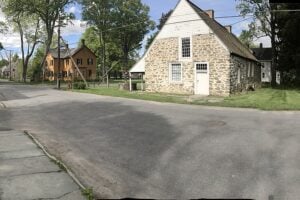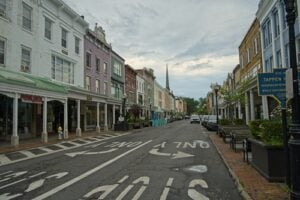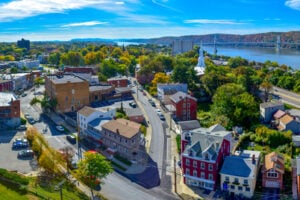

The historic Bowne House in Flushing, Queens. John Bowne was arrested in 1662 for allowing Quakers to worship in his home, continuing the struggle over religious liberty that followed the Flushing Remonstrance of 1657. Photo: Station1, CC BY-SA 4.0, via Wikimedia Commons.
On December 27, 1657, thirty residents of Vlissingen, today’s Flushing, Queens, signed a protest against the religious policies of New Netherland’s Director-General Peter Stuyvesant. Their town had been founded under Dutch rule with a charter promising liberty of conscience, but Stuyvesant issued orders to suppress Quaker worship and punish anyone who gave Quakers shelter.
The signers were not launching an armed rebellion, and none publicly identified as Quakers at the time. Instead, they argued that the government had no right to force them to turn peaceful religious dissenters away from their homes. The document they produced became known as the Flushing Remonstrance, and historians now regard it as one of the earliest principled defenses of religious pluralism in colonial America.
Its importance should not be overstated into a simple straight line to the First Amendment. The Remonstrance did not create modern religious freedom by itself, and there is no evidence that the framers of the Bill of Rights directly copied it. What it did accomplish was remarkable enough: ordinary residents of a small Long Island town openly challenged the government of New Netherland over liberty of conscience and refused to participate in the persecution of a religious minority.
Peter Stuyvesant and the Religious Order of New Netherland
Peter Stuyvesant became Director-General of New Netherland in 1647 after a military career in the Dutch West India Company. He had lost his right leg during an unsuccessful Dutch attack on the Portuguese-held island of St. Martin in 1644 and returned to colonial service with a reputation for discipline and authority.
New Netherland was religiously diverse, but that did not mean all religions enjoyed equal public rights. The Dutch Reformed Church held the privileged position in the colony. Stuyvesant opposed public worship outside that church and, at various times during his administration, resisted the settlement or religious activities of Jews, Lutherans, Quakers, and other dissenters.
By the mid-1650s, the conflict over religious practice was becoming increasingly difficult for the colonial government to contain. In 1656, Stuyvesant restricted unauthorized religious gatherings. The arrival of Quaker missionaries the following year pushed the confrontation into the open.
The Arrival of the Quakers
In 1657, twelve Quakers from Yorkshire reached Long Island after crossing the Atlantic. Two women from the group went into New Amsterdam and preached publicly, leading to their arrest and banishment. Another member of the party, Robert Hodgson, traveled to Hempstead and preached there.
Hodgson was arrested and brought before Stuyvesant. When he refused to comply with the authorities, he was chained to a wheelbarrow and ordered to work. After refusing, he was suspended by his hands and severely beaten. His punishment continued until Stuyvesant’s sister, Anna Bayard, intervened. Hodgson was eventually banished from the colony.
Stuyvesant’s anti-Quaker measures went beyond the missionaries themselves. Colonial ordinances threatened confiscation of vessels bringing Quakers into New Netherland and imposed a £50 fine on anyone who sheltered one. The policy placed residents of the English towns on Long Island in a direct conflict between obedience to the colonial government and what they believed their own town charters allowed.
Flushing’s Promise of Liberty of Conscience
Vlissingen had been established under a patent issued in 1645 by Director-General Willem Kieft. The charter granted its residents the right to enjoy “liberty of conscience” according to the custom and manner of Holland. That promise became central to the resistance that followed.
On December 27, 1657, thirty residents signed the document now known as the Flushing Remonstrance at a town meeting. Town clerk Edward Hart served as its draughtsman, although surviving records indicate that he described the document as expressing the collective sentiment of the residents rather than the work of a single author.
None of the thirty signers publicly identified as a Quaker in 1657. That made their protest especially significant. They were defending people whose religious beliefs they did not necessarily share.
The Remonstrance declared that the residents did not wish to harm anyone because of religious identity, naming Presbyterians, Independents, Baptists, and Quakers. Its most famous principle was simple: if peaceful people came among them, the residents believed conscience required that they be allowed to enter their town and homes.
The document closed by appealing directly to Flushing’s charter. The signers argued that refusing peaceful people entry would violate the liberty of conscience already promised to their town.
Stuyvesant Strikes Back
Stuyvesant did not accept the Remonstrance as a harmless petition. He treated the conduct of Flushing’s officials as a challenge to colonial authority. Tobias Feake, the town schout who delivered the document, town clerk Edward Hart, and magistrates Edward Farrington and William Noble were among the local officers arrested after the protest.
Some of the officials eventually apologized or recanted enough to secure their release. Stuyvesant also curtailed Flushing’s local autonomy. Town meetings were restricted, the local government structure changed, and officials considered politically reliable were given greater authority.
The crackdown suppressed the immediate protest, but it did not settle the larger argument over religious liberty. A few years later, that dispute returned through the actions of a Flushing resident named John Bowne.
John Bowne and the House That Defied Stuyvesant
John Bowne came to Flushing in the early 1650s and, with his wife, Hannah Feake Bowne, built the house now known as the Bowne House by 1661. Hannah became a Quaker minister, and John also joined the Religious Society of Friends.
The Bownes began allowing Quakers to meet for worship in their home. In September 1662, colonial officers arrested Bowne for hosting prohibited meetings. He was taken to New Amsterdam, tried, fined, and imprisoned. Bowne refused to recant, refused to pay the fine, and would not promise to stop holding Quaker meetings.
His own journal records periods of severe confinement, including time in a dungeon on coarse bread and water. After several months, the colonial authorities chose exile rather than persuasion. In January 1663, Bowne was sent from New Netherland to Europe.
Bowne Appeals to the Dutch West India Company
Exile gave Bowne an opportunity Stuyvesant probably did not intend. Bowne made his way to Amsterdam and appealed directly to the directors of the Dutch West India Company, the corporate authority that governed New Netherland.
He relied in part on the 1645 Flushing charter and its promise of liberty of conscience. His case also reached the Company at a time when merchants in New Amsterdam had warned that religious repression could discourage immigration and weaken the colony.
On April 16, 1663, the Company instructed Stuyvesant to moderate his policy. The directors told him that people should be allowed to hold their own beliefs as long as they behaved peacefully, obeyed the law, did not harm their neighbors, and did not oppose the government.
The Company did not suddenly establish complete modern freedom of religion. Public religious equality remained incomplete. But its rebuke significantly undermined Stuyvesant’s effort to use colonial power to suppress private religious conscience.
Bowne returned to Flushing in April 1664. He continued to host Quaker meetings and later helped the local Friends community establish a permanent meetinghouse and burial ground.
The English Take New Netherland
Only months after Bowne returned, English warships entered New York Harbor and demanded the surrender of New Netherland. Stuyvesant wanted to resist, but residents and other colonial leaders pressed for negotiation rather than the destruction of New Amsterdam.
The Dutch surrendered in September 1664. New Amsterdam became New York, and Dutch political rule came to an end. The religious arguments that had played out in Flushing, however, did not disappear with the change of flag.
The Flushing Remonstrance Survives
The original Flushing Remonstrance remained in New York’s public records for centuries. In 1911, a devastating fire at the New York State Capitol in Albany damaged the manuscript. The paper was badly burned around its edges, but the document survived and remains in the custody of the New York State Archives.
Its survival is fitting. The Remonstrance itself had survived Stuyvesant’s retaliation, the English conquest, the American Revolution, and enormous changes in the city and country around it.
A Precursor to American Religious Freedom
The Flushing Remonstrance did not create the First Amendment, and historians cannot demonstrate a direct documentary path from the thirty signers in 1657 to James Madison and the Bill of Rights more than a century later. Its importance lies in something more concrete.
Thirty residents of a small colonial town defended the right of a disliked religious minority to live and worship among them. They appealed to liberty of conscience, refused to enforce a policy they believed violated that principle, and accepted the risk of punishment from one of the most powerful officials in New Netherland.
John Bowne then carried the same dispute directly to the Dutch West India Company and won a significant order restraining Stuyvesant’s persecution of Quakers. For that reason, the Flushing Remonstrance and Bowne’s stand are widely remembered as important early precedents in the long development of religious liberty in America.
The modern neighborhood of Flushing bears little resemblance to the rural settlement of 1657, but its name remains tied to one of the most consequential arguments over conscience in colonial New York. For more on the borough’s history, explore How Queens Neighborhoods Got Their Names, and for a broader look at the city’s national role, read Why Is New York City So Important? How Gotham Built America’s Economy.
Sources
- Historical Society of the New York Courts — The Flushing Remonstrance, 1657
- New York State Archives — New Netherland Research Guide
- National Park Service — The Flushing Remonstrance
- Bowne House — Three Centuries of Activism
- Bowne House — The 1645 Charter of Flushing
- Bowne House — John and Hannah Bowne
- Bowne House — John Bowne’s Trial, Imprisonment, Exile, and Return
- Bowne House — John Bowne’s Petition to the Dutch West India Company
Published September 11, 2026.