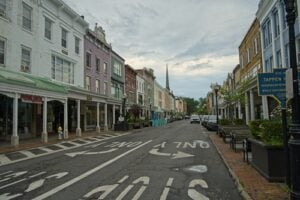

Stone Street in Lower Manhattan, one of the surviving streets whose history reaches back to Dutch New Amsterdam. Photo: Francisco Javier Diaz / Shutterstock.com.
In the autumn of 1643, the French Jesuit missionary Isaac Jogues reached New Amsterdam after escaping captivity among the Mohawks and finding refuge with Dutch traders. The settlement he encountered at the southern end of Manhattan was still tiny, but one detail stayed with him. Jogues later wrote that there were perhaps four or five hundred people of different nations and religious sects on Manhattan and in its surrounding settlements, and that Director-General Willem Kieft told him they represented eighteen different languages.
Jogues did not identify all eighteen languages, which means historians cannot reconstruct an exact list from his account. What the surviving records do make clear is that New Amsterdam was already remarkably diverse. Dutch officials and merchants lived alongside French-speaking Walloons, English settlers, Germans, Scandinavians, Africans, Jews from the Atlantic world, and Indigenous peoples whose languages had been spoken around Manhattan long before the Dutch arrived.
That diversity did not make New Amsterdam a modern haven of equality. The Dutch Reformed Church held a privileged position, slavery was part of the colony from its earliest years, and religious minorities repeatedly faced restrictions and discrimination. Yet commerce, migration, and the practical needs of a small colonial port brought people of many backgrounds into daily contact. Long before New York became famous as an immigrant city, its multilingual character was already taking shape.
A Commercial Colony That Needed People
The Dutch West India Company was chartered in 1621, and permanent European colonization of New Netherland began in 1624. Several of the earliest families were Walloons, French-speaking Protestants who had lived in the southern Netherlands before finding refuge in the Dutch Republic. Colonists were initially scattered among several outposts, but by the middle of the 1620s the Company was concentrating settlement at the southern tip of Manhattan, where New Amsterdam developed around Fort Amsterdam.
Unlike the religious communities that established some English colonies in New England, New Netherland was first and foremost a commercial venture. The Company wanted to control the fur trade, protect shipping, and strengthen Dutch claims in North America. Attracting enough settlers proved difficult, and the colony drew people from well beyond the Dutch Republic. Germans, English settlers, Walloons, Scandinavians, and others entered the colony as farmers, sailors, soldiers, craftsmen, merchants, and laborers.
The result was a place that was Dutch in government but far less uniformly Dutch in population. That distinction helps explain how a settlement of only a few hundred people could produce the extraordinary observation Jogues recorded in 1643.
Stone Street and the Streets of New Amsterdam
One of the best surviving links to this early city is Stone Street in Lower Manhattan. Portions of the modern street follow two Dutch-era streets, Brouwer Straet, or Brewers Street, and Hoogh Straet, or High Street. Brewers were important members of New Amsterdam’s economy, and their businesses helped give Brouwer Straet its name.
Residents petitioned the municipal government to improve the muddy roadway and agreed to help pay for the work. By 1658, Brouwer Straet had been surfaced with stone, making it the first paved street in New Amsterdam. The street’s later English name, Stone Street, preserved the memory of that improvement.
Stone Street therefore provides a physical connection to the commercial city Jogues described. Merchants, sailors, craftsmen, servants, enslaved laborers, customers, and visitors moved through this part of town, while nearby taverns, warehouses, docks, and markets tied Manhattan to an Atlantic trading network much larger than the settlement itself.
What Were the Eighteen Languages?
No surviving document gives us a definitive list of the eighteen languages mentioned by Jogues. His statement was based on what Willem Kieft told him, and historians have to be careful not to turn that single observation into a precise linguistic census.
We do know, however, that Dutch was the language of colonial government and the Dutch Reformed Church, while French-speaking Walloons were present from the colony’s first permanent settlement. English-speaking settlers lived throughout New Netherland, including in communities on Long Island that operated under Dutch authority. German and Scandinavian immigrants also appear frequently in the records as soldiers, sailors, craftsmen, and settlers.
Indigenous languages were part of this world as well. The Lenape communities of the region spoke Munsee and related Eastern Algonquian varieties, while peoples from farther north and west brought other languages into the trading network. The colony’s economic survival depended heavily on communication with Native communities, particularly through the fur trade.
The African presence added still another layer of linguistic and cultural complexity. The Dutch West India Company brought enslaved Africans to New Amsterdam during the colony’s early decades. Surviving records identify people with names connecting them to places such as Angola, Congo, São Tomé, and the Portuguese Atlantic world. Modern scholarship cautions against assuming that those names tell us exactly which languages each person spoke, but the records leave little doubt that New Amsterdam’s African population came from a multilingual Atlantic world.
Walloon, English, German, and Scandinavian New Amsterdam
French-speaking Walloon families were among the permanent settlers who arrived in New Netherland in 1624. Their presence is important because it shows that ethnic and linguistic diversity was not something that appeared late in the Dutch period. It was built into the colony from the beginning.
English settlers also became an increasingly important part of New Netherland. Communities including Gravesend and Hempstead developed under Dutch jurisdiction on Long Island, while English merchants and sailors moved regularly through New Amsterdam. German and Scandinavian names appear throughout the colony’s military, maritime, and commercial records.
Even familiar New York place names reflect this mix of origins. Jonas Bronck, the settler whose farm ultimately gave the Bronx its name, was part of the northern European maritime world that fed people into the Dutch colony. The precise details of Bronck’s birthplace have been debated by historians, but his presence is another reminder that “Dutch New York” was never populated solely by people born in the Netherlands.
The African Community and Half-Freedom
Africans were present in New Amsterdam during its earliest decades, most of them brought there through the Dutch West India Company’s slave system. They performed agricultural labor, constructed roads and fortifications, worked for the Company, and helped build the colonial settlement.
On February 25, 1644, eleven enslaved men and their wives received a conditional form of freedom that historians generally call “half-freedom.” The men received grants of farmland north of the settled town and were required to make annual payments to the Company. Their children, however, initially remained enslaved. The arrangement was therefore neither complete emancipation nor equality, but it did create a community of Black landholders on Manhattan decades before the English takeover.
This history is essential to any discussion of New Amsterdam’s diversity. The colony’s multilingual character emerged not only through voluntary immigration and commerce, but also through forced migration and slavery.
The Arrival of New Amsterdam’s Jewish Community
In 1654, twenty-three Jewish refugees arrived in New Amsterdam after the Portuguese reconquest of Dutch Brazil. They were part of a Sephardic Atlantic community whose members had connections to Portugal, Spain, the Netherlands, Brazil, and the Caribbean. Their arrival added another community to an already complicated colonial society.
Director-General Peter Stuyvesant did not welcome them. He asked the Dutch West India Company to remove the newcomers, but the Company overruled him and permitted Jews to remain and trade, provided that the community supported its own poor. Jewish residents continued to fight for additional civil and economic rights in the years that followed.
The episode reveals one of the contradictions at the center of New Amsterdam. Diversity was real, but acceptance was uneven. The colony could be cosmopolitan and discriminatory at the same time.
Religious Toleration Had Limits
It is tempting to describe New Amsterdam as an early paradise of religious freedom, but that goes too far. The Dutch Reformed Church was the colony’s officially favored church, and public worship by other religious groups could be restricted. Catholics, Lutherans, Jews, Quakers, and others did not enjoy the kind of equal religious liberty associated with modern New York.
Stuyvesant repeatedly attempted to enforce religious conformity more strictly. He opposed Jewish settlement, restricted Lutheran worship, and persecuted Quakers. Yet the Dutch West India Company often urged him to moderate those policies because excessive repression threatened immigration, commerce, and the colony’s stability.
The conflict became especially visible in 1657 with the Flushing Remonstrance. Residents of Vlissingen, now Flushing in Queens, protested Stuyvesant’s persecution of Quakers and defended liberty of conscience. In 1663, the Company itself instructed Stuyvesant to allow people to hold their own beliefs as long as they behaved peacefully, obeyed the law, and did not disturb their neighbors.
This was toleration shaped as much by pragmatism as by principle. New Amsterdam needed settlers, workers, merchants, and customers. That economic reality repeatedly collided with attempts to impose religious uniformity.
When the English Fleet Arrived
That practical attitude toward commerce became especially important in 1664. Four English warships under Colonel Richard Nicolls arrived to seize New Netherland for the Duke of York. Stuyvesant wanted to resist, but New Amsterdam was badly outnumbered and poorly defended. The English also offered surrender terms that protected property, commerce, and liberty of conscience.
Many residents saw little reason to risk the destruction of the town. They pressured Stuyvesant to negotiate rather than fight. Representatives of the English and Dutch met at Stuyvesant’s farm and agreed to the Articles of Capitulation, which allowed inhabitants to retain their homes, lands, goods, and many existing customs. New Amsterdam surrendered without a major battle and became New York.
The political flag changed, but the population did not suddenly become culturally English. Dutch families remained. Other European communities remained. Africans remained, both free and enslaved. Jewish residents remained. The habits of a trading city built around different peoples and languages survived the conquest.
The Multilingual Roots of New York City
Isaac Jogues’ reference to eighteen languages is remarkable because of when he heard it. New Amsterdam was still a tiny colonial settlement. Its population was measured in the hundreds, its defenses were crude, and many of the streets were still unpaved. Yet the city already contained people drawn from across Europe, Africa, the Atlantic world, and the Indigenous communities of the Northeast.
We cannot identify every one of the eighteen languages with certainty, and there is no evidence that all eighteen were specifically being spoken on Stone Street. What we can say is more interesting: linguistic diversity was present on Manhattan from the earliest decades of the colonial city.
The enormous immigrant metropolis that later grew around New York Harbor did not appear from nowhere in the 19th century. The scale changed beyond recognition, but the pattern was already visible in the 1600s—a commercial city where people of different origins had to work, bargain, argue, worship, translate, and live alongside one another.
For more on the city’s cultural evolution, read our New York Accent History, explore How Manhattan Neighborhoods Got Their Names, and see Why Is New York City So Important? How Gotham Built America’s Economy.
Sources
- The Jesuit Relations and Allied Documents — Isaac Jogues’ Description of New Netherland
- Smithsonian National Museum of American History — Dutch New Amsterdam
- NYC Department of Records and Information Services — Walking the Streets of New Amsterdam
- NYC Municipal Archives — Guide to the Records of New Amsterdam
- National Park Service — African Burial Ground in History
- Historical Society of the New York Courts — The Flushing Remonstrance, 1657
- Library of Congress — The First Jewish Community in New Amsterdam
- Library of Congress — Articles About the Transfer of New Netherland, 1664
- Museum of the City of New York — Petrus Stuyvesant and the Surrender of New Amsterdam
Published September 11, 2026.