Little Italy in Manhattan is still worth visiting, but the neighborhood visitors see today is much smaller than the Italian enclave that once spread across a larger section of Lower Manhattan. The tourist and restaurant core is concentrated mainly along Mulberry Street between Canal and Broome Streets, with Italian restaurants, cafes, shops, the Italian American Museum, and nearby landmarks such as the Shrine Church of the Most Precious Blood. Little Italy also remains an official New York City special zoning district designed to protect the neighborhood’s historic and cultural character.
When people ask me whether Little Italy is worth seeing, my answer is still yes. I have lived in New York for most of my life, and there are still parts of this city I have never seen. Little Italy is not enormous, and you do not need an entire day to walk through it. That is actually one of its advantages. You can spend a few hours walking Mulberry Street, have lunch or dinner, stop for a cannoli, visit the Italian American Museum, and then continue into Chinatown, SoHo, or the Lower East Side.
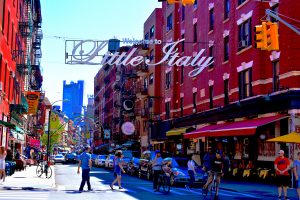
Gateway to Little Italy. Photo: Brian Kachejian © 2017
Where Is Little Italy in New York City?
Little Italy is in Lower Manhattan. For most visitors, the heart of the neighborhood is Mulberry Street between Canal Street and Broome Street, with Hester and Grand Streets crossing through the area.
The corner of Canal and Mulberry Streets is one of those intersections that could only exist in New York. Chinatown and Little Italy meet almost instantly. Walk a short distance in one direction and the storefronts, restaurants, languages, and street life can change dramatically.
New York City also maintains a larger Special Little Italy District through its zoning rules. That official district extends beyond the compact restaurant area most tourists think of as Little Italy. The city created the special district to preserve the neighborhood’s historic and cultural character, storefront scale, street life, and important buildings.
How Much of Little Italy Is Left?
The Little Italy most visitors experience today is only a small piece of the neighborhood that existed during the great period of Italian immigration.
Beginning in the late nineteenth century, large numbers of Italian immigrants settled throughout New York City. Lower Manhattan became one of the most important concentrations. Mulberry Street and the surrounding blocks were filled with Italian families, businesses, churches, social organizations, vendors, and neighborhood institutions.
The neighborhood was never completely uniform. Immigrants from different regions and towns in Italy often settled near people from the same places they had left behind. Parts of Mulberry, Mott, Hester, Prince, and surrounding streets developed their own regional identities.
Over generations, many Italian families moved to other parts of Manhattan, the Bronx, Brooklyn, Queens, Staten Island, Long Island, New Jersey, and elsewhere. Chinatown expanded through many of the surrounding blocks, while changing real estate patterns transformed Lower Manhattan. What remains of Little Italy is therefore much more concentrated than the immigrant neighborhood of a century ago.
Mulberry Street Is Still the Heart of Little Italy
If you visit Little Italy and do not walk Mulberry Street, you really have not seen the neighborhood. Restaurants and cafes dominate much of the street, particularly between Canal and Broome, while nearby portions of Hester and Grand Streets add more places to eat and shop.
Mulberry Street is also one of the best places to understand how tightly New York neighborhoods overlap. The street runs through both Little Italy and Chinatown, and the transition between the two is part of the experience.
During parts of the year, sections of Mulberry Street also participate in New York City’s Open Streets program, giving pedestrians more room during selected evenings and weekends. Schedules can change, so visitors should check the current city schedule before planning around a street closure.
Is Little Italy Worth Visiting?
Yes, especially if you are already spending time in Lower Manhattan. Little Italy is compact, easy to walk, surrounded by other major neighborhoods, and still offers an atmosphere that is difficult to duplicate somewhere else.
I would not tell a visitor that every Italian meal in Little Italy is automatically the best Italian food in New York City. New York has extraordinary Italian restaurants and bakeries throughout all five boroughs and the surrounding suburbs. The reason to eat in Little Italy is the combination of food and place.
You are sitting on Mulberry Street in a neighborhood that became internationally associated with Italian American New York. That experience matters.
The Cannoli Question
Just about every restaurant, cafe, and dessert counter in Little Italy seems ready to make a case for its cannoli. Are they the best in the world? That is impossible to answer because personal taste always wins that argument.
I now live on Long Island, which has some outstanding Italian bakeries of its own. I have eaten cannoli all over Little Italy and at bakeries across the New York area, and I would never say you have to come to Mulberry Street to find a great one.
Still, there is something about eating a cannoli while walking through Little Italy that makes the experience better.
The greatest cannoli I ever tasted came from De Robertis Pasticceria and Caffé in the East Village. Sadly, that bakery closed in 2014. New York is filled with stories like that. Great bakeries and restaurants disappear, while the memories of what they served can last for decades.
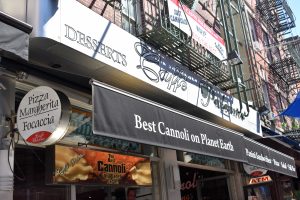
Cannoli store in Little Italy. Photo: Brian Kachejian © 2017
Dining in Little Italy
If you are visiting Little Italy for the first time and possibly the only time, I still recommend having lunch or dinner there. Part of the point of visiting the neighborhood is sitting down for a meal.
One dish my family has always enjoyed in Little Italy is fried calamari. My older son has said some of the best calamari he ever had was there, and I tend to agree with him.
My longtime favorite was Buona Notte, a small restaurant on Mulberry Street. When I originally wrote this article, I praised its pasta, sauces, calamari, service, and intimate atmosphere. Buona Notte is still operating on Mulberry Street in 2026. My comments about the food, however, reflect my own visits rather than a claim that every meal today will be identical to the ones I remember.
I have always tended to favor smaller restaurants. As a musician who spent years working in restaurants, I saw firsthand how different a small kitchen could feel from a huge operation. In a small place, the chef can sometimes have much more direct involvement with every plate leaving the kitchen.
That does not mean a large restaurant cannot serve an excellent meal. It simply explains why, when I walk down Mulberry Street deciding where I want to eat, I usually look toward the smaller rooms first.
Restaurant Hosts on the Sidewalk
Visitors should also know about one of Little Italy’s longtime street traditions. Restaurant hosts may stand outside and try to persuade people walking by to come inside.
Do not feel pressured. Smile, keep walking, look at menus, and choose the place that appeals to you. The competition between neighboring restaurants can be aggressive, but there is no reason to let it interfere with your visit.
In a way, the sales pitch is connected to an older New York street culture in which merchants competed loudly and directly for customers. Just remember that the decision is yours.
The Italian American Museum Is Open Again
One of the most important changes since the original version of this article is the return of the Italian American Museum.
The museum opened its new facility at 151 Mulberry Street on October 1, 2024. It preserves and presents Italian American history through exhibitions, artifacts, programs, and cultural collections. Among its holdings are the Manteo marionettes, which connect directly to the history of theatrical entertainment on Mulberry Street.
If you want more than restaurants and desserts from a Little Italy visit, the museum gives the neighborhood important historical context. Visitors should check the museum’s official website for current hours and admission before going.
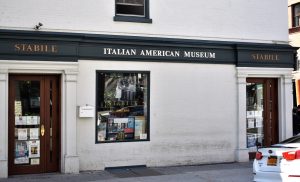
Italian American Museum in Little Italy. Photo: Brian Kachejian © 2017
The Feast of San Gennaro
The Feast of San Gennaro is one of the great surviving traditions of Little Italy. The religious and street celebration honors San Gennaro, the patron saint of Naples, and fills Mulberry Street and surrounding blocks with food stands, processions, music, games, and crowds.
The Shrine Church of the Most Precious Blood at 113 Baxter Street is the National Shrine Church of San Gennaro. During the feast, the statue of San Gennaro is carried from the church through the streets of Little Italy.
In 2026, the Feast of San Gennaro runs from September 17 through September 27. The official festival footprint includes Mulberry Street between Canal and Houston Streets and portions of Hester and Grand Streets.
The Shrine Church of the Most Precious Blood
The Church of the Most Precious Blood is one of the most important surviving institutions connected to the old Italian neighborhood. The church stands at 113 Baxter Street and is now part of the parish of the Basilica of St. Patrick’s Old Cathedral.
Its history reaches back to the great period of Italian immigration, when the neighborhood’s rapidly growing population needed churches and institutions that served Italian families. Today the church remains closely connected with the Feast of San Gennaro and the religious traditions of Little Italy.
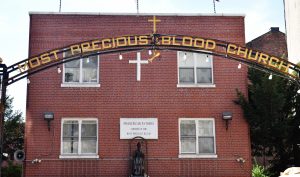
The Church of the Most Precious Blood. Photo: Brian Kachejian © 2017
My New Year’s Eve Gigs in Little Italy
Many years ago, I used to perform every New Year’s Eve at a large Little Italy restaurant called SPQR with a band called Phase IV. Because I had to carry equipment, I was forced to drive to those gigs. It was a nightmare double-parking on Mulberry Street long enough to unload my gear and then trying to find somewhere to park.
SPQR was located at 133 Mulberry Street and eventually closed in 2013. That is another reminder of how quickly the restaurant landscape can change even in a neighborhood built around nostalgia.
Whenever I visited Little Italy without musical equipment, I took public transportation. I still recommend that approach.
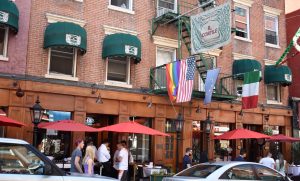
Former SPQR Restaurant location on Mulberry Street. Photo: Brian Kachejian © 2017
How to Get to Little Italy by Subway
Little Italy is easy to reach by subway. The Spring Street station on the 6 line is convenient from the north, while the Canal Street complex provides several subway options. Grand Street on the B and D lines is also within walking distance.
Because subway service changes for construction and weekend work, visitors should check the current MTA schedule before leaving.
Driving is possible, but I would not recommend it unless you have a specific reason to bring a car. Parking is difficult, traffic can be heavy, and Little Italy is one of those New York neighborhoods that makes much more sense on foot.
What Else Is Near Little Italy?
One reason Little Italy works so well for visitors is its location. Chinatown is directly beside it. SoHo is a short walk west. Nolita is immediately north, and the Lower East Side is nearby.
You can therefore combine Little Italy with several other neighborhoods in one day instead of treating it as an isolated destination.
If you are coming from Midtown, readers may also want our history of Times Square and history of Grand Central Terminal. Visitors exploring Lower Manhattan can continue with our history of the Brooklyn Bridge, and anyone who comes to Little Italy hungry may enjoy our history of New York pizza.
Little Italy in My Photographs
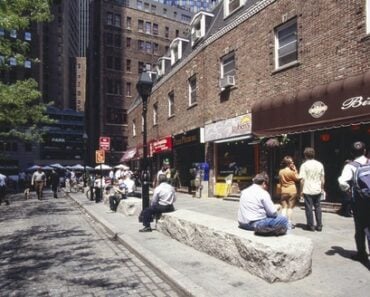
The photographs below were taken during my 2017 visit and preserve the look of Mulberry Street and the surrounding blocks at that moment in time.
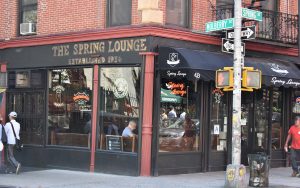
Photo: Brian Kachejian © 2017
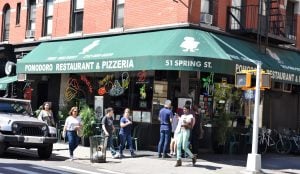
Photo: Brian Kachejian © 2017
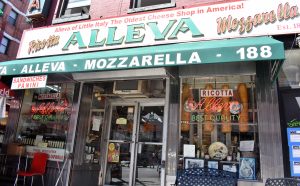
Photo: Brian Kachejian © 2017
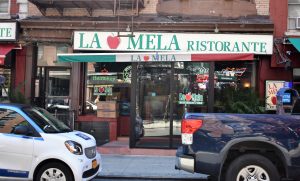
Photo: Brian Kachejian © 2017
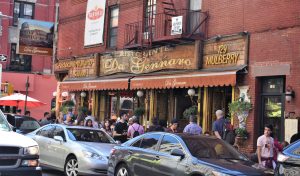
Photo: Brian Kachejian © 2017
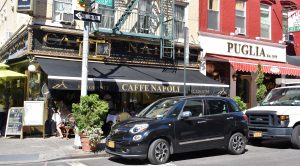
Photo: Brian Kachejian © 2017
Little Italy Map
Sources
New York City Department of City Planning, Special Little Italy District
Library of Congress, Italian Immigration: A City of Villages
Basilica of St. Patrick’s Old Cathedral, Shrine Church of the Most Precious Blood
Little Italy NYC at a Glance
| Question | Answer |
|---|---|
| Where is Little Italy? | Lower Manhattan, centered on Mulberry Street near Canal, Hester, Grand, and Broome Streets |
| How large is the visitor core? | Only a few blocks, primarily Mulberry Street between Canal and Broome Streets |
| Is Little Italy still an official district? | Yes. New York City maintains a larger Special Little Italy zoning district |
| Is Little Italy worth visiting? | Yes, especially as part of a Lower Manhattan walking day |
| What is the major annual event? | The Feast of San Gennaro |
| Is the Italian American Museum open? | Yes, at 151 Mulberry Street |
| Best way to get there? | Subway and walking rather than driving |
Updated August 8, 2026.
Little Italy NYC: What Remains, Where It Is, and Is It Worth Visiting? article published on ClassicNewYorkHistory.com © 2026
ClassicNewYorkHistory.com claims ownership of all its original content and intellectual property under United States copyright laws and those of all other foreign countries. No person, business, or organization is allowed to republish any of our original content anywhere on the web or in print without our permission. All photos used in the articles are either original photographs taken by ClassicNewYorkHistory.com journalists, public domain or Creative Commons photos, or photos officially licensed from Shutterstock under license with ClassicNewYorkHistory.com and ClassicRockHistory.com. Photo credits are included with the images.
We are not responsible for any locations visited based on our recommendations or information included in the articles, as the website is for entertainment purposes only.