
The TWA Flight 800 Memorial at Smith Point County Park stands as one of Long Island’s most moving places of remembrance. Overlooking the Atlantic Ocean near where TWA Flight 800 crashed on July 17, 1996, the memorial honors the 230 passengers and crew members who lost their lives while giving families, friends, and visitors a quiet place to reflect on one of the most heartbreaking tragedies in New York aviation history.
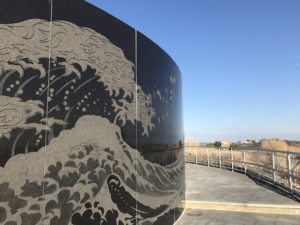
Photo: Brian Kachejian © 2017 All Rights Reserved
The TWA Flight 800 Memorial at Smith Point Beach
Many Long Islanders are unaware that at the entranceway to Smith Point Beach stands the TWA Flight 800 Memorial. Once one exits the legendary underpass on foot, they are greeted with a very moving tribute to those who lost their lives that summer evening in July of 1996. The TWA Flight 800 Memorial is located at Smith Point Beach in Suffolk County’s Smith Point County Park.
The memorial stands slightly elevated above the rest of the beach and is protected by concrete barriers hidden beneath the sand, shielding the site from future storms and erosion. Standing there, with the Atlantic Ocean stretching out beyond the memorial, one immediately understands why this location was chosen. It is quiet, open, solemn, and close to the waters where the tragedy occurred.
The Night of July 17, 1996
On the evening of July 17, 1996, at approximately 8:31 p.m., a Boeing 747-100 exploded in midair and crashed into the Atlantic Ocean near East Moriches on the southern coast of Long Island. The plane had lifted off from John F. Kennedy International Airport in Queens, New York. TWA Flight 800 had only been airborne for 12 minutes before the aircraft exploded and crashed into the Atlantic.
The plane had been destined for Rome. Sadly, all passengers and crew members aboard the aircraft lost their lives.
The Investigation Into TWA Flight 800
When news of the plane crash began to be reported, many stories circulated that a missile had shot down TWA Flight 800. There were many reports that witnesses had observed something streaking through the sky before the explosion. An investigation into the crash began the next morning by the National Transportation Safety Board and the Federal Bureau of Investigation.
After 16 months, the Federal Bureau of Investigation closed its investigation and ruled out terrorist activity, declaring that the plane crash was not the result of a criminal act. The National Transportation Safety Board kept the case open for several more years after the crash.
The result of one of the most exhaustive and expensive air-related investigations in aviation history was that fuel vapors from one of the plane’s fuel tanks had caused the explosion. A plaque at the site describes the events that occurred the evening of the crash. The plaque states that “a fatal explosion of controversial origin occurred in the vicinity of the center fuel tank, rupturing the fuselage and setting the plane afire.” The wording acknowledges the pain of those who lost loved ones, including those who may have never fully accepted the official findings.

Photo: Cole Kachejian. Copyright 2017. All Rights Reserved.
Why Smith Point Park Was Chosen
Smith Point Park was chosen to host the TWA Flight 800 Memorial because of its proximity to where the flight crashed in the Atlantic. Although the flight went down a few miles east of Smith Point Beach, the location was selected because of the thousands of people who visit the beach every year.
Even in the winter months, the site attracts a steady stream of visitors. We observed this firsthand when we visited the TWA Flight 800 Memorial in mid-January. Even in the cold of winter, the memorial continued to serve as a place where people came to stand, read, remember, and look out toward the ocean.
Building the Memorial
The labor that went into building the TWA Flight 800 Memorial was donated by many union workers. Local union workers, including carpenters, electricians, plumbers, and others, gave their time to help build a place worthy of the lives being remembered.
The TWA Flight 800 Memorial opened to the public on July 17, 2002. The architectural firm Busch Associates designed the memorial. The TWA Flight 800 Families Association was responsible for ensuring that there would be a fitting memorial where family members and friends could go to aid in the healing process.
The memorial provides enough protection for privacy while still standing in the open air and in view of the Atlantic Ocean, which became the final resting place for so many lives lost on TWA Flight 800.
The Flags and the Names
At the western portion of the TWA Flight 800 Memorial stands a collection of flags from various nations, representing the countries of origin of the passengers aboard the flight. The flags remind visitors that this was not only a Long Island tragedy or a New York tragedy. It was an international tragedy that touched families across the world.

Photo: Cole Kachejian. Copyright 2017. All Rights Reserved.
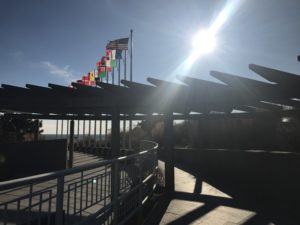
Photo: Cole Kachejian. Copyright 2017. All Rights Reserved.
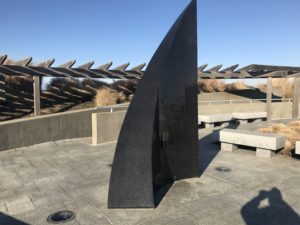
Photo: Cole Kachejian. Copyright 2017. All Rights Reserved.
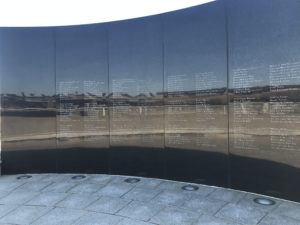
Photo: Cole Kachejian. Copyright 2017. All Rights Reserved.

Photo: Cole Kachejian. Copyright 2017. All Rights Reserved.
Visiting the TWA Flight 800 Memorial Today
Visiting the TWA Flight 800 Memorial is a quiet experience. There are places in New York where the noise of life seems to follow you everywhere. This is not one of them. The beach, the wind, the names, the flags, and the open view of the Atlantic all work together to create a space where people naturally lower their voices.
It is one of those memorials that does not need to overwhelm visitors with size or spectacle. Its power comes from its location and its purpose. Standing there, one is reminded of the lives lost, the families forever changed, and the way Long Island itself became part of the story on that July evening in 1996.
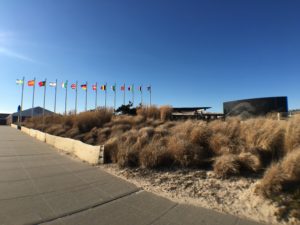
Photo: Cole Kachejian. Copyright 2017. All Rights Reserved.
More Long Island History
Readers interested in Long Island history may also enjoy our articles on the history of Little Gull Island Lighthouse, the story of Robert Moses State Park, and other places where Long Island’s beaches, landmarks, and memories continue to shape New York history.
Article updated June 24, 2026.