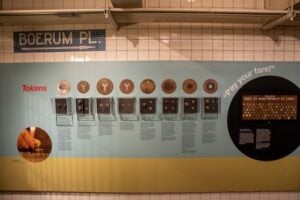
New York City subway token designs displayed at Boerum Place. Photo licensed from Shutterstock.
The subway token definitely gave true meaning to the word “token” on so many levels, especially for people who grew up in New York City the way I did. I was always fascinated by subway tokens, which were also used on city buses, and by the way they were punctured in the center. As a kid, I thought it was so cool that you could hold one up and see through it.
Those days of dropping a token into a turnstile slot are long gone. This article looks back at the history of the New York City subway token and the changes that carried riders from a small piece of brass to the MetroCard and then to OMNY, where we can now pay simply by tapping a phone, bank card, or watch.
It is amazing how much technology has changed. I remember looking at the comics in the Daily News and seeing Dick Tracy talking into his wrist radio. I thought, “That will never happen in my lifetime.” Now I sit here checking the time on my Apple Watch, looking at my security cameras through it, and, of course, talking to people on it.
For fifty years, the clink of a brass token dropping into a heavy turnstile was one of the defining sounds of a New York City commute. The token was practical, but it also became something much larger: a symbol of movement, independence, and the city itself.
Before the Subway Token: Paper Tickets, Nickels, and Dimes
When New York City’s first subway opened on October 27, 1904, a ride cost five cents. Riders initially purchased small paper tickets from station clerks and deposited them with attendants using ticket-chopping machines. Coin-operated turnstiles later replaced that system, allowing passengers to pay directly with a nickel.
The five-cent fare remained in place for forty-four years. On July 1, 1948, the fare doubled to ten cents, and the turnstiles were adjusted to accept dimes.
That system worked because both fares matched existing United States coins. The problem arrived in 1953, when the newly created New York City Transit Authority raised the fare to fifteen cents. There was no fifteen-cent coin, and asking every rider to insert both a dime and a nickel would have slowed entry and complicated the turnstile machinery.
The solution was to create a special piece of transit currency that represented one complete fare. On July 25, 1953, the New York City subway token entered service on subways and buses.
Why the Subway Token Became a New York City Symbol
The original token was a small brass coin stamped with “New York City Transit Authority” on one side and “Good for One Fare” on the other. The letters NYC appeared in the center, with the “Y” punched out to create the opening that fascinated generations of children, including me.
The token solved a mechanical problem, but its cultural meaning grew far beyond the turnstile. It fit into a pocket, purse, or token holder and could carry a New Yorker anywhere within the subway system after entering through the fare-control area. It did not matter whether the rider traveled one stop or crossed several boroughs.
That small coin represented the ability to move through the city. It was used by students, workers, musicians, tourists, executives, and families. The same object passed through the hands of almost every kind of New Yorker, which helped turn it into one of the most democratic symbols the city ever produced.
The Five Principal Generations of the NYC Subway Token
New York used five principal fare-token designs between 1953 and 2003. A special Diamond Jubilee token was also issued in 1979 to commemorate the subway’s seventy-fifth anniversary.
1. The Small Y-Cut Token, 1953–1970
The first familiar subway token was much smaller than the versions many riders remember from later decades. It displayed the letters NYC with the “Y” punched through the center. A rare solid variation without the opening circulated briefly during the token’s first year.
The Small Y token entered service with the fifteen-cent fare in 1953 and remained in use when the fare rose to twenty cents in 1966. Its size made it easy to lose or confuse with ordinary coins, inspiring the sale of leather, plastic, and metal token holders.
2. The Large Y-Cut Token, 1970–1980
When the fare increased to thirty cents in 1970, the Transit Authority introduced a larger token. It retained the recognizable Y-shaped opening but was closer to the size of a quarter.
The Large Y token survived several increases. Riders used it at the thirty-cent fare beginning in 1970, the thirty-five-cent fare beginning in 1972, and the fifty-cent fare beginning in 1975.
The 1979 Diamond Jubilee Token
New York marked the subway’s seventy-fifth anniversary in 1979 with a special commemorative token. It featured an off-center diamond-shaped opening and images representing the original subway era. Although it could be used for a ride, many New Yorkers saved it as a souvenir.
The Diamond Jubilee issue was a commemorative variation rather than one of the five principal fare-token generations.
3. The Solid Brass NYC Token, 1980–1986
The fare rose to sixty cents in 1980, bringing another redesign. The Solid Brass NYC token eliminated the punched-out center entirely. The letters remained part of the design, but children could no longer look through the “Y.”
This version was used for the sixty-cent fare, the seventy-five-cent fare introduced in 1981, and the ninety-cent fare that began in 1984.
4. The Bullseye Token, 1986–1995
When the fare reached one dollar in 1986, the Transit Authority introduced the distinctive Bullseye token. Its steel center was surrounded by a brass outer ring, creating the circular target appearance that gave the token its nickname.
The magnetically responsive center helped turnstiles distinguish genuine tokens from some of the washers, slugs, and look-alike coins used by fare evaders. Bullseye tokens were used at the one-dollar, $1.15, and $1.25 fares.
5. The Five Boroughs Token, 1995–2003
The final generation arrived with the $1.50 fare in November 1995. It returned to the open-center tradition, but instead of the old “Y,” it featured a pentagon-shaped opening representing New York City’s five boroughs.
This was the final subway token most New Yorkers placed into turnstiles. It remained in use while MetroCard equipment spread throughout the system and became the last physical coin created specifically for an ordinary New York City subway fare.
Token Holders, Hoarding, and the Culture Around the Coin
Tokens created habits and rituals that disappeared with electronic fare payment. Riders kept extras in kitchen drawers, glove compartments, coat pockets, purses, and small spring-loaded holders. Parents handed them to children before school. Employers distributed them. A person leaving home without a token might have to stop at a booth window before beginning the trip.
Fare increases also encouraged token hoarding. Whenever the Transit Authority announced a higher fare, riders tried to guess whether the old design would remain valid. If it did, anyone who bought extra tokens at the lower price had effectively purchased future rides at a discount.
The token became so closely identified with New York that its image appeared on jewelry, clothing, key chains, logos, and souvenirs. Even after it lost its practical purpose, it retained a visual power that the rectangular MetroCard never duplicated in quite the same way.
Token Sucking, Slugs, and Fare-Evasion Warfare
As token values increased, so did the incentive to steal or counterfeit them. Some fare evaders attempted to use washers, foreign coins, and other pieces of metal that resembled official tokens closely enough to fool turnstiles.
One of the most infamous methods became known as “token sucking.” A thief would jam a turnstile slot with paper or another obstruction. A rider would insert a token, discover that the turnstile had not opened, and walk away in frustration. The thief would then place his mouth over the slot and suck the trapped token back out.
It was revolting, even by New York standards. Token booth clerks and transit workers sometimes fought back with chili powder or other irritants placed around frequently jammed slots. The battle between fare evaders and the Transit Authority became part of the strange folklore surrounding the token era.
The MetroCard Revolution
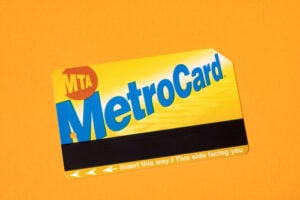
By the early 1990s, the MTA was preparing to replace mechanical token collection with an electronic fare system. MetroCard testing began in 1993, and the card reached the broader riding public in January 1994.
The earliest MetroCards were blue with yellow lettering. Riders had to learn the correct speed and angle for dragging the magnetic stripe through a reader. The dreaded message “Please Swipe Again at This Turnstile” quickly became part of everyday subway life.
MetroCard acceptance expanded gradually. New York City buses were accepting the card by the end of 1995, and every subway turnstile was equipped for MetroCard use by May 1997.
Free Transfers Changed the Way New Yorkers Traveled
The most important MetroCard breakthrough arrived on July 4, 1997, when MetroCard Gold introduced free transfers between subways and buses within a two-hour period. That change eliminated many of the old two-fare trips that had penalized riders whose neighborhoods required both a bus and a train.
On July 4, 1998, the MTA introduced seven-day and thirty-day Unlimited Ride MetroCards. For the first time, regular riders could pay one price in advance and take as many eligible subway and local-bus trips as they needed during the card’s active period.
The token could open a turnstile, but it could not store value, calculate a transfer, provide a bonus, or track the expiration of an unlimited pass. The MetroCard made all those fare policies possible and fundamentally changed how New Yorkers used the transit system.
The Last Clink: The End of the Subway Token
MetroCards and tokens coexisted for years, but the balance gradually shifted toward electronic payment. By 2003, only a small share of subway riders still relied on tokens.
New York City Transit stopped selling subway tokens at midnight on April 12, 2003. Tokens remained valid in subway turnstiles until May 4, when the base fare increased from $1.50 to $2 and MetroCard became the subway’s exclusive fare medium.
The token survived a little longer on buses. Bus fareboxes continued accepting a token plus fifty cents through December 31, 2003.
Large supplies of retired tokens were sold or expected to be sold as scrap, while others remained in drawers, collections, and souvenir shops. Authentic tokens were also turned into cuff links, jewelry, watch faces, and key chains, allowing a piece of the old fare system to remain in circulation in an entirely different form.
From Swipe to Tap: The Arrival of OMNY
History repeated itself when the MTA began replacing the MetroCard with OMNY, short for One Metro New York. The public pilot began in May 2019. By December 2020, OMNY readers had been installed at all 472 subway stations and on thousands of MTA buses.
OMNY does not require riders to purchase a separate fare card or download an app. A passenger can tap a contactless credit or debit card, a smartphone, a smartwatch, or a reloadable OMNY Card at the reader. The screen flashes “GO,” and the turnstile unlocks.
As of January 2026, the base subway and local-bus fare is $3. OMNY also provides a rolling seven-day fare cap. A rider who consistently uses the same card or device will not pay more than $35 for eligible subway and local-bus trips during that period. At the standard fare, the cap is reached during the twelfth ride, and later eligible rides are free until the seven-day period resets.
MetroCard sales and refills ended on December 31, 2025. Riders with value remaining can continue using their cards during the 2026 transition, but the MTA has said that the final MetroCard acceptance date will be announced separately. Current fare and transition information is available through the MTA subway and bus fare guide.
What Was Gained and What Was Lost
OMNY is faster and more flexible than the systems that came before it. A rider no longer has to find a booth, buy a physical fare product, carry exact change, or master the MetroCard swipe. The same phone or watch used to read a message, check the weather, or make a call can now open a subway turnstile.
Still, something disappeared as fare payment became invisible. A token had weight. It made a sound. It carried the letters NYC and could be held up to the light. The MetroCard had its own personality, especially after New Yorkers learned the exact motion needed to swipe it successfully. Tapping a phone is wonderfully convenient, but it does not leave much behind for a child to collect in a drawer.
That may be why subway tokens remain so meaningful. They are reminders of a New York in which transportation technology was mechanical, physical, and easy to understand. You handed over money, received a small brass coin, dropped it into a slot, and entered the city.
More New York City Subway History
Readers interested in the history and daily experience of the transit system can also explore our guide to the oldest subway stations in New York City still operating, our history of the Second Avenue Subway project, our look at Union Square Station and its subway connections, and our born-and-raised New Yorker’s guide to getting around New York City.
NYC Subway Fare Payment Timeline at a Glance
| Era | Primary Fare Method | Historic Importance |
|---|---|---|
| 1904–circa 1920 | Five-cent paper ticket | Riders bought tickets from station clerks before passing through fare control |
| Circa 1920–1948 | Nickel | Coin-operated turnstiles allowed direct five-cent entry |
| 1948–1953 | Dime | The fare doubled to ten cents |
| 1953–2003 | Subway and bus token | Five principal designs carried fares from fifteen cents to $1.50 |
| 1993–2026 transition | MetroCard | Introduced stored value, free bus-subway transfers, and unlimited-ride passes |
| 2019–present | OMNY tap-and-ride | Allows payment with a bank card, phone, wearable device, or OMNY Card |
History of the NYC Subway Token: The Journey to MetroCard and OMNY article published on ClassicNewYorkHistory.com © 2026