
Photo: Brian Kachejian
The St. James General Store is one of Long Island’s most cherished historic places to visit. It is always an enjoyable experience to step inside a historic building that has stood for well over a century, but it is something else entirely to walk into one that is still functioning as a store. Located along the North Shore in St. James, New York, the St. James General Store dates to 1857. Suffolk County Parks, which owns and operates the site, identifies it as the oldest continuously operating general store in the United States. That point alone is reason enough to visit this wonderful historic treasure. For anyone fascinated by nineteenth-century America, walking through its doors offers an experience that is increasingly difficult to find anywhere else.
St. James General Store Is the Oldest Still-Running General Store in the U.S.
There are a few other general stores in the United States that also argue that they are the oldest. With access to old records sometimes difficult and determining the authenticity and accuracy of those records a challenge, that debate will continue. However, it is the Suffolk County Parks Department, which owns the St. James General Store, that identifies the St. James General Store as the oldest continuously operating general store in the United States.
Upon stepping into the St. James General Store, one can instantly feel transported back into the late nineteenth century as the wooden floors, counters, display cases, and other surviving fixtures define a period no longer represented in modern retail architecture. During our visit, the interior was dimly lit, and that atmosphere only strengthened the feeling of walking into another time.

Photo: Brian Kachejian © 2016
St. James General Store Ownership
The St. James General Store is owned by Suffolk County and operated as a Suffolk County Parks museum shop. The store still functions as a place to buy souvenirs, books, gifts, and, most importantly, candy. During our visit, large glass containers lined the counter with old-school favorites such as licorice, Tootsie Rolls, jelly beans, taffy, Pixy Stix, and candy dots on paper. There was also a tempting selection of chocolates, chocolate-covered pretzels, peanut butter cups, and other treats. The candy counters alone make the store feel like a surviving piece of another era.

Photo: Brian Kachejian © 2016
What We Found at the St. James General Store
During our visit, the St. James General Store sold much more than its delightful assortment of candy. On the first floor, there were stacks of books, dishes, jars of potpourri, dolls, candles, toys, sodas, lamps, silverware, and various other items. Many of the items related in some way to the culture of the late nineteenth and early twentieth centuries. There were also products that helped promote Long Island businesses, including North Fork potato chips and other Long Island specialties. The second floor offered books, maps, Christmas items, jewelry, paintings, and much more. The staircases are narrow and steep, another reminder of the building’s nineteenth-century design. Some of our favorite finds at the St. James General Store were the display signs depicting how different life was in the nineteenth century for farmers and the rest of rural society.

Photo: Brian Kachejian ©
During our visit, we spoke with a woman who told us she had been working at the store for the previous ten years. She explained that while many people who visited came from the surrounding areas, visitors also arrived from around the world. New York City tour guides brought international travelers out to Suffolk County to see its beautiful North Shore towns, and one of the highlights was the St. James General Store. Travelers from many parts of the world had stepped inside the store to experience an authentic sense of nineteenth-century life on Long Island.

Photo: Brian Kachejian © 2016
The History of the St. James General Store
The St. James General Store was founded by Ebenezer Smith in 1857. A descendant of Richard “Bull” Smith, Ebenezer had traveled west as a young man and eventually took part in the California Gold Rush before returning to Long Island. He had originally lived in a hamlet of Smithtown once known as Sherawogge.
In the 1860s, there were not many people living in St. James. Suffolk County’s history of the store describes a community of only about thirty houses. The St. James General Store, like so many general stores in the United States at that time, served as the center of the community. Long before the days of supermarkets like the A&P or Bohack’s, the St. James General Store supplied local residents with many of the necessities of rural life. The store also functioned as the community’s post office. When the first telephone arrived in the village, it was installed at the St. James General Store. With the post office, the village telephone, groceries, hardware, medicines, and other goods all under one roof, the store played a significant role in the daily lives of St. James residents.
Over time, Ebenezer Smith passed the store on to his son Everett Smith. Everett continued running the store into the twentieth century. When Everett died in 1940, his father-in-law, Karl Ericson, assumed the duties of storekeeper and continued working there until he was ninety years old.
In 1959, Louise and Andrew Havriski took over the store and helped save it from being converted into a residence. The two ran the store while preserving the character of the building and its place in the community. So many people from the Smithtown and St. James areas have wonderful memories of the couple. Kate DeCamp, who worked at the St. James General Store with her three older brothers during that period, described Andy Havriski as a wonderful man who helped save the store. She remembered him as a great storyteller. Andy and Louise worked very hard at the store. The St. James General Store was their passion. People who grew up in the Smithtown and St. James areas often remember the molasses pops, rock candy, and chocolate toffee pops they bought there. These were candies you did not get at a 7-Eleven or supermarket. This was old-school candy, and it made the place special to everyone.
Kate DeCamp recalled that when customers bought gifts at the store, Andy Havriski and the other people who worked there would wrap the gifts and always place a peppermint stick on them for reasons she can no longer remember. In the end, it was probably all about the sense of community that took place at the St. James General Store, fueled by the Havriskis’ love for the place. That is what a general store has always been about in U.S. history.
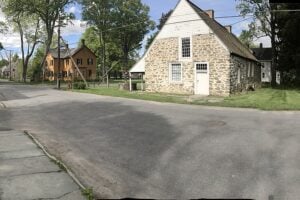
In 1980, the St. James General Store was owned by John and Eleanor Oakley, who were also concerned with protecting its historic character. In July 1990, Suffolk County and New York State joined in a preservation effort to purchase the 133-year-old store, with New York State providing a $110,000 grant toward the acquisition. The store is included within the Saint James Historic District, which was listed on the National Register of Historic Places in 1973, and it now stands within the boundaries of Deepwells Farm Historic Park. It remains at 516 Moriches Road in the middle of the St. James community.
For more than a century and a half, generations of people have passed through the same wooden doors and purchased items across counters and display cases that connect the present with the nineteenth century. Suffolk County notes that the building has remained structurally unchanged since 1894 and that many original features survive, including counters, cases, a coffee grinder, tea canisters, a potbelly stove, barrels, and an old checkerboard. It is an extraordinary experience to browse through a store that has preserved so much of its original character. If you’re visiting Long Island, we highly recommend making the trip to St. James and experiencing this magnificent nineteenth-century general store.
Visiting the St. James General Store Today
The St. James General Store remains open year-round as a Suffolk County Parks museum shop. Suffolk County currently lists the store as open seven days a week from 10:00 a.m. to 5:00 p.m. and notes that a post office substation still operates inside. The county also presents period craft demonstrations, special events, and other interpretive programs. Because hours and programs can change, visitors making a special trip should check the Suffolk County Parks page before leaving home.
More Photographs of the St. James General Store

Photo: Cole Kachejian

Photo: Cole Kachejian

Photo: Cole Kachejian

Photo: Cole Kachejian

Photo: Cole Kachejian

Photo: Brian Kachejian

Photo: Brian Kachejian

Photo: Brian Kachejian

Photo: Brian Kachejian

Photo: Brian Kachejian

Photo: Brian Kachejian

Photo: Cole Kachejian

Photo: Cole Kachejian

Photo: Cole Kachejian

Photo: Cole Kachejian
Readers interested in more local history can also visit our look at the St. James Train Station, along with our histories of A&P supermarkets, Bohack’s grocery stores, and Waldbaum’s.
Sources
Suffolk County Parks — St. James General Store
National Park Service — New York National Register Listings
Suffolk County — 1964 County Catalog of Historical Landmarks
Updated August 31, 2026.
The Wonder And History Of The St. James General Store article published on ClassicNewYorkHistory.com © 2026