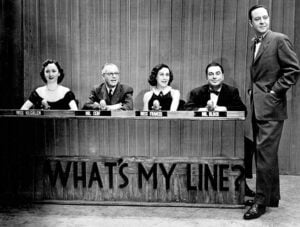
The original What’s My Line? television panel in 1952 with Dorothy Kilgallen, Bennett Cerf, Arlene Francis, Hal Block, and host John Charles Daly. Public domain image via Wikimedia Commons.
Decades before Southern California television stages came to dominate the modern game-show industry, New York City was one of the genre’s great creative centers. Broadway theaters, Midtown television studios, advertising agencies, and production companies such as Goodson-Todman turned panel games, physical contests, musical quizzes, and big-money question-and-answer programs into national television events.
This list focuses on game shows with a substantial New York City production history. Some spent their entire original runs in Manhattan, while others later moved to California or returned in later versions produced elsewhere. Because many early programs were broadcast live, recorded on videotape, or preserved by kinescope rather than literally shot on film, “produced in New York City” is the more accurate description.
The list is arranged chronologically by the beginning of each show’s New York television run rather than as a ranking.
1. Winner Take All (1948–1952)
- New York Production: CBS and NBC television facilities in New York City during its early television runs.
- Format & Legacy: Created by Mark Goodson and Bill Todman, Winner Take All became their first television game show and introduced several ideas that became basic parts of the genre. Two contestants competed directly against one another, the winner returned to face a new challenger, and a lockout buzzer prevented both players from answering at once. Those innovations became standard features of television quiz shows for decades.
2. Stop the Music (1949–1952; 1954–1956)
- New York Production: The Ritz Theatre in Manhattan during the original television run.
- Format & Legacy: Hosted by Bert Parks, Stop the Music brought its successful radio format to television. A live orchestra performed songs before calls were placed to viewers at home, who could win prizes by identifying the music. The show became one of television’s earliest successful audience-participation games and helped establish the idea that viewers far from the studio could become part of the program itself.
3. What’s My Line? (1950–1967)
- New York Production: CBS Studio 59 at the Mansfield Theatre, later CBS Studio 52 and CBS Studio 50 in Manhattan.
- Format & Legacy: Hosted by John Charles Daly, What’s My Line? became the defining sophisticated panel game of early television. Regular panelists including Dorothy Kilgallen, Arlene Francis, and Bennett Cerf questioned ordinary contestants in an attempt to identify their occupations, then donned blindfolds for the weekly celebrity Mystery Guest. The original CBS series remained a Sunday-night New York institution for 17 years.
4. Beat the Clock (1950–1961 Original Run)
- New York Production: CBS television studios in Manhattan, including Studio 52 and Studio 50 during the original run.
- Format & Legacy: Hosted by Bud Collyer, this Goodson-Todman game challenged contestants to complete comic physical stunts before a giant studio clock expired. Balloons, household objects, whipped cream, awkward costumes, and elaborate contraptions turned ordinary couples into performers and helped establish the physical-challenge game-show format.
5. Strike It Rich (1951–1958)
- New York Production: CBS television production in Manhattan.
- Format & Legacy: Hosted by Warren Hull, Strike It Rich mixed a quiz show with emotionally charged human-interest stories. Contestants facing financial hardship answered questions for money, while the program’s “Heart Line” allowed viewers and studio guests to offer additional assistance. The format became enormously popular while also drawing criticism over the use of personal hardship as television entertainment.
6. I’ve Got a Secret (1952–1967)
- New York Production: CBS Studio 59 at the Mansfield Theatre through 1960, followed by CBS Studio 52 in Manhattan.
- Format & Legacy: Created by Allan Sherman and Howard Merrill and produced by Goodson-Todman, I’ve Got a Secret asked a celebrity panel to uncover a contestant’s unusual secret through questioning. Garry Moore hosted most of the run before Steve Allen took over. The combination of ordinary people, historical witnesses, unusual accomplishments, celebrity guests, and spontaneous panel comedy made it one of CBS television’s most durable panel shows.
7. Masquerade Party (1952–1960)
- New York Production: New York television studios during its runs across NBC, CBS, and ABC.
- Format & Legacy: Celebrity guests appeared in elaborate makeup, masks, costumes, and disguises while a panel tried to determine who they really were. Hosts during the original run included Peter Donald, Eddie Bracken, and Bert Parks. The format blended a guessing game with theatrical costume design and the live unpredictability of early New York television.
8. Name That Tune (1953–1959 Original Run)
- New York Production: New York network studios during its NBC and CBS prime-time runs.
- Format & Legacy: Created by Harry Salter and Roberta Semple Salter, Name That Tune tested contestants’ ability to identify songs performed by a studio orchestra. Red Benson, Bill Cullen, and George DeWitt hosted during the original television era. The simple challenge of recognizing a melody as quickly as possible became one of the most enduring ideas in game-show history.
9. The $64,000 Question (1955–1958)
- New York Production: CBS Studio 52 at 254 West 54th Street in Manhattan.
- Format & Legacy: Hosted by Hal March, The $64,000 Question transformed television quizzes into national spectacle. Contestants chose specialized fields of knowledge and advanced through increasingly difficult questions toward the enormous top prize. PBS’s history of the quiz-show scandal notes that the program attracted 47 million viewers within ten weeks of its 1955 debut. Its sensational success helped ignite the big-money quiz boom that soon engulfed television.
10. Twenty-One (1956–1958)
- New York Production: NBC Studios at 30 Rockefeller Plaza, including Studios 6A and 6B.
- Format & Legacy: Created by Jack Barry and Dan Enright, Twenty-One placed contestants in separate booths and challenged them to accumulate 21 points through increasingly difficult questions. The show became the central symbol of the late-1950s quiz-show scandals after contestant Herb Stempel revealed that outcomes had been manipulated and that Charles Van Doren had received assistance. Congressional hearings and public outrage permanently changed television game-show standards.
11. The Price Is Right (Bill Cullen Era: 1956–1965)
- New York Production: The Hudson Theatre, NBC’s Colonial Theatre, the Ziegfeld Theatre for selected programs, and later the Ritz Theatre during the ABC era.
- Format & Legacy: Long before the Bob Barker and Drew Carey versions in California, The Price Is Right began in New York with Bill Cullen as host. Created by Bob Stewart for Goodson-Todman, the original program asked contestants to bid on consumer products and elaborate prize packages. The central idea of estimating retail prices proved durable enough to survive major format changes and become one of television’s longest-running game-show concepts.
12. Tic-Tac-Dough (Original NBC Run: 1956–1959)
- New York Production: NBC production facilities in New York, including the Colonial Theatre, the Ziegfeld Theatre, and Studio 6B at 30 Rockefeller Plaza.
- Format & Legacy: Produced by Barry & Enright, the show turned the familiar tic-tac-toe grid into a category-based quiz board. Contestants answered questions to claim X’s and O’s while trying to complete a line of three. The original New York version was among the programs touched by the broader quiz-show scandal era, while later revivals turned the format into another long-running television franchise.
13. To Tell the Truth (1956–1968 Original CBS Run)
- New York Production: CBS Studio 62 at the Biltmore Theatre, followed by Studio 59, Studio 52, and eventually CBS Studio 50.
- Format & Legacy: Created by Bob Stewart for Goodson-Todman and hosted by Bud Collyer, the show presented three people all claiming to be the same individual, although only one was sworn to answer truthfully. Panelists such as Kitty Carlisle, Peggy Cass, and Tom Poston questioned the trio before voting on the real person. The reveal became one of television’s most recognizable game-show moments.
14. Concentration (1958–1973)
- New York Production: NBC Studios at 30 Rockefeller Plaza for nearly the entire original network run.
- Format & Legacy: Hosted for many years by Hugh Downs and later by Bob Clayton, Concentration combined memory with rebus solving. Contestants matched numbered spaces on a large mechanical game board to reveal portions of a picture puzzle, forcing players to remember locations while simultaneously deciphering the hidden phrase. The original NBC series became one of the longest-running daytime game shows of its era.
15. Password (Original CBS Run: 1961–1967)
- New York Production: Primarily CBS Studio 52 and CBS Studio 50 in Manhattan, with occasional Hollywood tapings during the original run.
- Format & Legacy: Created by Bob Stewart and hosted by Allen Ludden, Password paired celebrities with civilian contestants who tried to communicate a secret word using one-word clues. Betty White became one of the program’s most familiar celebrity players and later married Ludden. The spare format became so durable that Password has returned repeatedly in new versions across several decades.
16. The Match Game (Original NBC Era: 1962–1969)
- New York Production: NBC Studio 8H at 30 Rockefeller Plaza.
- Format & Legacy: Before the famous 1970s version, Gene Rayburn hosted a more restrained New York incarnation built around teams trying to match one another’s answers to fill-in-the-blank questions. The basic matching concept, audience-response elements, and Rayburn’s personality laid the groundwork for the much looser revival that followed.
17. Jeopardy! (Original Art Fleming Era: 1964–1975)
- New York Production: NBC Studios at 30 Rockefeller Plaza, beginning in Studio 6A and later using Studio 8G.
- Format & Legacy: Created by Merv Griffin, with the answer-and-question idea suggested by his wife Julann, Jeopardy! premiered on NBC on March 30, 1964, with Art Fleming as host and Don Pardo as announcer. The New York production established the categories, clue board, Daily Doubles, Final Jeopardy, and answer-in-the-form-of-a-question structure that survived into the modern syndicated version.
18. Eye Guess (1966–1969)
- New York Production: NBC Studio 6A at 30 Rockefeller Plaza.
- Format & Legacy: Created by Bob Stewart and hosted by Bill Cullen, Eye Guess combined general knowledge with visual memory. Contestants were briefly shown answers hidden behind numbered squares, then had to remember where the correct answer was located after hearing each question. It was Stewart’s first game show after leaving Goodson-Todman and demonstrated how much innovation was still coming out of New York television in the late 1960s.
19. Pyramid (New York Era: 1973–1981)
- New York Production: CBS Studio 50, the Ed Sullivan Theater, followed by ABC Studio TV-15 at the Elysee Theatre on West 58th Street. Most of the franchise’s 1970s and 1981 New York versions originated from Manhattan, although several CBS weeks were taped in Hollywood.
- Format & Legacy: Bob Stewart’s The $10,000 Pyramid debuted in 1973 with Dick Clark as host, pairing celebrities with civilian contestants in a rapid word-association game. After moving from CBS to ABC, the format continued in New York under titles including The $20,000 Pyramid, while the 1981 syndicated The $50,000 Pyramid also originated from the Elysee Theatre. The Winner’s Circle became one of the most famous bonus rounds in game-show history.
20. Who Wants to Be a Millionaire (New York Era: 1999–2014)
- New York Production: ABC Television Center East on West 67th Street from 1999 through 2013, followed by NEP’s Metropolis Studios in East Harlem before production moved to Connecticut in 2014.
- Format & Legacy: Regis Philbin brought prime-time big-money quiz television roaring back at the end of the 1990s. Contestants climbed a fifteen-question money ladder while using lifelines including 50:50, Phone-a-Friend, and Ask the Audience. The show was taped, not broadcast live, from its Upper West Side studio and became a national phenomenon, with some broadcasts drawing audiences approaching 30 million viewers. Its success returned regular game-show production to New York after years in which most of the genre had migrated west.
Quick Reference: 20 Classic Game Shows Produced in New York City
| Show | New York Era / Run | Primary NYC Production Location | Historic Game-Show Legacy |
|---|---|---|---|
| Winner Take All | 1948–1952 | CBS / NBC New York | Introduced head-to-head contestants, returning champions, and lockout buzzers |
| Stop the Music | 1949–1952; 1954–1956 | Ritz Theatre | Musical quiz that brought viewers at home directly into the game |
| What’s My Line? | 1950–1967 | Studios 59, 52, and 50 | Defining occupation-guessing and Mystery Guest panel show |
| Beat the Clock | 1950–1961 | CBS Manhattan studios | Pioneering timed physical-stunt format |
| Strike It Rich | 1951–1958 | CBS New York | Combined quiz questions with hardship stories and viewer assistance |
| I’ve Got a Secret | 1952–1967 | Studio 59 / Studio 52 | Celebrity panel uncovered contestants’ unusual secrets |
| Masquerade Party | 1952–1960 | New York network studios | Celebrity identification through theatrical disguises |
| Name That Tune | 1953–1959 | NBC / CBS New York | Classic live-orchestra song-identification game |
| The $64,000 Question | 1955–1958 | CBS Studio 52 | National phenomenon that ignited the big-money quiz craze |
| Twenty-One | 1956–1958 | NBC Studios 6A / 6B | Quiz scandal centerpiece involving Herb Stempel and Charles Van Doren |
| The Price Is Right | 1956–1965 | Hudson / Colonial / Ritz theatres | Original Bill Cullen retail-price bidding format |
| Tic-Tac-Dough | 1956–1959 | Colonial / Ziegfeld / Studio 6B | Trivia played on a giant tic-tac-toe board |
| To Tell the Truth | 1956–1968 | Studios 62, 59, 52, and 50 | Three claimants and the famous reveal of the real contestant |
| Concentration | 1958–1973 | NBC Studios, 30 Rockefeller Plaza | Memory matching combined with picture-rebus puzzles |
| Password | 1961–1967 | CBS Studio 52 / Studio 50 | One-word clue game pairing celebrities and civilians |
| The Match Game | 1962–1969 | NBC Studio 8H | Original matching format that led to the famous 1970s revival |
| Jeopardy! | 1964–1975 | NBC Studios 6A / 8G | Established the answer-and-question format |
| Eye Guess | 1966–1969 | NBC Studio 6A | Combined trivia with visual memory |
| Pyramid | 1973–1981 NYC era | Ed Sullivan / Elysee theatres | Rapid word association and the Winner’s Circle |
| Who Wants to Be a Millionaire | 1999–2014 NYC era | ABC Television Center East / Metropolis Studios | Revived prime-time big-money quiz television |
Readers interested in more New York television history can continue with our History of NBC Studios at Rockefeller Plaza, History of the Ed Sullivan Theater, A Spectacular Visit to the Museum of the Moving Image in Queens, New York, and History of the Hudson Theater on Broadway.