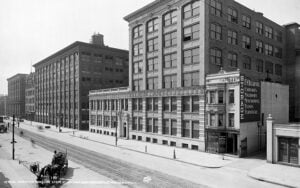
Eastman Kodak Company factory and main office in Rochester, New York, circa 1900–1910. Detroit Publishing Company, Public domain, via Library of Congress/Wikimedia Commons.
During the nineteenth and twentieth centuries, Upstate New York became one of America’s great centers of invention, manufacturing, and industrial research. The Erie Canal opened enormous commercial opportunities, Niagara Falls supplied industrial power on a scale few places could match, and cities such as Rochester, Schenectady, Buffalo, Troy, Corning, Elmira, and Endicott became homes to companies and inventors whose work reached far beyond New York State.
Some of the innovations on this list were invented outright in Upstate New York. Others were perfected, manufactured, commercialized, or transformed into world-changing products there. Together they show how deeply the region was tied to the rise of photography, electrical engineering, medicine, transportation, communications, food production, optics, computing, and modern industry.
1. Roll Film and the Kodak Camera (Rochester)
George Eastman turned Rochester into the center of a photographic revolution. Eastman introduced a roll-film holder in 1885 and then launched the Kodak camera in 1888, making photography far easier for ordinary people who no longer needed to work with cumbersome glass plates and complicated darkroom equipment. The original Kodak came preloaded with enough film for 100 exposures, and customers sent the entire camera back to Rochester for developing, printing, and reloading. Kodak introduced transparent flexible film in 1889, and that material became important to the emerging motion-picture industry as well as still photography.
2. The Commercial Typewriter and the QWERTY Keyboard (Ilion)
Christopher Latham Sholes and Carlos Glidden designed the machine that became the first commercially successful typewriter, but the transformation from experimental device to mass-produced business machine happened at E. Remington & Sons in Ilion, New York. Remington began manufacturing the Sholes and Glidden typewriter in 1874. The keyboard arrangement associated with Sholes evolved into the QWERTY layout that ultimately became the dominant standard. The typewriter helped reshape offices, publishing, business correspondence, and clerical work throughout the industrial world.
3. Modern Air Conditioning and Its Buffalo Connection
Willis Haviland Carrier designed the first modern air-conditioning system in 1902 while working for the Buffalo Forge Company. The system itself was created to solve a humidity problem at the Sackett-Wilhelms printing plant in Brooklyn, but Carrier’s engineering career and the research that led to the breakthrough were closely tied to Buffalo. In 1915, Carrier and six other engineers formed the Carrier Engineering Corporation. The company later became closely associated with Syracuse, helping make Central New York an important center of the air-conditioning industry.
4. Xerography and the Xerox 914 (Rochester)
Chester Carlson created the first xerographic image in Astoria, Queens, in 1938, but Rochester turned his difficult experimental process into a commercial revolution. The Haloid Company, founded in Rochester in 1906, acquired rights to develop Carlson’s technology and gradually built its future around xerography. In 1959, the company introduced the Xerox 914, the first automatic plain-paper commercial copier. The machine transformed office work, education, law, publishing, and recordkeeping and helped turn the Rochester company into Xerox Corporation.
5. Heavy Electrical Engineering and Electric Traction (Schenectady)
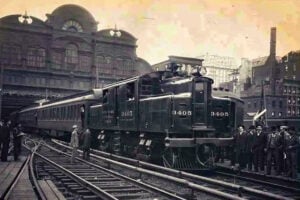
Schenectady became one of the most important electrical-engineering centers in the United States through the General Electric Company. Charles Proteus Steinmetz, who made Schenectady his home after joining GE, developed mathematical methods that made alternating-current systems easier for engineers to design and analyze. His work on hysteresis, AC theory, and electrical transients helped improve motors, transformers, generators, and transmission equipment. At the same time, GE became a major force in electric-traction technology and locomotive development, making Schenectady one of the defining centers of America’s electrical age.
6. Pyrex Heat-Resistant Glass (Corning)
Pyrex emerged from the laboratories of Corning Glass Works after the company developed heat-resistant glass for railroad lanterns and other industrial uses. The breakthrough moved into the kitchen after Bessie Littleton, wife of Corning physicist Jesse Littleton, experimented with a sawed-off Nonex battery jar and successfully baked a cake in it. Corning introduced Pyrex cookware in 1915. The heat-resistant glass soon became a household staple while related borosilicate-glass technology remained important in laboratories, industry, and scientific instruments.
7. Henry Burden’s Horseshoe-Making Machine (Troy)
Troy’s Burden Iron Works was one of the great industrial operations of nineteenth-century New York. Henry Burden developed machines that automated the production of horseshoes, replacing work that had traditionally been performed one shoe at a time by blacksmiths. By 1859, an improved Burden machine was said to be capable of producing one horseshoe per second, and by the Civil War he had several machines in operation. Burden’s factory demonstrated how mechanization could transform even one of the oldest trades into large-scale industrial production.
8. The Steam-Powered Grain Elevator (Buffalo)
Buffalo merchant Joseph Dart and engineer Robert Dunbar transformed grain handling in 1842 with the construction of a steam-powered grain elevator on Buffalo Creek. Before the elevator, crews unloaded grain from Great Lakes vessels largely by hand, a slow and exhausting process. Dart’s system used a vertical belt fitted with buckets to lift grain from ship holds into storage bins. The innovation dramatically accelerated the transfer of grain from the Great Lakes to the Erie Canal and helped establish Buffalo as one of the world’s great grain-handling ports.
9. The Practical Implantable Cardiac Pacemaker (Buffalo)
One of the most important medical breakthroughs associated with Upstate New York came from electrical engineer Wilson Greatbatch and surgeon Dr. William Chardack in Buffalo. Greatbatch developed a small battery-powered pacemaker, and after extensive experimental work with Chardack and Dr. Andrew Gage, the device was successfully implanted in a human patient in Buffalo in 1960. The Greatbatch-Chardack pacemaker helped establish the practical implantable cardiac pacemaker and opened a new era in the treatment of dangerous heart-rhythm disorders.
10. The Morrow Coaster Brake and Bicycle Hub (Elmira)
Elmira became an important center of bicycle-component manufacturing through the Eclipse Bicycle Company and later the Eclipse Machine Company. The company became widely known for the Morrow coaster brake, which was manufactured in Elmira and allowed riders to coast without continuously pedaling while also braking by back-pedaling. The Morrow brake became one of the best-known bicycle components of its era and helped make safer, more convenient bicycle operation a mass-market feature.
11. Celluloid Manufacturing (Albany)
John Wesley Hyatt helped turn early nitrocellulose chemistry into commercially useful celluloid, one of the first major artificial plastics. Hyatt and his brother Isaiah established the Albany Billiard Ball Company while developing and selling products made from the new material. The Hyatts eventually trademarked the name “celluloid,” and the material went on to be used for billiard balls, combs, collars, toys, photographic film, and many other products. Their work helped open the door to the modern plastics industry.
12. IBM Punched-Card Data Processing (Endicott)
Herman Hollerith invented his punched-card tabulating system before IBM existed, but Endicott became one of the most important places in the technology’s industrial development. The Computing-Tabulating-Recording Company established major operations in Endicott after the 1911 consolidation of several predecessor firms and changed its name to International Business Machines in 1924. IBM continued improving punched-card systems, and its 80-column card became a standard tool for business and government data processing. During the New Deal era, millions of IBM cards and tabulating machines were used to administer Social Security records.
13. Condensed Milk Production on an Industrial Scale (Wassaic)
Gail Borden patented his method for preserving condensed milk in 1856, but one of the crucial steps in turning that invention into a large-scale business occurred in Wassaic, New York. In 1861, the New York Condensed Milk Company opened a successful plant there, producing shelf-stable milk that became especially important during the Civil War. The Wassaic operation helped prove that preserved milk could be manufactured reliably on an industrial scale and transported far beyond the limits imposed by fresh milk.
14. American Optical Glass and Precision Optics (Rochester)
Bausch & Lomb began in Rochester in 1853 as a small optical shop and grew into one of America’s most important precision-optics companies. The firm manufactured eyeglasses, microscopes, binoculars, camera lenses, shutters, and other instruments, and during the early twentieth century its Rochester operation helped establish domestic production of high-quality optical glass. That capability became especially important when access to European optical glass was disrupted and the United States needed reliable lenses and instruments for military, scientific, and medical use.
15. The Building Mail Chute (Rochester)
As American cities began building upward, Rochester architect James G. Cutler devised a simple way for people on upper floors to mail letters without walking down to a street box. Cutler developed the vertical mail-chute system that carried letters by gravity to a collection box on the ground floor. The first mail chute was installed in Rochester’s Elwood Building in 1884. The idea spread to office buildings, hotels, and apartment houses across the country and became a familiar feature of urban architecture.
16. Jell-O (Le Roy)
One of Upstate New York’s most famous food products was created in Le Roy in 1897. Pearle Wait experimented with gelatin and developed a fruit-flavored dessert that his wife, May, named Jell-O. Wait struggled to market the product and sold the trademark in 1899 to fellow Le Roy businessman Orator Francis Woodward for $450. Under Woodward’s Genesee Pure Food Company, Jell-O became a national success and one of the most recognizable packaged foods in American history.
17. The 200-Inch Palomar Telescope Mirror Blank (Corning)
Corning Glass Works took on one of the most ambitious scientific manufacturing challenges of the twentieth century when it was asked to cast a 200-inch mirror blank for the Hale Telescope at Palomar Observatory. The first 1934 casting failed, but a second pour on December 2, 1934, succeeded. The enormous Pyrex disk then cooled slowly for ten months before traveling by rail to California for grinding and polishing. Installed in the Hale Telescope, the mirror helped make Palomar one of the world’s most important astronomical observatories.
18. The Modern Dynamic Loudspeaker (Schenectady)
General Electric engineers Chester W. Rice and Edward W. Kellogg helped establish the design principles of the modern direct-radiator dynamic loudspeaker while working in Schenectady. Their 1925 work used a moving coil attached to a lightweight diaphragm and was designed to reproduce a much broader and more natural range of sound than the horn speakers common at the time. The Rice-Kellogg design became enormously influential in radio, recorded music, public-address systems, and eventually nearly every field that depended on amplified sound.
19. The First Self-Contained Digital Camera (Rochester)
Photography changed again in Rochester nearly a century after George Eastman’s first breakthroughs. In 1975, Eastman Kodak engineer Steven Sasson built the world’s first self-contained digital camera prototype. The device captured an image, converted it into an electronic signal, digitized the signal, and stored the image electronically. Sasson’s prototype demonstrated that photographs could be captured, stored, and displayed without film, laying groundwork for the digital photography revolution that eventually transformed the entire industry.
20. Silicon Carbide and the Niagara Falls Industrial Boom
Edward Goodrich Acheson discovered silicon carbide, which he called Carborundum, during experiments in Pennsylvania in the early 1890s. The decisive Upstate New York chapter came when he established the Carborundum Company and moved the operation to Niagara Falls in 1895 to take advantage of the region’s abundant hydroelectric power. Niagara Falls became the manufacturing center for one of the world’s most important artificial abrasives, used in grinding wheels, sharpening stones, refractory products, and precision metalworking.
These inventions and industrial breakthroughs came from different eras and different kinds of minds, but they share an important New York connection. Upstate cities were not simply manufacturing centers where someone else’s ideas were copied. They were places where inventors, engineers, machinists, chemists, physicians, and entrepreneurs tested new ideas, solved practical problems, and learned how to manufacture technology on a scale large enough to change everyday life.
For more on the history of the region, read Where Does Upstate New York Begin? Defining New York State’s Regions and Boundaries, our History of the Erie Canal, and The Real Main Street of New York: The History of U.S. Route 20.