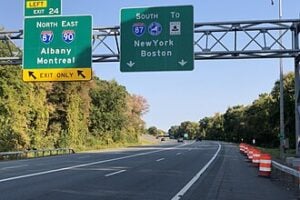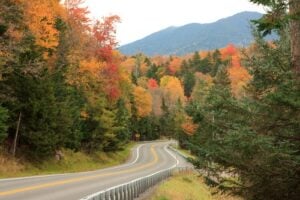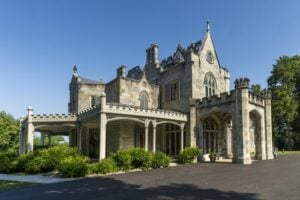
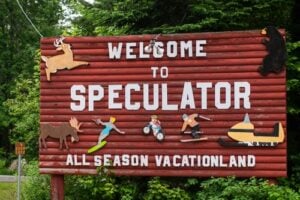
The Welcome to Speculator sign in Hamilton County, New York, celebrates this Adirondack village’s unusual name and year-round recreation. Photo: KMarsh / Shutterstock.com
Upstate New York has some of the country’s most unusual place names. A drive through the Finger Lakes, the Southern Tier, the Hudson Valley, or the North Country can take you past signs for Horseheads, Coxsackie, Fishkill, Halfmoon, and Speculator. Some names sound funny in modern English. Others seem nearly impossible to pronounce. Behind them are stories of rivers, early industry, European settlement, military campaigns, and Indigenous communities whose languages named the landscape long before New York State existed.
The names also preserve different periods of the state’s history. Dutch settlers left words such as kil for a creek and hoek for a corner. The classical interests of early American officials produced names associated with ancient Greece and Rome. Logging, transportation, and the shape of the terrain explain others. Many Indigenous-derived names survived in altered spellings even as colonization displaced the people who originally used them.
There is a difficulty with the history of place names: a good story can be repeated for generations without anyone establishing whether it is true. Historians sometimes find several competing translations of the same Indigenous word, and local traditions do not always agree with documentary or linguistic research. In this article, we distinguish well-supported origins from theories and legends rather than pretend every unusual name has one perfectly certain explanation.
These 25 communities include incorporated towns and villages as well as a few hamlets, using “towns” in the everyday sense of places people know by name. They are spread across Upstate New York, and every entry explains what the surviving historical evidence says about its name.
1. Horseheads
County: Chemung County. Community: Town and village.
The unusual name of Horseheads dates to the Revolutionary War and General John Sullivan’s 1779 campaign against the Haudenosaunee nations. As the army returned through the Chemung Valley, exhausted pack horses could no longer continue. Local historical accounts describe the animals being put down and their skulls left in the area; later settlers found the remains and associated the valley with horse skulls. The village’s own history preserves additional details about how the skulls were displayed, though those details come from local tradition. The story has a disturbing background: Sullivan’s campaign destroyed Indigenous settlements and food supplies across the region. Horseheads was not always the village’s official name, either. It was incorporated as Fairport in 1837, renamed Horseheads in 1845, briefly became North Elmira in 1885, and reverted to Horseheads in 1886.
2. Painted Post
County: Steuben County. Community: Village.
The village is named for a wooden post associated with the Indigenous history of the area near the meeting of the Cohocton and Tioga rivers. According to a longstanding account, the post marked the grave of a Native leader, often identified in local tradition as Captain Montour. Other accounts describe its use as a landmark or message post. Historical references disagree about its exact purpose and even whether the original post was painted when early settlers first saw it. That makes the dramatic story of a post stained red with berry juice too specific to present as established fact. The Village of Painted Post preserves the association through a replica post and a monument to Chief Montour. Although a much larger town once used the name, today Painted Post identifies the village in the Town of Erwin.
3. Coxsackie
County: Greene County. Community: Town and village.
Coxsackie is not a Dutch phrase, even though Dutch settlement shaped much of its early European history along the Hudson River. The place name comes from an Indigenous term rendered in colonial records with widely varying spellings, including Koxhacking and Koixhacking. The town and village histories acknowledge competing interpretations: “place of owls,” “hoot of the owl,” “migrating geese,” and meanings connected to the riverbank or cut rocks. No single English translation can safely be declared the winner. The community later became an important river landing for farm products and ice transported toward New York City. Its unusual modern spelling preserves a much older name that European mapmakers struggled to transcribe consistently.
4. Fishkill
County: Dutchess County. Community: Town and village.
Fishkill is one of the easiest names on this list to misread. The second syllable has nothing to do with killing fish. Dutch settlers used the word kil for a creek or water channel, and vis means fish. Together, the words refer to a fish stream or creek. The name reflects the period when Dutch-language place names were common throughout the Hudson Valley. During the Revolutionary War, Fishkill developed into an important Continental Army supply center, adding another layer to the community’s history. The town and village both retain the name, and Fishkill Creek remains a prominent geographical feature. Sometimes a strange-looking English place name is perfectly ordinary once its original language is understood.
5. Penn Yan
County: Yates County. Community: Village.
Penn Yan’s name emerged from the mixture of settlers who arrived from Pennsylvania and New England around the northern end of Keuka Lake. The traditional explanation combines Penn from Pennsylvania and Yan from Yankee, the familiar name for New Englanders. An early Yates County history describes a form resembling “Penn Yank” before the final consonant fell away. Although the original draft characterized the naming as the settlement of a bitter dispute, the historical record more securely establishes a practical combination of the two communities’ identities. Penn Yan later became the Yates County seat and a commercial center linked to the Crooked Lake Canal. The name is an unusually direct reminder of where two groups of settlers came from.
6. Skaneateles
County: Onondaga County. Community: Town and village.
Visitors sometimes stumble over the pronunciation of Skaneateles, but its origin is far older than the streets and storefronts surrounding the lake today. Both town and village histories identify the name as Haudenosaunee, traditionally translated as “long lake.” The description fits a Finger Lake extending approximately 16 miles from north to south. The village developed at its northern end, while the town was organized separately from Marcellus in 1830. What began as the name of a body of water became the name of the surrounding community. The survival of Skaneateles on modern road signs also preserves a small part of the Indigenous geography of Central New York.
7. Schaghticoke
County: Rensselaer County. Community: Town and village.
Schaghticoke has a spelling that can intimidate newcomers, but the historical meaning offered by the Town of Schaghticoke is simple: “the place where the waters mingle.” The name is associated with Indigenous communities and waterways in the upper Hudson region. The town’s history places the early settlement near the meeting of the Hoosic River and Tomhannock Creek and describes Mohican and other Native peoples who gathered in the area during the colonial period. Different historical spellings reflect the difficulty European scribes encountered when writing Algonquian-language names. The word should not be reduced to a decorative label on a map: it also recalls the Schaghticoke people and a complex history of migration, colonial alliances, and displacement.
8. Chili
County: Monroe County. Community: Town.
In Monroe County, Chili is pronounced “CHY-lye,” not like the bowl of food. The reason for the name is still debated. According to the Town of Chili’s own historical account, one longstanding explanation connects it to the South American country of Chile and local sympathy for its struggle for independence. Another connects it with Chiliast or Chilian religious beliefs held by some early settlers in South Chili. The town historian expressly presents both as theories rather than a proven conclusion. The Town of Chili separated from Riga in the early 1820s. Its spelling and pronunciation make it a memorable road-sign curiosity, but the most responsible answer to how it got the name is that historians have not settled the question.
9. Irondequoit
County: Monroe County. Community: Town.
The Town of Irondequoit borders Lake Ontario to the north, the Genesee River to the west, and Irondequoit Bay to the east. The town’s official planning documents trace its name to a Seneca term translated as “where the land and waters meet.” Unlike a fanciful folk explanation invented long afterward, the geography offers a clear reason this meaning has endured. The region was part of the homeland of the Seneca Nation long before French expeditions and European settlers entered the area. Later development brought lakeside recreation, resort hotels, and finally the suburban neighborhoods familiar today. The unusual word connects that changing history to the waters that still define the town.
10. Canajoharie
County: Montgomery County. Community: Town and village.
The Mohawk-language name Canajoharie is traditionally translated as “the pot that washes itself.” The Town of Canajoharie’s historian traces the expression to a naturally formed pothole in the stream flowing through the village, a circular basin scoured by water and sediment below a falls. It is an unusually vivid example of a place being named after a specific physical feature. Before the name became established, the settlement was associated with the tavern keeper Henry Schrembling and appeared under variations of his name. The Mohawk Valley subsequently became a major transportation corridor, with the Erie Canal and railroads passing through the region. The name Canajoharie, however, preserves an older local geographical description.
11. Halfmoon
County: Saratoga County. Community: Town.
Halfmoon’s name sounds like an obvious tribute to the Halve Maen, the ship commanded by Henry Hudson in 1609. That association is frequently repeated, but the Town of Halfmoon’s official history gives a more direct explanation. Dutch settlers used Halve Maen for a broad tract or plain near the junction of the Mohawk and Hudson rivers because of its shape. The area was known by that name well before Saratoga County existed. It eventually became one of the county’s original towns in 1788 and was briefly called Orange in the early 19th century before the older name returned. The ship story makes a memorable comparison, but the shape of the land is the better-supported origin in the town’s own historical account.
12. Neversink
County: Sullivan County. Community: Town.
Despite appearances, Neversink does not mean that something is physically incapable of sinking. Its spelling developed from much older regional place names, and the exact derivation remains uncertain. The Town of Neversink’s historian explicitly warns that researchers disagree; the town’s history mentions a possible connection to the Indigenous name Mahackamack rather than endorsing the tidy “mad river” translation found in some popular accounts. The town was established in 1798, when the area was still part of Ulster County, and later became part of Sullivan County. Its name acquired another layer of historical irony in the 20th century: construction of New York City’s reservoirs inundated several former communities, including the original settlement of Neversink, which had to be relocated.
13. Deposit
County: Broome and Delaware Counties. Community: Village; also a town in Delaware County.
Deposit may be the most literal business-related name on this list. Early lumbermen dragged pine logs and other timber to the West Branch of the Delaware River, where they deposited the material until spring high water made it possible to assemble large rafts for the trip toward Philadelphia. The Village of Deposit’s official historical account describes the practice as an important source of cash for early settlers. The village occupies land in both Broome and Delaware counties, an unusual jurisdictional arrangement, while the separate Town of Deposit is in Delaware County. The story is not about a bank deposit or an unexplained mineral deposit. It is about an early transportation economy in which the river carried goods to distant markets.
14. Triangle
County: Broome County. Community: Town.
Triangle sounds like a town named by a geometry teacher. Its actual explanation is geographical. The town was once called the “Chenango Triangle,” and Broome County’s comprehensive planning history states that the confluence of the Tioughnioga and Otselic rivers forms the angle from which the name was drawn. The town was organized in 1831 from part of Lisle. It includes Whitney Point, where the meeting of those waterways was important to early settlement and trade. The draft’s claim that the name came strictly from the shape of an original land purchase is less precise than the county planning record. In Triangle, a river junction became a local identity and eventually a municipal name.
15. Valatie
County: Columbia County. Community: Village.
Valatie’s compact and unusual spelling reflects a Dutch expression commonly rendered as Vaaltje, meaning “little falls.” The name fits a village that grew around the waterpower of Kinderhook Creek and Valatie Kill. Dutch settlers arrived in the broader Kinderhook area during the 17th century, and water-powered mills later drove Valatie’s development. By the 19th century, cotton manufacturing helped make it an important industrial community in northern Columbia County. The Village of Valatie’s own historical account supplies both the translation and the story of its mills. Those falls, rather than a person’s surname or an invented nickname, explain why this Dutch-derived name endured.
16. Oswegatchie
County: St. Lawrence County. Community: Town.
Oswegatchie takes its name from the Oswegatchie River, which passes through the northern Adirondack region toward the St. Lawrence. The precise meaning of the original Indigenous name has been debated for generations. A 19th-century historical compilation records “going or coming around a hill,” while also acknowledging “black water” and “slow and long” as alternative interpretations. A modern account of the Oswegatchie River watershed similarly uses the idea of dark, tea-colored water. Those variations make it misleading to announce one translation as certain. The town was organized in 1802, and the area near the river’s mouth had earlier been associated with French missionary activity. The surviving name keeps that much older river connection alive.
17. Caneadea
County: Allegany County. Community: Town and hamlet.
Caneadea is one of the most evocative names on this list. The Allegany County history site gives two closely related traditional renderings of the Seneca-derived name: “where the sun rests on the hills” and “where the heavens rest on the earth.” Both express a landscape in which the distant hills seem to meet the sky. The Town of Caneadea was formed from Angelica in 1808 and later included communities such as Houghton and Oramel. As with many Indigenous place names written down by English-speaking settlers, the wording of the English translation varies. Rather than insist on one perfectly literal phrase, the history is best understood as a traditional description of the local terrain.
18. Apalachin
County: Tioga County. Community: Hamlet.
Apalachin, the Tioga County hamlet near the Susquehanna River, is widely known for the 1957 meeting of organized-crime figures that drew national attention. Its place name is older and has nothing to do with the modern phrase Appalachian Mountains, despite the visual similarity. Research published by the New York State Museum discusses an interpretation from a Delaware or Munsee term meaning “the place whence the messenger returned.” That interpretation was recorded by early writers and deserves to be presented as an historical rendering rather than an uncontested modern translation. The same name appears in Apalachin Creek. The hamlet’s identity is thus linked both to the Indigenous geography of the Southern Tier and to an extraordinary moment in 20th-century law-enforcement history.
19. Tuxedo
County: Orange County. Community: Town and village.
The community of Tuxedo had its name long before the formal dinner jacket became fashionable. It traces to the Munsee or Lenape language and is connected with the wolf clan, rather than simply meaning “place of the bear” as some popular lists claim. Historical linguistic research relates the name to a word meaning “round foot,” with an extended form referring to the place of wolf-clan people. In the late 19th century, wealthy residents established Tuxedo Park as an exclusive country community. The dinner jacket’s American name then became associated with that social world. In other words, the town did not borrow its name from the clothing: the clothing name followed the place. The Indigenous origin is an important part of that often-repeated story.
20. Conewango
County: Cattaraugus County. Community: Town.
Conewango lies in southwestern New York near waterways whose names were established long before the present town was organized. The name is Indigenous in origin, but translations vary in historical and popular retellings. One regional history renders it as “walking slowly,” an interpretation quite different from the draft’s confident “in the rapids.” Without stronger linguistic documentation, neither phrase should be treated as a definitive word-for-word translation. The town was formed from Little Valley in 1823 and later lost land as neighboring towns were organized. Conewango’s name is therefore best explained as a preserved Indigenous place name whose exact original meaning is uncertain, rather than being forced into an appealing but inadequately sourced explanation.
21. Kinderhook
County: Columbia County. Community: Town and village.
Kinderhook comes from the Dutch Kinderhoek, meaning “children’s corner.” That translation is well established, although the exact circumstances of the naming are more difficult to prove. A longstanding local tradition holds that Henry Hudson or members of his crew saw Indigenous children along the Hudson River during the 1609 voyage and applied the name to the area. The Columbia County Historical Society presents the story as tradition, not as an independently documented quotation from Hudson. Kinderhook later grew into a prosperous Dutch-influenced community and became the birthplace of President Martin Van Buren. The name is one of the clearest surviving reminders of the Dutch-language geography of the Hudson Valley.
22. Ovid
County: Seneca County. Community: Town and village.
Ovid has no mysterious Indigenous translation. The Seneca County town was named for the ancient Roman poet Ovid, part of a wider tendency to give classical names to settlements in the Central New York Military Tract after the Revolution. The Town of Ovid’s official history attributes the choice to a clerk who liked the classics. The town was organized in 1794 and later shared county-seat responsibilities with Waterloo. This part of the Finger Lakes is dotted with names such as Romulus, Hector, and Ulysses, reflecting the classical education and interests of officials involved in surveying and naming the land. Ovid’s name is unusual among its neighbors chiefly because the original reference is literary rather than geographical.
23. Speculator
County: Hamilton County. Community: Village.
The Adirondack village of Speculator sounds as though it must have been founded by a crowd of risky investors. The documented naming story is more direct. Earlier known as Newton’s Corners, the community adopted the name Speculator in 1896 after Speculator Mountain, visible across Lake Pleasant. That history appears in local municipal records and in a New York State Senate resolution commemorating the village’s centennial. A claim that the mountain itself was named to mock land speculators is an appealing story, but the sources reviewed do not establish it reliably, so it should not be repeated as fact. The village was incorporated in 1925 and became associated with Adirondack tourism, lakeside lodging, and year-round recreation.
24. Gowanda
County: Cattaraugus and Erie Counties. Community: Village.
Gowanda stretches across the Cattaraugus Creek boundary between Erie and Cattaraugus counties. Its name comes from a Seneca expression traditionally translated as “a valley among the hills” or “under the cliffs,” matching the village’s setting near the dramatic terrain of Zoar Valley. The local historical society, quoted in the village’s official history, traces the early settlement through earlier names: Aldrich’s Mills and then Lodi, before Gowanda was adopted when the village incorporated in 1848. This is a place where the landscape, an Indigenous-derived name, and the municipal history line up particularly clearly. The two-county setting is another unusual feature of the community.
25. Chittenango
County: Madison County. Community: Village.
Chittenango owes its name to Chittenango Creek and an earlier Oneida place name. A New York State legislative resolution and a regional waterway-names study give the traditional meaning as “where the sun shines out.” Other accounts render the underlying term differently, including references to falling water; the exact linguistic interpretation is not universally agreed upon. What is firmly established is the connection to the creek and the older Oneida naming tradition. The village grew substantially with the Erie Canal, and it later became known as the birthplace of L. Frank Baum, the author of The Wonderful Wizard of Oz. Both the name and the nearby falls point to the waterways that shaped the community long before its Oz-related celebrations.
These place names tell us something important about New York’s history. Some record the physical landscape; others preserve the language of people who lived there long before modern municipal boundaries existed. A few names commemorate the practical work of early settlers. And for places such as Chili, Neversink, and Painted Post, the uncertainty itself is part of the story.
For more on the places and geography of New York State, read our articles on 10 Historic Small Towns in Upstate New York Worth Visiting and Where Does Upstate New York Begin?.
Quick Reference: The 25 Unusual Place Names
| Place | County | Origin or traditional explanation |
|---|---|---|
| Horseheads | Chemung County | The Revolutionary War pack horses |
| Painted Post | Steuben County | An old post with an uncertain purpose |
| Coxsackie | Greene County | An Indigenous name with several interpretations |
| Fishkill | Dutchess County | Dutch words for fish and stream |
| Penn Yan | Yates County | A compromise between Pennsylvanians and Yankees |
| Skaneateles | Onondaga County | A Haudenosaunee name for Long Lake |
| Schaghticoke | Rensselaer County | The place where waters mingle |
| Chili | Monroe County | Two rival explanations for a familiar-looking name |
| Irondequoit | Monroe County | Where the land and waters meet |
| Canajoharie | Montgomery County | The pot that washes itself |
| Halfmoon | Saratoga County | A crescent-shaped tract of land |
| Neversink | Sullivan County | A name whose origin remains unresolved |
| Deposit | Broome and Delaware Counties | A place to leave timber for river transport |
| Triangle | Broome County | The angle made by two rivers |
| Valatie | Columbia County | The Dutch words for Little Falls |
| Oswegatchie | St. Lawrence County | An Indigenous river name with competing interpretations |
| Caneadea | Allegany County | A poetic description of the horizon |
| Apalachin | Tioga County | The place from which a messenger returned |
| Tuxedo | Orange County | A Lenape name associated with the wolf clan |
| Conewango | Cattaraugus County | An Indigenous name whose English gloss varies |
| Kinderhook | Columbia County | Children’s corner in Dutch |
| Ovid | Seneca County | Named for a Roman poet |
| Speculator | Hamilton County | Named after Speculator Mountain |
| Gowanda | Cattaraugus and Erie Counties | A valley among the hills |
| Chittenango | Madison County | An Oneida name associated with the creek |