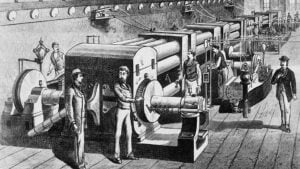
Feature Photo: Thomas Edison’s Pearl Street power station in Lower Manhattan, circa 1885. Public domain, via Wikimedia Commons.
Opening your monthly utility bill in New York can come with a dose of sticker shock. I have multiple air conditioners in my house, the kind you put in the window. Unlike many other people, I do not have central air. Probably because I am still a renter. I have always been a renter and will probably always be a renter. But I do pay the electric bill every month, and it has to be a sweltering heat wave before I turn those air conditioners on because I simply cannot afford to run them all the time. I know I am not alone.
New York is one of the most expensive states in the country for residential electricity. In May 2026, the latest monthly data available from the U.S. Energy Information Administration at the time of this article’s preparation showed that residential electricity in New York averaged 29.93 cents per kilowatt-hour. The national residential average was 18.44 cents per kilowatt-hour. That put New York about 62 percent above the national average.
Will knowing why make the bill feel any better? Probably not. But it does help explain why electricity costs so much in New York and why the amount on the bill is about much more than the electricity you actually use. To understand the modern system, you also have to go back to Lower Manhattan in 1882, when Thomas Edison helped create the first true electric grid in the United States.
How Expensive Is Electricity in New York?
The statewide average does not mean every New Yorker pays the same rate. Electric prices vary by utility, service territory, rate plan, season, usage, and the price of the electricity being supplied. Con Edison serves New York City and Westchester County, while Long Island and other parts of the state operate under different utility systems.
Still, the statewide numbers explain why so many New Yorkers feel the same shock when the bill arrives. The price of electricity here reflects the cost of the energy itself, the cost of moving that electricity through the local grid, the expense of maintaining an unusually complicated urban system, taxes and surcharges, and continuing investments needed to keep the system reliable.
The Spark in Lower Manhattan: Pearl Street Station
On September 4, 1882, Thomas Edison started his generating station on Pearl Street in Lower Manhattan. The station sent direct-current electricity to customers in a quarter-square-mile area and became the source of what Con Edison describes as the first true electric grid in the United States.
Pearl Street was not simply a power plant. Edison had to create an entire system around it. His electric-light network required generators, meters, wiring, distribution equipment, and underground conductors beneath the streets. The Thomas A. Edison Papers at Rutgers University documents that Edison had to win approval from the New York City Board of Aldermen to lay underground conductors for the station.
That decision established a pattern that remains important to New York’s electric system. Building and maintaining electrical infrastructure underneath one of the most crowded cities in the world is enormously different from running wires along poles through open suburban or rural land.
Edison’s direct-current system also had a major limitation: it could deliver electricity efficiently only over relatively short distances. That meant generating stations had to be located close to the customers they served. The technology would eventually change, but New York’s need to place expensive energy infrastructure inside a dense and valuable city never disappeared.
From Gaslight to the Birth of Con Edison
Electricity was still a new business in the 1880s. Manufactured gas had already been lighting New York streets and buildings for decades. One of Con Edison’s corporate ancestors, the New York Gas Light Company, had been chartered in 1823.
In November 1884, six major New York gas companies combined to form the Consolidated Gas Company of New York. As electric lighting grew, Consolidated Gas increasingly moved into the electric business as well.
The corporate history is more complicated than a simple merger between Consolidated Gas and Thomas Edison’s company. In 1899, Consolidated Gas purchased controlling interests in Edison Electric Illuminating, the New York Gas & Electric Light, Heat & Power Company, and the United Electric Light and Power Company. In 1901, those three electric companies were merged into the New York Edison Company. By 1910, New York Edison controlled most of the electricity generated in Manhattan and the western Bronx.
In 1936, as electricity had become the dominant part of the business, Consolidated Gas changed its name to the Consolidated Edison Company of New York. The name Con Edison had arrived, but the company’s roots stretched back more than a century by then.
Why a Con Edison Bill Has Supply and Delivery Charges
One of the most confusing things about an electric bill is that paying for electricity and paying to have electricity delivered are not the same thing. New York customers generally see separate supply and delivery charges.
The supply charge covers the electricity itself. Supply prices can change with wholesale energy markets, fuel costs, weather, demand, and the supplier a customer uses. New York customers may receive supply through their utility or choose an energy services company.
The delivery charge pays for the system that gets the electricity to the customer. That includes substations, transformers, cables, poles, meters, maintenance, repairs, system operations, and other costs of keeping the local network running. Delivery rates are regulated by the New York State Public Service Commission.
Taxes, surcharges, and other approved charges can also appear on the bill. The exact combination depends on the customer’s utility, service classification, location, and rate structure.
Why Is Con Edison’s Delivery Charge So High?
This is where New York City itself becomes part of the answer. Con Edison says its electric system includes approximately 94,000 miles of underground cable along with about 34,000 miles of overhead electrical wires. Much of the infrastructure serving the densest parts of New York City has to operate underneath streets filled with subways, water mains, sewer lines, telecommunications equipment, steam pipes, building foundations, and traffic.
Repairing or replacing equipment in that environment can require excavation, traffic control, specialized crews, permitting, coordination with city agencies, and work in confined underground spaces. The density that makes New York economically powerful also makes its infrastructure extraordinarily complicated to maintain.
The system also requires constant investment. For summer 2026, Con Edison announced a record $3.9 billion investment in its electric delivery system across New York City and Westchester County, including new cable, transformers, and substation equipment. Those projects are designed to improve reliability and prepare the system for periods of extreme heat and growing demand, but the cost of maintaining and rebuilding the grid is ultimately reflected in regulated delivery rates.
Natural Gas and Wholesale Electricity Prices Matter Too
The supply side of the bill has its own pressures. Natural-gas prices remain closely connected to wholesale electricity prices in New York because gas-fired generating plants often help set the market price during periods of high demand.
The New York Independent System Operator reported that the average 2025 natural-gas price at the Transco Zone 6 trading point serving the New York City region was about $4.64 per million British thermal units, compared with $2.10 in 2024. NYISO also reported that New York’s average wholesale electricity price reached $74.40 per megawatt-hour in 2025, significantly higher than the year before.
Those wholesale figures are not the same thing as the price on a residential bill, but they help explain why the supply portion can move sharply from one period to another. When the fuel used by generators becomes more expensive, electricity purchased through the wholesale market can become more expensive as well.
Why Heat Waves Make the Bill Hurt Even More
This brings me right back to those window air conditioners. During a serious New York heat wave, millions of air conditioners are running at the same time. The grid has to meet that surge in demand, and individual households are also consuming far more electricity than they do during mild weather.
That means even if the rate itself did not change, a household that uses substantially more kilowatt-hours will still receive a much larger bill. When higher usage happens at the same time as higher supply costs, the increase can feel brutal.
So when I wait until the apartment feels almost unbearable before turning on the air conditioners, I am responding to the one part of the bill I can see and control immediately: how much electricity I use. The rest of the bill reflects a power system that has been developing beneath and around New York for nearly a century and a half.
What Thomas Edison Still Has to Do With Your Electric Bill
It would be misleading to say New Yorkers pay high electric rates today because Thomas Edison built Pearl Street Station in 1882. Modern rates are shaped by today’s fuel markets, regulated delivery charges, taxes, infrastructure investment, demand, and public policy.
But Pearl Street still matters because it marks the beginning of the system New York had to build in one of the most difficult urban environments imaginable. From underground conductors in Lower Manhattan to tens of thousands of miles of modern cable, the history of electricity in New York has always been tied to the enormous cost of keeping a dense city powered.
That history probably will not make any of us smile when the next Con Edison bill arrives. At least now we know what we are paying for.
More New York Infrastructure History
Readers interested in the same era of rapid New York growth can continue with our History of the Brooklyn Bridge, which opened only months after Pearl Street Station began operating, and our History of the New York Stock Exchange in Lower Manhattan. You can also browse our New York History Article Directory for more stories about the people, institutions, and infrastructure that shaped the city.
New York Electricity Costs at a Glance
| Item | What It Means |
|---|---|
| New York residential electricity average, May 2026 | 29.93 cents per kWh |
| U.S. residential electricity average, May 2026 | 18.44 cents per kWh |
| Difference | New York was about 62 percent higher than the U.S. average |
| Supply charge | The electricity itself; affected by wholesale markets, fuel prices, demand, and supplier arrangements |
| Delivery charge | The regulated cost of operating, maintaining, and upgrading the local electric grid |
| Con Edison underground cable | Approximately 94,000 miles |
| Con Edison 2026 delivery-system investment | $3.9 billion across New York City and Westchester County |
Con Edison History at a Glance
| Year | Milestone |
|---|---|
| 1823 | New York Gas Light Company, one of Con Edison’s corporate ancestors, is chartered. |
| September 4, 1882 | Thomas Edison’s Pearl Street Station begins supplying direct-current electricity in Lower Manhattan. |
| 1884 | Six major gas companies combine to form the Consolidated Gas Company of New York. |
| 1899 | Consolidated Gas purchases controlling interests in three major New York electric companies, including Edison Electric Illuminating. |
| 1901 | The electric companies are merged into the New York Edison Company. |
| 1936 | Consolidated Gas becomes the Consolidated Edison Company of New York. |
Sources
Con Edison, Con Edison Celebrates 200 Years of Energizing New York
New York City Landmarks Preservation Commission, Consolidated Edison Building Designation Report
Thomas A. Edison Papers at Rutgers University, Electric Light and Power System
New York State Department of Public Service, Power to Choose Help: Supply and Delivery Charges
Con Edison, How We Source Our Electricity
Con Edison, $3.9 Billion in Electric System Upgrades for Summer 2026
New York Independent System Operator, Electricity Prices in New York
Why Electricity Costs So Much in New York: The History of Con Edison and the Power Grid article published on ClassicNewYorkHistory.com © 2026