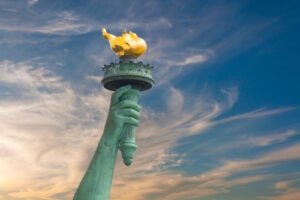
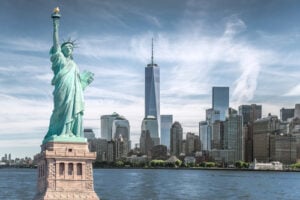
On July 4, 1976, this country celebrated one of the largest naturalization ceremonies ever held in the United States. If there ever was a country that welcomed immigrants and thrived because of immigrants, it’s the United States of America. Fifty years ago, we celebrated that fact dearly. A lot has changed over the past fifty years. As a New Yorker, born and raised, I live in a city where Lady Liberty still stands at our door, welcoming people seeking a new life, a chance at a better one. At the base of that statue still stand the words of Emma Lazarus: “Give me your tired, your poor, your huddled masses yearning to breathe free.”
I don’t think I would get much argument from others if I said that New York is the city at the center of the world, standing with its arms wide open and celebrating people of all cultures. It truly is one of the most diverse places on Earth. If you were born here, like I was at Manhattan General, you were made a New Yorker for the rest of your life. Even if you move away, you’re still a New Yorker. I have spoken with many people who immigrated here from other countries and learned to love this city, doing everything they could to attain legal status so they could continue living here and contributing. Because, in the end, what this country represents is freedom of religion, freedom of speech, and the chance for people to raise families in peace with the hope of prosperity. It doesn’t work out for everyone, for many reasons, but it does offer that chance, for the most part.
This weekend, on July 4, 2026, we celebrate the 250th anniversary of the founding of the United States of America. We are now a nation that is supposedly divided. Yet I do not think we are as divided as some people would have us believe. No matter what your politics, your religion, or your personal beliefs may be, we all share one common thread: the desire to live free.
I am 64 now. In 1976, I was 15. There are millions of Americans like me. The question is not so much what is different in 2026 compared to 1976. The question is how we, as individuals, are different. How do we look at life in our sixties as opposed to our teenage years? When I was in high school, I had many dreams. Everything was ahead of me. Where would I live? What type of career would I choose? Who would I marry? How many children would I have? How successful would I be? Would I be healthy? Of course there were plenty of questions, but those questions were also filled with possibilities. There was so much hope and so much excitement. Life doesn’t always work out the way you hope it will. People struggle. Tragedy strikes. But so does love and joy. Most of life’s achievements and failures are influenced by the choices we make, although some things remain beyond our control. What matters is how we stand back up. It’s how we move forward after life hits us hard.
I’m not trying to be poetic here. I’m simply trying to put into perspective the difference between being young, with everything in front of us, and being in our sixties and seventies, with so much behind us. We may not have as much time left, but we still have enough. Enough to make a difference. Enough to become role models. Enough to use our experiences to help others. Some adults understand that responsibility; some never do. It’s sad when people with large voices and the power to make changes fail to appreciate how much good they could do for others because they remain focused only on themselves. Everyone grows up at a different pace. But when you reach the point where you realize your purpose is to help others, to be there for other people, that’s when you’ve truly become the grown-up.
As a nation that is still very young, we are at a crossroads. What better time to step back and reflect on who we are and where we’ve been than during the celebration of 250 years of freedom? This is a prosperous nation, filled with love, yet hate still lingers. There is racism. There is greed. There is ignorance. But surrounding all of that is the beating of a good heart. I believe there are more people in this wonderful nation who are kind-hearted, caring, loving, and eager to contribute not only to this country but to the rest of the world. As a nation that celebrates democracy, and as a country known for opening its arms to the world, we need to be the adults. We need to be the grown-ups. We need to be the caretakers. There is greed, and then there is love, the kind of love that shines from a banner held by hand at the top of the Empire State Building by two people risking their own lives to send a simple message of love.
I believe New York City is this nation’s shining light. Not because it’s more important or better than any other great American city, but because it’s more visible. I believe it represents what this country can truly be, and I believe there is no better time to remind ourselves of that than on the 250th anniversary of the day, long ago, when we stood up to a king and put forth the goals of Life, Liberty, and the Pursuit of Happiness. When, a little over a hundred years after that, we were given a gift from a nation that our Revolution inspired to its own revolution thirteen years later, in 1789. A gift that still stands in New York Harbor shouting the words…”I lift my lamp beside the golden door!”
Works Cited
The lines “Give me your tired, your poor, your huddled masses yearning to breathe free” and “I lift my lamp beside the golden door” are from “The New Colossus,” the 1883 sonnet by Emma Lazarus, which has been mounted on a plaque inside the pedestal of the Statue of Liberty since 1903.