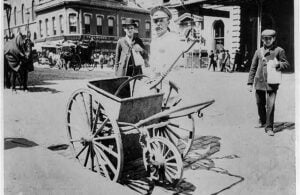
Feature Photo: Alice Austen, New York City street sweeper with handcart, circa 1896. Library of Congress Prints and Photographs Division. No known restrictions on publication.
In the late nineteenth century, New York City had a street-cleaning problem so severe that reformers described entire thoroughfares as coated with mud, ashes, garbage, paper, manure, and decomposing organic matter. The city already had a Department of Street Cleaning, but political patronage, weak supervision, and poor waste-disposal practices left the agency unable to keep pace with a rapidly growing metropolis.
That changed in 1895, when reform Mayor William L. Strong appointed Colonel George E. Waring Jr. as Commissioner of Street Cleaning. Waring reorganized the department, broke with the patronage system, imposed strict accountability, separated household waste into different streams, and put street sweepers into the white uniforms that gave them their famous nickname: the White Wings.
Waring did not invent sanitation, and he did not create New York’s Department of Street Cleaning, which had existed since 1881. What he did was transform a struggling municipal service into a disciplined public operation and establish practices that became part of the foundation of modern New York City sanitation.
Who Were the White Wings?
The White Wings were New York City street cleaners who worked under Commissioner George E. Waring Jr. during the reform administration of Mayor William L. Strong from 1895 through 1897.
Their name came from the white uniforms Waring required them to wear. The clothing gave the street cleaners a distinctive public identity and symbolized the cleanliness and professionalism Waring wanted the department to represent.
The White Wings swept streets, collected street refuse, helped remove snow, and became the most visible part of Waring’s campaign to prove that New York’s streets did not have to remain permanently filthy.
New York City Was Filthy Long Before Waring Arrived
New York’s sanitation crisis did not begin in 1895. The city had struggled with street waste for generations. By the end of the nineteenth century, however, population growth, dense tenement districts, horse-drawn transportation, commercial activity, household coal use, and weak municipal administration had made the problem overwhelming.
Before Waring’s reforms, garbage, ashes, paper, street sweepings, manure, and other refuse routinely accumulated along curbs and in gutters. In wet weather, the mixture became mud and slime. During dry weather, it was pulverized into dust that blew through streets, shops, and homes.
Waring later wrote that before 1895 rubbish, garbage, and ashes were commonly left in the streets and that summer heat intensified the odor of decomposing organic matter. Sewer inlets became clogged, paper litter blew through neighborhoods, and dirt could become so thick that the pavement itself was difficult to see.
The Horse Manure Problem Was Enormous
One of the greatest sanitation challenges came from the animals that powered the city’s transportation system. Horses pulled streetcars, delivery wagons, private carriages, freight carts, and countless other vehicles.
Historical estimates vary depending on the year and what was being counted, but the scale was staggering. The American Society of Civil Engineers cites an estimate of approximately 2.5 million pounds of horse manure and 60,000 gallons of urine deposited on New York streets each day when Waring arrived.
Dead horses created another problem. Carcasses could remain in streets until removal could be arranged, adding to the odors, insects, and health concerns surrounding an already overwhelmed waste system.
The horse problem is one reason the city streets of the 1890s should not be imagined as simply dirtier versions of modern avenues. They functioned inside an entirely different transportation economy, one in which animal waste was generated continuously in the same public space used by pedestrians, residents, merchants, and children.
The Department of Street Cleaning Existed Before the White Wings
It is important to separate Waring’s reforms from the creation of the agency itself. New York City established the Department of Street Cleaning in 1881, fourteen years before Waring took office.
The problem was not the absence of a department. The problem was how the department had been managed.
Waring described an agency deeply affected by political patronage. Jobs could depend on political influence rather than performance, employees were assessed for political funds, and workers had little confidence that good service would protect their positions.
That system gave Waring one of his most difficult challenges. Cleaning the streets meant reorganizing the workforce responsible for cleaning them.
Who Was George E. Waring Jr.?
George E. Waring Jr. was born in Pound Ridge, New York, on July 4, 1833. His career crossed agriculture, engineering, the military, drainage, sewer design, and municipal reform long before he arrived at New York City Hall.
In 1857, Waring was appointed agricultural and drainage engineer during the construction of Central Park. He designed and supervised major drainage work at a time when large portions of the future park remained wet and poorly drained.
Waring left the Central Park project during the Civil War. He served in the Union Army, eventually receiving a colonel’s commission and commanding cavalry forces.
After the war, he returned to agriculture and engineering. By the late 1870s, sanitary engineering had become one of the central subjects of his career.
The Memphis Sewer System Made Waring Famous
Memphis, Tennessee, suffered devastating cholera and yellow fever epidemics during the nineteenth century. After the catastrophic yellow fever epidemic of 1878, sanitation and drainage became urgent concerns.
In 1880, Waring designed an innovative sewer system for Memphis that separated household sewage from stormwater. Because the pipes did not have to carry both sewage and enormous volumes of rainwater, the system could use smaller pipes and could be constructed more economically than a conventional combined system.
The project helped improve Memphis sanitation and became nationally associated with Waring’s name.
There is an important scientific correction to the way this story has sometimes been told. Waring and many reformers of his era believed that poor sanitation was directly responsible for yellow fever. Yellow fever is actually transmitted by Aedes aegypti mosquitoes. Improved drainage and sewerage could reduce unhealthy standing water and improve urban conditions, but Waring’s sewer system did not discover or directly eliminate the biological cause of yellow fever.
Mayor William L. Strong Brings Waring to New York
The municipal election of 1894 brought reform Mayor William L. Strong to City Hall after years in which Tammany Hall and political patronage had dominated much of city government.
Waring began work as Commissioner of Street Cleaning on January 15, 1895.
He later wrote that he accepted the position only after receiving Strong’s assurance that the mayor would not interfere with appointments and dismissals. Waring wanted to run the department according to performance rather than political recommendations.
That condition became the foundation of his reorganization.
Waring Attacks the Patronage System
Waring did not simply fire everyone and replace the entire department with political allies of the new administration. Instead, he began by evaluating supervisors and senior officials.
Those he considered capable could remain. Those he considered ineffective were removed. For important positions, he sought men with military or technical backgrounds who were willing to separate themselves from partisan political influence.
Rank-and-file workers were then told that their positions depended on their conduct and performance. Waring promised that a worker who did the job faithfully, stayed sober, treated the public properly, and followed department rules would not be dismissed merely because a politician wanted the job for someone else.
The other side of that bargain was strict. Workers who repeatedly failed to perform could no longer count on political protection.
Why Did the White Wings Wear White?
Waring’s white uniforms were one of his most memorable innovations. Street sweepers appeared in white clothing, often with white helmets, creating a dramatic contrast with the dirty streets they were expected to clean.
The uniforms initially attracted ridicule, but that reaction changed as the streets improved. The clothing gave sweepers a recognizable identity and reinforced Waring’s effort to turn a mocked occupation into a professional public service.
Waring later wrote that the white uniforms helped the men and that public recognition did even more to improve their pride in the department.
The nickname White Wings became inseparable from New York street cleaning.
Every Sweeper Had a Defined Area
Waring’s reforms depended on accountability. Street sweepers were assigned specific areas rather than being treated as an anonymous workforce scattered across the city.
That made supervision much easier. A dirty section of street could be traced to the people responsible for cleaning that section.
Foremen were also watched closely. Waring equipped supervisors with bicycles so they could move rapidly through their districts. They were required to file written reports identifying where they had been at half-hour intervals, and false reports could lead to dismissal.
This combination of clearly assigned work, mobile supervision, written records, and performance consequences represented a fundamental change from the loosely managed patronage system Waring inherited.
The White Wings Were More Than Men With Brooms
Street sweeping was their most visible work, but Waring’s department handled far more than loose dirt and manure.
The force removed snow, collected different forms of household refuse, maintained carts and horses, worked at dumping facilities, and helped manage the movement of waste after it left neighborhood streets.
By 1897, Waring described his department as a force approximately 3,000 strong. His military language was deliberate. He saw the workers as a disciplined organization performing an essential public-health function.
Waring Gave Workers a Formal Grievance System
The military structure did not mean workers had no voice. Waring created a formal internal process for grievances and suggestions.
Workers elected a Committee of Forty-one made up entirely of sweepers and drivers. Complaints and appeals could be brought before that committee first.
Cases that could not be resolved there went to a Board of Conference composed of five worker representatives and five department officers. Waring wrote that laborers and officers participated in that body on equal footing, and its permanent chairman was a sweeper or driver.
Only unresolved cases reached the commissioner himself.
This was not the “Board of Arbitration” described in the original draft. The Committee of Forty-one and Board of Conference were the names Waring used for the system.
Waring Introduces Source Separation
Waring’s most forward-looking reform involved what happened before garbage ever reached a dump.
Householders were required to separate refuse into major categories rather than throwing everything together. Garbage, ashes, and dry rubbish followed different routes because each material could be handled differently.
Food garbage went to the Sanitary Utilization Company’s works at Barren Island, where it was steam-cooked and pressed. Grease could be sold for industrial uses, while processed solids and liquids could be turned into fertilizer.
Ashes and street sweepings were handled separately. Paper, rags, bottles, metals, rubber, and other recoverable rubbish went to picking yards where materials with resale value could be separated and marketed.
That makes Waring’s system one of the important early chapters in New York City’s recycling history.
Did Waring End Ocean Dumping?
The answer requires some nuance.
Ocean dumping was still part of New York’s waste system when Waring took office. Refuse was loaded onto scows and carried beyond Sandy Hook for dumping at sea, a practice that polluted beaches in New York and New Jersey when floating material returned with winds and tides.
Waring was actively replacing that system with other disposal methods. His 1897 description of the department laid out a system in which food garbage went to Barren Island, recoverable rubbish went to picking yards, and ashes and street sweepings were transported to Rikers Island for use as fill.
So it is fair to credit Waring with a decisive move away from indiscriminate ocean dumping and toward separation, recovery, and controlled disposal. It would be too simple, however, to say that every form of ocean disposal vanished the moment he entered office.
The 1896 White Wings Parade
Nothing demonstrated the change in the workers’ public standing more dramatically than the White Wings parade of 1896.
On May 26, 1896, the Department of Street Cleaning staged a major parade along Fifth Avenue. Contemporary photographs show reviewing stands and the uniformed sanitation force on display.
Approximately 1,400 White Wings marched in formation in the 1896 procession, accompanied by department equipment and bands. Thousands of New Yorkers came out to watch.
The spectacle would have been almost unimaginable a year earlier. Street cleaners who had been mocked and treated as symbols of municipal failure were now being presented as representatives of civic reform.
Waring later wrote that the parade marked an era in the workers’ history because the public could see that the men were proud of their positions and that their families were proud of them.
Did Waring’s Reforms Improve Public Health?
New York’s death rate declined during Waring’s tenure, and Waring argued that cleaner streets contributed to that improvement.
His own 1897 account, however, included an important qualification that is often lost in later retellings. Waring explicitly acknowledged that the reduction in deaths could not be attributed to street cleaning alone. Improvements by the Board of Health and the demolition of dangerous rear tenements also contributed.
That is the historically responsible way to understand his public-health legacy. Waring did not single-handedly cure New York’s infectious diseases. He dramatically improved one of the environmental conditions that reformers and health officials recognized as part of a healthier city.
Waring Leaves City Government in 1897
Waring’s transformation of the department lasted only three years under Mayor Strong.
When the Strong administration ended and Tammany Hall returned to City Hall, Waring left the commissionership at the end of 1897.
His departure demonstrated how closely municipal reform remained tied to politics. Later administrations could alter the systems he introduced, but the larger idea that street cleaning required professional management had already been established.
Waring’s Final Mission to Cuba
In 1898, after the Spanish-American War, President William McKinley asked Waring to study sanitary conditions in Cuba.
Waring traveled there because of his national reputation as a sanitary engineer. During the mission, he contracted yellow fever.
He returned to New York and died on October 29, 1898, at the age of 65.
There is a tragic irony in his death. Waring had spent decades working on drainage, sewerage, refuse, and public sanitation in cities repeatedly threatened by infectious disease. He died from yellow fever before scientists had fully established and acted upon the mosquito transmission that would transform prevention of the disease.
From the White Wings to the Department of Sanitation
The Department of Street Cleaning continued after Waring’s death. In 1929, the city renamed the agency the Department of Sanitation.
Today’s New York City Department of Sanitation handles refuse collection, recycling, composting, street cleaning, snow removal, illegal-dumping enforcement, and other responsibilities on a scale Waring could never have imagined.
DSNY still publicly refers to its sanitation workforce as New York’s Strongest. The uniforms, vehicles, technology, and waste systems have changed completely, but the connection to the White Wings remains visible in the idea that sanitation workers are a uniformed municipal force responsible for public health, safety, and the daily functioning of the city.
What George Waring Actually Changed
George Waring’s importance comes not from one invention but from the way he combined management, engineering, labor organization, waste separation, and civic pride.
He proved that New York’s dirty streets were not an unavoidable fact of urban life. He challenged a patronage system that treated public jobs as political property. He made individual workers and supervisors accountable for defined areas. He created a worker grievance structure. He separated waste before collection and recovery. He helped shift refuse away from indiscriminate ocean dumping. And he turned the people holding the brooms into some of the most recognizable municipal workers in the city.
That is why the White Wings still matter. They represent the moment when New York began treating street cleanliness not as an occasional cleanup job, but as a permanent public responsibility.
More New York City Reform and Infrastructure History
Waring’s story connects directly to our History of New York’s Central Park, where he worked as an agricultural and drainage engineer before the Civil War. Readers interested in another major era of municipal reform can also continue with our Fiorello La Guardia, History of New York City Mayors.
Sources
American Society of Civil Engineers, George Edwin Waring Jr.
The New York Public Library, Milestones in NYC’s Trash Revolution
Library of Congress, New York City at the Turn of the Century
New York City Department of Records, Department of Sanitation History
Weill Cornell Medicine, A Brief History of New York City Recycling
Museum of the City of New York, White Wings Parade, May 26, 1896
Library of Congress, White Wings on Review
George Waring’s Sanitation Reforms at a Glance
| Problem | Waring’s Reform | Why It Mattered |
|---|---|---|
| Political patronage | Appointments and dismissals based more heavily on performance and discipline | Reduced the power of political influence over day-to-day street cleaning |
| Anonymous street-cleaning assignments | Workers assigned defined areas with close supervision | Made responsibility for dirty streets easier to identify |
| Low public status of sweepers | Distinctive white uniforms and organized public presentation | Created the White Wings identity and increased civic recognition |
| Mixed household refuse | Separation of garbage, ashes, and dry rubbish | Allowed different materials to be processed, recovered, or disposed of differently |
| Recoverable materials lost in mixed waste | Picking yards for paper, rags, bottles, metals, and other materials | Became an important early municipal recycling system |
| Food waste | Processing at Barren Island for grease and fertilizer | Recovered useful products instead of treating all refuse as worthless |
| Worker grievances | Committee of Forty-one and Board of Conference | Created a formal internal process for employee complaints and appeals |
| Weak supervision | Foremen on bicycles with written location reports | Improved monitoring and accountability across street-cleaning districts |
George Waring and the White Wings Timeline
| Year | Milestone |
|---|---|
| 1833 | George E. Waring Jr. is born in Pound Ridge, New York. |
| 1857 | Waring becomes an agricultural and drainage engineer during the construction of Central Park. |
| 1861 | Waring leaves the Central Park project for military service during the Civil War. |
| 1880 | Waring designs the separate sewer system that becomes associated with sanitary reform in Memphis, Tennessee. |
| 1881 | New York City establishes the Department of Street Cleaning. |
| January 15, 1895 | Waring begins work as Commissioner of Street Cleaning under Mayor William L. Strong. |
| 1895 | Waring reorganizes the department, expands accountability, introduces white uniforms, and advances separated waste collection. |
| May 26, 1896 | The White Wings parade along Fifth Avenue, dramatically improving the public image of the street-cleaning force. |
| 1897 | Waring publishes a detailed account of the department’s reforms and leaves office at the end of the Strong administration. |
| October 29, 1898 | Waring dies in New York after contracting yellow fever during a sanitation mission to Cuba. |
| 1929 | The Department of Street Cleaning is renamed the New York City Department of Sanitation. |
Published August 16, 2026.
The White Wings: How Colonel George Waring Transformed New York City Sanitation article published on ClassicNewYorkHistory.com © 2026