 Photo by Tyler A. McNeil, via Wikimedia Commons, licensed under CC BY-SA 4.0.
There was a time when a home improvement project in Upstate New York began with a trip to a familiar hardware store, lumberyard, or neighborhood home center. Maybe it was a leaky pipe in a Rochester two-family house, a porch that needed new boards in the Southern Tier, or another winter spent trying to keep the snowblower working in Western New York. Before the largest warehouse chains dominated so many commercial strips, local owners, family businesses, cooperatives, and regional chains supplied the parts and advice that kept homes running.
Some of the businesses on this list are gone. Chase-Pitkin, once so closely identified with Wegmans and the Rochester area, disappeared in 2006. Others changed owners or names. Still others, including Curtis Lumber, Weiders Hardware, and White’s Lumber, have survived by doing what neighborhood stores have always done well: serving communities they know. This is not a list of 25 defunct chains. It is a look at 25 real businesses that form part of the history of home improvement in Upstate New York.
The difference matters. An old-fashioned lumberyard was not necessarily a discount warehouse, and a farm-supply cooperative was not exactly the same thing as a neighborhood hardware shop. Yet all of them belonged to the everyday life of Upstate communities. They sold lumber, paint, tools, screen-door parts, animal feed, and the innumerable things homeowners discover they need halfway through a repair. They also provided something harder to reproduce in a giant aisle: a clerk who might know exactly what went wrong and how to fix it.
For this article, Upstate includes Western and Central New York, the Finger Lakes, the Southern Tier, the North Country, the Capital Region, and the Hudson Valley north of the New York City suburbs. These 25 names are not ranked by size or importance. Each has a documented New York connection, although some began outside the state. The list also distinguishes businesses that closed from those still operating, because surviving local institutions deserve just as much recognition as the chains we remember.
Regional Chains and Home Centers
1. Chase-Pitkin Home & Garden Centers — Rochester and Central New York
For shoppers around Rochester, Chase-Pitkin was once one of the most recognizable places to buy garden supplies, hardware, paint, tools, and materials for remodeling. Its history began long before Wegmans became involved: the Chase family nursery business dated to the nineteenth century, and the Bilt-Rite Chase-Pitkin business had developed into a home improvement retailer by the middle of the twentieth century. Wegmans opened its own home centers in 1973 and bought Bilt-Rite Chase-Pitkin in 1974, bringing the businesses together under the Chase-Pitkin name.
The company expanded throughout the Rochester area and into Central New York, operating stores large enough for substantial lumber, garden, and kitchen-and-bath departments. Wegmans announced in October 2005 that it would close all 14 remaining stores, with closings beginning in 2006. Company officials said competing with national chains such as Home Depot and Lowe’s had become too difficult. For longtime customers, the decision meant losing a homegrown retail name with unusually deep Rochester roots.
2. Grossman’s Lumber and Grossman’s Bargain Outlet — Across Upstate New York
Grossman’s was a familiar building-materials name in New York well beyond the metropolitan area. Earlier Grossman’s lumber and home improvement outlets competed for contractors and do-it-yourself customers, and later Grossman’s Bargain Outlet stores sold discounted remodeling merchandise, cabinetry, windows, and building supplies. Historical listings document bargain outlets in places including the Capital Region, Rochester area, Cortland, Utica, and Western New York. The business appeared in several forms over time, so it would be misleading to treat every Grossman’s-branded location as one unchanged chain.
Grossman’s original home-center business lost ground amid the intense competition of the late twentieth century, while the bargain-outlet format developed a separate life. The latter stores eventually came to be known as Home Outlet. That distinction explains why some New Yorkers remember large lumber-oriented Grossman’s stores and others remember shopping a smaller discount building-supply outlet. Both memories belong to the complicated evolution of retail hardware and home improvement.
3. Hechinger Home Improvement Stores — Rochester Area
Hechinger was founded in the Washington, D.C., area rather than Upstate New York, but its expansion brought the name into Rochester’s competitive home improvement market. By the 1990s, Hechinger had joined Chase-Pitkin, Grossman’s, and newer big-box operators in the contest for regional customers. Rochester business reporting identified former Hechinger properties in Henrietta and Irondequoit, including locations that remained difficult to redevelop after the stores closed.
The company struggled nationally against larger competitors and announced in September 1999 that it would liquidate its remaining stores after failing to reorganize in bankruptcy. Its Upstate locations are worth including because they reveal how crowded the field had become even before Home Depot and Lowe’s established their eventual dominance. Not every familiar hardware chain began locally, but many left a visible mark on Upstate shopping centers.
4. Builders Square — Rochester’s Suburban Home Improvement Boom
Builders Square offered another version of the big-store approach that arrived in the Rochester region during the late twentieth century. The chain operated a substantial location in Henrietta, where shoppers could browse building materials and home improvement departments in a suburban retail setting. Contemporary Rochester Business Journal reporting described the former Builders Square store as one of several large vacant retail sites left behind when home improvement competition intensified.
Builders Square’s national fortunes became intertwined with Hechinger in the late 1990s, and the combined business ultimately failed. The former Henrietta site became a local example of the problems big-box vacancies could create. When a large store closed, another retailer could not always reuse the same building easily. That makes Builders Square part of the story of both Upstate shopping habits and the changing physical landscape of suburban retail.
5. Valu Home Centers — Buffalo and Western New York
Unlike many chains from the same era, Valu Home Centers survived and remained family-owned. The company traces its beginnings to Buffalo in 1968, when the business grew from a paint-selling operation into a regional home improvement retailer. Its medium-sized stores offered hardware, paint, tools, seasonal products, and other supplies to customers who preferred a neighborhood-scale alternative to a warehouse. Valu became especially familiar in Western New York, later extending into Central New York and northwestern Pennsylvania.
Survival has not meant that every location stayed open. In 2025 Valu announced the closure of stores in North Buffalo, Lockport, and Orchard Park, followed by closures in Cortland and Owego. The company said higher costs and competitive pressures were forcing it to concentrate on stronger locations, while emphasizing that the wider business would continue. Valu’s story is therefore not one of complete disappearance, but of a longstanding Buffalo-based chain adjusting to a very different retail market.
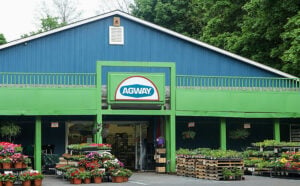
6. Agway Farm and Home Supply Stores — Communities Throughout Upstate
For many rural New Yorkers, the nearest place for garden seed, fencing, feed, work clothing, and seasonal supplies was an Agway store. Agway was formed in 1964 through the merger of major agricultural cooperatives, with Syracuse becoming its headquarters. Its roots in earlier cooperative movements reached back decades further. Although known especially for farming supplies, Agway also sold products used for ordinary home maintenance and construction, making it an important part of the region’s hardware and DIY history.
The original Agway cooperative filed for Chapter 11 bankruptcy protection in October 2002 and later sold major operations. That did not mean every store bearing the Agway name vanished. Independently owned dealers were legally separate from the bankrupt corporation, and many continued trading. This is one of the clearest examples of why a retail name can survive after the larger company behind it has disappeared. Agway’s history belongs to both the cooperative movement and everyday Upstate shopping.
Family Lumberyards and Building-Supply Institutions
7. Curtis Lumber — Ballston Spa and Beyond
Curtis Lumber is one of the most deeply rooted family businesses in Upstate New York. A sawmill operated on Charlton Road in the nineteenth century, and Elmer A. Curtis acquired the business in 1890. Over successive generations it grew from a local lumber operation into a regional supplier with hardware, building materials, windows, doors, decking, tools, and design services. The flagship moved to Route 67 in Ballston Spa in 1976, and the company later expanded across the Capital Region, North Country, and Central New York.
One remarkable part of the Curtis story is its acquisition of other historic local businesses, including Webb & Sons stores, Gregory Supply locations, Wiley Brothers, and JAY-K Lumber. Rather than replacing every local name with a completely unrelated national chain, those deals joined regional family businesses under a larger Upstate company. Curtis remained in operation into 2026, making it one of the clearest examples of a locally rooted supplier that successfully grew during the big-box era.
8. Wm. B. Morse Lumber Company — Rochester
William B. Morse entered Rochester’s lumber trade in the 1840s and established his own yard in 1853. The business developed in a city transformed by canal commerce, manufacturing, and residential growth. Over time, the company expanded into sash, doors, and millwork, supplying builders with more than raw framing lumber. Its present lumber operation is associated with 340 West Main Street, not the East Main Street address sometimes repeated in unreliable business lists.
Morse remained a major independent presence in Rochester and in 2016 announced plans to acquire the similarly historic Rochester Lumber Company. That acquisition joined two businesses with roots extending far back in the city’s building industry. Customers looking for windows, trim, doors, and framing supplies could still turn to a name that predates the Civil War. It is hard to find a stronger example of retail continuity in Rochester’s home-improvement history.
9. Matthews & Fields Lumber — Rochester, Greece, and Henrietta
Matthews & Fields dates its history to 1896, when the Matthews family established a lumber business connected to Rochester’s Charlotte waterfront. Later family generations continued the operation, and Leslie Fields became part of the business after marrying into the family. As the Rochester area expanded into the suburbs, the company grew beyond its original waterfront roots and opened a Henrietta operation with a truss plant to serve new construction.
The business has remained family-owned and offers the kinds of materials contractors need for serious projects: lumber, engineered wood, trusses, doors, windows, and related building supplies. Its present locations include Stonewood Avenue in Greece and Lehigh Station Road in Henrietta. Matthews & Fields illustrates a different retail model from the casual neighborhood hardware shop. It is a specialist building supplier that helped serve Rochester’s expanding housing market over several generations.
10. Belknap Building Center — Binghamton
Belknap Lumber is not a lost Binghamton business. Its own history places the start of the family company in 1956, and the business continues operating as Belknap Building Center at 7 Belknap Avenue. It supplies lumber and other materials for construction and remodeling in the Southern Tier. Alongside framing materials and decking, Belknap has offered millwork and kitchen-design services, allowing it to serve both contractors and homeowners planning major projects.
That continuity matters in a region where old industrial employers, shopping districts, and retail businesses have changed dramatically. Belknap’s role is not based on a supposed downtown Wall Street location or a closure in the 1990s; those details in the original draft were incorrect. Its real history is more valuable: a Binghamton-area lumber business still providing the practical services that helped it develop a loyal regional customer base.
11. J.E. Sawyer & Company — Glens Falls
Joseph Edward Sawyer founded his Glens Falls business in 1883 when he bought the company where he had worked as a bookkeeper and salesman. It began with the equipment and supplies needed by an economy of horses, wagons, and industry. As Glens Falls changed, the company moved into hardware, plumbing, heating, steel, and other industrial materials. Its imposing building at 64 Glen Street became a familiar part of downtown and reflected the size of the business it housed.
J.E. Sawyer’s history is preserved in the Sawyer Family Collection at Crandall Public Library. After more than a century of local ownership, the company was sold to Rochester-based VP Supply in 2015. The sale marked a change in ownership, not the disappearance of its long history. This store belongs on the list as an example of an industrial supplier that adapted repeatedly as the region moved from horse-drawn transport to modern building and mechanical systems.
12. White’s Lumber — Watertown and the North Country
The business that became White’s Lumber began in Watertown in 1892, when George W. White entered a partnership involved in lumber and related products. It developed into G.W. White & Son, later expanding with locations serving other North Country communities. The company’s own history records branches in Gouverneur, Pulaski, and Clayton, along with longstanding operations around North Rutland Street in Watertown. It has supplied materials to generations of builders dealing with the region’s long winters and demanding construction needs.
White’s experienced major challenges, including destructive fires, but continued operating and growing. Its history demonstrates how a regional lumber supplier could remain relevant by combining traditional products with modern building and home center services. For customers who wanted more specialized assistance than a general discount store could provide, an established local lumber company served a different and enduring purpose.
13. H.G. Page & Sons — Poughkeepsie and the Hudson Valley
H.G. Page & Sons began in Poughkeepsie in 1924, when Henry G. Page Sr. started a business connected to concrete-block production. Over the decades the company developed into a building-supply operation known for lumber, millwork, and materials used in home construction and renovation. Its growth followed the transformation of the Mid-Hudson Valley, where new houses and commercial buildings brought steady demand for dependable local suppliers.
The business marked its centennial in 2024 as Page Lumber, Millwork & Building Supplies. Its long life reminds us that Upstate home improvement history is not limited to stores that closed. In some communities, a regional supplier survived precisely because it kept evolving: from one building product to a broader range of materials, services, and customer needs.
Neighborhood Hardware Stores and Specialty Suppliers
14. A. Phillips Hardware — Albany and the Capital Region
The Phillips family arrived in Albany in 1886 and developed a business in steamfitting and locksmithing. Later generations expanded into hardware retailing, building a name that became familiar throughout the Capital Region. Family histories describe how the company weathered the Great Depression, wartime changes, and the growing competition from chains. Its stores became places where customers could seek advice as well as purchase household hardware, paint, tools, and repair supplies.
A. Phillips Hardware later operated stores in communities including Delmar, Altamont, and Voorheesville. The name represents the continuity of a family-owned regional business rather than a defunct department-store chain. Its roots in locksmithing also show how many classic hardware stores evolved: a specialized trade first, followed by a larger assortment as customers began asking for additional products.
15. Hector’s Hardware — Buffalo and Western New York
Hector’s Hardware became a neighborhood institution in the Buffalo area, with stores including the Kaisertown location on Clinton Street. A 2009 account in the Am-Pol Eagle described an employee who began working at that location as a young teenager and eventually managed it after decades of service. The business sold ordinary hardware and plumbing supplies while also repairing windows, screens, lawnmowers, and snowblowers.
Those repair services are a good reminder of what distinguished traditional neighborhood hardware stores from simple retail shelves. A customer could bring in a broken part, explain a problem, and sometimes leave with a workable repair instead of replacing an entire appliance or fixture. The daily relationships between staff and returning customers were central to Hector’s identity in Western New York.
16. Mayer Paint & Hardware — Rochester
Mayer Paint & Hardware opened in Rochester in the mid-1970s under Tom and Barb Green. The store is located at 226 North Winton Road, an important correction to the original draft, which placed it on St. Paul Street. The business became a neighborhood destination for paint, hardware, tools, household supplies, and advice. Its smaller scale meant shoppers could find help with everyday repairs without visiting a large building-materials warehouse.
Mayer’s own description emphasizes services such as key cutting, glass cutting, window and screen repair, and blade sharpening. Those are exactly the tasks that keep a neighborhood hardware store relevant even as large chains compete on price and inventory. Mayer is a reminder that an independent store does not need nineteenth-century origins to be a genuine classic. Half a century serving one neighborhood is a substantial history of its own.
17. Weiders Hardware — Greater Rochester
John A. Weider opened a horse-and-harness supply business in downtown Rochester in 1879. As transportation and household needs changed, the family expanded into hardware, adapting a nineteenth-century specialty operation to the modern retail world. The company’s own timeline records suburban expansion beginning in Henrietta in 1961, followed by later locations in communities such as Honeoye Falls, Brighton, and Fairport.
Weiders continues operating today, with services including key cutting, glass repair, paint matching, and outdoor equipment assistance. Few businesses provide a clearer example of adaptation: a store that began by selling goods for horses now serves homeowners working with modern lawn equipment and household repairs. Its survival across multiple generations also makes it one of the most historically distinctive names on the list.
18. Country True Value Hardware & Rental — Troy and East Greenbush
Three brothers from North Greenbush established Country True Value in 1978. The family later opened an East Greenbush store in 1989, developing the business into a familiar Capital Region source for everyday hardware. Customers came for paint, fasteners, plumbing parts, lawn equipment, and other supplies. In a period when independent stores faced mounting pressure from large retailers, the family looked for ways to serve customers whose projects went beyond a shopping bag of small parts.
Equipment rental became a major part of that strategy in the 2000s. The business added services for customers needing larger tools and machines without buying equipment for a one-time job. Country True Value remains a useful example of a hardware retailer evolving into both a store and a rental operation, while retaining its family ownership and local identity.
19. Hadlock’s House of Paint — Rochester Area
Hadlock Paint has been part of Rochester-area decorating and maintenance for more than a century. A 1940 Rochester city directory advertised Hadlock Paint Company at 466–470 Central Avenue, listing paints, finishes, glass, and roofing coatings among its products. The company identifies 1921 as an important date in its history. Its early customers were buying the materials needed to maintain houses and commercial buildings long before modern home centers offered enormous paint departments.
Hadlock continued as a specialty paint business, with later locations in the Rochester suburbs, including Victor, Webster, and Pittsford. Its emphasis on coatings and color assistance makes it different from the full-line lumberyards in this article, but no less central to the history of home improvement. Homeowners facing a difficult paint choice often valued specialist knowledge more than the size of the building.
20. Liverpool Lumber Company — Liverpool and Greater Syracuse
Liverpool Lumber Company began in 1948 when Harry Ehle and Francis Fuller established a lumber business in the village of Liverpool. It incorporated in 1952 and continued through generations of the Ehle family. Rather than functioning as a huge general merchandise chain, the business focused on supplying lumber, doors, windows, and related building materials to homeowners and professional builders around Greater Syracuse.
The company remained a recognizable local supplier as the surrounding area changed from a village-and-rural setting into a more densely developed suburban region. Its multigenerational story helps explain the value of a specialized building-materials business: contractors returned for products they knew, while homeowners could find advice and materials for projects that required more than a handful of screws.
Other Longtime Upstate Stores and Lumberyards
21. JAY-K Independent Lumber — New Hartford
JAY-K Lumber served the Mohawk Valley from 1937, operating a major building-supply location on Seneca Turnpike in New Hartford. Generations of the Kelly family developed a business that combined lumber sales with tools, home-improvement materials, and specialist assistance. Its drive-through lumberyard gave customers a practical way to load boards and construction materials directly into their vehicles, a convenience valued by both homeowners and contractors.
In 2025 Curtis Lumber acquired JAY-K, ending its separate family ownership but continuing the building-supply operation under another Upstate family business. The agreement also led Curtis to consolidate a nearby Waterville location. JAY-K is therefore neither a vanished chain nor an unchanged independent business. Its history illustrates how local home centers can continue serving their communities after a major change of ownership.
22. Burke’s Do it Best Home Centers — Oswego and Fulton
The business that became Burke’s Home Center began in 1926 when Timothy J. Burke acquired a sawmill operation in Oswego. Over time, family members expanded it into a lumber and home improvement supplier serving homeowners and contractors. By the late twentieth century, Burke’s had developed a fuller retail offering, adding showroom space and opening another location in Fulton. It became one of the recognizable independent building-supply names along the Lake Ontario corridor.
In 2023 the family sold the company to three longtime employees, giving it an unusual succession story. Rather than a national chain takeover or a liquidation, the change transferred ownership to people who already knew the business. Burke’s demonstrates that an independent home center can be part of a local economy for generations while adapting both its merchandise and its leadership.
23. Chittenango Lumber — Madison County
Chittenango Lumber dates its operations to 1952 and identifies itself as a family-owned building supplier serving Central New York. The company became known for helping customers choose materials for homebuilding and renovation, including windows, doors, and lumber. Its location in Madison County positioned it to serve homeowners and contractors who needed a local alternative to driving into larger Syracuse retail centers.
The business later developed specialized window and door displays, including a Marvin design gallery, reflecting the shift from a traditional lumberyard into a supplier of more complex building components. That kind of adaptation has helped many independent stores survive. Chittenango Lumber belongs on this list because its history is clearly documented and because its work reflects the continuing importance of local expertise in construction and remodeling.
24. Baker-Miller Lumber — Groton and the Finger Lakes
Baker-Miller Lumber has been a longstanding part of village life in Groton, north of Ithaca. The business operates at 102 West Cortland Street and supplies lumber, building materials, and hardware to customers across the Finger Lakes and Central New York. Its present company dates to 1968, although lumber and coal businesses occupied the same general commercial setting long before that. The village has identified Baker-Miller as an important downtown employer and supplier.
Recent public planning documents describe projects to expand its storage capacity and improve the loading area so that deliveries and customer pickups can be handled more safely. That is a particularly concrete example of how a traditional lumberyard remains relevant: it is not preserved merely as nostalgia, but continues investing in facilities used by people building and repairing homes today.
25. Blanding Hardware — Bridgeport and Oneida Lake
Blanding Hardware opened in Bridgeport in 1970 under William and Joan Blanding. Located near the Oneida Lake community, the store became a familiar source of hardware and building supplies for residents who needed practical products and local assistance. William Blanding continued to be closely associated with the business for decades. A later family obituary described his nearly lifelong enthusiasm for building, repairing, and working with tools.
The business stands for the smaller side of Upstate home improvement history. Not every important store operated dozens of branches or filled a warehouse the size of a supermarket. Some were independent neighborhood businesses that grew from a family’s skills and a community’s daily needs. Blanding Hardware represents the many local counters where people could ask a question, find a useful part, and get back to the job at hand.
What Happened to Upstate New York’s Old Home Improvement Stores?
There is no single answer. Chase-Pitkin, Hechinger, and Builders Square closed after the competitive economics of home improvement retail changed. Agway’s central cooperative failed, but independent dealers continued. Grossman’s passed through different business formats and names. JAY-K and J.E. Sawyer continued their histories after ownership changes. Other stores on this list, including Curtis Lumber, White’s Lumber, Weiders Hardware, Belknap Building Center, and many smaller regional businesses, continued serving customers.
Perhaps that is what makes these stores worth remembering. Upstate homeowners still need lumber, pipes, paint, and tools, even if the places selling them have changed. The best local stores have survived by knowing their communities, their products, and the particular problems of maintaining homes in New York’s varied climate. For a companion look at the history of hardware retailing farther downstate, read our 25 Classic Long Island Hardware & Home Improvement Stores.