Feature Photo: Ichabod at the English Wikipedia, CC BY-SA 3.0, via Wikimedia Commons
For a generation of Upstate New York shoppers, a trip to Hills Department Stores often began before anyone reached the clothing racks or toy aisles. Near the entrance, the smell of popcorn, soft pretzels, and hot dogs drifted from the snack bar. Children knew exactly where they wanted to go, and parents could pick up household necessities, school clothes, or a bargain without visiting several stores.
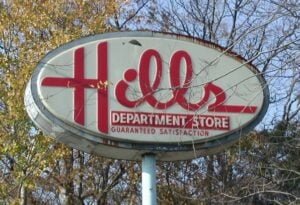
In Western and Central New York, Hills was a familiar name at suburban shopping plazas. For families who remember the chain, the bright red signs, inexpensive snacks, and television commercials promising that “Hills is where the toys are” have become part of the region’s shopping history. It wasn’t founded in Upstate New York, but it became a meaningful part of everyday life in communities from the Buffalo area to the Syracuse region and beyond.
So, what happened to Hills Department Stores? The immediate answer is that Ames Department Stores bought Hills in late 1998 and renamed most locations Ames in 1999. But that change followed a much longer story involving a heavily indebted buyout in 1985, an unsuccessful expansion, a bankruptcy filing in 1991, and a genuine corporate comeback before the final sale. Ames itself went bankrupt in 2001 and announced the liquidation of its remaining stores in 2002.
The history of Hills is therefore more complicated than the familiar claim that Walmart simply put every regional discount store out of business. Hills had a loyal audience and a merchandising strategy of its own. Financial decisions, the economics of expansion, and the growing power of national competitors all contributed to its disappearance. And for the customers who still remember a bag of warm popcorn on the way to the toy aisle, those financial explanations are only part of what was lost.
How Hills Department Stores Got Started
Hills began in Youngstown, Ohio, in 1957, when Herbert H. Goldberger opened the first store. Goldberger had previously worked in the hosiery business and saw an opportunity in the growing market for discount department stores. The idea was to sell everyday merchandise at prices that attracted families who wanted value without making a special trip to a traditional downtown department store.
The business expanded gradually in its early years. By 1964, Hills had seven stores, and Goldberger sold the chain to SCOA Industries, a company associated with the Shoe Corporation of America. He continued leading the Hills operation, which expanded through Ohio, Pennsylvania, West Virginia, and other markets. In 1981, his son Stephen A. Goldberger succeeded him as president.
Hills was part of the same postwar retail transformation that brought shopping centers and discount chains to the outskirts of American cities. Customers could drive to a plaza, park nearby, and buy a variety of goods in one relatively informal store. The format fit communities where shopping habits were shifting away from older downtown shopping districts.
How Hills Became a Favorite in Upstate New York
Western New York developed into one of Hills’ important regional markets. Buffalo-area retail historian Steve Cichon documented two Hills locations operating in 1979: one at Garden Village Plaza near French and Union roads in Cheektowaga and another on George Urban Boulevard in Depew. By 1984, the chain had eleven locations across Western New York. These were not isolated outposts; Hills had become a recognizable part of the region’s shopping landscape.
The company also operated stores in and around Central New York, including the Syracuse area, and reached other Upstate communities. Hills had a presence in locations such as the Watertown region and the Southern Tier. The extent of its footprint changed over time as stores opened, closed, and were sometimes acquired from competing chains. It is more accurate to speak of Hills as a substantial regional presence than to assume that every remembered location operated during the same years.
What made a Hills visit memorable was the combination of practical shopping and small treats. The store did not promise an elaborate luxury experience. It offered clothing, household goods, bedding, seasonal merchandise, and toys at prices intended for families watching their budgets. Its advertising emphasized bargains, but the familiar atmosphere mattered as well.
In Western New York, the name survived in local memories long after its signs disappeared. Former customers recalled picking up records, bicycles, holiday gifts, or simply a snack while accompanying their parents or grandparents. Those recollections explain why a discount retailer that was never headquartered in New York could nevertheless feel like a hometown institution.
“Hills Is Where the Toys Are”
No part of the Hills identity is remembered more vividly than its toy department. Its advertising slogan, “Hills is where the toys are,” became especially familiar during the Christmas shopping season. The commercials were designed to make children think of Hills when they imagined new action figures, dolls, games, or bicycles waiting under the tree.
The attention to toys was not merely an advertising invention. A published company history reports that Hills maintained a large year-round toy selection that accounted for more than 10 percent of its sales. That was significant in a discount-store industry where many competitors greatly expanded their toy assortments for the holidays and reduced them afterward. Hills tried to make toys an everyday reason to visit.
During the 1980s, shoppers could find products associated with major toy lines of the period, including action figures, dolls, board games, and increasingly popular electronic games. Layaway programs also helped some families spread the cost of Christmas purchases over several weeks or months. The toy department was one place where Hills could develop a personality distinct from competitors that otherwise sold many of the same household necessities.
There is an important correction to make to the chain’s merchandising story. Hills did not depend principally on hardware, automotive merchandise, and other hardlines. In 1992, approximately half its sales came from apparel and other soft goods, including merchandise such as towels and bedding. Hills deliberately emphasized categories it believed could compete effectively with Walmart and Kmart. The toy selection was a specialty within that broader business, not the entirety of it.
The Hills Snack Bar: Popcorn, Pretzels, and ICEEs
The other part of the Hills experience that people still describe is the snack bar. Warm popcorn, hot dogs, soft pretzels, and frozen drinks gave the store an atmosphere quite different from an ordinary aisle of discounted merchandise. For some children, the promise of a snack was as important as looking through the toys.
Those memories have continued well beyond the chain’s disappearance. In 2023, Pittsburgh Magazine reported on a mobile Hills-inspired snack bar created by a Pennsylvania entrepreneur who wanted to recreate the familiar concession-stand experience. The project offered foods such as popcorn, pretzels, hot dogs, and ICEEs. It was a nostalgia venture, not a reopening of the original Hills Department Stores company.
Food is often part of what makes a vanished retailer linger in people’s memories. Shoppers may not remember the precise price of a winter jacket purchased in 1987, but they remember the smell of popcorn at the entrance and the ritual of stopping for something to eat before going home. That is one reason Hills continues to be discussed years after its last signs came down.
The 1985 Buyout and the Debt That Followed
Behind the familiar sales floor, Hills was undergoing major corporate changes. In 1985, a buyout involving the Goldberger family, management, and financier Thomas H. Lee took control of SCOA Industries in a deal valued at approximately $642 million. Businesses outside Hills were subsequently sold, leaving the discount retailer carrying substantial financial obligations. It is misleading to suggest the transaction was simply the purchase of Hills alone for cash.
The leveraged buyout mattered because borrowed money had to be serviced while Hills was also trying to compete and expand. Debt does not automatically destroy a retailer, but it reduces the room a company has to respond to weak sales, unexpected costs, or a downturn. A business with strong revenue can still find itself in trouble when financing obligations become too large.
Hills expanded aggressively in the late 1980s. In 1988, it arranged the purchase of approximately three dozen Gold Circle locations, adding to its network and increasing its presence in markets already served by other major chains. Several of these stores opened under Hills in 1989. The acquisition demanded investment in operations and inventory at a time when the company was already carrying heavy debt.
The timing proved difficult. Consumer spending weakened as the early-1990s recession approached, and some newly acquired stores underperformed. Competition from Walmart and Kmart increased the pressure. By 1991, the combination of debt, expansion costs, and weaker business conditions had overwhelmed Hills’ ability to keep operating normally.
Why Hills Filed for Bankruptcy in 1991
On February 4, 1991, Hills and related companies filed for Chapter 11 bankruptcy protection. This was a reorganization, not an announcement that the entire chain would immediately close. The company hoped to reduce its debt, stabilize merchandise supplies, and preserve a core group of profitable stores.
During the restructuring, Hills closed a substantial number of locations and retreated from weaker markets. The company brought in Michael Bozic, an experienced Sears executive, to lead its turnaround. Management concentrated on stores that had proved more resilient, including operations around Buffalo and several Ohio and Pennsylvania markets.
The turnaround involved more than closing stores. Hills reorganized distribution, updated merchandise displays, and remodeled many surviving locations. Its strategy gave greater prominence to apparel, family necessities, and the toy departments that differentiated it from competitors. The chain also developed its American Spirit private-label clothing line.
The effort worked well enough for Hills to emerge from Chapter 11 on October 4, 1993, under the name Hills Stores Company. At that point it operated 151 stores, according to contemporary reporting. A bankruptcy filing had not ended the chain: Hills returned as a functioning retailer and continued trying to grow.
Hills Recovered — So Why Did It Disappear Anyway?
The recovery of the early 1990s is an important part of this story because it contradicts the idea that Hills died with its first financial crisis. The chain continued operating for another five years after leaving bankruptcy protection. It remodeled stores, opened or considered new locations, and recorded annual sales approaching $1.8 billion during the period.
Nevertheless, the discount-retail business remained difficult for chains of Hills’ size. Walmart, Kmart, and Target could spread purchasing, distribution, advertising, and technology costs over larger store networks. Hills could compete in selected merchandise categories, but it did not enjoy the same scale as the biggest national retailers.
In November 1998, Ames Department Stores announced that it would acquire Hills. The transaction was completed in December. Ames was itself a regional discount chain that had survived bankruptcy earlier in the decade. Its leadership believed that adding Hills would enlarge its reach and create a more formidable competitor.
At the time, Hills operated 155 stores in 12 states. The acquisition was valued at approximately $330 million, a figure that included cash, debt purchases, and assumed obligations. Ames planned to spend another substantial amount remodeling and converting the acquired stores. For customers, the corporate transaction soon became visible in the most direct possible way: the red Hills signs were replaced by Ames signs.
The Ames Takeover and the Disappearance of Hills in 1999
Ames moved quickly to convert most former Hills stores to its own banner during 1999. The process was not simply a matter of replacing letters above the entrance. Stores had to be prepared for new merchandise arrangements, advertising, technology, and other operating systems. Some locations were closed rather than converted, particularly where the two chains’ operations overlapped.
The changes did not necessarily mean every Hills employee lost a job. Contemporary reporting from Pennsylvania in July 1999 described former Hills stores reopening as Ames with many of their workers retained. At the same time, for shoppers who had a strong attachment to the Hills toy department, the snack bar, or the chain’s advertisements, the name change ended a familiar retail identity.
In Western New York, the transition was particularly visible. Local histories describe ten Hills locations still operating in the region near the end of the chain’s life, most becoming Ames stores. Some former buildings subsequently housed other retailers, while others were demolished or reused. A building that once contained a Hills should not be treated as evidence that the Hills business itself survived there.
The draft’s suggestion that removing snack bars and reducing toys immediately drove customers away from every converted store is too sweeping to establish without detailed store-level evidence. The broader problem is documented: Ames took on significant costs and obligations in a difficult, increasingly competitive business, and many of the acquired locations did not perform as the company had hoped.
Why Ames Also Went Out of Business
The Ames acquisition did not save the familiar Hills name, and it ultimately failed to produce the stable expanded chain Ames had envisioned. In November 2000, Ames announced 32 store closings, including 31 locations it had acquired from Hills. This was a particularly revealing sign that the merger had not met expectations in many markets.
Ames filed for Chapter 11 bankruptcy protection in August 2001, trying to continue operations while addressing its financial problems. But weak sales, competition, and increasingly restrictive supplier terms made recovery difficult. A retailer depends on vendors to ship merchandise; once that confidence weakens, keeping shelves stocked becomes a serious challenge.
On August 14, 2002, Ames announced plans to close its remaining 327 stores and liquidate the company. The old Hills locations that became Ames stores disappeared again within a few years. What began as an attempt to create a larger, stronger discount retailer ended with both familiar names absent from the American shopping landscape.
It’s too simple to say buying Hills was the only reason Ames failed, and it’s equally inaccurate to claim Walmart alone killed Hills. Corporate debt, conversion costs, competition, weakened consumer demand, and supplier confidence all contributed. The experience showed how risky expansion could be for regional chains trying to match competitors with far greater resources.
Why Upstate New Yorkers Still Remember Hills Department Stores
Decades after the conversions, Hills remains one of those store names that can bring an entire shopping trip back to mind. The red sign, the toy department, the advertisements, and the smell near the snack counter were part of the experience. For many children, it was where they looked at Christmas presents. For parents, it was a convenient place to shop for clothes and household goods without spending department-store prices.
Those memories are especially strong in Western New York, where Hills once operated a significant group of stores and where local historians have preserved photographs and accounts of former locations. Other parts of Upstate New York have similar memories, even as the exact addresses and buildings have changed. These are the details that distinguish Hills from a generic history of discount retailing.
So whatever happened to Hills Department Stores in Upstate New York? The chain founded in Ohio in 1957 expanded into the state, survived a serious bankruptcy in the early 1990s, and was acquired by Ames in 1998. Most of its stores lost the Hills name in 1999, and Ames itself liquidated in 2002. The original chain did not survive, but its place in the shopping memories of many Upstate New Yorkers certainly did.
For more stories about vanished retail chains, explore our articles on 25 Lost Department Stores Upstate New Yorkers Still Remember, Whatever Happened to Bradlees Department Stores?, Whatever Happened to Caldor Discount Stores?, and History of New York’s Korvettes Department Stores.