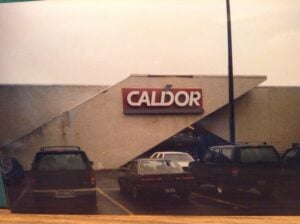
Caldor discount department store in Southington, Connecticut, circa 1990. Photo by Mike Mozart, licensed under CC BY 2.0.
Caldor discount stores disappeared from the American retail landscape in 1999, when the once-popular Northeast department store chain closed its remaining 145 locations following years of financial difficulties and bankruptcy proceedings. For generations of shoppers in New York, Connecticut, New Jersey, and surrounding states, Caldor was a familiar destination for clothing, electronics, housewares, and everyday bargains. Founded in Port Chester, New York, in 1951, the company grew into one of the Northeast’s most successful regional discount chains before its remarkable collapse.
I used to shop at the Lake Ronkonkoma, New York, store. I could always find a cheap T-shirt or shorts, an album on sale, or just some cheap snacks. Caldor was one of those stores that seemed as though it would always be there. Families went there for school clothes, toys, small appliances, records, and just about anything else they needed without paying department-store prices. Its red-and-white signs were familiar sights in shopping centers across Long Island, Westchester, the Hudson Valley, and much of the Northeast. The chain was large enough to compete with national retailers but still had a distinctly regional identity.
What makes Caldor’s loss remarkable is how quickly a thriving business disappeared. Carl and Dorothy Bennett opened their first store in Port Chester, New York, in 1951. Within a few decades, Caldor became a major discount retailer, known for its name-brand merchandise, attractive stores, and customer service. In 1995, it was still operating 166 stores. Four years later, the company was liquidating its remaining locations, and the Caldor name was about to disappear from American shopping centers.
For a company that began with just $8,000 in personal savings and a bank loan, that rise was extraordinary. Its collapse deserves more than the simple explanation that Walmart came along and put it out of business. Caldor went through a succession of corporate owners, a leveraged buyout, rapid expansion, a changing discount market, and serious trouble maintaining supplier confidence. The company spent more than three years trying to reorganize under bankruptcy protection before closing for good in 1999. The story begins in Westchester County, where a husband and wife thought they could offer customers something better than the discount stores of their day.
How Caldor Began in Port Chester, New York
Carl Bennett grew up in Greenwich, Connecticut, where his father operated a grocery store. After serving in the Army during World War II, Bennett worked as a wholesale liquor salesman. He and Dorothy Becker, whom he married after the war, were familiar with the emerging world of discount retailing. The success of E.J. Korvette, founded in New York City in 1948, showed that shoppers were willing to seek out a store offering recognizable merchandise below customary department-store prices.
In 1951, Carl and Dorothy opened their own discount business upstairs in Port Chester. They named it Caldor after the first parts of their names: Carl and Dorothy. Bennett had saved approximately $8,000 and, according to the family’s account of his life, secured a $50,000 bank loan to help finance the venture. The early operation was nothing like the enormous stores that later appeared in suburban shopping centers. It concentrated on merchandise such as appliances, jewelry, housewares, and other products that could attract customers willing to climb the stairs for a bargain.
The idea was not simply to sell cheap goods. Bennett wanted to sell desirable merchandise at lower prices while giving customers the service they expected in more expensive stores. His approach included knowledgeable employees, liberal returns, and attention to store appearance. Those principles became important selling points as the company expanded into Connecticut and other parts of New York. The Bennett family was building a discount chain, but one that did not want to look or feel like a bargain basement.
Why Caldor Became Known as the “Bloomingdale’s of Discounting”
The nickname “Bloomingdale’s of discounting” captured what distinguished Caldor from many competitors. Its stores offered familiar national brands, orderly merchandise presentations, broad aisles, and lighting that made shopping more comfortable. Caldor emphasized quality and value rather than relying on closeouts or damaged goods to define its identity. Customers could buy clothing, kitchen equipment, electronics, sporting goods, and toys without visiting several different stores.
That distinction mattered in the Northeast, where shoppers already knew chains such as E.J. Korvette, Bradlees, Kmart, and Times Square Stores. The discount market was crowded, but not every chain appealed to customers in the same way. Caldor targeted people who wanted lower prices but still cared about brands, store organization, and the shopping experience. Its approach appealed to middle-income families who were careful with money but didn’t want to sacrifice selection or service.
Caldor’s growth also followed the development of suburban shopping centers. Instead of relying on costly downtown department-store buildings, it occupied locations that people could reach by car, often with large parking lots and other businesses nearby. A Caldor could bring traffic to an entire shopping center. Its presence made it a useful anchor for smaller merchants, especially when the chain closed decades later.
Anyone interested in the earlier New York discount-store era will recognize similarities in our history of E.J. Korvette and our account of Times Square Stores. Caldor shared the same regional shopping culture, though its merchandising and growth followed a different path.
The Expansion Years and the Sale to Associated Dry Goods
By the end of the 1970s, Caldor was no longer a modest family operation. The chain had expanded through the Northeast and attracted the attention of Associated Dry Goods, a department-store corporation whose holdings included Lord & Taylor. In 1981, Associated Dry Goods purchased Caldor for approximately $313 million. Accounts of the transaction describe a company with about 60 to 70 stores, a strong regional reputation, and comparatively little debt.
The sale did not mean Carl Bennett immediately walked away. He remained involved in management during the transition, retiring in the mid-1980s. By 1984, the chain had reached approximately 100 stores and annual sales of about $1 billion. For a retailer that had begun in an upstairs Port Chester shop only three decades earlier, those figures represented an astonishing expansion.
Associated Dry Goods provided the financial backing for more stores. In 1986, the May Department Stores Company acquired Associated Dry Goods, bringing Caldor into another corporate structure. May operated major conventional department stores, including Lord & Taylor, and eventually decided that discount retailing did not belong at the center of its plans. Caldor was still a significant and functioning business, but its place within the larger company was increasingly uncertain.
The 1989 Leveraged Buyout and the Risk of Expansion
In 1989, May arranged to sell Caldor to an investor and management group that included Odyssey Partners and Donaldson, Lufkin & Jenrette. The transaction was structured as a leveraged buyout, meaning borrowed money played a major role in financing the purchase. That increased the financial obligations Caldor had to carry while running its stores and investing in future growth.
However, it would be misleading to say the buyout destroyed Caldor overnight. Contemporary business histories describe a company that continued growing after the sale. Caldor returned to public stock ownership in 1991, and the share offering helped reduce debt. By 1993, sales had reached roughly $2.4 billion, and the company was reporting profits. Management also renovated stores, expanded its fashion and household-goods offerings, and developed systems to support a larger retail operation.
But a regional chain could only absorb so much growth. Caldor kept opening locations while larger national competitors expanded into eastern markets. In New York City, the chain even acquired former Alexander’s store locations in the early 1990s, demonstrating its willingness to operate in urban spaces as well as familiar suburban shopping centers. At the same time, inventory, leases, borrowing, and store renovation demanded capital. A retailer can increase sales while becoming more exposed to financial trouble if its expenses and obligations rise just as quickly.
What Really Went Wrong at Caldor in the 1990s?
By the mid-1990s, the entire discount department-store business was under pressure. Walmart was expanding rapidly, Kmart was already a major competitor, and other retailers were fighting for the same customers. Regional chains such as Bradlees, Ames, Jamesway, and Caldor faced a market where purchasing power, distribution efficiency, and access to credit could determine survival. Caldor’s upscale presentation no longer guaranteed that shoppers would choose it over a competitor offering a lower price or a broader selection.
The competition was not quite as simple as three national chains simultaneously sweeping through Caldor’s home territory. Court records examining the discount-store industry noted that Walmart expanded sharply across the states where Caldor operated between 1989 and 1994. Target’s major presence in those same markets came later; at the beginning of 1995, it had no stores in the states covered by Caldor’s operations. Kohl’s became especially important after Caldor’s liquidation, when it acquired former Caldor sites as part of its northeastern expansion. Timing matters because it changes the explanation.
Caldor was still trying to modernize its operations. In 1994, it retained consultants to examine its distribution network, and a study completed in 1995 recommended reorganizing regional deliveries and upgrading warehouse equipment. The chain then relied on major distribution centers in North Bergen, New Jersey, and Newburgh, New York. Bankruptcy-court records document those planning efforts; they do not establish the dramatic story, sometimes repeated in accounts of the chain, that a single computer-system crash during Christmas 1994 left millions of dollars of merchandise stranded in warehouses. Without credible evidence, that claim should not be presented as the cause of Caldor’s downfall.
The documented problems were serious enough. Competition squeezed sales and profit margins, while the business needed merchandise, financing, and reliable deliveries to keep operating. When customers saw shortages or less appealing stores, they could shop elsewhere. When manufacturers worried a retailer couldn’t pay its bills, they could restrict shipments or demand faster payment. For a discount department store, supplier trouble could quickly become visible on every sales floor.
The 1995 Bankruptcy Filing
On September 18, 1995, Caldor filed for Chapter 11 bankruptcy protection in the Southern District of New York. At the time, the company operated 166 stores. Contemporary news reports listed assets of approximately $1.2 billion and liabilities of about $883 million. Although the asset figure exceeded liabilities on paper, that did not mean the company had enough readily available cash or supplier confidence to continue operating normally.
The timing was particularly damaging. Bradlees had filed for bankruptcy protection earlier that summer, and manufacturers feared that more regional discount chains might follow. Some suppliers reduced shipments or demanded faster payments, worsening an already difficult retail situation. Caldor’s management cited fierce competition, poor sales, and lost supplier confidence. The company secured new financing and continued operating under Chapter 11 while attempting to reorganize.
Bankruptcy protection did not immediately close the stores. Caldor kept serving customers, reduced operations in weaker markets, and tried new pricing and merchandising strategies. But Chapter 11 did not guarantee recovery. Creditors, landlords, suppliers, employees, and management all had interests in the outcome, and the company needed enough profitable sales to convince them that a reorganized Caldor could survive.
Why Caldor Finally Closed All Its Stores in 1999
More than three years into bankruptcy, Caldor still had not found a successful path out of Chapter 11. By late 1998, its performance was falling short of its business plan. Court records describe the company’s decision to suspend some vendor payments and stop accepting certain unpaid merchandise shipments. On January 9, 1999, the company announced it would no longer order or receive new goods for its stores. That was an unmistakable sign that the end was approaching.
On January 22, 1999, Caldor announced that it would liquidate its remaining 145 stores. About 20,000 employees lost their jobs. Newspaper accounts of the closures captured workers’ and customers’ responses in communities such as Newburgh and Middletown, New York. Store employees had spent years working for a chain that was now disappearing, and neighboring merchants worried about losing the shopping-center traffic that Caldor brought to their doors.
Liquidation sales continued through the spring, and the last Caldor locations closed in May 1999. No single event caused its disappearance. The leveraged buyout and borrowing obligations were part of the financial background, but increased competition, an ambitious store network, difficulty keeping merchandise flowing, and an inability to win sufficient creditor support for reorganization also played a role. The chain had been a successful retailer for decades; by 1999, its problems had become more than its remaining business could solve.
What Happened to the Former Caldor Stores?
The Caldor name disappeared, but many of its locations remained valuable. Retailers entering the Northeast could take over large, established shopping-center spaces without searching for entirely new properties. Kohl’s was one of the biggest beneficiaries. Its 1998 annual report described an agreement in early 1999 to occupy 33 former Caldor stores, a major step in its entry into the New York and Connecticut markets.
Six of those Kohl’s locations were on Long Island: Levittown, Ronkonkoma, Melville, Deer Park, East Setauket, and Shirley. Contemporary real estate reporting also identified a former Caldor location in Riverhead that became Walmart and one in Woodmere that became Kmart. Other former stores were occupied by different retailers or eventually redeveloped. It would be incorrect to suggest that the buildings were all demolished or that every site became a Walmart, Target, or Kohl’s.
The irony is hard to miss. Caldor had once helped define the modern suburban discount shopping center. After the chain closed, its established sites helped other retailers strengthen their own positions in the Northeast. Its real estate retained value even when the company operating inside those stores could no longer survive.
Why New Yorkers Still Remember Caldor
Caldor belonged to an era when strong regional names shaped shopping in New York. Families knew the difference between Caldor, Bradlees, Korvettes, TSS, and the mall’s department stores. Each chain had its own merchandise mix, ads, sales, and familiar neighborhood locations. Caldor was especially good at making an ordinary discount-store visit feel a little more like department-store shopping, without the higher prices.
Its closing illustrates how quickly a successful regional business can be displaced when retailing changes. But the memories endure because the stores were part of everyday family life. For many shoppers, Caldor was where they bought their first stereo, picked out school supplies, shopped for holiday gifts, or made a quick stop on a Saturday afternoon. Those are small moments in New York’s larger history, but they’re exactly why a name that vanished in 1999 still means something more than 25 years later.
For more on the stores and shopping centers that shaped New York, read our history of Korvettes, history of TSS (Times Square Stores), and history of John’s Bargain Stores. We also look at the broader changes to shopping centers in Can New York’s Dead Malls Be Saved?