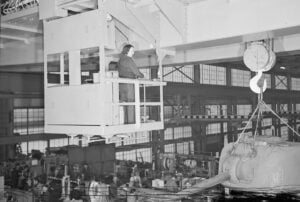
Ida F. Molitor operates an overhead crane at the American Locomotive Company plant in Schenectady, New York, in January 1943. Photo by Howard R. Hollem, Library of Congress.
Upstate New York once had an extraordinary concentration of factories that supplied the country with locomotives, trucks, fire engines, cameras, dinnerware, office machines, industrial chemicals, and agricultural equipment. Some of those companies became household names. Others manufactured the tools and materials behind products people bought without ever knowing where they were made. Workers and factories spread from the Buffalo waterfront and the Southern Tier to Rochester, Syracuse, the Mohawk Valley, and the North Country.
It is easy to picture the region’s industrial past as one great story of factories closing because manufacturers found cheaper places to operate. But that was only part of what happened. Some businesses were bought by larger competitors at their height. Others suffered through collapsing markets, costly technological transitions, bankruptcy, or transportation changes. A few disappeared as independent corporations many years before their original Upstate factories finally closed. The consequences varied, but the effect on local communities could be profound.
That is why this list makes an important distinction. The companies here are historical manufacturers or industrial enterprises that no longer exist in their original independent form, or whose defining Upstate production operations have ended. In certain cases, their names, products, or technologies survived through successor corporations. For example, Syracuse China dinnerware kept its familiar name after the local factory closed, while General Railway Signal’s technology survived a change in ownership. A company’s disappearance is not always the same as the disappearance of everything it produced.
We have also deliberately left out Upstate’s lost department stores and the familiar local retailers already covered in our other articles. This is about the factories and manufacturing companies themselves: where they worked, what they made, and why the original businesses vanished. Some built products that people still collect; others left behind abandoned buildings, contaminated industrial ground, or communities searching for new economic identities. Together, these twenty-five stories show both the remarkable reach of Upstate New York manufacturing and the many ways an industrial age can come to an end.
1. American Locomotive Company (ALCO)
Upstate location: Schenectady, Schenectady County
What happened: Locomotive production ended in Schenectady in 1969
In Schenectady, the sound of locomotives being built was once part of daily life. The American Locomotive Company emerged in 1901 when the Schenectady Locomotive Works joined seven other locomotive builders in a major consolidation. ALCO’s Schenectady headquarters and factory placed the city at the center of an industry essential to moving America’s people, freight, and raw materials. Its workers built steam engines for railroads nationwide, including some of the biggest locomotives ever put into service.
ALCO did not remain exclusively a steam-locomotive business. It worked on early diesel-electric designs and supplied military equipment during wartime, but the railroad market changed and rival diesel producers secured a greater share of new orders. The company’s ownership and business structure changed in the 1960s, and it ended locomotive production at Schenectady in 1969. Equipment made under the ALCO name still exists in preservation and in railroad service elsewhere; what disappeared was the historic Schenectady-based locomotive manufacturer that defined a major part of the city’s working life.
2. Endicott Johnson Corporation
Upstate location: Endicott and Johnson City, Broome County
What happened: Original company absorbed; final Broome County footwear operations ended in 2004
For generations, shoe factories in Endicott and Johnson City shaped not only employment but also everyday social life. The company grew out of the region’s nineteenth-century footwear trade, and under George F. Johnson it became nationally known for its enormous production capacity and its treatment of employees. Workers and their families benefited from a program called the Square Deal, which included health services, recreation, parks, and the famous carousels that still shape Broome County’s identity.
The decline came gradually, not through a single factory shutdown. Imports, rising manufacturing costs, shifting ownership, and competition reduced jobs in the region. The rubber-footwear business sold in 1992; the company passed to new corporate hands in 1995, and later transactions continued to reduce its local footprint. A National Park Service industrial-history study records that the remaining Broome County operations ended in 2004 after another acquisition. The factories and original corporate identity were lost, though some community features associated with the Johnson era survived.
3. Onondaga Pottery Company / Syracuse China
Upstate location: Salina and Syracuse, Onondaga County
What happened: Historic Syracuse-area dinnerware factory closed in April 2009
Syracuse China was one of those manufacturers whose products reached places far beyond the city printed on the bottom of a plate. Founded as the Onondaga Pottery Company in 1871, the business became a major source of durable commercial dinnerware for restaurants, hotels, institutions, and railroad dining service. The weight and appearance of its plates, cups, and serving dishes made the brand familiar to diners who might never have heard of the men and women making them in Central New York.
Ownership changed over the years, and the manufacturer eventually became part of Libbey. In December 2008, Libbey announced it would close the Syracuse China factory, citing the need to cut costs during an especially difficult period for the restaurant and retail markets. The closure ended in April 2009, bringing local production to an end after more than a century. The Syracuse China name continued in the marketplace, so not every product carrying the trademark went extinct. It was the disappearance of the historic Upstate manufacturing operation and the jobs attached to it.
4. Pierce-Arrow Motor Car Company
Upstate location: Buffalo, Erie County
What happened: Luxury automobile manufacturing ended in 1938
Buffalo once produced automobiles that ranked among the most prestigious in the country. The company associated with Pierce-Arrow began in the nineteenth century making household goods before moving into bicycles and then automobiles in 1901. Its luxurious cars were recognized for their careful construction, elegant lines, and later the distinctive headlights mounted in the front fenders. Pierce-Arrow became associated with wealthy buyers and official transportation at a time when an American-made car could be an extraordinary expression of status.
The trouble was that luxury automobile manufacturing was expensive, especially when buyers could choose more modern designs or less costly vehicles. Studebaker acquired Pierce-Arrow in 1928, but the relationship did not resolve the company’s difficulties. The Great Depression devastated the market for expensive automobiles, and although Buffalo investors attempted to keep the marque alive after Studebaker entered receivership, the manufacturer closed in 1938. Antique Pierce-Arrows remain highly valued, but the Buffalo company that built them could not survive the economic pressures of its era.
5. Graflex Inc.
Upstate location: Rochester and Pittsford, Monroe County
What happened: Independent camera maker dissolved in 1973
Before newspaper photographers carried compact cameras, the large press camera was almost an emblem of the profession. Graflex manufactured some of the best-known examples, including the Speed Graphic. The business began in New York City as Folmer & Schwing, but its photographic operations became firmly connected with Rochester and the region’s wider optical industry. Its cameras were used by professional photographers who needed equipment capable of producing sharp negatives in challenging conditions.
Graflex’s ownership history was complicated, including years associated with Eastman Kodak and later years under other manufacturers. Its corporate identity changed to Graflex Inc., and the company was eventually acquired by Singer. Meanwhile, smaller cameras and changing professional photographic practices reduced the importance of the equipment with which Graflex was most closely identified. The historic company was dissolved in 1973. Photographers and collectors still value the cameras, but the specialist Rochester-area manufacturer behind them disappeared.
6. Agway Inc.
Upstate location: DeWitt and Syracuse, Onondaga County
What happened: Original agricultural cooperative entered bankruptcy in 2002 and did not emerge
Agway was more than a chain of farm and garden supply stores. It was an agricultural cooperative that connected the everyday needs of farmers with a large system for buying, manufacturing, and distributing feed, fertilizer, fuel, and other products. Organized in 1964 through the combination of three cooperatives, Agway made Central New York an important administrative center for agricultural commerce across the Northeast. Its feed operations, distribution network, and recognizable name reached rural communities far beyond the Syracuse area.
Expansion into several lines of business exposed the cooperative to financial problems, and Agway entered Chapter 11 bankruptcy in October 2002. Its assets and operating divisions were sold through the bankruptcy process. The University of Florida’s bankruptcy database records that the company itself did not emerge. That does not mean every store bearing the Agway name disappeared: the name continued to be used in the agricultural retail marketplace. What vanished was the original cooperative enterprise and its integrated industrial and supply network, an important distinction in telling its history.
7. Lackawanna Steel Company
Upstate location: Lackawanna, Erie County
What happened: Independent steel company acquired by Bethlehem Steel in 1922
Few companies left such a literal mark on the map. Lackawanna Steel moved its principal manufacturing ambitions from northeastern Pennsylvania toward the eastern shore of Lake Erie, where it built a huge integrated steelworks south of Buffalo. The operation helped give the new city of Lackawanna its name and created an industrial landscape dominated by furnaces, mills, rail lines, and the movement of ore and coal. For families living nearby, the steelworks was part of the rhythm of work for generations.
As an independent corporation, Lackawanna Steel disappeared in 1922 when Bethlehem Steel acquired the plant. That did not shut the furnaces down. Bethlehem expanded the works, and steel production continued under new ownership long after the original company name vanished. The later decline of the Lackawanna plant belongs to a second chapter of American steel history. The loss here is therefore corporate independence first, followed much later by the contraction of a once-enormous regional steelmaking operation.
8. Remington Rand
Upstate location: Ilion and Tonawanda, Herkimer and Erie Counties
What happened: Independent office-machinery corporation ended with 1955 merger
The Remington name connects two different chapters of Upstate manufacturing: machinery made in Ilion and office equipment produced through businesses associated with the Mohawk Valley and Tonawanda. Remington Rand was formed in 1927 when the Remington typewriter enterprise joined the Rand Kardex business. Its product world ranged from typewriters, card systems, and accounting machines to increasingly sophisticated office technologies. Workers at its New York facilities were part of a national shift in how information was recorded and processed.
The company’s technological ambitions went well beyond the typewriter. It acquired the Eckert-Mauchly Computer Corporation in 1950, becoming associated with UNIVAC and some of the earliest commercial computers. In 1955 Remington Rand merged with Sperry to form Sperry Rand, ending the old corporation as an independent enterprise. This is not a story in which all its products instantly ceased to exist: the computer and business-machinery lines continued within successor corporations. What disappeared was the manufacturer whose historic corporate name had linked New York machine shops with an emerging digital industry.
9. Brockway Motor Company
Upstate location: Cortland, Cortland County
What happened: Cortland truck manufacturing ended in 1977
Brockway trucks once made Cortland a name familiar to drivers far outside Central New York. The company grew from the region’s carriage-building traditions into a manufacturer of heavy-duty commercial trucks. Its sturdy vehicles served businesses that needed dependable equipment on difficult roads and construction sites. The familiar Brockway hood ornaments and the pride of workers who built the trucks gave the factory an unusually strong identity within the community.
Brockway became part of Mack Trucks, but the ownership relationship did not preserve production indefinitely. Labor disputes, corporate decisions, and changing economics converged in 1977, when the Cortland operation closed. A SUNY Cortland historical study places the shutdown within the wider story of industrial consolidation and deindustrialization. Enthusiasts still restore and show Brockway trucks, but that community of collectors is preserving the memory of a manufacturer that no longer exists in its hometown.
10. H. H. Franklin Manufacturing Company
Upstate location: Syracuse, Onondaga County
What happened: Automobile company declared bankruptcy in 1934
Long before most Americans associated automobile production with Detroit, Syracuse had an ambitious motorcar manufacturer of its own. Herbert H. Franklin and engineer John Wilkinson developed cars built around air-cooled engines, an approach that offered advantages in winter climates and reduced the need for conventional radiators. Franklin automobiles became known for engineering choices that distinguished them from competing cars. The company also made a contribution to the history of aircraft engines.
The company could not withstand the combined pressures of the Depression and a marketplace dominated by larger automobile makers with greater production scale. Its automobile business went bankrupt in 1934. Former employees later acquired assets and continued making Franklin-derived engines under new business arrangements, meaning that the technical legacy lasted beyond the original car company. The manufacturer that built the distinctive Syracuse automobiles, however, had disappeared. Syracuse University’s Franklin company archives preserve the history of both the cars and the engineers behind them.
11. American LaFrance
Upstate location: Elmira, Chemung County
What happened: Fire-apparatus manufacturer ceased business in 2014
Firefighters across the United States once depended on apparatus bearing a name closely connected with Elmira. American LaFrance emerged in its familiar form in 1903 from earlier fire-engine businesses and grew into a leader in motorized firefighting equipment. The company made pumpers, aerial ladders, and specialized apparatus used by departments of many sizes. Its postwar designs were especially recognizable, bringing modern layouts to a profession in which visibility, access, and maneuverability matter.
American LaFrance eventually moved production away from Elmira in the 1980s, and its later history involved several owners and further efforts to remain competitive. The company finally went out of business in 2014. Unlike a manufacturer whose old name survives only because of a merger, this was the loss of a once-major national vehicle builder. Preserved engines in fire museums and parades continue to connect the American LaFrance name with Elmira’s place in the history of firefighting technology.
12. Larkin Company
Upstate location: Buffalo, Erie County
What happened: Manufacturing ended in the 1950s; last retail shipment in 1962
The Larkin Company made Buffalo an important center of soap manufacturing, mail-order sales, and ambitious marketing. Founded in the nineteenth century, the firm developed a direct-to-customer business in which household staples and premiums encouraged repeated purchases. Larkin did not merely manufacture soap: it sold an idea about convenient shopping before the modern mail-order and online economy existed. Its large operations and famous Frank Lloyd Wright administration building made the company part of Buffalo’s industrial and architectural identity.
The Depression severely damaged the business, and its operations were divided among separate corporate entities. Manufacturing dwindled and ended during the 1950s, while the last retail order was shipped in January 1962. The administration building had already been demolished in 1950, one of Buffalo’s most lamented architectural losses. The firm’s failure was not a single bankruptcy event; its business declined through a long succession of reorganizations and closures. Larkin remains a powerful example of a vanished manufacturer whose distribution and advertising ideas anticipated later retailing methods.
13. General Railway Signal Company
Upstate location: Rochester, Monroe County
What happened: Independent railway-signal company acquired by Alstom in 1998
Railroad travelers rarely noticed the machinery controlling train movements, but companies that built those systems were essential to safe transportation. General Railway Signal was established in Rochester in 1904 through the combination of earlier railway-signal businesses. Its products helped railroads manage switches, track occupancy, and train movements at a time when expanding traffic required increasingly complex safety equipment. Rochester’s factory expertise extended into a field where reliability mattered more than a recognizable consumer label.
The company continued evolving through electrical and electronic signaling, but it did not remain an independent manufacturer forever. A company chronology maintained by the successor railway-signaling business records its acquisition by Alstom in 1998. That changed the corporate identity rather than instantly eliminating railway signaling as an industry. The GRS name and its technologies remained part of railroad history, while the once-independent Rochester firm became absorbed into a much larger international supplier.
14. Wollensak Optical Company
Upstate location: Rochester, Monroe County
What happened: Rochester lens and shutter manufacturer closed in 1972
Rochester’s reputation as an optics center did not rest on Eastman Kodak alone. Wollensak manufactured photographic lenses, camera shutters, and other precision optical equipment used by amateurs, professionals, and government customers. The company began in 1899, grew from Andrew Wollensak’s experience as a skilled machinist, and developed products remembered by photographers for their engineering and quality. Its work connected Rochester’s established photographic supply trade with the specialized machinery required to make cameras useful.
Wollensak passed through several owners, including Revere and 3M, as the photographic market changed. Its Rochester operation closed in 1972. An account of Rochester camera and lens manufacturers by optical historian Rudolf Kingslake describes the decline and the company’s importance to the city’s industrial community. A Wollensak lens or shutter may still be found on an old camera, but the manufacturing organization that employed local workers and built those products is gone.
15. New Process Gear
Upstate location: East Syracuse, Onondaga County
What happened: Historic East Syracuse drivetrain plant closed in 2012
The New Process Gear works in East Syracuse was part of the industrial world behind the automobile, a place where gearboxes and drivetrain components were made rather than advertised to motorists. Its products were used in vehicles assembled elsewhere, connecting local manufacturing workers with a national automotive supply chain. Over generations, the complex became a significant employer and a familiar symbol of the region’s mechanical trades.
Ownership changed as the automotive industry consolidated, and New Process Gear eventually became part of Magna Powertrain. The closing process involved successive rounds of layoffs and official notices, including a 2012 announcement affecting hundreds of employees. The plant ceased production that year, bringing an end to an important chapter of manufacturing in East Syracuse. The disappearance of the local factory should not be confused with the disappearance of every type of component made there; the underlying technologies continue to be manufactured by other companies and at other plants.
16. Vacuum Oil Company
Upstate location: Rochester, Monroe County
What happened: Merged into Socony-Vacuum in 1931; Rochester refinery closed around 1930
One of the lesser-known roots of a giant American oil business can be found along the Genesee River. In 1866, Matthew Ewing and Hiram Bond Everest developed a company around a method for making lubricating oils. Vacuum Oil established a Rochester refinery and storage operation that served industry at a time when dependable lubricants were increasingly important to steam machinery, transportation, and manufacturing. Standard Oil obtained control during the nineteenth century, but the company later emerged as a separate enterprise after the 1911 antitrust breakup.
Vacuum Oil merged with Standard Oil of New York in 1931 to create Socony-Vacuum, an ancestor of Mobil and today’s ExxonMobil. The original Rochester refinery closed around the same period. Its industrial legacy is not entirely a comfortable one: the city has documented contamination at the former refinery lands and work to address that history. This is a case in which the corporate name disappeared through a merger while the industrial site itself left a lasting environmental challenge.
17. D. M. Osborne & Company
Upstate location: Auburn, Cayuga County
What happened: Independent farm-equipment maker sold to International Harvester in 1903
Auburn once manufactured machinery that changed the lives of farmers across the country. D. M. Osborne & Company built agricultural equipment used in planting and harvesting, and its factory became one of the city’s largest industrial employers. The business grew during a period when mechanized farm equipment was transforming the work that could be done by a family or a crew. Its name appeared on catalogs and machines far from the Finger Lakes, helping establish Auburn as a serious center of farm-implement production.
The company was sold to International Harvester around 1903, ending its independence as a major Upstate agricultural-equipment manufacturer. The transaction was part of a broader consolidation in the industry as competing makers were combined into large national organizations. Museum collections still preserve Osborne catalogs and advertisements, but the original company name did not survive as a standalone business. Its history makes clear how a manufacturing concern could vanish through acquisition even when the equipment and industrial knowledge it developed remained valuable.
18. Columbian Rope Company
Upstate location: Auburn, Cayuga County
What happened: Moved manufacturing from Auburn in 1982; company sold in 2002
The Columbian Rope Company grew out of Auburn’s agricultural machinery and cordage trades. Established in 1903 by Edwin Dickinson Metcalf, it manufactured rope and related products for an expanding American industrial and commercial economy. Its roots lay in the need for baling twine and other cordage used alongside equipment made by Auburn’s farm-machinery businesses. Over time, Columbian Rope became a significant employer and a recognizable manufacturer in its own right.
Changes in markets and overseas competition contributed to the company’s decision to leave Auburn for Mississippi in 1982. The business was subsequently sold to Unicord International in 2002. That sequence is important: the Auburn factory disappeared long before the final corporate sale, and the historic local company did not simply cease on one convenient date. The Cayuga Museum preserves company publications and artifacts that document how deeply rope manufacturing was woven into Auburn’s industrial history.
19. Stromberg-Carlson
Upstate location: Rochester, Monroe County
What happened: Independent communications manufacturer bought in 1955; business broken up by 1982
Stromberg-Carlson was a leading maker of telephone equipment, radios, and related communications products, with a major manufacturing presence in Rochester. Founded in Chicago in the 1890s, the enterprise moved to Rochester and built a substantial operation supplying independent telephone companies. It later branched into sound equipment, broadcasting technology, and television. In a city best known for film and optics, Stromberg-Carlson offered another route into sophisticated electrical manufacturing.
General Dynamics acquired the business in 1955, and over the following decades its operations were gradually moved, sold, or reorganized. Rochester’s remaining General Dynamics operation left the area in 1971, and the old Stromberg-Carlson business was broken into different components by 1982. The name has appeared on products or legacy equipment since then, but the Rochester-based manufacturer that once supported thousands of jobs was no longer the same company. Its departure illustrates how a change in corporate ownership could empty out a local industry even without an immediate nationwide demand collapse.
20. E. R. Thomas Motor Company
Upstate location: Buffalo, Erie County
What happened: Automaker sold in 1911; assets liquidated in 1913
Long before Buffalo became associated primarily with other kinds of machinery, Edwin Ross Thomas was building bicycles, motorcycles, and automobiles there. His company’s Thomas Flyer became famous after winning the extraordinary 1908 New York-to-Paris automobile race. The achievement attracted public attention to a car made in Buffalo and demonstrated the ambitions of manufacturers competing in the early automotive age. Workers at the Niagara Street complex produced expensive machines aimed at customers willing to pay for power and prestige.
The company nevertheless struggled as the automobile market moved toward far cheaper mass-produced cars. Thomas sold the business in 1911, and the effort to preserve the manufacturer failed. Its remaining assets were sold in 1913. The factory buildings later found other uses, but the Thomas motorcar name disappeared from production. The surviving Thomas Flyer and other historical materials make this one of the more dramatic examples of a Buffalo business whose national fame proved too brief to guarantee survival.
21. Solvay Process Company
Upstate location: Solvay and Geddes, Onondaga County
What happened: Original company merged in 1920; successor soda-ash plant closed in 1986
The village of Solvay took its name from an industrial process that once helped supply some of the country’s essential chemicals. The Solvay Process Company was incorporated in 1881 and began producing soda ash in the 1880s. That chemical served glassmaking, paper production, and many other industries, and the company’s enormous facilities transformed the southwestern shore of Onondaga Lake. The operation provided work and revenue, but it also disposed of large quantities of industrial wastes that would shape the region’s environmental history.
In 1920 the Solvay Process Company became part of the corporate combination that created Allied Chemical and Dye, losing its independent identity. Soda-ash production continued under successor ownership for decades, until the Solvay plant shut down in 1986. The closing eliminated many jobs, while remediation of the damaged lake and nearby industrial sites continued as a long-term public concern. This history cannot be reduced to a story of foreign competition or a changing market; industrial success and environmental cost were intertwined from the beginning.
22. Wickwire Brothers
Upstate location: Cortland, Cortland County
What happened: Wire-manufacturing complex closed in 1971
At one time, Cortland was known not only for trucks but for wire products used in homes, farms, and construction across the country. Wickwire Brothers developed from a hardware business into a major manufacturer of wire cloth, fencing, screens, and other metal products. The factory employed large numbers of people and became closely associated with the industrial neighborhoods that grew around it. Its wares were ordinary rather than glamorous, which made them part of everyday American life.
The business passed to outside ownership late in its history, and the Cortland complex shut down in 1971. City historical materials describe the closing as the end of what had long been one of the area’s largest employers. The site later underwent demolition and industrial reuse, while local museums and historical groups preserved the Wickwire story. It is a reminder that an entire community can be shaped by a factory whose products are so common that consumers rarely think about where they were made.
23. Ansco / Agfa-Ansco Photographic Manufacturing
Upstate location: Binghamton and Johnson City, Broome County
What happened: Original photographic-manufacturing identity absorbed; Binghamton operations ended by 1998
Binghamton was once a formidable competitor in the manufacture of photographic products. The company eventually known as Ansco produced cameras, film, photographic paper, and related materials, and its large factories became major employers in the Southern Tier. Its ancestry began with nineteenth-century photographic businesses outside Upstate New York, but its industrial operations grew into a defining part of Binghamton’s manufacturing economy. Later corporate identities included Agfa-Ansco and General Aniline & Film.
The business underwent complicated ownership changes, including a period of government control during World War II and later restructuring. Ansco moved away from its old consumer-photography lines; it sold operations and product rights in stages, and the remaining Binghamton industrial activities ended by 1998. The trademark was used elsewhere afterward, but that does not make the old Southern Tier manufacturer a continuing local company. Binghamton University preserves an account of the firm’s history, including the factories’ importance and how successive transactions eroded the operation.
24. St. Regis Paper Company
Upstate location: Deferiet, Jefferson County
What happened: Original corporation absorbed in 1984; historic paper mill closed in 2001
The Black River helped support a powerful paper industry in northern New York, and one of its best-known manufacturers was St. Regis Paper. Founded in 1899, the company developed a major mill at Deferiet, where production began in 1901. The industrial complex became so important that company housing, shops, and other services helped shape the village around it. Making paper was labor-intensive work, and the mill sustained families in Jefferson County for generations.
St. Regis lost its independent corporate identity when it merged with Champion International in 1984. The Deferiet mill continued operating under successor ownership, but it closed in 2001 after a century of production. The William G. Pomeroy Foundation’s historical marker for the site preserves that chronology. In this case, the corporate disappearance came first and the final loss of the local manufacturing operation followed seventeen years later, illustrating why industrial decline is often a long process rather than one headline-making event.
25. Meneely and Company Bell Foundry
Upstate location: Watervliet, Albany County
What happened: Historic bellfounding business closed in the early 1950s
Bells made along the Hudson and Mohawk rivers traveled much farther than the foundries that cast them. Andrew Meneely established a bell-making operation in what is now Watervliet in 1826, developing a manufacturing business that produced bells for churches, public buildings, and other institutions. The work combined metalcasting with careful attention to tone and mechanical operation. Meneely became one of the best-known names associated with the Capital Region’s nineteenth-century bellmaking trades.
The company remained a family-connected business for generations, but the American market for large bells changed as buildings and industries adopted other technologies and manufacturers faced shifting demand and material costs. The historic foundry ceased operations in the early 1950s. This is one entry in which the evidence survives quite literally in sound: Meneely bells continue to ring in places far from Watervliet, though the foundry itself is long gone. The New York State Library preserves company records, an unusually direct resource for understanding the people and production behind the objects.
For related New York business histories, see our articles on 25 Historic Brands That Began in Upstate New York, 25 Lost Department Stores Upstate New Yorkers Still Remember, and 25 Hudson River Industries That Disappeared. Each approaches a different part of New York’s commercial and industrial past.