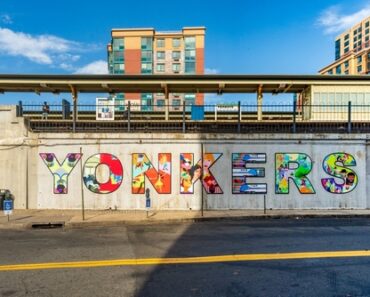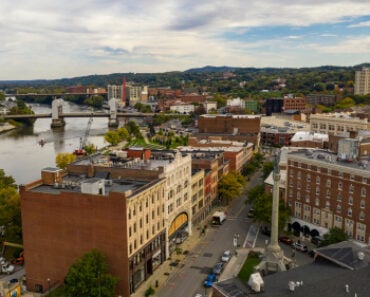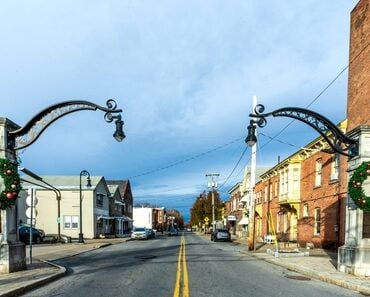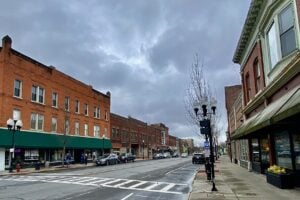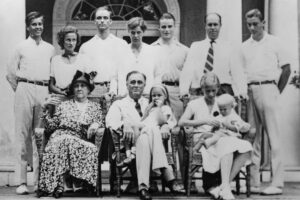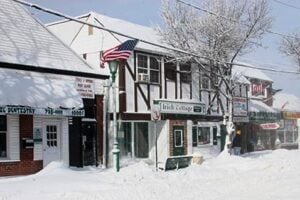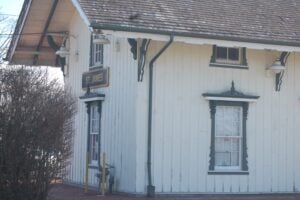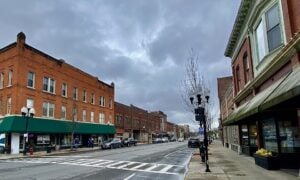
Historic Fall Street in downtown Seneca Falls, New York, photographed on April 16, 2022. Photo: Andre Carrotflower / Wikimedia Commons / CC BY-SA 4.0.
For a community its size, Seneca Falls occupies an extraordinary place in American history. Situated near the northern end of Cayuga Lake in New York’s Finger Lakes region, the town became a center of manufacturing during the 19th century and the setting for a convention that changed the course of the struggle for women’s rights in the United States. Few places in Upstate New York can claim such a remarkable combination of industrial and social history.
The area was originally part of the homeland of the Cayuga Nation of the Haudenosaunee Confederacy. After the American Revolution, mills and factories developed along the Seneca River, taking advantage of its waterfalls. The construction of canal locks in 1818 and the connection of the Cayuga-Seneca Canal to the Erie Canal in 1828 helped local manufacturers reach distant markets. Seneca Falls became a town in 1829 and its village was incorporated in 1831. The town’s official history documents the relationship between its waterways, industry, and growth.
By the 1840s, the community had also become a center of reform, with residents supporting abolition, temperance, and women’s rights. On July 19 and 20, 1848, the first women’s rights convention in the United States took place at the Wesleyan Chapel on Fall Street. The Women’s Rights National Historical Park and the National Women’s Hall of Fame preserve that extraordinary chapter of the town’s history.
Yet the story of Seneca Falls extends well beyond the convention. The community has connections to early professional baseball, Hollywood, federal law, astronomy, and inventions that transformed urban life. The following list includes people born in Seneca Falls, those raised there, and residents who made the community an important part of their lives. Their individual connections are explained below.
1. Elizabeth Cady Stanton
Born in Johnstown, New York, in 1815, Elizabeth Cady Stanton moved to Seneca Falls with her husband, Henry, and their three sons in 1847. Her experiences as a wife and mother, together with her involvement in abolitionism, influenced her efforts to challenge the restrictions placed on women. The house on Washington Street where the family lived for 14 years is now part of Women’s Rights National Historical Park.
Stanton helped organize the 1848 convention and was the principal author of its Declaration of Sentiments, which called for women’s equality and included the controversial demand for voting rights. Her partnership with Susan B. Anthony began in Seneca Falls in 1851 and lasted for decades. Although Stanton did not live to see the adoption of the 19th Amendment in 1920, her work helped establish the movement that achieved it. Her Seneca Falls home is one of the most important surviving sites associated with her life.
2. Amelia Bloomer
Amelia Jenks was born in Homer, New York, in 1818 and settled in Seneca Falls after marrying newspaper editor Dexter Bloomer in 1840. She became active in local temperance efforts and began writing about social reform. In 1849, she launched The Lily, a periodical that developed from a temperance publication into a forum for women’s rights.
Bloomer became nationally known for promoting a less restrictive style of women’s clothing consisting of a shorter skirt worn over trousers. She did not invent the costume, but the attention she gave it in her newspaper led to the association with her surname. In 1851, she introduced Stanton to Susan B. Anthony in Seneca Falls, an encounter commemorated by a sculpture near the canal. She later moved west and continued her advocacy in Iowa. The National Women’s History Museum documents her remarkable career.
3. Eunice Newton Foote
Eunice Newton Foote was born in Connecticut in 1819 and received part of her education at the Troy Female Seminary in New York. After marrying lawyer Elisha Foote in 1841, she lived in Seneca Falls, where the couple became acquainted with Elizabeth Cady Stanton. Both signed the Declaration of Sentiments in 1848, and their daughter Mary was born in the village.
Foote’s place in the history of science rests on experiments she conducted with different gases exposed to sunlight. In 1856, she published findings showing that carbon dioxide and moist air could retain more heat than ordinary air under the conditions she tested. She recognized the possibility that an atmosphere richer in carbon dioxide would produce a warmer Earth. Her work preceded later studies of the greenhouse effect and is now recognized as an important early contribution to climate science. The American Physical Society explores both her scientific achievements and her Seneca Falls connections.
4. Mary Foote Henderson
Mary Foote Henderson was born in Seneca Falls in 1842, the daughter of Eunice and Elisha Foote. She spent part of her childhood there before the family moved to Saratoga. In 1868, she married John B. Henderson, a former United States senator from Missouri who had helped introduce the constitutional amendment abolishing slavery.
Mary became an influential figure in Washington, D.C., where she and her husband acquired extensive property. She promoted the development of the area around Sixteenth Street, including residences intended for diplomats, and advocated the creation of Meridian Hill Park. Henderson also published books on food and health. Her career offers an interesting contrast to that of her mother, whose scientific work remained relatively obscure for generations. The National Park Service documents her life and her influence on Washington’s development.
5. Birdsill Holly
Born in Auburn in 1820, Birdsill Holly grew up in Seneca Falls, where his father worked with machinery used in the local mills. Holly eventually became a partner in the Silsby manufacturing enterprise. His 1856 patent for an improved pumping engine identifies him as a resident of Seneca Falls, providing direct evidence of his early engineering work there.
In 1859, Holly relocated to Lockport, where he established the Holly Manufacturing Company. He developed a pressurized municipal water supply system that improved firefighting and helped cities deliver water without relying exclusively on elevated reservoirs. He also pioneered commercial district steam heating, an approach in which a central plant supplies heat to multiple buildings. The mechanical skills he developed in the industrial environment of Seneca Falls ultimately contributed to changes in the way American cities operated.
6. Ira Sprague Bowen
Ira Sprague Bowen was born in Seneca Falls on December 21, 1898, while his father was serving as a minister there. The family moved to Pennsylvania when Ira was two. He subsequently attended school in Houghton, New York, and graduated from Oberlin College. His studies in physics led him to work with Nobel Prize-winning physicist Robert Millikan.
Bowen solved a longstanding astronomical mystery by demonstrating that certain lines in the spectra of nebulae came from familiar elements, rather than from a hypothetical element that scientists had called nebulium. He later directed the Mount Wilson and Palomar observatories, overseeing the completion of major telescopes, including the 200-inch Hale Telescope. The Palomar Observatory recognizes his contributions to both astrophysics and the development of astronomical instruments.
7. Judith Pipher
Judith Pipher was born in Toronto in 1940 and came to the Finger Lakes region to pursue graduate studies at Cornell University. She earned her doctorate in 1971 and joined the University of Rochester’s faculty. She later made her home in Seneca Falls, where she died in February 2022.
Pipher became a pioneer of infrared astronomy, developing instruments that allowed scientists to study astronomical objects difficult to observe with visible light. Her work included infrared imaging of galaxies and the development of detectors for NASA’s Spitzer Space Telescope. She was inducted into the National Women’s Hall of Fame in Seneca Falls in 2007. The University of Rochester and the American Astronomical Society have documented her career and scientific legacy.
8. Dave Giusti
David John Giusti was born in Seneca Falls in 1939 and went on to attend North Syracuse High School and Syracuse University. He helped Syracuse reach the 1961 College World Series before beginning his major league career with the Houston Colt .45s in 1962, the franchise’s inaugural season. He initially established himself as a starting pitcher.
Giusti enjoyed his greatest success as a relief pitcher for the Pittsburgh Pirates. He led the National League with 30 saves in 1971 and helped Pittsburgh defeat the Baltimore Orioles in the World Series that year. His distinctive palmball made him particularly difficult for opposing hitters to handle. He earned an All-Star selection in 1973 and finished his major league career with 145 saves. His Society for American Baseball Research biography traces his journey from Central New York to the major leagues.
9. Ezra Sutton
Ezra Ballou Sutton was born in Seneca Falls in 1849, the son of a flour miller. He played baseball for teams in the Rochester area before joining the Forest City club of Cleveland. When the National Association began play in 1871, Sutton was among the players participating in the first major professional league.
On May 8, 1871, Sutton hit the first home run in National Association history and added another later in the same game. He subsequently spent many years with the Boston club, where he became one of the leading third basemen of his era. His recorded major league career lasted through 1888, with a batting average of .294. The Society for American Baseball Research documents his role in the formative years of professional baseball.
10. Charlie Boardman
Charles Louis Boardman was born in Seneca Falls in 1893 and attended Mynderse Academy. A right-handed pitcher, he reached the major leagues at the age of 20, making his debut with the Philadelphia Athletics in September 1913. Connie Mack managed the Athletics during a period in which the club won several American League pennants and World Series championships.
Boardman pitched for Philadelphia in 1913 and 1914 and for the St. Louis Cardinals in 1915. Although his major league career was brief, he also played in the minor leagues. He is one of several players born in Seneca Falls who advanced to the highest level of professional baseball. His local school and playing record are documented by Baseball Reference.
11. Bob Valesente
Bob Valesente was born in Seneca Falls in 1940 and played on Mynderse Academy’s undefeated 1955 football team. He attended Ithaca College, where he excelled in both football and baseball, before spending time in the Chicago Cubs’ minor league organization. He then pursued a career in football coaching, including a decade on the staff at Cornell University.
Valesente eventually became head football coach at the University of Kansas, leading the Jayhawks in 1986 and 1987. He also worked as an assistant coach in the National Football League, including assignments with the Pittsburgh Steelers and Green Bay Packers. His career took him from a high school football field in Seneca Falls to some of the most familiar sidelines in American sports. Contemporary coverage of his appointment at Kansas documents his local origins and coaching background.
12. George Dashiell Bayard
George Dashiell Bayard was born in Seneca Falls in 1835. His family moved west during his childhood, and he subsequently attended the United States Military Academy, graduating in 1856. His early Army career involved cavalry service on the western frontier, where he was wounded in fighting with Kiowa warriors.
During the Civil War, Bayard commanded the 1st Pennsylvania Cavalry and was promoted to brigadier general of volunteers in 1862. He served in campaigns in Virginia before suffering a mortal wound at the Battle of Fredericksburg on December 13, 1862. He died the following day, only four days short of his 27th birthday. The biographical account in The Union Army records his military career and Seneca Falls birthplace.
13. Wilhelmus Mynderse
One of the most important figures in the early development of Seneca Falls was Wilhelmus Mynderse, born in Albany in 1767. He settled in the area during the 1790s as a proprietor and agent of the Bayard Land Company. The mills and other enterprises he helped develop around the Seneca River became the foundation of a settlement initially known as Mynderse Mills.
Mynderse contributed land and financial support to the school that became Mynderse Academy and gave land for a village park. His name remains familiar to generations of local students. The Town of Seneca Falls recognizes him as a principal founder of the community, while acknowledging earlier settlers such as Lawrence Van Cleef. Mynderse died in 1838 and is buried in Restvale Cemetery.
14. Norman J. Gould
Norman Judd Gould was born in Seneca Falls in 1877 and graduated from Cornell University in 1899. His grandfather, Seabury Gould, had been instrumental in establishing the local pump manufacturing business that became Goulds Pumps. Norman trained as a mechanical engineer and eventually became president of the family company in 1908.
Gould combined his industrial career with public service, representing New York in Congress from 1915 to 1923 before returning to manufacturing. He remained president of Goulds Pumps until his death in 1964. During his tenure, the company’s products reached customers far beyond the Finger Lakes. The Lehigh University archives preserve a photographic record of the company’s early factory and document its long history in Seneca Falls.
15. Jacob P. Chamberlain
Jacob Payson Chamberlain was born in Dudley, Massachusetts, in 1802 and moved to Central New York with his family as a child. He established himself in Seneca Falls as a businessman involved in flour milling and textile manufacturing. He also became active in village affairs, banking, education, and the emerging antislavery political movement.
Chamberlain served in the New York State Assembly before winning election to Congress as a Republican. His congressional term, from 1861 to 1863, coincided with the opening years of the Civil War. After leaving office, he returned to his milling business in Seneca Falls, where he died in 1878. The National Park Service’s biography also places him within the circle of neighbors and entrepreneurs who helped shape the community during the women’s rights movement.
16. Simon L. Adler
Simon Louis Adler was born in Seneca Falls in 1867. He graduated from Cornell University in 1889 and Harvard Law School in 1892, then established a legal practice in Rochester. His career in public office began when he entered the New York State Assembly in 1911.
Adler became majority leader of the Assembly in 1916 and held that position until 1926. President Calvin Coolidge appointed him to the United States District Court for the Western District of New York in 1927. He remained a federal judge until his death in 1934. His education, birthplace, and government career are recorded in the Federal Judicial Center’s biographical directory.
17. Thomas James Clary
Thomas James Clary was born in Seneca Falls in 1899. He graduated from Cornell University in 1920 and received his law degree from Georgetown in 1924. After completing his education, he practiced law in Philadelphia for approximately 25 years.
President Harry S. Truman appointed Clary to the United States District Court for the Eastern District of Pennsylvania in 1949. Clary served as chief judge from 1961 to 1969 and remained on the court in senior status until his death in 1977. He also served on the Judicial Conference of the United States. His career is documented in the Federal Judicial Center records.
18. Frederick S. Armitage
Frederick S. Armitage was born in Seneca Falls in 1874, just a few years before Thomas Edison’s laboratory began developing motion picture technology. Armitage entered the film industry during its earliest years, working as a cameraman and director for the American Mutoscope and Biograph Company. His films included street scenes, sporting events, and experiments in photographic effects.
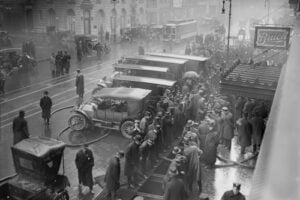
One of his most historically significant films recorded the demolition of the Star Theatre at Broadway and 13th Street in Manhattan in 1901. By photographing the demolition at intervals, Armitage compressed weeks of work into a short film. The result is both a remarkable early example of time-lapse photography and a valuable record of a vanished New York theater. The Library of Congress preserves the film, which was selected for the National Film Registry.
19. Kelly Connell
Actor Kelly Connell was born in Seneca Falls in 1956. He developed a career in theater, film, and television, appearing in stage productions before becoming a familiar face on television during the 1990s. His credits include guest appearances on Night Court, Murphy Brown, and The Fresh Prince of Bel-Air.
Connell is particularly recognizable for his role as Dr. Carter Pike on the CBS series Picket Fences. Movie audiences may also remember him as Pierre Salinger in the Cuban Missile Crisis drama Thirteen Days or from his appearances in Hot Shots! and Spider-Man 2. His varied career demonstrates how actors from small Upstate New York communities have contributed to some of America’s most popular television programs and films. His birthplace and screen credits are recorded in his IMDb filmography.
20. Emil Bove
Born in Geneva in 1981, Emil Joseph Bove III grew up in Seneca Falls and graduated from Mynderse Academy in 1999. He went on to earn a bachelor’s degree from the University at Albany in 2003 and a law degree from Georgetown University in 2008. A Finger Lakes Daily News profile documents his schooling and family connections to Seneca Falls.
Bove worked as a federal prosecutor in the Southern District of New York, including assignments involving narcotics and international terrorism. He later represented Donald Trump in criminal proceedings and served in senior positions at the United States Department of Justice in 2025. In August 2025, he received his commission as a judge of the United States Court of Appeals for the Third Circuit following a contested Senate confirmation. The Federal Judicial Center records his professional and judicial career.
More Famous People From the Finger Lakes and Upstate New York
Seneca Falls will always be closely associated with the history of women’s rights, but its residents and natives have contributed to a surprisingly wide range of endeavors. From the factories that once lined its waterways to the athletes who played on its school fields and the scientists who investigated the distant universe, the community’s history reaches far beyond the boundaries of Seneca County.
For more stories about the remarkable people connected to this part of New York, explore our articles on 25 Famous People You Didn’t Know Were From the Finger Lakes, New York, 25 Famous Women You Didn’t Know Were From Upstate New York, 25 Famous Scientists and Innovators You Didn’t Know Were From Upstate New York, and 25 Famous People You Didn’t Know Were From Upstate New York.