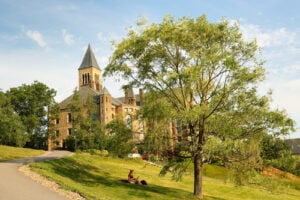
Uris Library and McGraw Tower at Cornell University in Ithaca, New York. Photo: Jay Yuan / Shutterstock.com.
When most readers think of New York’s literary heritage, their minds drift to Greenwich Village, Manhattan publishing houses, and Brooklyn’s literary neighborhoods. Yet some of the most memorable books and poems in American literature have their roots far north of New York City. From the towns of the Erie Canal and the shores of Lake Ontario to the Catskills, the Adirondacks, and the Hudson Valley, Upstate New York has produced writers who changed fiction, poetry, children’s literature, journalism, and even television.
The connections in this list are personal, not simply professional. These 25 writers were born in Upstate New York, grew up there, or spent an important part of their formative years in the region. Some stayed close to home; others left as children or young adults and achieved fame elsewhere. What links them is the place where their lives began, whether it was Lockport, Cooperstown, Buffalo, Albany, Watertown, or a smaller community that rarely appears on a literary map. Here are 25 famous writers you might not have realized were from Upstate New York.
1. Joyce Carol Oates (Lockport)
One of the most prolific and decorated figures in contemporary American letters, Joyce Carol Oates was born on June 16, 1938, in Lockport, New York, and raised in the rural farming hamlet of Millersport in Niagara County. She began her formal education in the exact same one-room schoolhouse her mother had attended as a child before graduating from Williamsville South High School and earning her bachelor’s degree from Syracuse University in 1960 as class valedictorian. Her early immersion in the stark contrasts of rural and industrial Western New York formed the backbone of her literary worldview.
Over a career spanning more than six decades, Oates has published nearly 60 novels, dozens of short story collections, and numerous plays and essays, winning the 1970 National Book Award for her novel them and receiving critical acclaim for works including Black Water and Blonde. Frequently mentioned as a leading contender for the Nobel Prize in Literature, Oates fictionalized her Niagara County homeland as “Eden County” in important parts of her fiction, transforming the quiet farm roads and canal towns north of Buffalo into an enduring landscape of American literature.
2. L. Frank Baum (Chittenango)
Before creating the magical land of Oz, Lyman Frank Baum was born on May 15, 1856, in the Madison County village of Chittenango in Central New York. The seventh of nine children born to a wealthy barrel manufacturer and oil speculator, Baum was raised on his parents’ plush country estate, Rose Lawn, just north of Syracuse. A sickly, daydreaming child tutored at home before briefly attending the Peekskill Military Academy in Westchester County, Baum spent his youth writing homemade newspapers on a printing press his father bought him and breeding fancy Hamburg chickens in the Upstate countryside.
Published in 1900 after Baum had moved away from Central New York, The Wonderful Wizard of Oz became a landmark of American children’s literature. Baum followed it with 13 further Oz novels, creating a world that later became even more familiar through the 1939 film. His family’s roots were in Chittenango, although he spent much of his childhood at the family’s Rose Lawn estate outside Syracuse. The town of Chittenango celebrates its famous native son through Oz-related events and local landmarks. Claims that a particular Upstate brick road directly inspired the Yellow Brick Road are appealing folklore, but no clear contemporary evidence establishes that connection.
3. James Fenimore Cooper (Cooperstown)
Widely recognized as the first major American novelist to achieve international fame, James Fenimore Cooper was born in New Jersey in 1789 but was brought as an infant to the untamed shores of Otsego Lake in Central New York. His father, Judge William Cooper, became an important landowner and founded the village of Cooperstown, on land that had long been home to Indigenous communities. Growing up at Otsego Hall, the family’s grand manor house, the young Cooper roamed the forests and heard frontier stories that later influenced his fictional treatment of settlers and Indigenous peoples.
After being expelled from Yale for pulling pranks and serving as a midshipman in the U.S. Navy, Cooper began publishing fiction in 1820. His five-volume Leatherstocking Tales, featuring the iconic frontier scout Natty Bumppo and anchored by his 1826 masterpiece The Last of the Mohicans (set around Lake George and Glens Falls during the French and Indian War), helped establish the American frontier novel for a wide international readership. Cooper spent his final years back at Otsego Hall in Cooperstown, where he died in 1851 and is buried in the Christ Episcopal Churchyard.
4. David Foster Wallace (Ithaca)
One of the most discussed prose stylists of his generation, David Foster Wallace was born in Ithaca, New York, on February 21, 1962. His parents, James Donald Wallace and Sally Foster Wallace, were both in Ithaca while his father was completing a doctorate in philosophy at Cornell University. Although the family relocated to Champaign-Urbana, Illinois, when Wallace was only a few months old, his birth in the shadow of Cornell’s clock tower connects him to one of Upstate New York’s richest literary traditions.
After the publication of his first novel, The Broom of the System, in 1987, Wallace developed a reputation for challenging fiction and essays. In 1996, he published Infinite Jest, a 1,079-page encyclopedic tour de force complete with 388 endnotes that tackled addiction, entertainment, and American loneliness. Winner of a MacArthur Fellowship in 1997 and the author of celebrated essay collections like A Supposedly Fun Thing I’ll Never Do Again, his posthumous 2011 novel The Pale King was named a finalist for the Pulitzer Prize.
5. Rod Serling (Syracuse and Binghamton)
Born in Syracuse on December 25, 1924, Rod Serling grew up in Binghamton, where the streets, schoolyards, and parks of his childhood would follow him into his writing. His family moved to the Southern Tier while he was a small child, and he graduated from Binghamton Central High School before serving as a paratrooper in World War II. Serling is best remembered as the creator and host of The Twilight Zone, but his achievement rested first on his skill as a writer. He created stories that used familiar American settings to confront prejudice, cruelty, loneliness, and fear.
Before The Twilight Zone premiered in 1959, Serling made his reputation writing television dramas such as “Patterns” and “Requiem for a Heavyweight.” The series gave him a way to explore difficult social issues through science fiction and fantasy. One of its most personal episodes, “Walking Distance,” draws on his longing for childhood Binghamton, including the atmosphere of Recreation Park and its carousel. He went on to write for film as well, including work on the screenplay for Planet of the Apes. His ties to the Southern Tier remained central to his imagination even after his career took him west.
6. Lauren Groff (Cooperstown)
One of the most acclaimed literary voices of the 21st century, Lauren Groff was born on July 23, 1978, and raised in Cooperstown, New York. Growing up in the historic Otsego County village made famous by James Fenimore Cooper and the National Baseball Hall of Fame, Groff graduated from Cooperstown Central High School before attending Amherst College and earning her MFA from the University of Wisconsin–Madison. Her deep familiarity with the history, architecture, and folklore of her hometown became the direct catalyst for her breakout literary career.
Groff burst onto the national scene in 2008 with her New York Times bestselling debut novel, The Monsters of Templeton, a richly imagined tale set in a lightly fictionalized version of Cooperstown (calling it “Templeton,” the exact name James Fenimore Cooper had used for the village in his 1823 novel The Pioneers). She has since been named a finalist for the National Book Award three times for Fates and Furies, Florida, and Matrix, establishing her place among the leading writers of contemporary American fiction.
7. Lucille Clifton (Depew and Buffalo)
Poet Lucille Clifton was born Thelma Lucille Sayles in Depew, just outside Buffalo, in 1936 and grew up in the city’s East Side neighborhoods. She graduated from Fosdick-Masten Park High School and studied at Howard University and SUNY Fredonia. Her family and the language of the people around her helped shape the spare, direct style for which she became famous. Clifton wrote about family, Black American life, women’s experiences, and survival in poems that could be remarkably brief without losing their emotional force.
Her first collection, Good Times, appeared in 1969. Clifton later won the 2000 National Book Award for Poetry for Blessing the Boats: New & Selected Poems 1988–2000. Two of her books were Pulitzer Prize finalists in the same year, an exceptional achievement for any poet. She also published books for children and served as poet laureate of Maryland. Buffalo has continued to honor her work and the years that helped form her voice. The close relationship between her poems and everyday experience made her an influential writer well beyond Western New York.
8. John Ashbery (Rochester & Sodus)
Widely considered the greatest and most influential American poet of the second half of the 20th century, John Lawrence Ashbery was born in Rochester, New York, on July 28, 1927. He grew up on his parents’ fruit farm in the rural Wayne County town of Sodus, near the southern shore of Lake Ontario, and spent extended stretches of his childhood living with his maternal grandparents in Rochester, where his grandfather, Henry D. Lawrence, was a prominent physics professor at the University of Rochester. The shifting weather patterns, quiet orchards, and subtle melancholy of the Lake Ontario shoreline deeply informed his poetic imagination.
After graduating from Harvard and living in Paris as an art critic during the 1950s, Ashbery became the leading figure of the “New York School” of poetry. In 1976, his masterpiece collection Self-Portrait in a Convex Mirror achieved an unprecedented literary “triple crown,” winning the Pulitzer Prize, the National Book Award, and the National Book Critics Circle Award in the same year. In his later decades, Ashbery returned to Upstate New York, restoring a grand Victorian mansion in Hudson, Columbia County, where he lived and wrote for nearly 40 years until his death in 2017.
9. Richard Russo (Johnstown & Gloversville)
No writer in modern American literature has captured the humor, heartbreak, and stubborn dignity of decaying Upstate New York mill towns better than Richard Russo. Born on July 15, 1949, in Johnstown, Fulton County, and raised in neighboring Gloversville on the southern fringes of the Adirondacks, Russo grew up immersed in the world of the leather tanneries and glove factories that once made Fulton County the glove-making capital of the world. Working alongside his father and grandfather on construction crews and leather mills during his youth gave him an unerring ear for blue-collar dialogue and small-town rivalries.
Russo turned his Fulton County upbringing into literary gold across a string of beloved novels set in fictionalized Upstate towns, beginning with his 1986 debut Mohawk and continuing through The Risk Pool (1988), Nobody’s Fool (1993, set in fictional North Bath and later adapted into a film starring Paul Newman, discussed in our look at famous movies filmed in Upstate New York), and its sequels Everybody’s Fool and Somebody’s Fool. Although he won the 2002 Pulitzer Prize for Fiction for Empire Falls, set in a Maine mill town, his deeply personal 2012 memoir Elsewhere pays direct, poignant tribute to his mother and their roots in Gloversville.
10. William Kennedy (Albany)
Born and raised in the working-class neighborhoods of Albany, New York, on January 16, 1928, William Kennedy is the undisputed poet laureate of the state capital. After graduating from Siena College in nearby Loudonville in 1949 and serving in the U.S. Army, Kennedy worked as an investigative reporter and columnist for the Albany Times Union, where digging into the city’s corrupt Democratic political machine, Prohibition-era bootlegging empires, and colorful underworld characters gave him the raw material for a lifetime of fiction.
After encountering considerable resistance from publishers, Kennedy published Ironweed in 1983 with the support of his friend Saul Bellow. The novel, which follows former baseball player Francis Phelan wandering the streets of Albany on Halloween in 1938, won both the Pulitzer Prize for Fiction and the National Book Critics Circle Award, while Kennedy also received a MacArthur Fellowship in 1983. Along with Legs (about gangster Jack “Legs” Diamond) and Billy Phelan’s Greatest Game, his “Albany Cycle” comprises eight interconnected novels, and he used part of his MacArthur prize money to support a visiting-writer program that became the New York State Writers Institute at the University at Albany.
11. James Patterson (Newburgh)
One of the most commercially successful authors in the world, James Patterson was born in Newburgh, New York, in 1947. He grew up in the Hudson Valley city before his family moved to Massachusetts during his high-school years. Patterson’s career did not begin with the expectation that he would publish an enormous library of bestselling novels. He studied English, worked in advertising, and developed the fast-moving approach to storytelling that would eventually make his name familiar to readers around the world.
His first novel, The Thomas Berryman Number, won the Edgar Award for a first mystery novel. Patterson went on to create the detective Alex Cross and the Women’s Murder Club series, among numerous other thrillers and books for younger readers. His novels are known for short chapters, cliffhangers, and plots that encourage readers to keep turning pages. He has also supported literacy and libraries through substantial donations and book programs. For all the international sales and major publishing ventures, the beginning of his story remains a childhood in Newburgh on the Hudson River.
12. Lorrie Moore (Glens Falls)
Celebrated as one of the sharpest, funniest, and most moving short story writers in the English language, Lorrie Moore was born Marie Lorena Moore on January 13, 1957, in Glens Falls, Warren County, at the southeastern gateway to the Adirondack Mountains. Named “Lorrie” by her insurance-executive father and raised in the quiet foothills of the Adirondacks, she began writing stories as a teenager and won Seventeen magazine’s prestigious national fiction contest at just 19 years old while studying at St. Lawrence University in Canton, located deep in the Upstate North Country.
After graduating Phi Beta Kappa from St. Lawrence in 1978, Moore returned to Upstate New York in 1980 to earn her Master of Fine Arts degree from Cornell University in Ithaca, where she studied under novelist Alison Lurie. Her Cornell master’s thesis was acquired by Alfred A. Knopf and published in 1985 as her hit debut collection, Self-Help. Over the ensuing decades, her collections Like Life, Birds of America (a New York Times bestseller that spent weeks on the charts, a rare feat for short fiction), and Bark, along with novels like A Gate at the Stairs and I Am Homeless if This Is Not My Home, have earned her substantial critical attention and major literary honors.
13. Ishmael Reed (Buffalo)
A fearless satirist, poet, essayist, and literary trailblazer, Ishmael Scott Reed was born in Chattanooga, Tennessee, in 1938, but moved with his mother and stepfather, an autoworker, to Buffalo, New York, at the age of four. Reed grew up in Buffalo’s working-class East Side, graduated from East High School in 1956, and attended the University at Buffalo (first through its night division at Millard Fillmore College while working odd jobs, and later as a full-time student). During his formative years in Erie County, he worked as a staff writer for the Empire Star Weekly, a prominent local African American newspaper in Buffalo, and co-hosted a bold local radio interview program that challenged the city’s political establishment.
Departing Buffalo for New York City in 1962 and later relocating to California, Reed became one of the most inventive postmodern voices in American literature. His 1972 masterpiece, Mumbo Jumbo, blended jazz rhythms, African mythology, conspiracy satire, and Harlem Renaissance history into a tour de force named by Harold Bloom as one of the 500 most important books in the Western canon. A finalist for two National Book Awards in the same year (1973, for both fiction with Mumbo Jumbo and poetry with Conjure) and a recipient of the MacArthur “Genius” Fellowship in 1998, Reed was honored by the University at Buffalo in 1995 with an honorary doctorate.
14. Gore Vidal (West Point & Annandale-on-Hudson)
Towering over 20th-century American letters as a patrician novelist, razor-tongued essayist, playwright, and public intellectual, Eugene Luther Gore Vidal was born on October 3, 1925, at the United States Military Academy Cadet Hospital in West Point, Orange County, New York. His father, Eugene Luther Vidal, had been an All-American quarterback at West Point and was serving at the academy in the Hudson Highlands as its very first Aeronautics Instructor and assistant football coach at the time of Gore’s birth.
After shocking postwar America in 1948 with The City and the Pillar—one of the first major American novels to depict openly gay characters without moralizing—Vidal returned to the Hudson Valley during the 1950s and 1960s. In 1950, at the age of 25, he purchased Edgewater, a magnificent 1820 Greek Revival mansion perched on a tiny peninsula jutting into the Hudson River at Barrytown (near Annandale-on-Hudson in Dutchess County). Living at Edgewater for nearly two decades, Vidal hosted guests ranging from Eleanor Roosevelt and Paul Newman to Jack Kerouac, ran for Congress in the Hudson Valley in 1960, and developed the historical-fiction career that later included Julian, Burr, and Lincoln, and ultimately won the 1993 National Book Award for United States: Essays 1952–1992.
15. Donald E. Westlake (Albany)
Widely revered by mystery writers and crime fiction aficionados as the grandmaster of the comic caper novel and the hardboiled heist, Donald Edwin Westlake was born in Brooklyn in 1933 but spent formative years in Albany, New York. Raised in the state capital, he attended Saint Joseph’s Academy and Christian Brothers Academy in Albany before enrolling at Champlain College in Plattsburgh (in the Adirondack region) and later Harpur College (now Binghamton University in the Southern Tier), soaking up the distinct geography of Upstate New York before launching his prolific career.
Publishing more than 100 books under his own name and over a dozen pseudonyms, Westlake was a three-time winner of the Edgar Award and was named a Grand Master by the Mystery Writers of America in 1993. Under his own name, he created the hilariously unlucky master thief John Dortmunder across 14 comic heist novels (beginning with The Hot Rock in 1970, adapted into a film starring Robert Redford), while under the gritty pseudonym “Richard Stark,” he wrote the cold-blooded, influential Parker crime thrillers. In 1991, he earned an Academy Award nomination for Best Adapted Screenplay for the neo-noir classic The Grifters, and spent his later years living on a sprawling country property in Ancram, Columbia County, before his death while traveling in Mexico in 2008.
16. Gregory Maguire (Albany)
Before his work inspired one of the highest-grossing Broadway musicals and motion picture events in history, Gregory Maguire was born in Albany, New York, on June 9, 1954. When his mother, Helen, died of complications during his birth, the newborn Maguire and his three older siblings were briefly placed in St. Catherine’s Infants Home and Orphanage in Albany before his grieving father, John Maguire—a prominent columnist for the Albany Times Union—remarried and reunited the family. Raised in a strict Catholic household in the capital city and educated at the Vincentian Institute and the State University of New York at Albany (class of 1976), Maguire wrote stories and staged neighborhood puppet plays throughout his childhood.
After teaching art and music for several years at the local Saint Sophia Parochial School in Albany and earning a PhD in English and American Literature from Tufts University, Maguire achieved global literary stardom in 1995 with the publication of his revisionist adult fantasy novel Wicked: The Life and Times of the Wicked Witch of the West. Reimagining L. Frank Baum’s classic villain as a misunderstood, green-skinned political activist named Elphaba, the novel sold millions of copies, spawned three direct sequels, and served as the basis for the blockbuster Broadway musical Wicked, all rooted in Maguire’s lifelong fascination with the nature of good and evil sparked during his Albany youth.
17. Taylor Caldwell (Buffalo)
The novelist Taylor Caldwell was born Janet Miriam Holland Taylor Caldwell in Manchester, England, in 1900, but Buffalo became her home when her family immigrated to the United States in 1907. She was still a child when she began inventing stories, and she grew up to become one of the most widely read American historical novelists of the twentieth century. Caldwell balanced writing with work as a stenographer and court reporter, studied at the University of Buffalo, and continued to produce manuscripts while raising a family.
Caldwell published her first major novel, Dynasty of Death, in 1938. Her later books included Dear and Glorious Physician, Great Lion of God, and Captains and the Kings, the last of which became a television miniseries. The novels combined family sagas, business rivalries, religion, and political power in stories that attracted large audiences. Buffalo was far more than a stop on her way to literary success: she lived and worked there for much of her life, and her childhood in the city helped establish the disciplined writing habits that sustained her long career.
18. Frederick Exley (Watertown & Alexandria Bay)
Born in Watertown, Jefferson County, on March 28, 1929, Frederick Earl Exley is the legendary author of one of the most original, heartbreaking, and fiercely admired cult masterpieces in post-war American literature. Growing up in the snowy North Country near the Canadian border, Exley watched his father, Earl Exley, achieve prominence as an athlete in Watertown—a standard of masculine athleticism the bookish young Frederick felt he could never live up to. After briefly attending Hobart College and later graduating from the University of Southern California, Exley drifted through jobs, alcoholism, and periods of hospitalization and personal difficulty.
Retreating to his mother’s couch in Watertown and a series of barstools in the Thousand Islands resort village of Alexandria Bay on the St. Lawrence River, Exley spent years pouring his failures, delusions of grandeur, and obsession with New York Giants hall-of-famer Frank Gifford into his 1968 “fictional memoir,” A Fan’s Notes. Despite selling poorly at first, the book stunned the literary world, winning the William Faulkner Foundation Award for Best First Novel and earning a nomination for the National Book Award. Exley lived out his remaining decades in Alexandria Bay, completing his autobiographical trilogy with Pages from a Cold Island and Last Notes from Home before his death in Alexandria Bay in 1992.
19. Harold Frederic (Utica)
Born in Utica, Oneida County, on August 19, 1856, Harold Frederic was a trailblazing realist novelist and international journalist whose works paved the way for 20th-century American psychological fiction. After his father, a railroad freight conductor on the New York Central line, was killed in a train wreck when Harold was just 18 months old, the boy was raised by his fiercely industrious mother in working-class Utica. Leaving school at age 15 to work as a photographic retoucher, Frederic joined the staff of the Utica Morning Herald as a proofreader at 19 and rose so rapidly that he was named editor-in-chief of the prestigious Albany Evening Journal at just 26 years old, where he closely observed the politics of the New York State capital.
Recruited by The New York Times in 1884 to serve as its chief London correspondent, Frederic spent the rest of his life reporting from Europe while writing fiction set back in his native Mohawk Valley (which he fictionalized as the “Dearborn County” and “Thessaly” regions). His 1896 masterpiece, The Damnation of Theron Ware—set in a thinly disguised Utica (“Octavius”) and detailing the intellectual and moral unraveling of a naive young Methodist minister who falls under the spell of a sophisticated Irish-Catholic organist and a cynical priest—became a nationwide bestseller and remains a landmark of 19th-century American literary realism.
20. Carl Carmer (Cortland & Albion)
During the mid-20th century, no writer did more to preserve, celebrate, and popularize the rich folklore, ghost stories, and eccentric history of Upstate New York than Carl Lamson Carmer. Born in Cortland, New York, on October 16, 1893, and raised in the Orleans County canal village of Albion in Western New York, Carmer graduated from Hamilton College in Clinton (Oneida County) in 1914 before earning a master’s degree from Harvard. After teaching English at Syracuse University and the University of Rochester and serving as an artillery officer in World War I, Carmer embarked on a career as a folklorist, historian, and bestselling author.
Following the massive success of his 1934 book Stars Fell on Alabama, Carmer turned his gaze squarely back to his native state with his monumental 1936 bestseller, Listen for a Lonesome Drum: A York State Chronicle. Traveling thousands of miles across Upstate New York, Carmer documented the Burned-over District’s religious zealots, the Oneida Community, the Cardiff Giant hoax, Erie Canal boatmen, Iroquois traditions, and Adirondack lumberjacks. He followed it with classics including The Hudson (1939) and Dark Trees to the Wind (1949), living for decades in a famous octagonal house in Irvington-on-Hudson and serving as president of the Authors Guild and the Poetry Society of America.
21. Samuel Hopkins Adams (Dunkirk & Auburn)
One of the greatest muckraking investigative journalists in American history and a prolific author of popular fiction, Samuel Hopkins Adams was born on January 26, 1871, in Dunkirk, Chautauqua County, on the shores of Lake Erie. The son of a Presbyterian minister, Adams spent his youth moving among Upstate parsonages before attending Hamilton College in Clinton, New York, where he graduated in 1891 and maintained a lifelong devotion to the campus. After spending a decade as a star reporter for the New York Sun, he joined McClure’s and Collier’s magazines at the height of the Progressive Era.
In 1905, Adams published his legendary 11-part investigative series in Collier’s titled “The Great American Fraud,” which exposed misleading and dangerous claims made by patent-medicine manufacturers. His reporting helped build the public pressure that contributed to federal consumer-protection reforms, including the Pure Food and Drug Act of 1906. Settling permanently at “Wide Waters,” his beloved country estate overlooking Owasco Lake near Auburn in the Finger Lakes, Adams spent the next five decades writing dozens of novels and biographies—including the scandalous Warren G. Harding novel Revelry, iconic Erie Canal historical novels like Canal Town and Grandfather Stories, and the 1933 short story “Night Bus,” which was adapted into Frank Capra’s five-time Academy Award-winning film It Happened One Night.
22. John Gardner (Batavia)
A towering, fiercely debated figure in late-20th-century American fiction, John Champlin Gardner Jr. was born on July 21, 1933, in Batavia, Genesee County, midway between Buffalo and Rochester. Growing up on his family’s dairy farm in the rolling countryside outside Batavia—where his father worked as a farmer and lay preacher and his mother taught school—Gardner’s childhood was permanently scarred in April 1945 when, at age 11, he was driving a farm tractor pulling a heavy cultipacker and accidentally ran over and killed his younger brother, Gilbert, an event that haunted his writing for the rest of his life, most directly in his 1977 story “Redemption.”
Educated in medieval literature, Gardner exploded onto the literary scene in 1971 with his brilliant, darkly philosophical short novel Grendel, which retold the Old English epic Beowulf entirely from the perspective of the existential monster. He followed it with sprawling novels often set directly in Batavia and Western New York, including the bestseller The Sunlight Dialogues (1972, featuring a grumpy Batavia police chief named Clumly), Nickel Mountain (1973, set in a Catskills diner), and October Light, which won a National Book Critics Circle Award. A legendary teacher who mentored Raymond Carver and wrote the classic instruction manuals The Art of Fiction and On Becoming a Novelist, Gardner died in a motorcycle crash in 1982 at age 49 and is buried in Batavia’s Grand View Cemetery alongside his brother.
23. David Sedaris (Johnson City)
Humorist David Sedaris was born in Johnson City, in the Greater Binghamton area, on December 26, 1956. His family later moved to North Carolina, where he grew up, and the everyday incidents of that childhood became material for his sharp, often uncomfortable comic essays. Sedaris is especially skilled at exposing the absurdities of family relationships, travel, work, and his own behavior. His Upstate New York connection is a birthplace rather than the setting of his best-known childhood stories, an important distinction for readers following the geography of this list.
Sedaris broke through to a national radio audience with “Santaland Diaries,” his account of working as a department-store elf. Books including Barrel Fever, Naked, Me Talk Pretty One Day, and Dress Your Family in Corduroy and Denim made him a major figure in contemporary humor writing. His appearances on public radio and his live readings have become nearly as important as his published collections. Few listeners hearing his North Carolina stories would suspect that his life began in a village in New York’s Southern Tier.
24. Walter D. Edmonds (Boonville)
Born on July 15, 1903, on his family’s Black River Valley farm in Boonville, Oneida County, at the foot of the Tug Hill Plateau and the Adirondacks, Walter Dumaux Edmonds was the master chronicler of Upstate New York’s pioneer and canal eras. Growing up alongside the old Black River Canal—a crucial feeder branch connecting the Erie Canal at Rome to the North Country—Edmonds spent his boyhood listening to aging canal boat captains, lock tenders, and timbermen swap stories on the porches of Boonville stores.
While studying at Harvard University, Edmonds sold his first Erie Canal story to Scribner’s Magazine, and in 1929 he published his breakout first novel, Rome Haul, which brought the bustling, brawling 1850s world of the Erie Canal to vivid life and was later adapted for Broadway and the silver screen as The Farmer Takes a Wife (with Henry Fonda appearing in the adaptations). In 1936, Edmonds published his masterpiece, Drums Along the Mohawk, an epic historical novel depicting the brutal frontier warfare suffered by Mohawk Valley settlers during the American Revolution. The book spent two years on the bestseller list, was adapted into John Ford’s first Technicolor film in 1939, and was followed by Edmonds winning both the Newbery Medal (for The Matchlock Gun in 1942) and the National Book Award (for Bert Breen’s Barn in 1976).
25. Laurie Halse Anderson (Potsdam and Central New York)
Born in Potsdam, New York, in 1961, Laurie Halse Anderson grew up in the North Country and Central New York and attended Fayetteville-Manlius High School near Syracuse. She became one of the most significant American authors writing for teenagers, known for stories that take young people and their experiences seriously. Her 1999 novel Speak follows a high-school student struggling with trauma and isolation and became a widely taught and discussed work of young adult literature.
Anderson also wrote the historical novels Fever 1793 and Chains, along with the memoir in verse Shout. She received the American Library Association’s Margaret A. Edwards Award for her contribution to young adult writing and the international Astrid Lindgren Memorial Award in 2023. Her books address difficult subjects without treating their teenage characters as incapable of understanding them. From her early years in Potsdam and the Syracuse area, Anderson developed a career that has reached students, teachers, and readers far beyond Upstate New York.
These writers represent many different corners of New York State, from Western New York and the Southern Tier to the Mohawk Valley, Capital Region, and Hudson Valley. For more connections, explore our 25 famous people from Upstate New York, our famous people from Syracuse, and our famous people from Albany.
And a few more……
12 Most Charming Main Streets in Upstate New York That Feel Like a Movie Set
15 Historic Great Camps of the Adirondacks and Their Remarkable Architecture
20 Inventions and Innovations From Upstate New York That Changed the World
The Beauty and History of Lake George
Beyond the Spotlight: 25 Legends Who Found a Quieter Life in Upstate New York