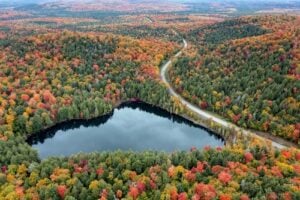
Autumn foliage surrounds a road near Panther Pond and Panther Mountain Bog in New York’s Adirondack Park, a region protected by the state’s historic Forever Wild conservation laws. Photograph by pics721 / Shutterstock.com.
It is difficult to look at the Adirondack Mountains today and imagine that the forests surrounding their lakes, rivers and villages might once have been sold, logged or developed on a vastly different scale. The Adirondack Park covers approximately six million acres of northern New York, making it the largest publicly protected area in the contiguous United States. It is larger than Yellowstone, Everglades, Glacier and Grand Canyon National Parks combined. But the Adirondacks are unlike those national parks in one essential respect: millions of acres within the park belong to private owners, and people live and work throughout its communities.
State-owned Forest Preserve lands account for roughly 2.6 million acres. The balance includes privately owned forests, farms, homes, businesses and villages, as well as other lands subject to different forms of protection and management. Approximately 123,000 people live year-round in the park’s 101 towns and villages, according to the Adirondack Park Agency. The region is simultaneously a great wilderness, a working landscape and a place people call home.
That unusual arrangement emerged from a nineteenth-century argument over the future of New York’s forests. The state’s political and business leaders feared that uncontrolled timber cutting could damage the headwaters of the Hudson River and other waterways essential to transportation and commerce. Surveyors, conservationists and local residents did not always agree on what should happen next. The result was a series of remarkable decisions: a state Forest Preserve in 1885, the creation of the Adirondack Park in 1892 and, in 1894, a constitutional promise that state Forest Preserve lands would remain forever wild.
Before the Park: Logging, Settlement and the Adirondack Watershed
The Adirondacks were not an untouched landscape suddenly discovered by nineteenth-century conservationists. Indigenous peoples had long known and used the region, and European American settlement, commercial hunting, mining and logging had been changing the forests for generations. By the middle of the nineteenth century, railroads, expanding markets and improving transportation routes were bringing new industries and visitors into northern New York.
Timber was particularly valuable. Spruce and other Adirondack trees supplied lumber and, later, the paper industry, while hemlock bark was important to tanning. Cutting trees was a source of jobs and income, but some operators removed timber without considering how the land would recover. Fires, erosion and abandoned logging areas raised fears that the mountains’ role as a vast source of clean water was being damaged.
The concern extended far beyond the communities where the trees were cut. The Adirondack Mountains contain headwaters connected to the Hudson, Black and other major New York rivers. The Hudson helped support commerce in the eastern part of the state, and water supplies were essential to the canals that had helped build New York’s economy. A damaged watershed could become an economic problem for people hundreds of miles away.
Verplanck Colvin and the Fight to Preserve the Mountains
One of the most influential advocates for protecting the Adirondacks was Verplanck Colvin, born in Albany in 1847. He studied law but became best known as a surveyor, topographical engineer and explorer. Beginning in the 1860s, Colvin traveled into the mountains, observing both their extraordinary natural features and the evidence of destructive logging. His work offered state officials something more useful than a sentimental appeal to scenery: a detailed explanation of why the forests mattered to New York’s future.
Following his explorations, including an ascent of Seward Mountain in 1870, Colvin reported on threats to the region and argued for a protected park. In 1872, he became superintendent of the Adirondack Survey. His crews mapped mountains, lakes, streams and property boundaries in a landscape where reliable geographic information was often difficult to obtain. Their work also examined the headwaters of the Hudson, including the high-elevation waters around Lake Tear of the Clouds near Mount Marcy.
Colvin understood that surveying and conservation were connected. Before the state could responsibly acquire and protect forestland, it needed to know where that land was and who owned it. He also emphasized the relationship between forests, rainfall, stream flow and the economic importance of navigation. His argument helped convince lawmakers that Adirondack conservation was not simply a benefit for vacationers or sportsmen. It was an investment in the state’s water resources and long-term prosperity.
The 1885 Forest Preserve: New York Takes Its First Major Step
Colvin was not alone. In 1884, a state commission headed by Harvard botanist Charles Sprague Sargent examined the possibility of protecting extensive northern forests. Meanwhile, the state had acquired considerable acreage through unpaid property taxes, and lawmakers were debating whether these lands should be sold, logged or retained for public purposes.
On May 15, 1885, Governor David B. Hill signed legislation creating the New York State Forest Preserve in designated Adirondack and Catskill counties. The law declared that state lands within the preserve were to remain wild forest lands rather than be treated simply as property available for disposal. This was a major change in the state’s relationship with its forests, although the protections were established by ordinary legislation and were vulnerable to later legislative changes.
That vulnerability soon became apparent. The state continued to face pressure to permit commercial timber cutting, and subsequent legal changes and administrative decisions weakened what preservationists believed the 1885 law had promised. The central problem was becoming clear: a Forest Preserve could exist on paper while its timber and natural resources remained exposed to political and commercial demands.
May 20, 1892: The Adirondack Park Is Created
The next major step came on May 20, 1892, when Governor Roswell P. Flower signed the legislation formally creating the Adirondack Park. The original park encompassed approximately 2.8 million acres, including both state-owned Forest Preserve lands and extensive private holdings. The law described a region intended for public health and enjoyment as well as the preservation of important river headwaters.
Creating a park did not mean that the state suddenly owned everything inside its boundaries. Much of the land remained in private hands, a distinction that still defines the Adirondacks. The original approach anticipated that the state would gradually acquire suitable parcels rather than immediately take possession of the whole region. It also left unresolved how preservation should work in a place where private landowners, businesses, residents and visitors had different interests.
The park was established more than two decades after Yellowstone became America’s first national park, but New York chose a very different model. Instead of setting aside a mostly federal landscape, it defined a large region that mixed public conservation land with communities and private property. That complicated structure would eventually become one of the Adirondacks’ most distinctive features.
Where the Adirondack Park’s Blue Line Came From
The park’s boundary is commonly called the Blue Line, a name rooted in nineteenth-century cartography. State maps prepared before the park’s formal creation showed a proposed protected area with its outline drawn in blue. The blue boundary appeared on planning maps in 1890 and 1891, and the park established in 1892 gave the idea legal significance.
The Blue Line should not be confused with the boundary of state-owned land. It surrounds a much larger area that contains Forest Preserve parcels alongside villages, private forests, farms, resorts and other properties. In the early years, the line helped identify where the state should concentrate future land purchases. As laws and management practices evolved, it also became the boundary within which special regional land-use rules would apply.
The original Adirondack Park was considerably smaller than today’s six-million-acre region. Its boundaries were expanded over time, and public land acquisitions gradually increased the size of the Forest Preserve. There was no single 1912 decision that first brought private land within the park: private holdings had already been included within the original Blue Line in 1892.
1894: The Constitutional Promise of Forever Wild
By the early 1890s, preservationists had concluded that legislation alone was not enough. Decisions allowing timber sales on protected state lands undermined confidence in the existing system. If a legislature or state commission could weaken preservation rules whenever commercial pressures increased, the forests might never receive lasting protection.
At New York’s Constitutional Convention in 1894, delegates considered how to create a barrier that ordinary legislation could not easily overcome. A committee chaired by David McClure heard testimony from Colvin and others concerned about the future of the Adirondacks. The convention approved language requiring state Forest Preserve lands to be kept as wild forests, forbidding their sale or exchange and barring the sale, removal or destruction of their timber. Voters ratified the provision in November 1894, and it took effect on January 1, 1895.
The provision was originally Article VII, Section 7 of the New York State Constitution. Since the constitutional reorganization of 1938, it has appeared as Article XIV, Section 1. Its central promise is the same: state-owned lands constituting the Forest Preserve are to be kept as wild forest lands, not treated as a source of timber or real estate available for ordinary disposal.
The distinction between the park and the preserve remains essential. Forever Wild is a constitutional protection for Forest Preserve land, including lands in the Adirondack and Catskill regions. It does not mean that every house, farm or privately owned timber tract inside the Blue Line is constitutionally required to remain wilderness. Those properties operate under different laws and, within the Adirondack Park, a regional planning system developed much later.
When Forever Wild Was Tested in Court
Putting conservation language in the state constitution did not end disagreements about how land should be used. Roads, recreation, ski trails and other public projects sometimes required tree removal or changes to the landscape. The recurring question was how far officials could go before violating the constitutional promise.
One famous dispute involved preparations for the 1932 Winter Olympics in Lake Placid. State officials wanted to construct a bobsled run on Forest Preserve land, but the project required removing thousands of trees. In 1930, New York’s highest court ruled against the proposal in Association for the Protection of the Adirondacks v. MacDonald. The decision made clear that even a major sporting event could not justify ignoring the constitution.
Over time, New Yorkers approved narrowly drawn constitutional amendments allowing certain projects that would otherwise conflict with Forever Wild. Some concerned skiing facilities or transportation; others addressed particular land exchanges and public improvements. The history of the preserve is therefore not a story of absolutely no change. It is a story of requiring especially high public accountability before protected state land can be used for purposes that the constitution does not ordinarily allow.
1971 to 1973: The Adirondack Park Agency and Private Land
The constitutional provision dealt principally with state-owned Forest Preserve lands. By the middle of the twentieth century, however, a different challenge had emerged on the much larger landscape inside the Blue Line. New highways, increased automobile travel and rising demand for vacation homes made parts of the Adirondacks more accessible to development. Conservation of public forests alone could not address every question about the region’s future.
Under Governor Nelson Rockefeller, New York established the Adirondack Park Agency in 1971. The agency was directed to help plan and regulate the use of both public and private land within the park. Its creation reflected a new recognition that development on one parcel could affect lakes, streams, scenery and neighboring communities far beyond that property’s boundaries.
In 1972, New York adopted the Adirondack Park State Land Master Plan, which guides the management of state lands through categories such as Wilderness, Wild Forest and Intensive Use. The following year, the state enacted the Adirondack Park Land Use and Development Plan for private property. That plan created categories ranging from hamlets and moderate-intensity areas to resource-management lands where development is more restricted.
The new system did not erase the distinction between the Forest Preserve and private property. It recognized that the park needed conservation rules alongside functioning towns, businesses and private homes. The Adirondack Park Agency also became a source of continuing controversy. Some residents and local officials regarded regional controls as necessary but burdensome; conservation advocates emphasized the danger of fragmented development gradually changing the character of the entire park.
What It Takes to Change the Forever Wild Protections
Because Forever Wild is part of the state constitution, the Legislature cannot simply pass an ordinary law authorizing the sale of Forest Preserve acreage or a major incompatible project. The normal amendment process requires approval by both houses of the Legislature, another approval after the next Assembly election and then a statewide vote. This gives New Yorkers far beyond the Adirondack region a direct role in decisions affecting protected land.
A 2017 statewide referendum demonstrated how this process can accommodate limited local needs. Voters approved a constitutional amendment creating a 250-acre health and safety land account for qualifying public projects in the Adirondack and Catskill Forest Preserves, subject to conditions and compensating land additions. The measure was intended to help communities address projects such as dangerous road curves, utility lines and bridges without requiring a separate statewide amendment for every qualifying small project.
The 2017 vote did not abolish Forever Wild or open the Forest Preserve to general development. Rather, it established a narrow procedure for specified public needs while preserving the larger constitutional framework. Decisions about these exceptions still provoke debate, illustrating how closely New Yorkers continue to examine the meaning of the promise first approved in 1894.
The Adirondack Park’s Living Legacy
Today the Adirondack Park contains more than 3,000 lakes and ponds and approximately 30,000 miles of rivers and streams. Its mountains include Mount Marcy, New York’s highest peak, while its communities range from small hamlets to established vacation centers. The region supports hiking, paddling, skiing, tourism, forestry and the everyday activities of people whose families have lived there for generations.
Its history also reveals that conservation has never been simply a question of drawing a line on a map. The Adirondacks became a park because New Yorkers recognized that forests, water supplies, local economies and the interests of future generations were connected. They gave that judgment legal force in 1885, drew a regional boundary in 1892, strengthened its protection in 1894 and added a more comprehensive land-use system in the 1970s.
More than 130 years after the Adirondack Park was created, Forever Wild remains an unusually powerful promise. It has not eliminated disagreements over land, development or recreation, but it has changed who gets to make those decisions and how difficult it is to reverse the state’s commitment. The forests that inspired Verplanck Colvin still stand because generations of New Yorkers decided that some natural places should not be sacrificed to the needs of the moment.
For more Adirondack history, explore our 15 Historic Great Camps of the Adirondacks and Their Remarkable Architecture, 10 Vanished Grand Resorts and Hotels of the Catskills and Adirondacks and 25 Famous People You Didn’t Know Were From the Adirondacks and New York’s North Country. The waterways that helped motivate early conservation also connect this story to our History of the Erie Canal.