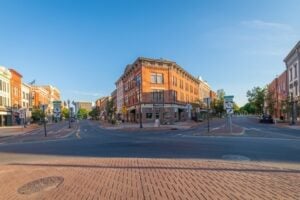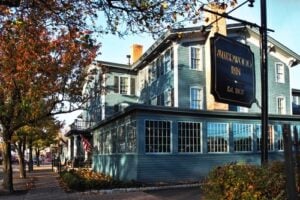
The historic Sherwood Inn in Skaneateles, New York, was established in 1807. Photo: Debra Millet / Shutterstock.com.
One of the things I enjoy most about traveling through Upstate New York is finding a restaurant that has been part of its community for generations. There is something special about sitting down to eat in a place where travelers stopped long before interstate highways, or ordering lunch from a business that served customers when our grandparents were young.
Upstate New York’s restaurant history stretches from Hudson Valley taverns and stagecoach inns to family-run pizzerias, diners, and neighborhood landmarks. Some businesses on this list trace their roots to the eighteenth or nineteenth century. Others occupy much older buildings but began operating as restaurants considerably later. Those are two different histories, and it is important not to confuse them.
These are 25 of the oldest and most historically significant restaurants in Upstate New York where customers can still get something to eat. This is a researched selection, not a claim that they are precisely the 25 oldest in an official statewide ranking. Nor does an old founding date always mean uninterrupted operation. A few historic inns were closed for renovations and reopened, while others changed locations or names. I have included those distinctions because the real history is more interesting than an exaggerated claim of continuous service.
The list ranges from the Hudson Valley and Capital Region through Central and Western New York and the North Country. For this article, the Hudson Valley north of New York City is included within the broad geographic scope. It covers formal dining rooms and humble places to grab a hot dog or a plate of pasta, because restaurant history is made in both.
1. Hoffman House Tavern (Kingston, Ulster County)
Historic building: Before 1679. Restaurant: A much later use of the building.
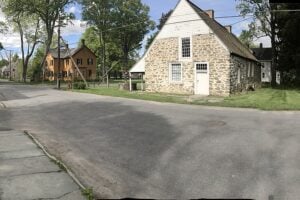
At 94 North Front Street in Kingston, the Hoffman House offers an unusual experience: dining inside a stone building whose history reaches back to the seventeenth century. Its surviving architecture reminds us of Kingston’s colonial era, when the settlement was an important center of government and commerce in the Hudson Valley. The building is far older than most restaurants anywhere in the state.
That does not mean the current Hoffman House Tavern has served the same meals since 1679. The modern restaurant operates in a carefully preserved historic structure, and the building’s age should not be confused with the business’s founding date. It remains a real working restaurant, with a dining room and tavern rather than simply a historic house open for tours.
2. Old Drovers Inn (Dover Plains, Dutchess County)
Historic tavern roots: Eighteenth century; the inn’s account uses 1750.
Old Drovers Inn, on East Duncan Hill Road in Dover Plains, recalls an age when cattle and other livestock traveled on foot toward the markets of New York City. Drovers moved animals along established roads and needed places to stop, eat, drink, and sleep. The establishment traces its origins to a tavern known as the Clear Water Tavern, associated with the Preston family. Its website dates the opening to 1750, while an older Dutchess County Historical Society account places a public house on the property as early as 1727. That difference is a reason to avoid pretending there is one undisputed founding year.
The inn operates as a lodging and dining destination today, serving dinner and pub-night meals in rooms that emphasize its historic character. The current kitchen is not an eighteenth-century operation preserved unchanged, but the tavern tradition remains central to the place. It is one of the strongest examples of the old roadside hospitality that shaped travel through the Hudson Valley.
3. Stagecoach Inn (Goshen, Orange County)
Original structure: 1747. Inn origins: Late eighteenth century; modern dining reopened after restoration.
Goshen’s Stagecoach Inn stands in a building whose oldest portion dates to 1747. The property acquired an innkeeping role after Anthony Dobbin purchased it in the 1790s, and by the early nineteenth century it served travelers moving through Orange County. Its history connects the region’s agricultural roads, local courts, and old routes toward Albany and New York City.
After major restoration work, the inn reopened in 2016, bringing hospitality and dining back to the historic property. Its current restaurant serves weekend dinners, rather than operating as an uninterrupted eighteenth-century kitchen. That is precisely why its history is worth presenting carefully: it is a preserved old inn that has found a new place in modern Hudson Valley dining.
4. Bird & Bottle Inn (Garrison, Putnam County)
Historic establishment: 1761. Modern restaurant: Reopened in 2022 after renovation.
Located on Old Albany Post Road in Garrison, the Bird & Bottle Inn traces its history to 1761. The old road and the surrounding Hudson Highlands help explain why an inn was needed here. During the colonial period, establishments along these routes offered food, lodging, and news to travelers moving between settlements.
The property changed hands over the generations and underwent another major restoration after its owners purchased it in 2020. The restaurant and tavern reopened in April 2022 after a two-year closure. Diners can again visit the historic property for meals, but its recent closure and reopening mean that calling it continuously operated without qualification would be wrong.
5. The Tavern at the Beekman Arms (Rhinebeck, Dutchess County)
Inn and tavern history: 1766.
The Beekman Arms in the village of Rhinebeck is among the most widely recognized historic inns in the Hudson Valley. Its hospitality history dates to 1766, before the American Revolution. The colonial tap room, heavy overhead beams, and open hearth give visitors a sense of the kind of surroundings that once greeted travelers passing through the village.
Unlike several historic properties converted into restaurants much later, the Beekman Arms has a longstanding and well-documented tradition of innkeeping. The Tavern at the Beekman Arms still serves meals, including lunch and dinner, and the larger property continues to operate as an inn. It is an especially fitting place to begin understanding how dining, travel, and local history became intertwined in New York.
6. Bull’s Head Inn (Cobleskill, Schoharie County)
Historic inn: 1802. Current dining: In the restored Cobleskill landmark.
Bull’s Head Inn is located in Cobleskill, not Campbell Hall in Orange County as some restaurant lists mistakenly state. Dating to 1802, the property recalls Schoharie County’s early nineteenth-century road travel and village development. Its restored rooms preserve the atmosphere of an old tavern while accommodating modern dining and gatherings.
The operators offer restaurant and tavern service, including meals by reservation. The building’s early date is well documented, but its current restaurant should be described as a contemporary operation within a historic property rather than a business proved to have operated without interruption for more than two centuries. For travelers in the Schoharie Valley, it remains a distinctive place to eat in a genuine local landmark.
7. The Sherwood Inn (Skaneateles, Onondaga County)
Established: 1807.
Isaac Sherwood established the tavern that became the Sherwood Inn in 1807 to serve his stagecoach business. Its location in Skaneateles made sense during an era when travelers depended on roads, horses, and roadside accommodations. The property changed names and owners over time, reflecting the evolution of the village from a transportation stop into a Finger Lakes destination.
Today, the Sherwood Inn overlooks Skaneateles Lake and maintains an active dining operation. The chance to have a meal beside the lake in a place with more than two centuries of recorded hospitality history is part of its appeal. Its age is connected to the actual inn and tavern business, rather than simply to an old house that acquired a restaurant much later.
8. Olde Bryan Inn (Saratoga Springs, Saratoga County)
Site’s tavern history: 1770s and 1780s. Current stone building: 1825. Present restaurant: Established around 1981.
The Olde Bryan Inn has an unusually layered history. Inns and taverns operated near Saratoga’s High Rock Spring during the Revolutionary era, and Alexander Bryan later became associated with the site. The stone house that forms an important part of today’s restaurant was constructed by John Bryan in 1825. For many years, however, the building served other uses, including a private residence and a laundry.
The present restaurant emerged after the property was purchased for restoration near the end of the 1970s, with the Olde Bryan Inn operating by 1981. Its tavern rooms and historic appearance offer a genuine connection to Saratoga’s past, but it would be inaccurate to say the modern restaurant has operated continuously since 1773. The distinction makes its story richer: an old Saratoga property found a new life as a popular dining room.
9. The Eagle House Restaurant (Williamsville, Erie County)
Established: 1827.
In Williamsville, the Eagle House stands near a historic crossroads once used by freight wagons and stagecoaches traveling between Buffalo and communities farther east. The tavern opened in 1827 under Oziel Smith, serving travelers who needed a meal or a bed along the road. Western New York was changing rapidly at the time, with Buffalo’s growth increasing traffic through the surrounding villages.
The Eagle House continues to operate as a restaurant in the heart of Williamsville, with a menu built around familiar American dining traditions. Its history is strongly tied to hospitality rather than merely to architecture, and regional tourism sources have described it as Erie County’s oldest restaurant. It is a reminder that some local establishments have survived while the transportation routes and communities around them were transformed.
10. Hudson House River Inn (Cold Spring, Putnam County)
Building: 1827. Welcoming guests: Since 1832.
The Hudson House River Inn sits beside the Hudson River in Cold Spring, where boats, waterfront industry, and visiting travelers helped shape village life. Built in 1827, it began welcoming guests in 1832 under an earlier name. Its location has long made it an attractive stopping place, particularly for visitors who want to experience the scenery of the Hudson Highlands.
The inn now offers public dining in its River Room and Half Moon Tavern. The menus and management have naturally changed over nearly two centuries, but hospitality remains central to the property. It combines an unusually old inn history with a restaurant that is genuinely serving customers today.
11. The Lincklaen House (Cazenovia, Madison County)
Built and established as an inn: 1835.
The Lincklaen House has been a defining building in downtown Cazenovia since 1835. Named for John Lincklaen, who helped establish the community, the inn reflects the prosperity of a village connected to the roads and commercial routes of Central New York. Its historic rooms became part of Cazenovia’s tradition of welcoming guests, social gatherings, and formal meals.
The property continues to operate with a restaurant, tavern, and other food service. The Seven Stone Steps tavern is one of the familiar names associated with its dining operation. Because the Lincklaen House still functions as an inn and dining destination, the nineteenth-century history is more than a date on a building plaque.
12. Schwabl’s (West Seneca, Erie County)
Business tradition: 1837. West Seneca location: Since 1942.
Schwabl’s is a classic Western New York food institution with origins dating to 1837. The family business developed through several locations in the Buffalo area before arriving at its present West Seneca home in 1942. That distinction is important: the restaurant has a long historical lineage, but it has not occupied its current building since the nineteenth century.
Schwabl’s is especially famous for beef on weck, the region’s roast-beef sandwich served on a kummelweck roll. Its traditional carving and old-fashioned atmosphere have helped it remain a destination for generations of diners. For an article about historic restaurants, it offers something essential: not just an old name, but a living local food tradition that customers can still taste.
13. Historic Hotel Broadalbin (Broadalbin, Fulton County)
Original building: 1854. Converted to hotel use: Nineteenth century.
The Historic Hotel Broadalbin began in a building constructed in 1854 for the glove trade, an important industry in Fulton County. An expansion in 1881 helped transform it into a hotel, and the property later experienced several other uses, including a period associated with medical treatment. The building’s history is therefore not the story of one uninterrupted restaurant.
Today, the restored hotel offers food through its restaurant and 1854 Pub, along with lodging and events. Diners are eating in a property that has survived major changes in Broadalbin’s economy and downtown life. It belongs on a list of historic places to dine, provided the 1854 date is correctly identified as the building’s origin rather than the opening of the present kitchen.
14. The White Inn (Fredonia, Chautauqua County)
Historic property: 1868. Recent reopening: After a closure beginning in 2018.
The White Inn is a familiar landmark on East Main Street in Fredonia, with roots in the nineteenth-century property of Dr. Squire White. Its historic character has long made it a recognizable part of the village, and it eventually became a hotel and dining destination associated with important community occasions and visitors to the Chautauqua region.
The inn closed in 2018 and underwent restoration under new ownership before reopening with guest rooms, a restaurant, and event spaces. The current dining room serves the public, but the recent closure means that claims of uninterrupted restaurant service from 1868 would be inaccurate. Its survival is still significant: a historic Fredonia landmark has returned to active hospitality use.
15. Belhurst Castle’s Edgar’s Restaurant (Geneva, Ontario County)
Castle built: 1880s. Restaurant and entertainment use: Since 1933.
Belhurst Castle overlooks Seneca Lake from a property developed as a private residence in the late nineteenth century. The stone castle was constructed during the 1880s and became an elaborate lakeside landmark. Its transformation into a public hospitality destination began in 1933, when Cornelius ‘Red’ Dwyer opened a restaurant and gambling establishment there.
Today, Edgar’s Restaurant operates inside the castle, with dining rooms that incorporate the setting’s historic architecture and lake views. This is an excellent example of why the age of a building and the age of its restaurant are separate facts. Belhurst dates to the nineteenth century, but its documented restaurant history begins in the twentieth.
16. The Krebs (Skaneateles, Onondaga County)
Restaurant founded: 1899. Closure and revival: Closed in 2010 and reopened in 2014.
Fred and Cora Krebs began serving meals in Skaneateles in 1899, creating a restaurant that eventually became famous for elaborate, generous dinners. Diners traveled from far beyond the Finger Lakes to experience the hospitality, and the name became associated with a particular style of formal American dining. Its reputation grew through many decades of family management.
The Krebs closed in 2010 after the death of a longtime co-owner, but new owners restored the restaurant and reopened it in 2014. Its current operation offers contemporary fine dining while acknowledging its history. It is one of Upstate New York’s most remarkable restaurant revivals, though not an example of completely continuous operation since 1899.
17. Manory’s Restaurant (Troy, Rensselaer County)
Established: 1913.
Manory’s has been part of Troy’s dining scene since 1913, a rare survival in a downtown that has seen businesses come and go for more than a century. Located on Congress Street, it represents the everyday side of historic dining: breakfasts, lunches, coffee, and a familiar place to meet rather than an elaborate inn or formal dining room.
The restaurant continues to serve customers from its long-established Troy address. Its appeal lies in continuity and community memory, the kind that develops when several generations grow up knowing the same restaurant name. Manory’s also provides a useful contrast to older taverns: restaurant history did not stop with stagecoaches and colonial buildings.
18. O’Scugnizzo Pizzeria (Utica, Oneida County)
Established: 1914.
O’Scugnizzo Pizzeria began in Utica in 1914 when Eugeno Burlino sold tomato pies for a nickel. Its history predates the national popularity of pizza chains and reflects the Italian-American food traditions that developed in Central New York during the early twentieth century. The business remained associated with the Burlino family as its menu and customer base grew.
Still serving customers from Bleecker Street, O’Scugnizzo is known for the distinctive style of Utica pizza, including pies in which sauce is added over the cheese. It is a particularly valuable choice for this list because the historical claim concerns the restaurant itself, not merely a building constructed before the business existed.
19. Heid’s of Liverpool (Liverpool, Onondaga County)
Hot-dog stand origins: Around 1917. Restaurant at present site: Around 1930.
Heid’s is one of the most recognizable eating places in Central New York. Valentine Heid’s hot-dog business dates to about 1917, and the restaurant developed near the family meat market in Liverpool. A historical marker approved by the William G. Pomeroy Foundation distinguishes the early stand from the restaurant that opened at its current corner around 1930.
The business remains famous for its grilled hot dogs and coneys and still welcomes customers near Onondaga Lake Parkway. Heid’s is proof that an enduring restaurant does not have to serve formal meals or occupy a colonial tavern. Sometimes a simple regional specialty, prepared for generations, is enough to create a historic institution.
20. Nick Tahou Hots (Rochester, Monroe County)
Restaurant tradition: 1918.
Nick Tahou Hots represents a different part of Rochester’s restaurant history from its elegant hotels or neighborhood diners. The restaurant traces its history to 1918 and is closely associated with the famous Garbage Plate, a combination meal that became one of the city’s most recognizable culinary traditions.
The restaurant on West Main Street remains in business, continuing the name and the local food tradition that helped make Rochester famous to travelers looking for something unusual. Its long history reminds us that restaurant longevity can emerge from food made for everyday customers rather than from expensive dining or historic architecture.
21. Chef’s Restaurant (Buffalo, Erie County)
Established: 1923.
Chef’s Restaurant opened in Buffalo in 1923 on the corner of Seneca and Chicago streets. Its Italian-American menu grew over the decades as the restaurant developed a large following. Lou Billittier began working there in 1941, eventually becoming an owner and helping transform Chef’s into one of the city’s most familiar dining names.
Generations of customers have known Chef’s for pasta and especially its spaghetti parmesan. The restaurant expanded its dining spaces as demand grew but retained its connection to the neighborhood where it began. Its story illustrates the staying power of immigrant-influenced family food traditions in the industrial cities of Western New York.
22. The Crystal Restaurant (Watertown, Jefferson County)
Established: 1925.
The Crystal Restaurant opened on Watertown’s Public Square in 1925, when the city’s downtown was an important center for shopping, travel, and community life. It became known for its traditional interior, including a historic bar and original-looking details that recall an earlier age of North Country restaurants.
Still operated by descendants of the family closely associated with its history, the Crystal continues to serve meals and drinks. Watertown’s downtown has changed considerably over the past century, but the restaurant’s survival gives residents a direct link to the days when Public Square was filled with independent businesses and gathering places.
23. Varsity Pizza (Syracuse, Onondaga County)
Established: 1926.
Varsity Pizza opened near Syracuse University in 1926 and became a fixture of University Hill. Its location helped it attract students, hospital workers, neighborhood residents, and generations of Syracuse sports fans. The restaurant’s long-standing relationship with campus life is part of what distinguishes it from an ordinary pizzeria.
The business remains family operated and serves pizza, breakfast foods, and other casual meals at its South Crouse Avenue location. Its history stretches across changes in the university, the city, and the expectations of diners. Few places so closely connect Syracuse food traditions with the experience of attending a college game or spending a day on the Hill.
24. Ted’s Hot Dogs (Buffalo and Western New York)
Established: 1927.
Ted’s Hot Dogs began in 1927 when Theodore Spiro Liaros developed a hot-dog business near Buffalo’s Peace Bridge. The company grew into a Western New York institution through a straightforward idea: charcoal-grilling hot dogs and other familiar foods in front of customers. Its origins belong to a period when automobile travel and inexpensive roadside eating were becoming important parts of American life.
The chain is still operating in Western New York and has expanded beyond the region. It has remained associated with the flavor of real charcoal cooking and a menu that can be recognized by generations of local families. Although the company now has more than one location, its history began with a single small food business on Buffalo’s waterfront.
25. Hattie’s Restaurant (Saratoga Springs, Saratoga County)
Established: 1938.
Hattie’s opened in Saratoga Springs in 1938 and became an important part of the city’s distinctive restaurant culture. Founded by Hattie Moseley Austin, it brought Southern and Louisiana-influenced cooking to a northern resort and racing community. Its fried chicken developed a following that extended far beyond Saratoga.
The original restaurant on Phila Street continues to serve customers under new ownership that has retained the Hattie’s name and food traditions. A separate Hattie’s Chicken Shack location in Wilton closed in 2026, but that did not mean the historic downtown restaurant had closed. It remains a fitting final example of how a restaurant can preserve its identity across generations and ownership changes.
What Makes These Restaurants Part of Upstate New York History?
There is an enormous difference between an eighteenth-century tavern that has hosted travelers for generations and a restaurant opened in a restored seventeenth-century house. Both can be important historical places, but they should not be given identical founding claims. The same is true of restaurants that survived through new owners, changed addresses, or reopened after a long closure. Their history deserves accuracy rather than a more impressive-sounding date.
What connects the places on this list is that their stories remain visible in places where customers can still eat. From an old stone tavern in Kingston to a plate of pasta in Buffalo or a hot dog in Liverpool, they demonstrate how the food and hospitality of Upstate New York have changed without erasing every trace of the past.
For more stories about New York’s enduring and vanished places to eat, see our articles on 15 Historic Diners in Upstate New York Worth Visiting, 25 Lost Restaurants Upstate New Yorkers Wish Were Still Open, and 10 Classic New York Restaurants We Miss the Most.