Feature Photo: Chester Higgins, Jr., Public domain, via Wikimedia Commons
When a garbage bag disappears from a New York City curb, it does not go to a landfill somewhere inside the five boroughs. New York City has no active municipal solid waste landfill or incinerator. Ordinary residential and institutional refuse collected by the New York City Department of Sanitation is ultimately exported for disposal to landfills and waste-to-energy facilities outside the city.
That does not mean, however, that every pound of material collected by DSNY leaves New York City. Paper recycling and organics are largely processed within the city, while refuse destined for disposal is exported. According to the city’s Revised Draft 2026 Solid Waste Management Plan, DSNY managed close to 3.2 million tons of residential and institutional refuse in 2023, and approximately 86 percent of DSNY-managed refuse moved by rail.
The modern export system is the direct legacy of one of the most extraordinary chapters in New York sanitation history. For more than half a century, much of the city’s household garbage ended its journey at Fresh Kills on Staten Island, a tidal marsh that became the largest landfill in the world and is now being transformed into Freshkills Park.
Where Does NYC Trash Go Today?
For ordinary household refuse collected by DSNY, the answer depends on the borough and sanitation district. Some garbage goes to landfills in Virginia, South Carolina, or upstate New York. Other refuse goes to waste-to-energy facilities in New Jersey, Pennsylvania, or Niagara Falls, New York.
The exact routing can change depending on contracts and operational needs, but the basic system is consistent: collection trucks bring refuse to transfer facilities, the waste is consolidated into intermodal containers, and much of it travels by barge and freight rail before reaching a final disposal site.
New York City itself still contains hundreds of facilities involved in transferring, recycling, composting, processing, and recovering waste. What it does not contain is an active municipal solid waste landfill or municipal solid waste incinerator.
How Much Trash Does New York City Produce?
The answer depends on what is being counted. New York City residents, businesses, institutions, and construction activity together generate more than 13 million tons of residential, commercial, and construction and demolition waste each year. Most of that total is not collected by DSNY.
For the publicly managed residential and institutional system, the city’s 2026 waste plan estimates that approximately 3.85 million tons of DSNY-managed waste were generated in the 2023 baseline year. About 3.15 million tons were disposed of, while approximately 700,000 tons were diverted through recycling and other recovery programs.
That distinction is important because the often-repeated claim that New Yorkers produce roughly 14,000 tons of residential garbage every day mixes different parts of the waste stream together. DSNY’s official planning numbers provide a clearer picture when residential refuse, recycling, organics, commercial waste, and construction debris are kept separate.
How a New York City Garbage Bag Travels From the Curb
The first stage is familiar to every New Yorker. DSNY collection trucks pick up residential and institutional refuse from the curb and bring it to a public or private transfer facility.
At a transfer station, refuse from many collection trucks is consolidated and loaded into intermodal containers. At the city’s refuse Marine Transfer Stations, those containers are moved by barge to terminals with rail connections. The containers are then transferred to freight trains for the long trip to a landfill or waste-to-energy facility.
In 2023, approximately 86 percent of DSNY-managed refuse was transported by rail. The remainder was exported by truck. This represents a major change from the years immediately following the closure of Fresh Kills, when New York depended much more heavily on long-distance truck export.
Where Does Manhattan’s Garbage Go?
Manhattan’s refuse follows more than one route. Garbage collected in several central and Upper East Side sanitation districts goes to the East 91st Street Marine Transfer Station. From there, containerized refuse travels by barge to the Port Liberty New York terminal at Howland Hook on Staten Island, where it is transferred to railcars.
Those rail shipments can ultimately go to Reworld’s Delaware Valley Resource Recovery Facility in Chester, Pennsylvania, or the company’s Niagara Resource Recovery Facility in Niagara Falls, New York.
Refuse from southern and western Manhattan follows a different route. DSNY trucks serving those districts currently haul the material directly to the Reworld Essex thermal treatment facility in Newark, New Jersey.
Where Does Brooklyn’s Garbage Go?
Much of southern and central Brooklyn’s refuse is delivered to the Hamilton Avenue or Southwest Brooklyn Marine Transfer Stations. The sealed containers are barged to Elizabeth, New Jersey, transferred to rail, and transported to the Maplewood, also known as Amelia, Landfill in Virginia.
Some northern Brooklyn districts use the privately operated Varick Transfer Station. Most of that material is containerized and ultimately moved by rail through the regional freight network to the High Acres Landfill in Fairport, New York.
Where Does Queens Garbage Go?
Eastern Queens districts use the North Shore Marine Transfer Station. Like waste handled at East 91st Street in Manhattan, the containerized refuse is barged to Port Liberty on Staten Island and then moved by rail toward waste-to-energy facilities in Pennsylvania or upstate New York.
Western Queens districts use the Review Avenue Transfer Station, where refuse is containerized and placed onto railcars. Those containers currently follow a rail route that ultimately reaches the High Acres Landfill in Fairport, New York.
Where Does Bronx Garbage Go?
Residential and institutional refuse from the Bronx is delivered to the Harlem River Yard. There, the waste is containerized and transported by freight rail to the Atlantic Waste Disposal Landfill in Virginia.
The modern rail system reduces dependence on fleets of long-haul tractor-trailers crossing city neighborhoods and bridges, although local collection trucks and short-distance truck movements remain essential parts of the system.
Where Does Staten Island Garbage Go?
Staten Island has perhaps the most striking before-and-after story. For decades, garbage from across New York City came to Staten Island. Today, Staten Island’s own refuse leaves the borough.
DSNY trucks bring Staten Island residential and institutional refuse to the Staten Island Transfer Station beside the Freshkills site. Containerized waste is placed on rail and currently transported to the Lee County Landfill in Bishopville, South Carolina.
What Happens to NYC Recycling and Food Scraps?
Not everything collected at the curb follows the landfill and incinerator network. New York City’s recycling system includes substantial processing capacity inside the five boroughs.
Sims Municipal Recycling operates a material recovery facility in Brooklyn and processes DSNY metal, glass, and plastic recyclables along with some paper. Pratt Industries operates a paper recycling and paper mill facility on Staten Island that processes most of the paper collected by DSNY.
Organics collected through the city’s residential composting program are also largely processed within New York City, including at the Newtown Creek Wastewater Resource Recovery Facility and city-owned composting facilities. This is why it is inaccurate to say that every pound of New York City waste is shipped outside the city.
What Was Fresh Kills Before It Became a Landfill?
Before garbage began arriving, Fresh Kills was a landscape of tidal creeks, wetlands, and coastal marsh on the western shore of Staten Island. The name comes from the Middle Dutch word kille, meaning a riverbed or water channel.
The landscape was low, wet, and difficult to develop, which made it vulnerable to an approach to urban planning that was common in the middle of the 20th century: fill the wetlands, raise the land, and prepare the property for development.
How Fresh Kills Landfill Began in 1948
Fresh Kills Landfill was established in 1948 by New York City and Parks Commissioner Robert Moses. The original concept was not to operate a giant landfill forever. The early plan envisioned using fill for roughly three years to raise the approximately 450-acre wetland site and prepare it for future development.
A 1951 development proposal associated with Moses envisioned parks, roads and other public works, residential development, and a major industrial area along the west shore.
That temporary vision never materialized. Instead of closing after a few years, Fresh Kills continued accepting New York’s garbage for more than half a century.
How Fresh Kills Became the World’s Largest Landfill
By 1955, Fresh Kills had become the largest landfill in the world. As other New York City landfills closed, more and more of the city’s household refuse was redirected to Staten Island.
At its peak during the 1980s, Fresh Kills received as much as 29,000 tons of trash per day. The landfill’s four major mounds eventually contained approximately 150 million tons of solid waste.
By 1991, after the Edgemere Landfill in Queens closed, Fresh Kills was the only remaining active New York City landfill accepting household garbage. From that point until its closure, the city’s residential garbage system depended overwhelmingly on one enormous disposal site on Staten Island.
Fresh Kills was once legitimately described as the world’s largest landfill. More sensational claims that it was the largest man-made structure on Earth, larger than the Great Wall of China, or plainly visible from orbit are better left out. The documented scale of the landfill is extraordinary enough without repeating those myths.
The Garbage Barges That Fed Fresh Kills
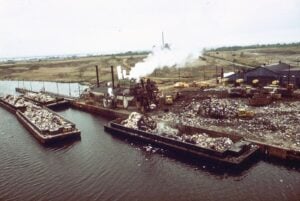
For generations, New York garbage traveled to Staten Island aboard barges. Refuse collected around the city was taken to marine transfer stations and loaded for the trip through New York Harbor and the Arthur Kill to Fresh Kills.
The barge system allowed enormous quantities of garbage to be moved without sending every load across the city’s bridges and streets by truck. Once the barges arrived, the refuse was unloaded and added to the growing landfill mounds.
The image of garbage barges arriving at Fresh Kills became inseparable from Staten Island’s long fight against the landfill. What the rest of New York threw away was physically concentrated on one borough’s western shore.
Why Fresh Kills Landfill Closed
Staten Island residents opposed the landfill for decades, objecting to odors, truck and barge traffic, environmental conditions, and the fundamental unfairness of one borough carrying such a large share of the city’s disposal burden.
In 1996, New York State enacted legislation requiring Fresh Kills to stop accepting solid waste by the end of 2001. The phaseout moved faster than that final deadline.
On March 22, 2001, Fresh Kills received its last barge of regular New York City household garbage. After 53 years, New York City’s last landfill had stopped accepting ordinary municipal refuse.
What Happened to NYC Trash After Fresh Kills Closed?
The closure solved one problem and created another. New York City still produced millions of tons of refuse, but the disposal site that had absorbed much of it was gone.
In the years surrounding the closure, the city became heavily dependent on private transfer stations and long-distance truck export. Many of those facilities were concentrated in communities in the South Bronx, North Brooklyn, and Southeast Queens that were already carrying substantial environmental burdens.
The city’s 2006 Solid Waste Management Plan sought to build a more geographically balanced system and reduce dependence on long-haul trucks. A major part of that strategy was the reconstruction and reactivation of Marine Transfer Stations, allowing sealed containers of refuse to move by barge and rail instead.
Fresh Kills and the September 11 Recovery
Fresh Kills had been closed to regular household garbage for less than six months when the September 11, 2001 terrorist attacks changed the site’s role once again.
A section of the former landfill was temporarily used for the investigation and recovery operation involving material brought from the World Trade Center site. This was not a return to ordinary municipal garbage disposal.
Over approximately ten months, the FBI, NYPD, Office of Emergency Management, and recovery workers screened and sifted approximately 1.2 million tons of material from Ground Zero. The work involved the recovery of human remains, personal effects, and evidence connected to the attacks.
That history gives part of the Fresh Kills site a meaning completely separate from its decades as a municipal landfill. The area associated with the recovery operation remains connected to the memory of September 11 and the people who worked there.
From Fresh Kills Landfill to Freshkills Park
The former landfill is now being transformed into Freshkills Park, with the park name written as one word. The full master-plan site covers approximately 2,200 acres, almost three times the size of Central Park.
The transformation is not simply a matter of planting grass over garbage. The landfill mounds are engineered and capped with layers that isolate the buried waste. Systems of wells, trenches, and pipes collect landfill gas and leachate, while air, groundwater, and surface water are monitored.
Landfill gas collected at the site can be refined into pipeline-grade natural gas and used as fuel. The environmental-control systems will remain part of Freshkills for decades because the buried waste continues decomposing long after the landfill’s closure.
How Much of Freshkills Park Is Open?
The entire 2,200-acre park is not yet open to the public. In October 2023, New York City opened the 21-acre North Park section, the first public area located inside the former landfill site.
North Park includes pedestrian and cycling paths, a wetland overlook, a bird-viewing tower, native plant areas, and access to views of the creeks and surrounding landscape.
Freshkills Park is being constructed in phases and is currently scheduled for completion in 2036. When fully developed, the city says it will be the second-largest park in the five boroughs.
How the Modern Marine Transfer Station System Replaced Fresh Kills
Today’s Marine Transfer Stations perform a very different job from the old system that carried loose municipal refuse to Staten Island for burial. Modern facilities consolidate waste into intermodal containers so the same container can move across different transportation modes without repeatedly unloading the garbage itself.
DSNY currently operates four Marine Transfer Stations used for refuse, with locations in Manhattan, Brooklyn, and Queens, as well as a separate Manhattan Marine Transfer Station used for paper recycling.
At the refuse facilities, collection trucks deliver the material, which is containerized and moved by barge to a transload terminal. The sealed containers are then placed on freight rail for the long-distance portion of the trip.
Why New York Uses Freight Rail to Move Garbage
Rail export allows a large amount of waste to travel long distances without requiring the same number of tractor-trailers on highways, bridges, and neighborhood streets. It also reflects the simple geography of modern New York: the city no longer has an operating landfill, while suitable disposal capacity exists hundreds of miles away.
According to DSNY, approximately 86 percent of DSNY-managed refuse was transported by rail in 2023. The remaining tonnage was exported by truck.
The system is complicated. A container may be collected in Manhattan, barged to Staten Island, moved by rail through New Jersey, and eventually reach a facility in Pennsylvania or upstate New York. Another load may begin in Brooklyn and travel by barge and train to Virginia.
How Much Does NYC Spend Exporting Trash?
Long-distance waste export is expensive. The New York City Council’s Fiscal 2026 Executive Plan analysis lists approximately $480.5 million for DSNY’s Waste Export program in Fiscal Year 2026.
That figure helps explain why waste reduction and recycling are not merely environmental goals. Every ton that can be prevented, reused, recycled, composted, or otherwise recovered reduces pressure on a disposal system that requires New York to pay for transfer infrastructure, transportation, contracts, and distant disposal capacity.
How Much Waste Does the Average New Yorker Generate?
The city’s latest solid waste plan calculates DSNY-managed daily waste generation at approximately 2.4 pounds per person per day using the 2023 baseline. That figure includes refuse and recyclables from residential and some institutional sources.
It should not be compared directly with larger national or statewide per-capita waste figures that also include commercial waste. New York City’s restaurants, offices, stores, construction sites, manufacturers, and other businesses generate additional waste that is generally managed by private haulers rather than DSNY.
More Staten Island and New York City Infrastructure History
The history of Fresh Kills is closely connected to the larger story of Robert Moses and the way he reshaped New York. Readers can also see how the former landfill fits into the city’s changing park system in our guide to the 10 Largest Public Parks in NYC. For the history connected to the site’s 2001 recovery operation, continue with our 9/11 Memorial location, history, and visitor guide. Staten Island’s larger transportation story can be explored in our History of the Verrazzano-Narrows Bridge.
Sources
New York City Department of Sanitation, Revised Draft 2026 Solid Waste Management Plan
New York City Department of Sanitation, Solid Waste Management Plan
Freshkills Park, History, Waste Management, and Landfill Engineering FAQs
Freshkills Park, Robert Moses on Fresh Kills
New York City Mayor’s Office, Opening of North Park at Freshkills Park
New York City Council, Fresh Kills Landfill History and Report
New York City Council, Department of Sanitation Fiscal 2026 Executive Plan
Where NYC Trash Typically Goes Today at a Glance
| Area Served | Transfer Route | Typical Final Destination |
|---|---|---|
| Central and Upper East Side Manhattan districts | East 91st Street MTS → barge to Port Liberty on Staten Island → rail | Reworld Chester, Pennsylvania, or Reworld Niagara, New York |
| Eastern Queens districts | North Shore MTS → barge to Port Liberty on Staten Island → rail | Reworld Chester, Pennsylvania, or Reworld Niagara, New York |
| Much of southern and central Brooklyn | Hamilton Avenue or Southwest Brooklyn MTS → barge to Elizabeth, New Jersey → rail | Maplewood/Amelia Landfill, Virginia |
| Staten Island | Staten Island Transfer Station → rail | Lee County Landfill, Bishopville, South Carolina |
| Bronx | Harlem River Yard → rail | Atlantic Waste Disposal Landfill, Virginia |
| Northern Brooklyn | Varick Transfer Station → local transfer → rail | High Acres Landfill, Fairport, New York |
| Western Queens | Review Avenue Transfer Station → rail | High Acres Landfill, Fairport, New York |
| Southern and western Manhattan districts | Direct truck export | Reworld Essex thermal treatment facility, Newark, New Jersey |
Typical routes are based on New York City’s Revised Draft 2026 Solid Waste Management Plan and may change according to contracts and operational needs.
Fresh Kills Landfill History at a Glance
| Year | Milestone |
|---|---|
| 1948 | Fresh Kills Landfill is established by New York City and Parks Commissioner Robert Moses on Staten Island wetlands. |
| 1955 | Fresh Kills has become the largest landfill in the world. |
| 1980s | At peak operation, Fresh Kills receives as much as 29,000 tons of trash per day. |
| 1991 | After the Edgemere Landfill closes, Fresh Kills becomes New York City’s only remaining active landfill for household garbage. |
| 1996 | New York State legislation requires Fresh Kills to stop accepting solid waste by the end of 2001. |
| March 22, 2001 | The final barge of regular New York City household garbage arrives at Fresh Kills. |
| 2001–2002 | A section of the site is temporarily used for the World Trade Center investigation and recovery operation; approximately 1.2 million tons of material are screened and sifted. |
| 2008 | Construction on the transformation into Freshkills Park begins. |
| October 2023 | The 21-acre North Park section opens as the first public area inside the former landfill site. |
| 2036 | Current city schedule for completion of the phased Freshkills Park project. |
Published August 16, 2026.
Where Does NYC Trash Go? The History of Fresh Kills Landfill & Modern Waste Removal article published on ClassicNewYorkHistory.com © 2026