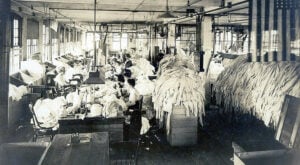
Feature Photo: Workers inside the Shaughnessy Knitting Mill in Watertown, New York, circa the 1910s. Public domain, via Wikimedia Commons.
New York’s minimum wage in 2026 isn’t a single number. The general minimum wage is $17.00 per hour in New York City and in Nassau, Suffolk, and Westchester counties, while it is $16.00 per hour in the rest of New York State.
For executive and administrative employees who are classified as exempt from overtime under New York’s wage orders, the 2026 state salary threshold is also regional. It is $1,275.00 per week, or $66,300 annually, in New York City, Nassau, Suffolk, and Westchester, and $1,199.10 per week, or $62,353.20 annually, in the rest of the state.
Those numbers are the latest chapter in a much longer New York story. More than a century before today’s regional wage rates and salary thresholds, garment workers, reformers, labor unions, legislators, and courts were fighting over a basic question: how far could government go in protecting workers from wages and working conditions that left them unable to support themselves?
This article is a historical and general-information guide, not legal advice. Wage and overtime rules depend on job duties, industry, employer coverage, work location, and other facts. Workers and employers should confirm current requirements with the New York State Department of Labor or qualified counsel.
What Is the Minimum Wage in New York in 2026?
As of January 1, 2026, the general minimum wage is $17.00 per hour in New York City, Nassau County, Suffolk County, and Westchester County. The general minimum wage is $16.00 per hour throughout the rest of New York State.
New York bases the applicable minimum wage on where the employee performs the work. Certain industries and categories of workers, including tipped employees, can be subject to additional rules, credits, or wage orders.
What Is the Minimum Salary for an Overtime-Exempt Employee in New York?
For 2026, New York’s minimum weekly salary for the executive and administrative overtime exemptions is $1,275.00 in New York City, Nassau, Suffolk, and Westchester counties and $1,199.10 in the remainder of the state.
That salary level is only one part of the exemption. Paying someone a salary does not automatically eliminate the right to overtime. The employee must also satisfy the applicable duties test for the exemption, and overlapping federal and state rules can matter.
The professional exemption is more complicated. New York’s state salary thresholds described above specifically apply to executive and administrative employees. Under the currently operative federal rule, the standard salary level for many executive, administrative, and professional exemptions is $684 per week, but federal law contains exceptions to the salary requirement for certain occupations, including bona fide teachers, lawyers, and doctors. For that reason, there is no single New York “professional employee minimum salary” that accurately describes every professional exemption.
How Overtime Works in New York
For most nonexempt employees, overtime is based on one and one-half times the employee’s regular rate of pay after 40 hours in a workweek. That distinction is important because the overtime rate is not automatically $25.50 downstate or $24.00 upstate. Those figures are simply what one and one-half times the 2026 minimum wage would equal for a worker whose regular rate is exactly the minimum wage.
New York also has industry-specific and occupation-specific overtime rules, so a general minimum-wage article should not treat every worker as if the same 40-hour calculation applies in exactly the same way.
Before Minimum Wage Laws, New York’s Garment Workers Lived With Sweated Labor
At the beginning of the 20th century, New York City stood at the center of the American garment industry. Immigrant labor, especially young Jewish and Italian women, powered factories and smaller workshops where long hours, piece-rate pay, weak bargaining power, and unsafe conditions were common.
The struggle over wages did not begin with a minimum-wage statute. It grew out of a much broader fight over hours, factory safety, union organization, child labor, workplace sanitation, and the power of employers over a largely immigrant workforce.
Labor organizers were already challenging those conditions before 1911. Clara Lemlich became one of the leading voices of the 1909 garment workers’ uprising, while Rose Schneiderman emerged as one of the most forceful advocates for working women. Their campaigns helped make New York’s garment industry one of the most important battlegrounds in American labor history.
The Triangle Shirtwaist Factory Fire Changes New York
On March 25, 1911, fire tore through the Triangle Waist Company on the upper floors of the Asch Building in Greenwich Village. The disaster killed 146 workers, most of them young immigrant women and girls.
Locked and inadequate exits, a failed fire escape, and other dangerous conditions left workers with few ways out. Some died inside the building. Others jumped from the upper floors as crowds watched from the streets below.
The Triangle fire did not create the minimum wage by itself, and the connection should not be overstated. What it did was expose, in a horrifyingly public way, the larger system of weak workplace regulation surrounding industrial labor. New York responded with a reform movement that reached far beyond fire safety.
The Factory Investigating Commission Studies Wages and Working Conditions
In 1911, New York established the Factory Investigating Commission. State Senator Robert F. Wagner served as chairman and Assemblyman Alfred E. Smith as vice chairman. The commission investigated factory safety, sanitation, working hours, child labor, and eventually wages and workers’ living conditions.
Frances Perkins, who had witnessed the Triangle fire and became one of the most important labor reformers of the 20th century, worked closely with the reform effort and assisted the commission. She was not, as the original draft stated, the commission’s “chief investigator.” The commission appointed different directors and field investigators for its various studies.
Beginning in 1913, the commission undertook a major wage investigation. It examined industries with large numbers of women workers and documented wages that were too low to maintain what reformers considered a decent standard of living. In its final work, the commission recommended machinery for establishing minimum wages for women and minors.
New York did not immediately enact that recommendation, but the idea had entered state policy. The question was no longer simply whether low wages existed. The political fight became whether government had the constitutional authority to set a wage floor.
The 1933 Minimum Wage Law Brings Wage Boards to New York
In 1933, during the depths of the Great Depression, New York finally enacted a minimum-wage law for women and minors. The statute authorized the Industrial Commissioner to investigate occupations in which substantial numbers of women or minors were receiving oppressive and unreasonable wages.
When the commissioner found such conditions, a wage board could be appointed. The board included representatives of employers, employees, and the public and could recommend minimum fair wage rates for the occupation.
This was not yet the universal minimum wage New Yorkers know today. The 1933 law did not establish one statewide hourly rate for all workers, and it did not generally extend the same wage-setting protection to adult men.
Morehead v. Tipaldo Strikes Down New York’s Minimum Wage Law
New York’s wage law soon collided with the constitutional doctrine of “freedom of contract.” In Morehead v. New York ex rel. Tipaldo, decided in 1936, the United States Supreme Court struck down New York’s minimum-wage system for women under the same line of reasoning that had invalidated the District of Columbia minimum-wage law in Adkins v. Children’s Hospital in 1923.
The Tipaldo decision became one of the most controversial labor rulings of the era. It showed how difficult it remained for states to regulate wages while the Supreme Court continued to treat freedom of contract as a major constitutional limitation on economic regulation.
West Coast Hotel v. Parrish Changes the Constitutional Rules
Only a year later, the constitutional landscape changed dramatically. In West Coast Hotel Co. v. Parrish in 1937, the Supreme Court upheld Washington State’s minimum-wage law for women and rejected the earlier constitutional approach that had blocked wage regulation.
New York moved again. State Archives records show that 1937 legislation established a Division of Minimum Wage within the Department of Labor and restored minimum-wage machinery for women and minors under the new constitutional environment.
The important point is that the shift was not simply the result of one New York lawsuit. Tipaldo became part of a national constitutional struggle over economic regulation, and West Coast Hotel marked the Supreme Court’s decisive move away from the older doctrine that had made minimum-wage laws so vulnerable.
Frances Perkins Takes New York’s Labor Reform Experience to Washington
By the time Franklin D. Roosevelt became president in 1933, Frances Perkins had already spent years working on New York labor policy and had served as New York State Industrial Commissioner. Roosevelt appointed her Secretary of Labor, making her the first woman to serve in a presidential Cabinet.
Perkins became one of the major champions of federal labor standards. The Fair Labor Standards Act became law in 1938 after a long political battle. It established a federal minimum wage of 25 cents per hour for covered workers, created federal maximum-hour and overtime protections, and restricted oppressive child labor.
New York’s earlier reforms were part of the experience Perkins carried into national government, but it would be too strong to say that the 1933 New York wage-board law was simply copied into the federal statute. The FLSA emerged from a broader New Deal campaign involving Congress, the Roosevelt administration, labor, business, and years of constitutional conflict over wage regulation.
New York Establishes a General State Minimum Wage in 1960
Before 1960, New York’s minimum-wage rates varied by industry. That changed when the state created a general minimum wage.
On October 1, 1960, New York’s newly established general minimum wage took effect at $1.00 per hour. The state continued raising the rate over the following decades as the economy, cost of living, and labor market changed.
The 1960 law is the clearest dividing line between New York’s earlier system of occupation-specific wage regulation and the general statewide wage floor that became familiar to later generations of workers.
The Fight for $15 Begins in New York City
New York again became a center of the national minimum-wage debate on November 29, 2012. Approximately 200 fast-food workers in New York City walked off their jobs demanding $15 an hour and the right to organize a union.
The one-day action grew into the Fight for $15, a movement that spread far beyond New York and far beyond fast food. What initially sounded politically unrealistic became a defining wage demand of the 2010s.
New York ultimately enacted a regional plan in 2016 that phased in a $15 minimum wage at different speeds depending on location, employer size in New York City, and industry. New York City reached $15 before much of the rest of the state, while Long Island, Westchester, and upstate counties followed different schedules.
Why New York Has Different Minimum Wages by Region
The regional system reflects the enormous economic differences within New York. The labor market and cost structure of New York City and the downstate suburbs are very different from those of many communities in the North Country, Southern Tier, Central New York, and Western New York.
Beginning with the post-2016 phase-in, New York increasingly used geography rather than one statewide effective date for every increase. By 2026, the structure had settled at $17 in New York City, Nassau, Suffolk, and Westchester and $16 in the rest of the state.
New York Begins Inflation Indexing in 2027
In 2023, New York adopted another major change. The state scheduled increases for 2024, 2025, and 2026 and then provided for inflation-based adjustments beginning in 2027.
Starting in 2027, the minimum wage is scheduled to increase annually based on the three-year moving average of the Consumer Price Index for Urban Wage Earners and Clerical Workers, or CPI-W, for the Northeast Region. The law also includes an “off-ramp” under certain economic or budget conditions.
That indexing system changes the political mechanics of the minimum wage. Instead of waiting years for the Legislature to enact every increase, the wage floor can move with inflation under a statutory formula, subject to the safeguards written into the law.
Salary and Duties Tests for Overtime Exemption
One of the most common misunderstandings in New York workplaces is that a salaried employee is automatically exempt from overtime. That is not true.
For the executive and administrative exemptions, compensation and job duties both matter. A job title such as “manager” does not by itself establish an exemption. The actual work performed must satisfy the applicable duties test, and the employee must meet the relevant salary requirements when those requirements apply.
Because federal and New York standards overlap, employers generally must comply with whichever applicable rule gives the employee greater protection.
Spread-of-Hours Pay in New York
New York also has a rule known as spread-of-hours pay, but it should not be described as a universal rule applying identically to every worker.
Under the Hospitality Industry Wage Order, spread-of-hours pay is due when the time between the beginning and end of an employee’s workday exceeds 10 hours, including meal periods and time between split shifts. A covered employee receives an additional hour of pay at the applicable minimum wage.
Other New York wage orders contain their own spread-of-hours or split-shift provisions, and the calculation can differ. Workers and employers should therefore check the wage order governing the particular industry rather than assuming the hospitality rule applies everywhere.
Minimum Wage Protections Apply Regardless of Immigration Status
The New York State Department of Labor states that its Division of Labor Standards protects workers who are undocumented or paid off the books. Minimum-wage and overtime protections are not lost simply because a worker lacks immigration status.
Workers who believe they were denied minimum wage, overtime, or other required wages can file a labor standards complaint with the state. Immigration status does not give an employer permission to withhold legally required wages.
What Damages Can Be Available for Unpaid Wages?
New York Labor Law provides substantial remedies for wage underpayments. Depending on the claim and circumstances, a successful worker may recover unpaid wages, costs, reasonable attorneys’ fees, prejudgment interest, and liquidated damages.
For covered wage-underpayment claims, liquidated damages can equal 100 percent of the wages found to be due unless the employer proves a good-faith basis for believing the underpayment complied with the law. That is why wage-theft cases are sometimes described as exposing an employer to an amount approaching double the unpaid wages, although the exact recovery depends on the legal claim and facts.
Why New York’s Minimum Wage History Still Matters
New York’s wage law did not arrive in one clean legislative moment. It developed through garment strikes, industrial disasters, investigations, wage boards, constitutional defeats, New Deal reforms, statewide legislation, modern organizing, and repeated amendments.
The Triangle fire exposed the human cost of weak workplace regulation. The Factory Investigating Commission turned outrage into evidence and legislation. The Tipaldo case demonstrated the constitutional barriers reformers still faced in the 1930s. Frances Perkins carried decades of New York labor experience into the federal government. The 1960 law created a general state wage floor. More than fifty years later, fast-food workers in New York City helped launch the Fight for $15.
The numbers have changed from $1.00 an hour in 1960 to $17.00 in the downstate region and $16.00 across the rest of New York in 2026. The argument underneath those numbers has remained remarkably consistent: what is the minimum standard that work should provide, and what role should government play in enforcing it?
More New York Labor and Social History
The struggle over wages belongs to the larger story of how New York became an industrial and economic powerhouse. Readers can continue with our Why Is New York City So Important? How Gotham Built America’s Economy, which includes the garment industry, Triangle fire, and New York’s influence on national labor reform. The fire also belongs to the history of Greenwich Village and nearby Washington Square Park, which became a gathering place for labor protests after the disaster. For another chapter in New York’s political and labor history, see our History of New York City Mayor Fiorello La Guardia.
Sources
New York State Department of Labor, Minimum Wage
New York State Department of Labor, Minimum Wage Frequently Asked Questions
New York State Department of Labor, History of the Minimum Wage in New York State
New York State Archives, Factory Investigating Commission
U.S. Department of Labor, New York Factory Investigating Commission and Labor Reform
Cornell Legal Information Institute, Morehead v. New York ex rel. Tipaldo
Cornell Legal Information Institute, West Coast Hotel Co. v. Parrish
U.S. Department of Labor, Fair Labor Standards Act of 1938: Maximum Struggle for a Minimum Wage
National Employment Law Project, Ten-Year Legacy of the Fight for $15 and a Union Movement
New York State, Minimum Wage Rate Schedule and Inflation Indexing
New York State Department of Labor, Hospitality Wage Order Frequently Asked Questions
New York State Department of Labor, Labor Standards and Worker Protections
New York State Senate, Labor Law Section 198: Costs and Remedies
U.S. Department of Labor, Federal Overtime Exemption Salary Levels
2026 New York Minimum Wage and Salary Thresholds at a Glance
| Rule | NYC, Nassau, Suffolk & Westchester | Remainder of New York State |
|---|---|---|
| General minimum wage | $17.00 per hour | $16.00 per hour |
| Executive and administrative exemption salary threshold | $1,275.00 per week | $1,199.10 per week |
| Annual equivalent of state salary threshold | $66,300.00 | $62,353.20 |
| Overtime for most nonexempt employees | 1.5 times the regular rate after 40 hours | 1.5 times the regular rate after 40 hours |
| If regular rate equals the minimum wage | 1.5 × $17.00 = $25.50 | 1.5 × $16.00 = $24.00 |
New York Minimum Wage History at a Glance
| Year | Milestone |
|---|---|
| 1911 | The Triangle Shirtwaist Factory fire kills 146 workers and intensifies New York’s labor-reform movement. |
| 1911–1915 | The Factory Investigating Commission studies safety, hours, wages, and living conditions and recommends minimum-wage machinery for women and minors. |
| 1933 | New York enacts a minimum-wage law for women and minors using an industry wage-board system. |
| 1936 | The U.S. Supreme Court strikes down New York’s law in Morehead v. New York ex rel. Tipaldo. |
| 1937 | West Coast Hotel v. Parrish changes the constitutional landscape; New York establishes a Division of Minimum Wage and renews wage regulation. |
| 1938 | The federal Fair Labor Standards Act establishes a 25-cent federal minimum wage for covered workers. |
| October 1, 1960 | New York’s first general minimum wage takes effect at $1.00 per hour. |
| November 29, 2012 | Approximately 200 New York City fast-food workers walk out demanding $15 an hour and union rights, launching the Fight for $15 movement. |
| 2016 | New York enacts a regional phase-in toward a $15 minimum wage. |
| 2023 | New York adopts scheduled increases for 2024 through 2026 and inflation indexing beginning in 2027. |
| 2026 | The general minimum wage reaches $17.00 in NYC, Nassau, Suffolk, and Westchester and $16.00 in the rest of the state. |
| 2027 | Annual adjustments are scheduled to begin using the three-year moving average of Northeast CPI-W, subject to statutory safeguards. |
Published August 15, 2026.
History of the Minimum Wage in New York: Labor Reform, Worker Rights, and Modern Wage Laws article published on ClassicNewYorkHistory.com © 2026