
For generations of Bronx residents, Mosholu Parkway was much more than a roadway connecting parks and neighborhoods. It was a backyard, a playground, a meeting place, and a landmark woven into everyday life. Designed as part of New York City’s great park system in the late nineteenth century, Mosholu Parkway became one of the defining landscapes of the northern Bronx. Its history is one of urban planning, neighborhood identity, and the countless memories created by the people who grew up along its tree-lined paths.
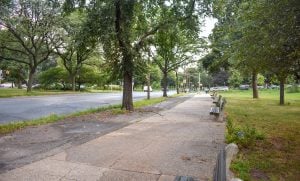
Mosholu Parkway. Photo: Brian Kachejian ©2018
Mosholu Parkway History
The impact of Mosholu Parkway Park has always been significant in the daily lives of anyone who grew up in the northern section of the Bronx near Mosholu Parkway. For millions, Mosholu Parkway was basically a backyard to their apartment buildings. Mosholu Parkway stretches for approximately three miles, beginning near the New York Botanical Garden on Webster Avenue and continuing through Van Cortlandt Park toward the Henry Hudson Parkway.
The history of Mosholu Parkway dates back to 1883, when Mayor Franklin Edson appointed a commission to “Select and Locate Lands for Public Parks in the 23rd and 24th Wards of the City of New York.” Their report recommended creating several parks and connecting parkways for the recreation and enjoyment of New Yorkers.
The commission proposed what would become Van Cortlandt Park, Pelham Bay Park, Bronx Park, Crotona Park, Claremont Park, St. Mary’s Park, Mosholu Parkway, Bronx and Pelham Parkway, and Crotona Parkway.
The Design Of Mosholu Parkway
In 1935, under the direction of New York’s legendary planner Robert Moses, Mosholu Parkway was reconstructed and widened. What had originally been envisioned as a scenic parkway connecting Van Cortlandt Park and Bronx Park evolved into more of a boulevard with numerous intersections, traffic lights, and connecting avenues.
While Mosholu Parkway serves as an important roadway connecting Bronx parks, highways, and parkways, including the Bronx River Parkway, Major Deegan Expressway, and Henry Hudson Parkway, it has always been much more than a transportation corridor. For generations of Bronx residents, it has served as an enormous neighborhood park.
Unlike enclosed parks such as Williamsbridge Oval Park or Van Cortlandt Park, Mosholu Parkway is a long landscaped strip running parallel to the roadway. Park benches, mature trees, hills, rock formations, open grassy areas, sidewalks, and a small playground create a unique public space that feels less like a destination park and more like part of the neighborhood itself.
Growing Up Along Mosholu Parkway
Mosholu Parkway Park played a significant role in the everyday lives of those of us who grew up on the streets and avenues connected to it. First of all, nobody called it Mosholu Parkway Park. We simply said, “Meet me down at Mosholu.” How you used the park depended entirely on your age and which block you called home.
One of my earliest memories of Mosholu Parkway was sled riding down the steep hill bordering Van Cortlandt Avenue near P.S. 80. During every snowfall, neighborhood kids would race down the hill on sleds, garbage can lids, or anything else that would slide. It was exciting, but it could also be dangerous. If you couldn’t stop in time, you might find yourself heading directly toward the metal fence at the bottom of the hill.
One afternoon, my friend Kevin O’Donnell attempted to slide headfirst beneath one of the park benches. Unfortunately, he never made it underneath. He struck the bench and badly cut his face. I can still remember the blood mixing with the snow and the expression on his face. It was one of those childhood moments that never leaves you. After that day, I was finished with sled riding in the Bronx.
Life In The 1970s
As teenagers, we made Mosholu Parkway our nighttime gathering place. Throughout the 1970s, neighborhood kids filled the benches lining the park. Radios blasted Boston, Heart, Led Zeppelin, Queen, and Jethro Tull while WNEW and WPLJ provided the soundtrack to our evenings. Six-packs of Miller cost about $1.25, and before the night ended, we usually stopped at Napoli’s Pizzeria for a fifty-cent slice.
Each avenue had its own unofficial territory. Perry Avenue, Hull Avenue, Decatur Avenue, and the surrounding streets tended to converge near the ends of their blocks, where they met Mosholu Parkway. Occasionally, everyone mixed together, but most of the time, each neighborhood stayed close to home.
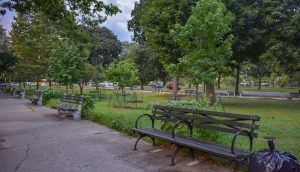
Mosholu Parkway Park benches at Perry Avenue. Photo: Brian Kachejian ©2018
At the western end of the park stood the NYPD 52nd Precinct. Looking back, it’s amazing how much harmless teenage activity took place in plain view of the police station. During the terrifying days of the Son of Sam murders in 1976 and 1977, however, everything changed. Every noise made us turn around. Everyone watched over their shoulder until the killer was finally captured.
Football At Mosholu Parkway
Mosholu Parkway was never designed for organized sports. There were no football fields, baseball diamonds, basketball courts, or hockey rinks. That never mattered to Bronx kids.
While we often played at Williamsbridge Oval Park, its football field was frequently occupied by organized teams. Mosholu Parkway became our alternative.
Neighborhood football games were played on the wide grassy center median between the parkway roadways. There were no uniforms, referees, or official goalposts. Park benches became end zones, and the moving traffic on either side of us conveniently defined the out-of-bounds lines. Nobody wanted to get hit by a car, so players generally stayed in bounds.
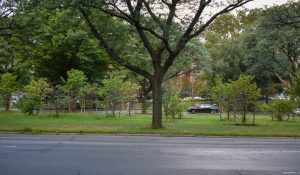
The center median where we played football. None of these trees was there during the 1970s. Photo: Brian Kachejian ©2018
The football itself was only part of the experience. What I remember most was everything that came afterward. Win or lose, we laughed, talked, and spent hours hanging around together. Looking back, that’s what city life was really about.
A Neighborhood Landmark
As you walked north toward Jerome Avenue, the character of Mosholu Parkway changed from gently sloping lawns to rocky hillsides. It also served as an unofficial dividing line between neighborhoods, separating sections of Norwood, Bainbridge Avenue, and the Grand Concourse.
It wasn’t just a place for kids. Elderly residents relaxed on the benches during the day, neighbors walked their dogs in the shade of the trees, and families treated it as an extension of their own backyards. We never really thought of it as a park. It was simply part of everyday life.
Over the decades, planners repeatedly proposed changes to Mosholu Parkway. Robert Moses and other city planners constantly sought to reshape New York’s roadways. Fortunately, Mosholu Parkway managed to retain the green spaces that made it so special to those of us who grew up there.
It gave us a place to throw a football, toss a Frisbee, sit beneath the trees, listen to music, meet our friends, or simply spend a summer evening outdoors. At the time, we never imagined that one day those ordinary moments would become some of our most treasured memories.
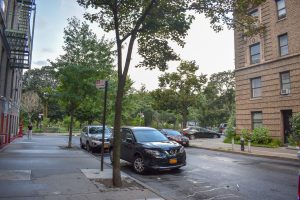 View of Mosholu Parkway Park from Perry Avenue. Photo: Brian Kachejian ©2018
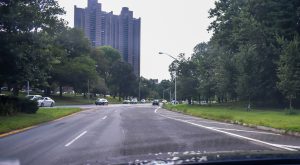 Mosholu Parkway. Photo: Brian Kachejian ©2018
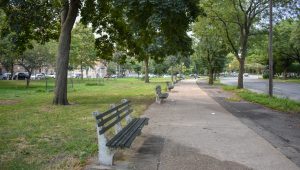 Mosholu Parkway Park. Photo: Brian Kachejian ©2018
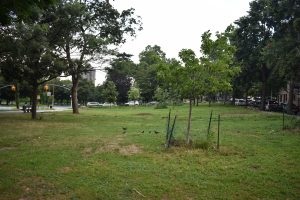 Mosholu Parkway. Photo: Brian Kachejian ©2018
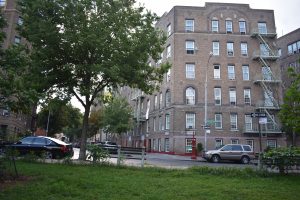 Mosholu Parkway. Photo: Brian Kachejian ©2018

Eating a Doritos chip on Mosholu Parkway in 1977. Photo taken by Fran Diemer.
Sources
(1) 1914 NYC Parks Department Report
Article updated June 28, 2026




Thank you for sharing your feeling of Mosholu Parkway. Those memories you wrote about your past are also new memories now for this generation (except a bit more safer for sledding- Lol). We have this parkland oasis that has always been part of our community and part of our lives. Today, kids still sled on different slopes, families build snowman, snow fights after school can still be seen. Nowadays we have a growing sweet community tree lighting where grassroots organizations come out and provide hot apple cider, hot chocolate and songs to residents. Schools in the area make tree ornaments and kids craft bird feeders using pine cones that hang on a tree. Mosholu is not a park –but a parkland that provides all the nature one could have in-spite of the growing housing developments in the area that will bring thousands of more residents on the the landscape.
It’s because of this urbanization that brings more of us residents to come out, get together to protect this asset of green environment that is part of our community. Sports are still played on the open fields but a bit smaller as we continue to keep Mosholu what it is –parkland enclaves surrounding a busy parkway.
Mosholu parkland is providing more than past memories. It’s now a place where youth groups work on the landscape protecting it’s trees and wildlife. It provides opportunities for neighbors to gather and plant gardens that soak up rainwater to prevent storm water runoff. It brings together city agencies, grassroots advocacy organizations and environmental institutions to help with land management issues and plant trees that help our environment in many ways. Yet it’s still a place where kids and adults can walk through the trees, picking up sticks and pine cones.
It’s an awesome place Mosholu Parkland and I’m grateful that I get to walk on it being so close to my home.
The Friends of Mosholu Parkland thank you for this awesome story.
Someone’s history is another one’s present day. No one could have made that more clearer than you just did. I could not have asked for a more meaningful and wonderful comment. It’s great to know that the old neighborhood is in such caring hands as you and your neighbors. Thanks for spending the time to let us all know what going on.
Another great article. Good job
Thank you for this wonderful story about ,my, park. For the first 22 years of my life, i lived on the corner of mosholu and 206 th st, with 2 of our windows facing the park. I played on the big rocks, picked flowers ( dandelions), dug in the dirt, enjoyed seeing the maple trees bloom, hung out on the railing, had picnics, walked over to the playground, went sledding, and had lots of fun in ‘my’ park. It really was my frontyard and backyard.
It was always an interesting question: was it pronounced MOSH-a-loo, or mosh-OOL-ah. It depended on whom you asked!
Famous people from the area:
Comedian Robert Klein (Decatur Ave. & Gun Hill Road)
Carl Reiner and Rob Reiner (Mosholu Parkway & the Grand Concourse)
Others?
Penny Marshall on the G.C at Reese Street/ Van Cortland Ave East.
evan mcelroy MOSH-a-loo, if you lived there and mosh-OOL-ah. if you didn’t 🙂
GREW UP IN THE 40’S AND 50’S LOVING THAT WHOLE AREA…IT MADE UP FOR 4 ADULTS CRUNCHED INTO A ONE BEDROOM ON ROCHAMBEAU…HOWEVER I NEVER REALIZED UNTIL NOW; THAT HUBBY AND I LIVE ON A WATERWAY IN S.FL. IN A 3/2 WITH QUIET AND SO MUCH GREEN ALL YEAR AROUND~
P.S. THE NUMBER OF VERY SUCCESSFUL FOLKS FROM THE LATE 30’S TO THE LATE 50’S THAT MADE THAT WHOLE AREA HOME IS 100X MORE THAN WHAT EVAN MCELROY POSTED!
SMARTEST KIDS IN MY JHS ’80 SP CLASS THAN I EVER COME ACROSS AGAIN…ANY PLACE! SOMEONE WITH KNOWLEDGE. PATIENCE AND ABILITIES TO DO SO REALLY NEEDS TO RESEARCH AND WRITE THAT NECESSARY BIOGRAPHY ABOUT MOSH – A – LOO!