Horn & Hardart’s last New York City Automat closed on April 9, 1991, at East 42nd Street and Third Avenue. The closure ended nearly eighty years of Automat dining in New York, but the name did not disappear forever. Horn & Hardart has since been revived as a coffee brand, and the current company says its long-term goal is to bring the Automat concept back.
For those who grew up in New York City or Philadelphia, the name Horn & Hardart can bring back memories of restaurants unlike almost anything operating today. The Automats were self-service dining rooms where rows of small glass doors displayed sandwiches, vegetables, desserts, and other prepared foods. Put in the required coins, turn the knob, open the little door, and your meal was waiting on the other side.

Feature Photo: Horn & Hardart/Lumitone Photography, New York, Public domain, via Wikimedia Commons
What Was a Horn & Hardart Automat?
An Automat was a self-service restaurant built around walls of coin-operated food compartments. Customers could see the food through small glass windows, deposit the required coins, open the door, and remove the dish they wanted. Employees working behind the wall continually replaced the food as customers took it.
The word “automatic” sometimes gives the wrong impression. Horn & Hardart was never simply a room full of vending machines. Large kitchens, bakers, cooks, counter workers, coffee attendants, cashiers, cleaners, and employees behind the food walls kept everything running. The machinery changed the way customers received their food, but human beings prepared and replenished it.
That combination was part of the magic. The customer felt as if a meal had appeared instantly from a wall, while an entire restaurant operation was working out of sight behind it.
My Sunday Mornings at Horn & Hardart on Third Avenue
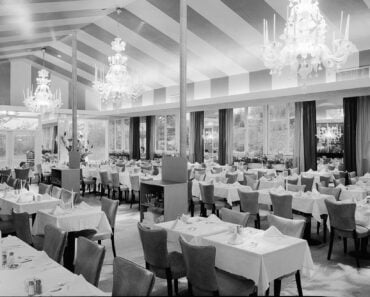
If you never had the chance to eat at a Horn & Hardart, the experience went something like this. Depending on the location you walked into, you were greeted by walls lined with small glass windows in front of compartments containing different food items. You put your money in the slot next to the food item and then pulled the glass door open to get your food. The dining area was set up almost like a school cafeteria, with individual tables.
What people do not always remember about the Horn & Hardart Automats is that they were not completely automated. I used to go to the Third Avenue location in New York City with my father and uncle on Sunday mornings in the early 1980s. I clearly remember waiters coming to our table and bringing us orange juice or coffee that we could order. I also remember that you could order some food made fresh if there was nothing in the Automat windows that you wanted.
We would sit there for hours, and no one ever made us feel like we had to leave. It might not have been like that in the beginning, but by the 1980s the locations that remained had clearly tried to keep up with the times to a certain point without completely changing what they were known for.
Who Founded Horn & Hardart?
Horn & Hardart began with Joseph V. Horn and Frank Hardart. The two men opened a small restaurant together at 39 South 13th Street in Philadelphia on December 22, 1888. Their first establishment was not yet an Automat. It was a small lunchroom with a counter and only a handful of seats.
Frank Hardart had emigrated from Germany to New Orleans as a child. Working in restaurants there exposed him to French-drip coffee, a smoother brewing method than the boiled coffee commonly served in many American establishments at the time. Coffee became one of the defining parts of the Horn & Hardart identity.
The partnership was incorporated as the Horn & Hardart Baking Company in 1898. By then, the two men were looking for ways to expand beyond the traditional lunchroom.
The First Horn & Hardart Automat Opens in Philadelphia
Frank Hardart became fascinated with the waiterless restaurant concept he encountered in Europe. Horn & Hardart ordered specialized equipment from Germany, but the first shipment was lost when the ship carrying it sank after a collision. The partners ordered replacement machinery and kept going.
On June 9, 1902, Horn & Hardart opened the first Automat in the United States at 818 Chestnut Street in Philadelphia. The strange new restaurant immediately attracted attention. Customers could select food through glass-fronted compartments instead of placing a conventional order with a waiter.
The early equipment was more complicated than the later Automat system New Yorkers would know. Horn & Hardart continued refining the machinery, eventually developing the familiar banks of windows that allowed a customer to insert coins, turn a knob, open the compartment, and remove the food.

Photo: Library Company of Philadelphia, No restrictions, via Wikimedia Commons
When Did the First Horn & Hardart Automat Open in New York City?
The first Horn & Hardart Automat in New York City opened on July 2, 1912, at 1557 Broadway in Times Square. The New York location used improved American-made Automat machinery and introduced the concept to one of the busiest pedestrian districts in the country.
New Yorkers embraced it. Horn & Hardart expanded throughout the city, and Automats became part of the rhythm of daily life for office workers, shoppers, theatergoers, students, tourists, and people who simply needed an inexpensive meal without spending much time waiting for it.
The first New York Automat also helped make Horn & Hardart a true New York institution even though the company had begun in Philadelphia. Readers interested in the neighborhood where that first location opened can also explore our history of Times Square in New York City.
How Did a Horn & Hardart Automat Work?
Customers first needed the right coins for the food compartments. Cashiers became famous for making change, especially during the years when nickels were essential to the system. The women working those booths were sometimes nicknamed “nickel throwers.” Black uniforms were practical because handling large quantities of coins could leave their hands and clothing dirty.
Inside the Automat, dishes sat behind individual glass windows. When a customer selected an item, workers on the other side of the wall replaced it with another serving. The front of the restaurant looked mechanical and almost futuristic, but the system depended on a large staff behind the scenes.
The menus went far beyond sandwiches. Horn & Hardart became known for baked beans, macaroni and cheese, creamed spinach, pies, cakes, vegetables, sandwiches, breakfast foods, and full hot dishes. For generations of customers, the Automat provided familiar food at prices ordinary New Yorkers could afford.
Horn & Hardart Coffee Became Almost as Famous as the Automat
Coffee had been at the center of the business from the beginning. Frank Hardart brought his knowledge of French-drip brewing from New Orleans, and Horn & Hardart made freshness part of its reputation.
The company’s ornate coffee dispensers became famous in their own right. Customers placed their coins into the machine and coffee poured from decorative dolphin-head spouts inspired by European fountain designs.
Horn & Hardart took coffee quality seriously. The current Horn & Hardart company, working from surviving records, says the famous Automat coffee did not contain chicory despite the long-running assumption that Hardart’s New Orleans background meant it did. The company says Hardart developed his own blend while preserving the French-drip brewing method he had learned in New Orleans.
How Popular Were the New York Automats?
Horn & Hardart became enormous. By the time Joseph Horn died in 1941, the company had 157 restaurants and retail outlets and was serving hundreds of thousands of customers each day. During the 1940s and 1950s, more than fifty Horn & Hardart restaurants operated in New York.
The Automats worked because they offered something that crossed social and economic lines. An office worker could sit near an actor, a student, a tourist, or somebody simply passing through the neighborhood. There was no pressure to order an expensive meal and no expectation that diners had to leave as soon as they finished.
The restaurants also delivered remarkable consistency. Customers knew what the baked beans, coffee, pie, or macaroni and cheese would taste like regardless of which Horn & Hardart they entered.
The Horn & Hardart Children’s Hour
The company extended its name beyond restaurants. The Horn & Hardart Children’s Hour began on Philadelphia radio in 1927 and later reached New York audiences. The program featured young performers and became a long-running part of the company’s public identity.
The Children’s Hour eventually moved into television as the medium became commercially important after World War II. The program helped turn Horn & Hardart into more than a place to eat. It became a brand that families encountered in their homes as well as on city streets.
Why Did Horn & Hardart Automats Close?
There was no single event that killed the Automat. The decline happened over decades. By the 1960s and especially the 1970s and 1980s, operating costs were rising, eating habits were changing, and national fast-food chains were offering inexpensive meals in a format that seemed newer and more convenient to younger customers.
The Automat’s great strength had once been speed. By the fast-food era, competitors such as McDonald’s and Burger King could serve a hot meal quickly without requiring customers to collect coins or move between multiple food windows. At the same time, New York itself was changing, and the enormous dining rooms that had once handled huge crowds became increasingly difficult to operate economically.
Horn & Hardart also moved away from the business that had made it famous. The company converted some former Automat locations into Burger King restaurants and invested in other businesses. It acquired Bojangles’ Famous Chicken ‘n Biscuits in the early 1980s and sold the chain in 1990. Horn & Hardart’s current management acknowledges that rising costs, changing consumer preferences, and management mistakes all contributed to the decline.
When Did the Last Horn & Hardart Automat Close in NYC?
The last Horn & Hardart Automat in New York City closed on April 9, 1991. It stood at the southeast corner of East 42nd Street and Third Avenue.
That location had survived long after the Automat had disappeared from most of the city. Its closing marked the end of an era that had begun in Times Square almost seventy-nine years earlier.
For New Yorkers who had grown up with Horn & Hardart, the loss was about much more than a restaurant. The Automat represented a kind of New York dining that was inexpensive, democratic, practical, and wonderfully strange. You could sit alone without feeling alone, stay for a while, read the newspaper, drink coffee, and watch the city pass through the room.
Are There Any Horn & Hardart Automats Left Today?
There is currently no operating Horn & Hardart Automat restaurant like the original New York and Philadelphia locations. However, pieces of the Automat survive in museums and private collections.
The Smithsonian’s National Museum of American History owns a large Horn & Hardart Automat installation. The museum once displayed a thirty-five-foot section of Automat equipment and decorative framework, although the museum’s current collection record states that the Automat is not presently on display.
A separate collection of surviving Horn & Hardart Automat machines is also preserved in Ellenville, New York. The collection’s website states that the machines came from the last New York Automat and that visits to the warehouse can be arranged by appointment.
Is Horn & Hardart Coming Back?
The Horn & Hardart name is alive again, but not yet as a traditional Automat restaurant. The current company revived Automat Coffee and now sells Horn & Hardart coffee and related products online.
The company says its goal is eventually to bring back a modern version of the Automat. It has released concept designs built around the original glass-window idea but updated for tap-to-pay technology instead of nickels and tokens.
As of 2026, that revival remains a work in progress rather than the return of a fully operating Horn & Hardart Automat restaurant. That distinction matters because the name has returned, while the famous restaurant experience has not yet fully returned with it.
Readers who want to follow the current revival can visit Horn & Hardart’s official website.
The Legacy of Horn & Hardart
There was something wonderfully New York about the Automat. It was fast without feeling rushed. It was inexpensive without pretending to be luxurious. It relied on machinery while still depending on a huge number of people behind the scenes. It could feed an office worker in a hurry and still let my father, my uncle, and me sit at a table on a Sunday morning for hours.
That is probably why people still talk about Horn & Hardart decades after the last New York Automat closed. The glass doors and coin slots were memorable, but the machines were never the whole story. What people remember is the food, the coffee, the room, and the feeling that the city had created a restaurant where almost anyone could walk in and belong.
More Classic New York Restaurant History
Readers interested in the restaurants and foods that defined everyday New York can continue with our history of Chock Full o’Nuts coffee shops and lunch counters, our look at Katz’s Delicatessen and its famous pastrami, our history of New York cheesecake, and our memories of an old-school New York egg cream.
Horn & Hardart Automat Timeline at a Glance
| Year | Milestone |
|---|---|
| 1888 | Joseph Horn and Frank Hardart open their first Philadelphia restaurant |
| 1898 | Horn & Hardart Baking Company is incorporated |
| 1902 | The first American Horn & Hardart Automat opens at 818 Chestnut Street in Philadelphia |
| 1912 | The first New York City Automat opens at 1557 Broadway in Times Square |
| 1927 | The Horn & Hardart Children’s Hour begins on radio |
| 1940s–1950s | More than fifty Horn & Hardart restaurants operate in New York during the chain’s peak era |
| 1960s–1980s | Fast-food competition, rising costs, changing dining habits, and management decisions contribute to decline |
| 1991 | The last New York Automat closes at East 42nd Street and Third Avenue on April 9 |
| 2023 | Horn & Hardart is revived under new leadership with the return of Automat Coffee |
| 2026 | The revived company continues selling coffee while developing plans for a possible modern Automat |
History of Horn & Hardart Automats: What Happened to New York’s Famous Restaurants? article published on ClassicNewYorkHistory.com © 2026