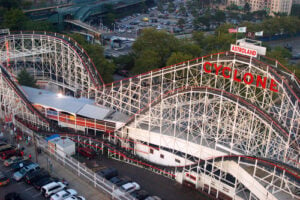
The Cyclone at Coney Island in Brooklyn, where New York’s amusement-park roller coaster history stretches back to the 1880s. Feature Photo: James Kirkikis / Shutterstock.com
From everyday household products and modern air conditioning to cameras, toys, radio, finance, and amusement rides, New York has been the birthplace of inventions that changed daily life far beyond the Empire State.
Some were created in New York City. Others came from communities such as Yonkers, Rochester, and Le Roy. Together, they show just how deeply New York inventors and businesses have shaped American culture, technology, entertainment, and commerce.
Here are 10 famous things you may not have realized were invented or first developed right here in New York.
1. Modern Air Conditioning – Brooklyn, 1902
The Inventor: Willis Haviland Carrier
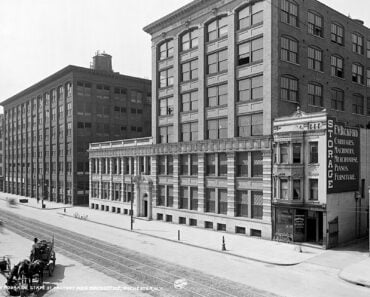
The Place: Sackett & Wilhelms Lithographing and Publishing Company, Brooklyn
The Story: In the summer of 1902, high humidity inside a Brooklyn printing plant was causing paper to expand and contract, throwing color printing out of alignment. Engineer Willis Carrier, working for the Buffalo Forge Company, designed a system that could control both temperature and humidity by passing air through cooling equipment. The installation at Sackett & Wilhelms became the foundation of modern air conditioning. What began as a solution to a printing problem eventually transformed factories, theaters, offices, stores, transportation, and homes around the world.
2. The American Teddy Bear – Brooklyn, 1902
The Inventors: Rose and Morris Michtom
The Place: Brooklyn, New York
The Story: In 1902, Brooklyn shopkeepers Rose and Morris Michtom saw Clifford Berryman’s famous political cartoon depicting President Theodore Roosevelt refusing to shoot a bear that had been tied up during a hunting trip. The Michtoms created a stuffed bear inspired by the episode and displayed it in their shop. Morris Michtom wrote to Roosevelt asking permission to call it “Teddy’s Bear.” The toy became a sensation, and the Michtoms went on to establish the Ideal Novelty and Toy Company. Their creation became the American version of one of the most recognizable toys in the world.
3. The Kodak Camera and Snapshot Photography – Rochester, 1888
The Inventor: George Eastman
The Place: Rochester, New York
The Story: Photography existed long before George Eastman, but it was complicated, expensive, and generally required technical knowledge. In 1888, Eastman’s company in Rochester introduced the original Kodak camera, a simple handheld camera preloaded for 100 exposures. When the roll was finished, the owner could send the entire camera back to Rochester, where the film was processed, prints were made, and the camera was reloaded. Kodak’s famous promise, “You press the button, we do the rest,” helped turn photography from a specialist’s craft into something ordinary people could enjoy.
4. Commercial Toilet Paper – New York City, 1857
The Inventor: Joseph C. Gayetty
The Place: New York City
The Story: Joseph Gayetty is widely credited with introducing the first modern commercial toilet paper in the United States in 1857. Sold as “Gayetty’s Medicated Paper for the Water-Closet,” the product came as individual flat sheets rather than on a roll. Gayetty marketed the paper as a cleaner alternative to newspapers and other materials commonly used at the time. His name was watermarked on the sheets, turning one of life’s most basic necessities into a packaged commercial product.
5. The Safety Elevator – Yonkers, 1852
The Inventor: Elisha Graves Otis
The Place: Yonkers, New York
The Story: Elevators and hoists existed before Elisha Otis, but broken lifting ropes could send platforms crashing to the bottom of a shaft. While working in Yonkers in 1852, Otis developed a safety mechanism that would automatically stop a hoisting platform if the rope failed. He established his elevator business in Yonkers the following year. In 1854, Otis famously demonstrated the safety device at New York’s Crystal Palace by standing on a raised platform and having the supporting rope cut. The brake caught the platform. Safe passenger elevators followed, helping make the modern skyscraper possible.
6. FM Radio – New York City and Yonkers, 1930s
The Inventor: Edwin Howard Armstrong
The Place: Columbia University in Manhattan and Yonkers, New York
The Story: Engineer Edwin Howard Armstrong spent years trying to eliminate the static and interference that plagued AM radio. Working at Columbia University, he developed wideband frequency modulation, or FM, which transmitted sound by varying radio frequency rather than amplitude. By the mid-1930s, Armstrong had patented the system and demonstrated its remarkable clarity. During a celebrated 1935 demonstration, an FM signal transmitted from a house in Yonkers was received before an audience in Manhattan with a level of fidelity and freedom from static that AM broadcasting could not match. FM eventually transformed radio broadcasting and became a foundation of modern communications technology.
7. Scrabble – Jackson Heights, Queens, 1930s
The Inventor: Alfred Mosher Butts
The Place: Jackson Heights, Queens
The Story: During the Great Depression, unemployed architect Alfred Mosher Butts began developing a word game that combined vocabulary, chance, and strategy. Living in Jackson Heights, he studied the frequency of letters in printed English, including the front page of The New York Times, to determine how many of each letter his game should contain and how much they should be worth. Early versions were called “Lexiko” and later “Criss-Cross Words.” James Brunot later helped refine and market the game, and in 1948 it took the name Scrabble. The game that began in Queens went on to become one of the most famous board games in the world.
8. The Multi-Purpose Charge Card – New York City, 1950
The Founders: Frank McNamara and Ralph Schneider
The Place: Major’s Cabin Grill, Manhattan
The Story: According to Diners Club’s own history, businessman Frank McNamara was dining in Manhattan in 1949 when he discovered that he had forgotten his wallet. The embarrassing episode helped inspire the idea of a payment card that could be used at multiple businesses rather than at only one store or gasoline company. In February 1950, McNamara returned to Major’s Cabin Grill with business partner Ralph Schneider and paid with a small cardboard Diners Club card. Diners Club became the world’s first multipurpose charge card and helped establish the payment-card industry that eventually transformed how people bought goods and services.
9. The Amusement-Park Roller Coaster – Coney Island, 1884
The Inventor: LaMarcus Adna Thompson
The Place: Coney Island, Brooklyn
The Story: On June 16, 1884, LaMarcus Adna Thompson’s Gravity Pleasure Switchback Railway opened at Coney Island. Riders climbed to an elevated platform, boarded cars, and coasted down a gravity-powered track at about six miles per hour before the cars were switched for the return trip. The ride cost five cents and quickly became a success. Earlier gravity railways had existed, but Thompson’s Coney Island attraction became the first amusement-park roller coaster in the United States and helped launch the roller-coaster industry that became inseparable from American amusement parks.
10. Jell-O – Le Roy, New York, 1897
The Creators: Pearle Bixby Wait and May Wait
The Place: Le Roy, Genesee County, New York
The Story: In 1897, Pearle Bixby Wait of Le Roy experimented with gelatin to create a fruit-flavored dessert. His wife, May, named the new product Jell-O. The original flavors included orange, lemon, strawberry, and raspberry. The Waits couldn’t turn the product into a major commercial success themselves, and in 1899 Pearle sold the rights to neighboring businessman Orator Francis Woodward. Woodward’s Genesee Pure Food Company transformed Jell-O into one of America’s most recognizable packaged desserts, forever connecting the brand with the small western New York community where it began.
Readers interested in more stories about the places connected to New York innovation can continue with our History Of Manhattan’s Bryant Park, where New York’s Crystal Palace once stood, our History of New York City’s Chrysler Building, and our Top 10 New York Amusement Parks, which includes Coney Island.
Sources
- Carrier — Willis Carrier and the Invention of Modern Air Conditioning
- Smithsonian National Museum of American History — Teddy Bear
- George Eastman Museum — The Revolutionary Kodak Camera
- Hagley Museum and Library — History of Commercial Toilet Paper
- Library of Congress — Elisha Otis and the Safety Elevator
- Columbia University Electrical Engineering — Edwin Armstrong and FM Radio
- CultureNOW — Scrabble Invented in Jackson Heights
- Hasbro — History of Scrabble
- Diners Club International — History of the First Multipurpose Charge Card
- American Society of Civil Engineers — Coney Island’s Switchback Railway
- New York State Legislature — Jell-O’s History in Le Roy, New York