If you grew up in one of New York City’s old-school neighborhoods, nobody had to explain what the corner bar was. It was simply there, as permanent as the church, the schoolyard, and the candy store. In the Bronx, Brooklyn, and Queens, the neighborhood bar was where your father stopped after his shift, where the local softball team celebrated, and where half the block seemed to end up on a Friday night.
For generations of immigrants, the bar was often the first American institution that felt like home. Irish, German, Italian, and Polish newcomers found work through the bartender, cashed paychecks at the taps, and heard news from the old country before it reached the newspapers. For people born here, the bar was part of everyday life. It could serve as a meeting hall, employment office, wake, and wedding reception, all within the same room.
That way of life had two sides, and any honest New Yorker will tell you so. For most patrons, the neighborhood bar offered an escape, a place to unwind and belong. For some families, it became a source of real heartbreak. Both truths are woven into the history of this city, and traces of them remain in the worn wood, stamped ceilings, old mirrors, and narrow barrooms that survived.
Long before rooftop lounges and hidden cocktail rooms dominated New York nightlife, residents gathered in low-ceilinged taverns near the waterfront, racecourses, markets, and working-class neighborhoods. George Washington said farewell to his officers in one of these rooms. Sailors drank beside the old Hudson shoreline. Writers, actors, dockworkers, politicians, musicians, and civil rights activists later turned other taverns into landmarks of New York culture.
Ranking the city’s oldest bars is not as simple as comparing dates on signs. Some locations began as groceries that sold alcohol, some temporarily changed names or uses, and several traditional founding dates remain disputed. The following list uses the earliest widely associated date for each establishment and focuses on historic taverns, bars, and brasseries that are operating today.
What Is the Oldest Bar in New York City?
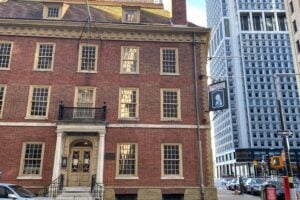
Fraunces Tavern is generally recognized as New York City’s oldest surviving tavern by establishment date. Samuel Fraunces opened the Queen’s Head Tavern at 54 Pearl Street in 1762, inside a building originally constructed in 1719. The site is best known as the place where George Washington bid farewell to his officers on December 4, 1783. Because the property has served other purposes and undergone extensive restoration, claims involving the city’s oldest continuously operating bar depend on how continuity is defined.
10 of the Oldest Historic Bars and Taverns in NYC
1. Fraunces Tavern, Financial District
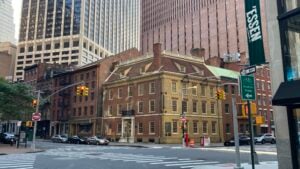
Photo by Brian Kachejian
Established: 1762
Location: 54 Pearl Street
Status: Open as a tavern and museum
The building at 54 Pearl Street was constructed in 1719 as a residence for merchant Etienne “Stephen” De Lancey. Samuel Fraunces purchased it in 1762 and opened the Queen’s Head Tavern. The establishment became connected to the political and military life of Revolutionary New York, hosting meetings, dinners, and gatherings during the struggle for independence.
Its most famous moment came on December 4, 1783, after the British evacuation of New York. George Washington met with officers of the Continental Army in the second-floor Long Room and delivered an emotional farewell before leaving the city. The room remains the historical centerpiece of the Fraunces Tavern Museum.
When New York served as the first capital of the United States under the Constitution, parts of the building housed offices associated with the young federal government. The structure later survived fires, alterations, demolition threats, and a deadly bombing in 1975 that killed four people in an adjoining section of the complex.
The Sons of the Revolution acquired the property in the early 20th century and restored it as a museum and historic tavern. Visitors can now eat and drink downstairs before touring galleries devoted to the Revolutionary era and the building’s long history.
What to order today: The slow-roasted chicken pot pie and a whiskey from the tavern’s extensive spirits selection.
2. The Ear Inn, Hudson Square
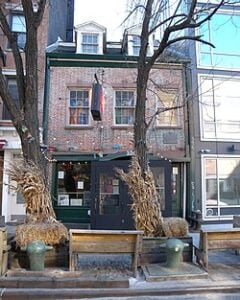
Established: 1817
Location: 326 Spring Street
Status: Open
The Ear Inn occupies the James Brown House, a Federal-style building dating to the early 19th century. When the house was constructed, the Hudson River shoreline sat only a short distance from the front door. The surrounding blocks became filled with warehouses, docks, boarding houses, and businesses serving sailors and waterfront laborers.
The ground floor developed into a drinking establishment associated with seamen, stevedores, and longshoremen. Over the decades, the building also contained rooms and businesses connected to the neighborhood’s rough waterfront economy. During Prohibition, the tavern continued operating in the manner of many old New York bars, with legal appearances maintained in front while drinks remained available inside.
The Ear Inn received its unusual name during the late 1970s. Because the building had landmark protection, replacing the old neon “BAR” sign would have required additional approvals. The owners instead painted over part of the letter B, turning “BAR” into “EAR.” The new name also connected the tavern to Ear Magazine, an experimental music publication associated with the building.
The tavern’s ghost stories are part of its modern identity. Regulars have long blamed a sailor called Mickey for unexplained noises, flickering lights, and glasses that appear to move. Whether or not Mickey exists, the narrow rooms and low ceilings preserve the feeling of an old Hudson waterfront bar.
What to order today: The Ear Inn Burger with a pint of Guinness.
3. Neir’s Tavern, Woodhaven
Established: 1829
Location: 87-48 78th Street, Woodhaven, Queens
Status: Open
Neir’s Tavern began in 1829 as the Blue Pump Room beside the Union Course racetrack. The track drew enormous crowds to what was then a rural section of Queens, and the tavern served riders, gamblers, trainers, spectators, and neighborhood residents. It became one of the earliest lasting institutions in the community that later developed into Woodhaven.
Louis Neir purchased the tavern in 1898 and expanded the operation with hotel rooms, a ballroom, and a bowling alley. The Neir name remained attached to the business long after the racing era ended. Local tradition also connects a young Mae West, who grew up nearby, with early appearances at the establishment.
The tavern became familiar to movie audiences through Goodfellas and later appeared in Tower Heist. Those screen appearances added to its reputation, but Neir’s significance comes primarily from its role as a genuine neighborhood bar that survived while much of the old racing district disappeared around it.
In January 2020, rising rent brought the tavern close to closing. Public attention and an agreement involving the owner, landlord, and city officials kept the doors open. The rescue became a rare example of a historic neighborhood business surviving a modern New York real estate crisis.
What to order today: Neir’s Famous Goodfella Burger Deluxe and a draft beer.
4. Fanelli Cafe, SoHo
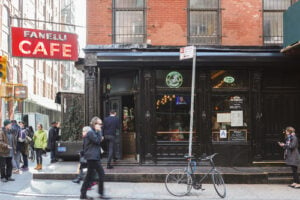
Established: 1847 as a food-and-drink business; operating as a saloon by the 1860s
Location: 94 Prince Street
Status: Open
The corner of Prince and Mercer Streets has housed a food-and-drink business since 1847. City directories first identified the location as a grocery, an important distinction because 19th-century groceries commonly sold beer, wine, and spirits. The business was operating as a saloon by the 1860s and continued under a succession of owners.
Michael Fanelli purchased the establishment in 1922 and gave it the name that still appears above the red storefront. The bar continued through Prohibition, reportedly using hidden storage areas for alcohol. Fanelli’s family remained connected to the business for decades before later owners preserved its name and informal character.
During SoHo’s transformation from an industrial district into an artists’ neighborhood, Fanelli became a meeting place for painters, sculptors, photographers, writers, and gallery workers. Its tiled floor, checkered tablecloths, corner windows, and crowded sidewalk tables became as recognizable as the cast-iron buildings surrounding it.
Unlike many historic places that have been polished into museums, Fanelli remains a busy downtown bar and restaurant. Its history is visible, but the room still operates with the noise and speed of a neighborhood establishment rather than a preserved exhibit.
What to order today: The Burger and Fries with a cold beer.
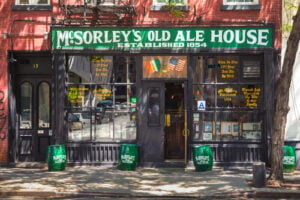
5. McSorley’s Old Ale House, East Village
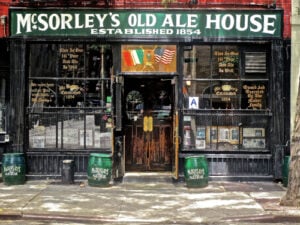
Established: Traditionally dated to 1854
Location: 15 East 7th Street
Status: Open
McSorley’s has long identified 1854 as its founding year, although later archival research has suggested that the bar may have opened during the early 1860s. The traditional date remains part of its identity, and the establishment is unquestionably one of New York’s oldest surviving Irish saloons.
The interior is covered with old photographs, newspaper clippings, paintings, pipes, political memorabilia, and objects left behind by generations of patrons. Sawdust covers the floor, a potbelly stove warms the room in winter, and dusty wishbones hang above the bar. According to McSorley’s tradition, soldiers left those wishbones before departing for World War I, intending to retrieve them after returning home.
The ale house became a subject for artists and writers, including painter John Sloan and journalist Joseph Mitchell. The bar’s refusal to modernize helped turn it into a living document of the East Village before the neighborhood carried that name.
For 116 years, McSorley’s barred women. A federal civil rights case and a new city law finally forced the establishment to admit female customers in 1970. A separate women’s restroom was not installed until 1986, demonstrating how slowly the bar surrendered one of its most exclusionary traditions.
What to order today: Light ale or dark ale. The small mugs are traditionally served two at a time.
6. Pete’s Tavern, Gramercy
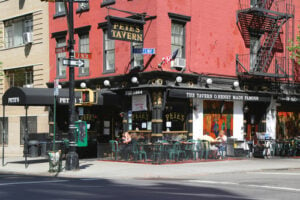
Established: 1864
Location: 129 East 18th Street at Irving Place
Status: Open
Pete’s Tavern began as a grocery and grog shop on the ground floor of a building constructed in 1851. The drinking establishment dates to 1864 and survived Prohibition by disguising itself as a flower shop while continuing to serve customers through the barroom.
The tavern’s best-known literary connection is O. Henry, the pen name of William Sydney Porter, who lived nearby at 55 Irving Place. Pete’s identifies the second booth from the front as the place where the writer worked on “The Gift of the Magi.” The exact details belong partly to neighborhood lore, but O. Henry’s connection to the area and the tavern became central to Pete’s identity.
The long rosewood bar, tile floor, wooden booths, mirrors, and pressed ceiling create one of the most recognizable old tavern interiors in Manhattan. Gramercy changed dramatically around it, yet Pete’s remained a neighborhood gathering place rather than becoming only a historical attraction.
The tavern also benefits from its position near Irving Place, Gramercy Park, Union Square, and the former Tammany Hall headquarters. That location placed it near writers, theater people, politicians, residents, and workers across several eras of New York history.
What to order today: Pete’s 1864 House Ale with the spaghetti and meatballs.
7. Julius’, Greenwich Village
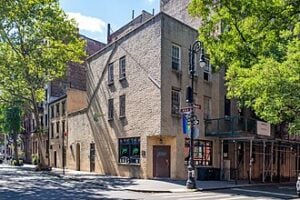
Photo: Ajay Suresh, CC BY 4.0 <https://creativecommons.org/licenses/by/4.0>, via Wikimedia Commons
Established: 1864 as a bar
Location: 159 West 10th Street at Waverly Place
Status: Open
The building occupied by Julius’ dates to 1826 and originally housed a grocery store. It became a bar in 1864 and developed into one of Greenwich Village’s oldest surviving drinking establishments. By the middle of the 20th century, Julius’ had become an important gathering place for gay New Yorkers.
On April 21, 1966, Mattachine Society members Dick Leitsch, Craig Rodwell, and John Timmons entered Julius’ as part of a planned “Sip-In.” At the time, New York’s liquor regulations were used to discourage bars from serving openly gay customers by treating their presence as potentially disorderly.
The men announced that they were homosexuals and requested drinks. The bartender placed his hand over the glass and refused service. Photographer Fred W. McDarrah captured the moment, producing one of the defining images of the early gay rights movement. The protest occurred three years before the Stonewall uprising and helped challenge discriminatory enforcement practices.
New York City designated Julius’ an individual landmark in 2022. The bar remains a working neighborhood institution, with its grill, circular tables, old photographs, and front windows preserving the setting in which the Sip-In occurred.
What to order today: The Julius Burger with fries and a tap beer.
8. Landmark Tavern, Hell’s Kitchen
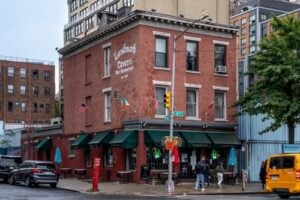
Established: 1868
Location: 626 11th Avenue at West 46th Street
Status: Open
Irish immigrant Patrick Henry Carley opened the Landmark Tavern in 1868 when the Hudson River shoreline sat much closer to 11th Avenue. The tavern served dockworkers, sailors, factory laborers, and residents of the rough industrial district that later became known as Hell’s Kitchen.
Carley and his family lived above the bar, while the upper floors also operated as lodging for workers and travelers. The expansion of Manhattan through landfill eventually moved the river farther west, but the tavern remained in place as warehouses, rail yards, slaughterhouses, and tenements reshaped the surrounding streets.
The Landmark continued serving customers during Prohibition as a speakeasy. Its mahogany bar, tin ceiling, dining rooms, fireplaces, and old stairways retained the atmosphere of a 19th-century waterfront establishment even after the neighborhood’s industrial economy faded.
Like many old taverns, the Landmark has accumulated ghost stories, including tales involving a former barmaid and a Confederate soldier. Those legends are difficult to prove, but they reflect the building’s long connection to sailors, transient workers, illness, accidents, and the crowded waterfront life of old Manhattan.
What to order today: The shepherd’s pie or Irish bangers and mash with a draft beer.
9. The Paris Café, South Street Seaport
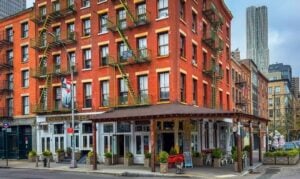
Established: 1873
Location: 119 South Street
Status: Open
The Paris Café opened in 1873 in the South Street Seaport, when the East River waterfront was crowded with ship chandlers, warehouses, ferry slips, sailors, merchants, and laborers. Its location made it a natural meeting place for people working around the port and for travelers moving through Lower Manhattan.
Over the years, the café became associated with public figures including Theodore Roosevelt and Thomas Edison, although many old New York bar stories have grown more elaborate with repetition. What is certain is that the establishment became one of the Seaport’s most enduring gathering places and remained closely tied to the neighborhood’s maritime identity.
Superstorm Sandy severely damaged the café in 2012. It recovered and reopened, only to close again in 2020. A new ownership group later restored and revived the business, preserving the historic name while recasting the interior and menu as a contemporary French-influenced brasserie.
The present operation is not an untouched continuation of the old dockside tavern, but its return preserved a historic drinking and dining address that appeared lost. It also demonstrates how New York’s oldest hospitality businesses often survive through reinvention rather than complete continuity.
What to order today: A classic martini with the Paris Café Burger or French onion soup.
10. White Horse Tavern, West Village
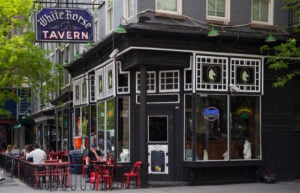
Established: 1880
Location: 567 Hudson Street at West 11th Street
Status: Open
The White Horse Tavern opened in 1880 as a bar for longshoremen working along the nearby Hudson River piers. For its first several decades, the room belonged primarily to waterfront laborers rather than writers, tourists, or celebrities.
That identity changed during the 1950s as poets, novelists, journalists, musicians, and political organizers made the White Horse one of Greenwich Village’s most important gathering places. Dylan Thomas became its most famous regular, while James Baldwin, Jack Kerouac, Norman Mailer, Allen Ginsberg, and members of the folk scene were also associated with the tavern.
The claim that Thomas drank 18 whiskies at the White Horse shortly before his death became one of New York’s most repeated bar legends. The story captures his reputation and the tavern’s mythology, but it should not be treated as a settled explanation of the illness that led to his death several days later.
The White Horse survived changes in ownership and the transformation of the West Village into one of Manhattan’s most expensive neighborhoods. Its literary history remains visible in portraits and photographs, while the establishment continues as a busy modern tavern rather than a memorial to the 1950s.
What to order today: The White Horse Tavern Burger with a draft beer.
| Rank | Tavern or Bar | Earliest Associated Date | Neighborhood |
|---|---|---|---|
| 1 | Fraunces Tavern | 1762 | Financial District, Manhattan |
| 2 | The Ear Inn | 1817 | Hudson Square, Manhattan |
| 3 | Neir’s Tavern | 1829 | Woodhaven, Queens |
| 4 | Fanelli Cafe | 1847 | SoHo, Manhattan |
| 5 | McSorley’s Old Ale House | 1854, traditional date | East Village, Manhattan |
| 6 | Pete’s Tavern | 1864 | Gramercy, Manhattan |
| 7 | Julius’ | 1864 | Greenwich Village, Manhattan |
| 8 | Landmark Tavern | 1868 | Hell’s Kitchen, Manhattan |
| 9 | The Paris Café | 1873 | South Street Seaport, Manhattan |
| 10 | White Horse Tavern | 1880 | West Village, Manhattan |
Historic Bars That Fell Just Outside This List
P.J. Clarke’s, established in 1884, and Old Town Bar, established in 1892, remain two of New York’s most important historic saloons. Both would belong in any broader guide to the city’s classic bars. The Bridge Cafe occupies an even older building and traces its tavern history to the 19th century, but it has remained closed since Superstorm Sandy and was therefore excluded from this list of operating establishments.
Why Did Old New York Taverns Put Sawdust on the Floor?
In the 19th and early 20th centuries, tavern keepers spread fresh sawdust across wooden floors to absorb mud, spilled beer, tobacco juice, and other debris. At closing time, the dirty sawdust could be swept out and replaced. The practice was inexpensive, practical, and especially useful in crowded waterfront and working-class bars where customers entered with wet or muddy boots.
10 Oldest Historic Taverns and Bars in NYC article published on ClassicNewYorkHistory.com © 2026