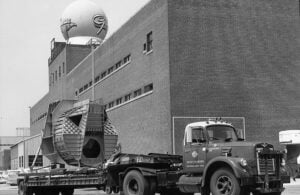
A Lunar Module ascent fuselage being transported outside Grumman’s Plant 5 facility in Bethpage, Long Island, where Grumman built the spacecraft that carried Apollo astronauts to the lunar surface. Photo: Jkirschberg, CC BY 4.0, via Wikimedia Commons.
During World War II and the Cold War, Long Island became one of the most important aerospace, defense, and electronics centers in the United States. Factories and laboratories in Farmingdale, Bethpage, Lake Success, Deer Park, Greenlawn, Syosset, Plainview, St. James, and other communities employed tens of thousands of engineers, machinists, technicians, office workers, and production employees.
These companies helped build fighter aircraft, radar systems, navigation equipment, anti-submarine technology, military electronics, missile-guidance systems, and spacecraft hardware. Their rise was closely tied to the enormous postwar growth that reshaped Long Island, the same transformation explored in our History of Levittown and the American Dream.
Not every company on this list simply went bankrupt and disappeared. Some were acquired, merged into larger corporations, or transformed into completely different businesses. What vanished was the independent Long Island company, manufacturing operation, or corporate identity that generations of residents once knew.
1. Fairchild Republic / Republic Aviation
Long Island Base: Farmingdale, along Route 110
Peak Era: World War II through the 1980s
Republic Aviation grew out of the Seversky Aircraft operation in Farmingdale and became one of Long Island’s great military aircraft manufacturers. During World War II, Republic built thousands of P-47 Thunderbolts, one of the most important American fighter aircraft of the war. At its wartime peak, Republic employed more than 24,000 workers in Farmingdale.
After the war, Republic entered the jet age with aircraft including the F-84 Thunderjet and the supersonic F-105 Thunderchief. Fairchild acquired Republic in 1965, and the Farmingdale operation later became known as Fairchild Republic. Its best-known later aircraft was the A-10 Thunderbolt II, the close-air-support aircraft widely nicknamed the “Warthog.”
What Happened: The T-46A trainer program became crucial to the future of the Farmingdale plant. When the Air Force decided not to fund production beyond the first aircraft, Fairchild announced in March 1987 that it would close the facility. Aircraft manufacturing at the site ended that year, bringing an extraordinary era of Farmingdale aviation history to a close.
2. Sperry Gyroscope Company
Long Island Base: Lake Success
Peak Era: World War II through the Cold War
Sperry Gyroscope became one of the giants of Long Island defense electronics. As military demand expanded during World War II, the federal government built a vast new plant for Sperry at Lake Success. The facility employed approximately 22,000 people during the war and produced navigation, fire-control, radar, and other military systems.
The Lake Success complex also played an extraordinary role outside defense. After World War II, part of the Sperry plant became the temporary headquarters of the United Nations. From 1946 into the early 1950s, diplomats and international officials worked in a building that had been constructed for wartime manufacturing.
Sperry continued developing advanced guidance, radar, navigation, and electronic-warfare systems during the Cold War. The company became Sperry Rand after a 1955 merger with Remington Rand and later returned to the Sperry name.
What Happened: Sperry merged with Burroughs in 1986 to form Unisys. Manufacturing at the historic Lake Success site ended in the 1990s, although defense work continued there under successor companies. The Sperry name disappeared as an independent Long Island corporate giant.
3. Gyrodyne’s Defense Manufacturing Era
Long Island Base: Flowerfield, St. James
Defense Manufacturing Era: 1946–1975
Gyrodyne Company of America was founded in 1946 and became one of Long Island’s most unusual aerospace manufacturers. After moving to St. James, the company concentrated on coaxial-rotor helicopter technology and eventually developed the QH-50 DASH, or Drone Anti-Submarine Helicopter, for the U.S. Navy.
The remotely piloted QH-50 was designed to extend the anti-submarine reach of Navy ships that were too small to operate full-size helicopters. Hundreds were built during the 1960s, making Gyrodyne an important part of the Cold War defense industry on Long Island.
What Happened: The Navy’s DASH program ended, and Gyrodyne left helicopter manufacturing. By 1975, the company had begun converting its St. James property to industrial rental use.
What Survived: Gyrodyne itself did not disappear. It survives today as a real estate company. What vanished was the Long Island helicopter manufacturer and defense contractor that once tested and produced military aircraft at Flowerfield.
4. Airborne Instruments Laboratory / AIL Systems
Long Island Base: Deer Park, with additional Long Island operations
Founded: 1945
Airborne Instruments Laboratory, better known as AIL, was formed in 1945 by engineers whose wartime work had included radar and electronic countermeasures research. From Deer Park, AIL became one of Long Island’s most important military electronics organizations, working in electronic warfare, radar, microwave technology, air-navigation systems, and other advanced defense fields.
AIL became part of Cutler-Hammer and later Eaton while maintaining a major Long Island engineering presence. The company eventually emerged again as AIL Systems. One of its most prominent corporate figures was astronaut Neil Armstrong, who served as chairman of AIL Systems before later becoming chairman of EDO Corporation.
What Happened: AIL Systems merged with EDO Corporation in 2000. The AIL name subsequently disappeared into the larger EDO organization, ending the independent identity of a defense-electronics company whose roots reached back to the final months of World War II.
5. American Bosch Arma / AMBAC Industries
Long Island Base: Roosevelt Field area, Garden City
Peak Long Island Era: 1950s–1960s
American Bosch Arma was one of the major Long Island defense-electronics companies of the early Cold War. Its Arma operation grew out of a New York military-technology company known for gyroscopes, fire-control systems, precision instruments, and advanced guidance equipment. By the 1950s, the company’s large Garden City operation at the former Roosevelt Field property had become an important center for military electronics and missile-guidance work.
The Arma Division worked on the MD-9 fire-control system for the B-52 bomber and on inertial-guidance technology connected to the Atlas intercontinental ballistic missile program. The Garden City laboratories also became important in early computer development. Engineer Wen Tsing Chow’s work there helped produce an early programmable read-only memory concept, while the company developed specialized computers and navigation systems for military and aerospace applications. Federal labor records show approximately 5,000 American Bosch Arma employees working at Garden City in 1962.
The company’s fortunes were heavily tied to defense programs. In the early 1960s, the loss of anticipated work on the Titan III guidance program contributed to substantial layoffs at the Long Island operation.
What Happened: American Bosch Arma changed its corporate name to AMBAC Industries in 1968. New York State environmental records indicate that American Bosch Arma’s defense manufacturing and testing operations at the Garden City site ended at about the same time. AMBAC continued as a diversified industrial company before becoming a wholly owned subsidiary of United Technologies following a 1978 merger. The enormous Long Island defense-electronics operation and the American Bosch Arma name disappeared, leaving behind another major chapter in the history of Long Island’s Cold War economy.
6. Hazeltine Corporation
Long Island Base: Greenlawn, with other Long Island facilities
Independent Era: 1924–1986
Hazeltine Corporation began with radio technology associated with engineer Louis Alan Hazeltine and developed into a major Long Island defense-electronics company. Its Long Island operations became deeply involved in military communications, radar, antennas, and Identification Friend or Foe technology.
During World War II, engineers associated with Hazeltine and Wheeler Laboratories contributed important work on IFF equipment that helped military radar operators distinguish friendly aircraft from potential enemy targets. Hazeltine later expanded its defense work through facilities in Greenlawn and elsewhere on Long Island.
What Happened: Emerson Electric acquired Hazeltine in 1986. The defense business passed through additional corporate owners, including ESCO and GEC-Marconi, before becoming part of BAE Systems. Defense electronics work continues in Greenlawn under BAE Systems, but the independent Hazeltine Corporation and its historic corporate identity are gone.
7. Fairchild Camera and Instrument Corporation
Long Island Base: Syosset, with additional Long Island divisions
Independent Era: Through 1979
Fairchild Camera and Instrument Corporation was a separate company from the Fairchild Republic aircraft operation in Farmingdale. Founded by Sherman Fairchild, it became a major developer of aerial photography, reconnaissance, electronics, test equipment, and other aerospace and defense technology.
By the late 1950s, Fairchild Camera and Instrument had its corporate headquarters in Syosset. Its Long Island divisions worked on military imaging, reconnaissance systems, controls, electronics, and space-and-defense technology. The company also became historically important to the semiconductor industry after acquiring Fairchild Semiconductor.
What Happened: Schlumberger acquired Fairchild Camera and Instrument in 1979. Its businesses were subsequently reorganized, sold, and absorbed into other corporations, including Loral and later Lockheed Martin. The original Fairchild Camera and Instrument corporate identity disappeared, even though portions of its technology lineage continued under successor companies.
8. EDO Corporation
Long Island Operations: Deer Park, Bohemia, North Amityville, and other locations
Independent Era: 1925–2007
EDO Corporation began in 1925 under founder Earl Dodge Osborn and became closely associated with military aviation and naval technology. Its early fame came from aircraft floats and pontoons, but the company evolved into a diversified defense contractor working in sonar, antennas, electronic warfare, aircraft systems, mine countermeasures, and other military technologies.
EDO significantly expanded its Long Island presence through operations in Suffolk County and through its 2000 combination with AIL Systems. By the early 2000s, the company was moving employees among facilities in Deer Park, Bohemia, and North Amityville as it modernized its Long Island operations.
What Happened: ITT Corporation acquired EDO in December 2007 in a transaction valued at approximately $1.7 billion. EDO’s technologies and operations continued within larger successor organizations, but EDO disappeared as an independent defense corporation.
9. Aeroflex
Long Island Base: Plainview
Independent Public-Company Era: Through 2014
Aeroflex grew into a major Long Island technology company specializing in high-performance microelectronics and test-and-measurement equipment. Headquartered on South Service Road in Plainview, it served aerospace, defense, wireless communications, space, and other technology markets.
Aeroflex’s products occupied a less visible part of the defense economy than fighter aircraft or giant radar installations, but the company’s components and test systems became important wherever extremely reliable electronics had to perform under demanding conditions.
What Happened: Cobham acquired Aeroflex in September 2014 in a transaction with an enterprise value of approximately $1.46 billion. The acquisition ended Aeroflex’s life as an independent Long Island public company, although Aeroflex technology and product lines continued within successor businesses.
10. Grumman Corporation
Long Island Base: Bethpage and Calverton
Peak Long Island Workforce: More than 20,000 employees
No company symbolizes Long Island’s aerospace era more powerfully than Grumman. Founded on Long Island in 1929, the company became famous for rugged Navy aircraft and earned the nickname the “Grumman Iron Works.” Its aircraft included the F6F Hellcat, TBF Avenger, A-6 Intruder, E-2 Hawkeye, and F-14 Tomcat.
Grumman’s place in American history extended far beyond naval aviation. NASA selected Grumman to build the Apollo Lunar Module in Bethpage, the spacecraft that carried astronauts from lunar orbit to the surface of the Moon and back. The lunar modules built on Long Island became some of the most important machines ever produced in New York State.
At its peak in the 1980s, Grumman employed more than 20,000 people on Long Island. Bethpage and the enormous Calverton testing complex became symbols of an economy built around engineering, skilled manufacturing, military contracts, and aerospace technology.
What Happened: The end of the Cold War brought major reductions in defense spending and consolidation throughout the aerospace industry. Northrop acquired Grumman in 1994, creating Northrop Grumman. The independent Grumman Corporation disappeared, and much of its historic Long Island manufacturing footprint was subsequently closed or redeveloped.
Grumman’s name survives inside Northrop Grumman, and its aviation legacy remains visible throughout New York. Visitors can even see a Grumman F-14 Tomcat aboard the Intrepid Sea, Air & Space Museum.
More Long Island History
Long Island’s defense economy grew alongside the enormous suburban transformation that followed World War II. For more on the forces that reshaped Nassau and Suffolk counties, read our History of Levittown and the American Dream, How Robert Moses Shaped the Long Island He Misunderstood, and our History of the Intrepid Sea, Air & Space Museum.
Sources
Suffolk County: Maximizing the Potential of Long Island’s Defense Sector in an Era of Change
U.S. Environmental Protection Agency: Fairchild Republic Company, Farmingdale
Armed Services Board of Contract Appeals: Fairchild Republic and the T-46A Program
Hagley Museum and Library: Sperry Gyroscope Company Division Records
United Nations: Lake Success and the Sperry Gyroscope Plant
U.S. Tariff Commission: AMBAC Industries and American Bosch Arma Corporate History
Engineering and Technology History Wiki: American Bosch Arma at Garden City
U.S. Bureau of Labor Statistics: 1962 Wage Record for American Bosch Arma, Garden City
Congressional Record: 1963 Long Island Defense Contract Cuts at American Bosch Arma
U.S. Securities and Exchange Commission: AMBAC and United Technologies Merger
NASA: Neil Armstrong and AIL Systems
IEEE Long Island Section: Airborne Instruments Laboratory and Long Island Electronics History
Stony Brook University: Harold Wheeler, Hazeltine, and Long Island Defense Electronics
Schlumberger 1979 Annual Report: Acquisition of Fairchild Camera and Instrument
ITT Corporation: Acquisition of EDO Corporation
Aeroflex / Cobham: Completion of the Aeroflex Acquisition