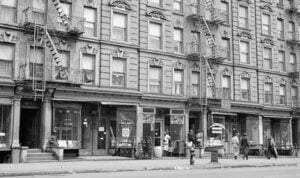
A Harlem apartment house in New York City in 1943, the year federal wartime rent controls were introduced in the city. Photo: Gordon Parks, Library of Congress, Prints and Photographs Division. No known restrictions on publication.
Few phrases in New York City real estate carry as much weight as “rent stabilized.” For generations of tenants, rent regulation has limited certain rent increases, provided renewal rights, and shaped the economics of apartment living across the five boroughs.
According to the 2023 New York City Housing and Vacancy Survey, the city had approximately 996,600 rent-stabilized apartments, representing about 41% of the rental housing stock, along with roughly 24,020 rent-controlled apartments. Those two systems are related, but they are not the same. Their history spans World War II price controls, the Rent Stabilization Law of 1969, the Emergency Tenant Protection Act of 1974, the major deregulation battles of the 1990s and 2000s, and the Housing Stability and Tenant Protection Act of 2019.
How Rent Regulation Started in New York City During World War II
The roots of modern New York rent regulation lie in the emergency economy of World War II. Congress enacted the Emergency Price Control Act in 1942, giving the federal Office of Price Administration broad authority to control prices and rents in defense areas.
New York City did not come under federal rent control immediately. After growing pressure over housing shortages and rising rents, the federal government imposed a wartime rent freeze on November 1, 1943. Residential rents were generally frozen at the levels that had existed on March 1, 1943.
The federal system was never designed as a permanent New York housing program. It was an anti-inflation measure created during wartime. But when the war ended, New York’s housing shortage did not disappear. Returning service members, growing families, limited wartime construction, and continued demand kept enormous pressure on the city’s rental market.
How Rent Control Became a New York System After the War
The federal Emergency Price Control Act expired in 1947, but Congress continued rent controls under the Housing and Rent Act of 1947 and later extensions. New York had already enacted standby legislation in 1946 in case federal controls ended.
In 1950, New York State activated its own emergency rent-control framework, and in 1951 administration of roughly 2.1 million regulated apartments was transferred from the federal government to the state. Federal involvement in local rent regulation ended in 1953.
Today’s New York City rent-control system is the surviving descendant of that earlier framework. It generally applies to apartments in buildings constructed before February 1, 1947, where the tenant or a qualifying successor has maintained the required continuous occupancy dating back to before July 1, 1971.
Rent-controlled apartments are governed by the Maximum Base Rent system. The MBR is calculated under a formula tied to building operating costs and is adjusted on a two-year cycle. Rent control has become increasingly rare as apartments leave the system when qualifying tenancies end.
Why New York City Created Rent Stabilization in 1969
Rent stabilization was created later and for a different segment of the housing market. By the late 1960s, vacancy rates were falling, and complaints were rising about sharp rent increases in postwar apartment buildings that were not covered by traditional rent control.
Under Mayor John Lindsay, New York City enacted the Rent Stabilization Law of 1969. The original law covered hundreds of thousands of apartments in larger postwar buildings and created a system in which the New York City Rent Guidelines Board set allowable rent adjustments.
Rent stabilization generally applies today to apartments in buildings with six or more units built between February 1, 1947, and December 31, 1973. It can also apply to tenants in older buildings who moved in after June 30, 1971, as well as certain newer buildings brought into stabilization through tax-benefit or regulatory programs.
The 1971 Urstadt Law and Vacancy Decontrol
The rent laws changed dramatically again in 1971. New York State adopted vacancy decontrol, which removed traditional rent control from apartments when qualifying tenants left. Many of those apartments later became rent stabilized if they were in buildings covered by stabilization.
The same period produced the law commonly known as the Urstadt Law. It prohibited New York City from adopting new rent regulations that were more stringent than the state framework already in place. That shift gave Albany a decisive role in the future of New York City’s rent laws.
The Emergency Tenant Protection Act of 1974
Vacancy decontrol contributed to sharp rent increases during the early 1970s. In response, New York State enacted the Emergency Tenant Protection Act of 1974, commonly known as the ETPA.
The ETPA expanded the rent-stabilization framework and helped restore regulation to many apartments that had lost protection during the vacancy-decontrol period. It also established the continuing principle that rent stabilization depends on a declared housing emergency. In New York City, that emergency remains in effect because the rental vacancy rate remains below the statutory 5% threshold. The 2023 Housing and Vacancy Survey measured the citywide rental vacancy rate at just 1.41%.
Rent Control and Rent Stabilization Are Not the Same
Rent control is the older and much smaller system. In New York City, it generally applies to pre-February 1947 buildings where the tenant or a qualifying successor meets the required continuous-occupancy rules dating to before July 1, 1971. When a rent-controlled apartment becomes vacant, it generally becomes rent stabilized if it is in a building with six or more units. In smaller buildings, it may leave regulation altogether.
Rent stabilization is the much larger system. Stabilized tenants generally have the right to one- or two-year renewal leases, and the New York City Rent Guidelines Board sets allowable lease adjustments. State and city law regulate rent, required services, lease renewals, and grounds for eviction.
High-Rent Deregulation and the 1990s Rent Battles
Beginning in the 1990s, New York adopted rules that allowed some stabilized apartments to leave regulation when rents and, in certain circumstances, tenant incomes crossed statutory thresholds.
The Rent Regulation Reform Act of 1993 introduced high-rent and high-income deregulation. Later laws changed the thresholds and expanded vacancy deregulation. By 2019, the high-rent vacancy threshold had risen to $2,774.76.
These policies removed a substantial number of apartments from stabilization. A 2024 analysis by the New York City Comptroller estimated that 170,386 rent-stabilized apartments were permanently deregulated between 1994 and 2019, mostly through vacancy decontrol.
The Housing Stability and Tenant Protection Act of 2019
On June 14, 2019, New York State enacted the Housing Stability and Tenant Protection Act, or HSTPA, one of the most consequential changes to rent regulation in decades.
The law eliminated high-rent vacancy deregulation and high-rent/high-income deregulation for most stabilized apartments. It also eliminated the statutory vacancy bonus, changed the treatment of preferential rents, limited Major Capital Improvement increases, and substantially revised the rules governing Individual Apartment Improvements.
One important qualification is that apartments lawfully deregulated before June 14, 2019, did not automatically return to stabilization. Certain tax-program apartments also remain subject to specialized rules.
The Rent Laws Changed Again in 2024
The 2019 law did not permanently freeze the improvement rules. State legislation enacted in 2024 revised the Individual Apartment Improvement system again. Effective October 17, 2024, the standard IAI cost cap increased from $15,000 to up to $30,000, with a separate higher tier of up to $50,000 available in qualifying circumstances. The legislation also made qualifying IAI rent increases permanent under the new framework.
Major Capital Improvement increases continue to be separately regulated, including an annual 2% collection cap for qualifying MCI increases. Because these rules can change, tenants and owners should use current New York State Homes and Community Renewal guidance rather than relying on older summaries of the 2019 law.
Current NYC Rent-Stabilized Lease Increases in 2026
For rent-stabilized apartment leases beginning between October 1, 2025, and September 30, 2026, the New York City Rent Guidelines Board approved a 3% increase for a one-year lease and a 4.5% increase for a two-year lease.
The Board has also adopted the next set of guidelines. For leases beginning between October 1, 2026, and September 30, 2027, the adopted adjustment is 0% for one-year leases and 0% for two-year leases.
Those percentages apply to guideline adjustments and do not by themselves answer every question about a legal rent. Other lawful adjustments may apply in specific situations.
How to Find Rent-Stabilized Apartments in NYC
There is no single public apartment-search website that identifies every available stabilized unit, but several steps can greatly improve the chances of finding one.
1. Start with the classic building profile. Buildings with six or more apartments constructed before 1974 are the most familiar place to look. Older apartment buildings in neighborhoods such as Washington Heights, Inwood, the Grand Concourse, Flatbush, Crown Heights, Bay Ridge, Astoria, Ridgewood, and other parts of the outer boroughs contain large numbers of stabilized units. Our guide to 10 Affordable NYC Neighborhoods for Renters provides another starting point for comparing neighborhoods.
2. Check the Rent Guidelines Board and HCR building searches. New York publishes lists and searchable records for buildings that have registered rent-stabilized units. These are useful screening tools, but they are not definitive proof that a particular apartment is currently stabilized. A building can contain a mixture of stabilized and unregulated apartments, and some buildings may be missing from the lists if registrations were not filed.
3. Look for the rent-stabilization lease rider. A tenant signing a rent-stabilized lease should receive the required New York City rent-stabilization lease rider, which includes information about the regulated rent and the basis for rent changes.
4. Request the apartment’s official rent history from HCR. This is not a Freedom of Information Law request. Tenants can request the rent-registration history for their own apartment directly from New York State Homes and Community Renewal. The history can help identify prior regulated rents, registration status, and changes reported by owners.
5. Do not assume that every Housing Connect apartment is rent stabilized. NYC Housing Connect is an excellent source for affordable rental opportunities, and many developments are subject to regulatory agreements or rent-stabilization requirements. But the exact legal status depends on the program and the individual development. Read the lottery advertisement and lease documents rather than assuming every Housing Connect unit has the same rent-regulation status.
6. If the history looks wrong, ask HCR. Tenants who believe they are being charged more than the lawful regulated rent may file a rent-overcharge complaint with HCR’s Office of Rent Administration. If HCR finds an overcharge, it can order a rent reduction and repayment of excess rent. Apartment histories can be complicated, so a tenant with a significant dispute may also wish to speak with a qualified tenant attorney or housing organization.
Important: This article provides general historical and consumer information and is not legal advice. Rent-regulation status can depend on the history of a particular apartment, building, tax benefit, conversion, renovation, or prior deregulation.
Rent Control vs. Rent Stabilization at a Glance
| Rent Control | Rent Stabilization |
|---|---|
| Generally applies to pre-February 1, 1947 buildings with qualifying continuous occupancy dating to before July 1, 1971 | Generally applies to six-or-more-unit buildings built between February 1, 1947, and December 31, 1973, plus other qualifying apartments |
| Approximately 24,020 apartments in the 2023 Housing and Vacancy Survey | Approximately 996,600 apartments in the 2023 Housing and Vacancy Survey |
| Uses the Maximum Base Rent system | Renewal lease guidelines are set annually by the NYC Rent Guidelines Board |
| Becomes rarer as qualifying tenancies end | Represents about 41% of the city’s rental housing stock |
| Vacated units generally become stabilized in qualifying six-or-more-unit buildings | Includes some newer apartments brought under regulation through tax or affordable-housing programs |
More New York Housing and Cost-of-Living History
For more on the economics of living in New York, read our 10 Affordable NYC Neighborhoods for Renters, 10 Most Expensive Neighborhoods in NYC Ranked by Median Sale Price, and History of the Minimum Wage in New York.
Sources
New York State Homes and Community Renewal: Rent Stabilization and Emergency Tenant Protection Act
New York City Rent Guidelines Board: Rent-Stabilized Building Lists
New York City Mayor’s Office to Protect Tenants: Rent Stabilization
New York State Homes and Community Renewal: Rent Increases and Rent Overcharge
New York State Homes and Community Renewal: 2024 Changes to New York Housing Laws
New York State Homes and Community Renewal: Individual Apartment and Major Capital Improvements
New York City Rent Guidelines Board: Adopted Guidelines for 2025–2026
New York City Rent Guidelines Board: Adopted Guidelines for 2026–2027
NYC Housing Preservation and Development: Housing Connect Guidebook
New York City Comptroller: Rent-Stabilized Housing Stock and Deregulation