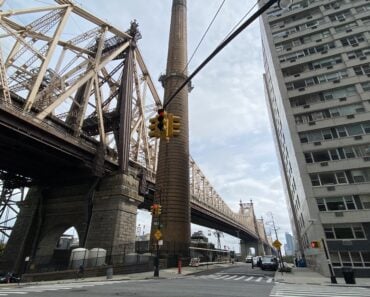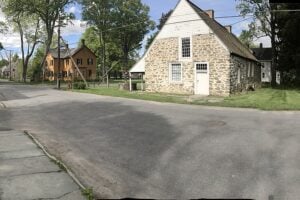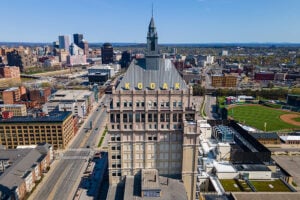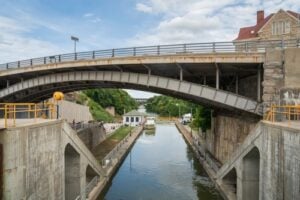
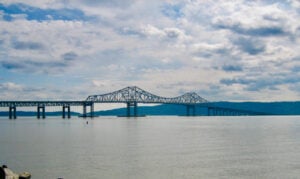
The old Tappan Zee Bridge as viewed from Pierson Park in Tarrytown, New York, during the summer of 2006. Photo: David Garcia / Shutterstock.com
New York’s waterways have always tested the limits of civil engineering. While landmark spans like the Brooklyn Bridge, Manhattan Bridge, and George Washington Bridge have endured through continuous maintenance and retrofits, many other vital crossings eventually reached the end of their useful lives.
Aging steel, changing traffic demands, narrow roadways, marine navigation needs, and modern engineering standards forced transportation authorities to remove older structures and build newer crossings in their place.
These bridges were not simply renamed. In each case, authorities dismantled or removed an earlier structure and replaced it with a newer crossing. Here are 10 lost New York bridges and the spans that replaced them.
1. The Original Tappan Zee Bridge
Original Bridge in Service: 1955–2017
Location: Hudson River between Tarrytown in Westchester County and South Nyack in Rockland County
The Original Bridge: Designed by engineer Emil H. Praeger, the 3.1-mile Tappan Zee Bridge opened on December 15, 1955, carrying the New York State Thruway across one of the widest points of the Hudson River. Construction began during the Korean War era, when nationwide steel shortages complicated the project. The bridge also became an engineering landmark as the first permanent bridge in the United States supported in part by buoyant caissons, a solution developed for the deep, soft riverbed.
The Replacement: After decades of heavy traffic, congestion, structural deterioration, inadequate shoulders, and seismic concerns, New York replaced the aging crossing with the twin-span Governor Mario M. Cuomo Bridge. The first new span opened in 2017 and the second followed in 2018. The cable-stayed crossing carries eight general traffic lanes, dedicated bus lanes, emergency shoulders, and a shared bicycle and pedestrian path. Eight 419-foot towers support its main span. Dismantling of the old Tappan Zee Bridge began after traffic moved to the new crossing; an unstable eastern anchor span was brought down with controlled explosive charges in January 2019.
2. The Original Goethals Bridge
Original Bridge in Service: 1928–2017
Location: Arthur Kill between Elizabeth, New Jersey, and Howland Hook, Staten Island
The Original Bridge: Named for Major General George Washington Goethals, who supervised construction of the Panama Canal and later became the Port Authority’s first consulting engineer, the original Goethals Bridge opened to traffic on June 29, 1928. Waddell & Hardesty designed the steel cantilever truss bridge, with John Alexander Low Waddell among the leading engineers associated with the project. Its four 10-foot travel lanes and lack of shoulders became serious limitations as modern traffic and truck sizes increased.
The Replacement: The Port Authority replaced the old bridge with two parallel cable-stayed spans. The first new span opened in June 2017, allowing the original bridge to close permanently, and the second opened in May 2018. The replacement provides six 12-foot travel lanes, full shoulders, and a shared bicycle and pedestrian path. The old cantilever bridge was dismantled during 2018, including the careful lowering of its main span onto barges for removal and recycling.
3. The Original Kosciuszko Bridge
Original Bridge in Service: 1939–2017
Location: Newtown Creek between Greenpoint, Brooklyn, and Maspeth, Queens
The Original Bridge: The bridge opened on August 23, 1939, as the Meeker Avenue Bridge and was renamed the following year for Polish and American Revolutionary War hero Tadeusz Kościuszko. The high-level steel truss crossing eventually became part of the Brooklyn-Queens Expressway. By the early 2000s, approximately 170,000 vehicles were using the bridge each day. Its narrow lanes, steep grades, lack of shoulders, and deteriorating structure made it one of the most difficult bottlenecks on the BQE.
The Replacement: The first span of the new cable-stayed Kosciuszko Bridge opened in April 2017. The old bridge’s main span was lowered onto a barge that July, and 20 approach truss spans were brought down in October through a controlled process known as energetic felling. The second new span opened in August 2019. Together, the two replacement bridges carry nine travel lanes and include a 20-foot-wide bicycle and pedestrian path.
4. The Original Willis Avenue Bridge
Original Bridge in Service: 1901–2010
Location: Harlem River between First Avenue in Manhattan and Willis Avenue in the Bronx
The Original Bridge: Engineered by Thomas C. Clarke, the original Willis Avenue Bridge opened on August 22, 1901. Its distinctive bowstring-truss swing span opened on a central pivot to allow marine traffic to pass along the Harlem River. By the early 21st century, the bridge’s age, tight approach curves, deteriorated components, and heavy traffic made full replacement more practical than continued reconstruction.
The Replacement: New York City built a new swing bridge just south of the old crossing. The 350-foot, 2,400-ton swing span was assembled in Coeymans, New York, and transported by barge to the city in 2010. The new Willis Avenue Bridge opened to traffic on October 2, 2010. The old swing span was floated out later that month and ultimately removed for recycling.
5. The 1861 Macombs Dam Bridge
Earlier Bridge in Service: 1861–1895
Location: Harlem River between West 155th Street in Manhattan and Jerome Avenue in the Bronx
The Earlier Crossing: The history of this crossing goes back to Robert Macomb’s dam, completed in 1815 and also used as a toll bridge. Although Macomb had been required to preserve navigation, the dam became a major obstruction on the Harlem River. By 1838, a legal fight over the blocked waterway resulted in the structure being declared a public nuisance. In 1858, the state directed New York City and Westchester County to remove the dam and build a free bridge. The resulting wooden Central Bridge, commonly called Macombs Dam Bridge, opened in 1861 with a movable central draw span.
The Replacement: The wooden bridge required repeated rebuilding as traffic increased. It was eventually replaced by the steel Macombs Dam Bridge designed by engineer Alfred P. Boller. The present swing bridge opened on May 1, 1895, and remains in service today near Yankee Stadium. It later became a designated New York City landmark.
6. The 1901 City Island Bridge
Original Bridge in Service: 1901–2015
Location: Eastchester Bay between Rodman’s Neck and City Island in the Bronx
The Original Bridge: Opened in 1901, the old City Island Bridge consisted of seven spans supported by six piers in the water. Its overhead truss included a central section that originally operated as a swing span before being permanently fixed in 1963. For generations, the bridge served as the sole vehicular connection between City Island and the mainland.
The Replacement: After more than a century of service and increasingly demanding maintenance needs, a temporary bridge opened beside the old structure in December 2015 so the 1901 crossing could be demolished. The permanent replacement opened on October 29, 2017. The three-span, causeway-style bridge is approximately 17 feet wider than its predecessor and accommodates three traffic lanes along with bicycle lanes and pedestrian walkways.
7. The 1929 Greenpoint Avenue Bridge
Earlier Bridge: Opened December 3, 1929; replaced in the 1980s
Location: Newtown Creek between Greenpoint, Brooklyn, and Blissville, Queens
The Earlier Crossing: Greenpoint Avenue has crossed Newtown Creek by bridge since the 1850s, when the first drawbridge at the site was known as the Blissville Bridge. Several structures followed. A bridge completed in 1900 was badly damaged during a 1919 fire and was eventually succeeded by a new drawbridge that opened in 1929. That span served the industrial crossing for more than five decades before mechanical problems and changing transportation needs made another replacement necessary.
The Replacement: The current Greenpoint Avenue Bridge, also known as the J.J. Byrne Memorial Bridge, was built in 1987. The modern double-leaf trunnion bascule bridge carries four lanes of traffic across Newtown Creek, along with sidewalks and bicycle connections between Brooklyn and Queens.
8. The 1906 Broadway Bridge
Earlier Bridge in Service: 1906–1960
Location: Broadway over the Harlem River Ship Canal between Inwood and Marble Hill
The Earlier Crossing: The first steel swing bridge at this location opened in 1895. When the subway was extended north, that span was removed and floated down the Harlem River, where it became the University Heights Bridge and remains in service today. A new double-deck swing bridge was installed at Broadway in 1905 and 1906, carrying subway trains on the upper deck and roadway traffic below.
The Replacement: The 1906 swing bridge was removed in 1960 and replaced by the present double-deck vertical-lift bridge. The lift span entered service in stages, with subway traffic using it first; New York City records the current Broadway Bridge as officially opening in 1962. By eliminating the old center-pivot arrangement, the vertical-lift design created a much wider navigation channel while continuing to carry both Broadway traffic and the subway.
9. The Original Mill Basin Bridge
Original Bridge in Service: 1940–2017
Location: Belt Parkway over Mill Basin in Brooklyn
The Original Bridge: The original Mill Basin Bridge opened in 1940 as part of the Belt Parkway system. It was a low-level double-leaf bascule drawbridge with approximately 35 feet of vertical clearance. Because vessels regularly needed the bridge to open, marine traffic could interrupt the already heavily traveled parkway.
The Replacement: Construction of a high-level fixed replacement began in 2015. Westbound traffic shifted to the new bridge in August 2017, and the old drawbridge was raised for the final time that December before being demolished. The replacement fixed-girder bridge provides approximately 60 feet of vertical clearance, greatly reducing the need for traffic interruptions. The full project was completed in 2019.
10. The Earlier Ninth Street Bridge
Earlier Bridge in Service: 1905–1994
Location: Ninth Street over the Gowanus Canal in Brooklyn
The Earlier Crossing: The bridge that preceded today’s Ninth Street Bridge was a bascule span dating to July 1905. After nearly nine decades of service over the industrial Gowanus Canal, it had deteriorated significantly. Reconstruction began on September 19, 1994.
The Replacement: The new Ninth Street Bridge reopened to traffic on September 1, 1999. Instead of another bascule span, the city built a vertical-lift bridge with electronically controlled machinery and a wider navigation channel for vessels using the canal. The current bridge remains one of New York City’s movable bridges.
Readers interested in New York’s bridge history can continue with our History of the Brooklyn Bridge, History of the Williamsburg Bridge, History of the Manhattan Bridge, and History of the Verrazzano-Narrows Bridge.
Sources
- New York State Thruway Authority — History of the New York State Thruway
- Library of Congress — Historic American Engineering Record: Tappan Zee Bridge
- Port Authority of New York and New Jersey — The New Goethals Bridge
- New York State Department of Transportation — Energetic Felling of the Old Kosciuszko Bridge
- New York State Department of Transportation — Opening of the Second Kosciuszko Bridge Span
- New York City Department of Transportation — Willis Avenue Bridge
- New York City Landmarks Preservation Commission — Macomb’s Dam Bridge and 155th Street Viaduct
- New York City Department of Transportation — City Island Bridge Replacement
- New York City Department of Transportation — Bridges Over Newtown Creek
- New York City Department of Transportation — Harlem River Bridges
- New York City Department of Transportation — 2017 Bridges and Tunnels Annual Condition Report
- New York City Department of Transportation — Bridges Over the Gowanus Canal
Updated August 23, 2026.