
Feature Photo: Dennis W Donohue / Shutterstock.com
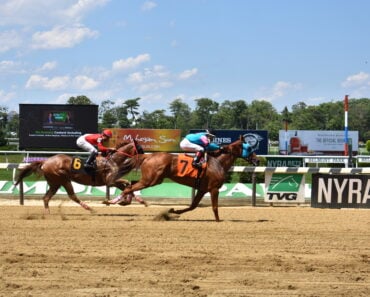
The history of Saratoga Race Course takes a look at one of New York’s great thoroughbred racing institutions. For generations, Saratoga has occupied a unique place on the New York racing calendar, with its famous summer meet drawing horses, jockeys, trainers, and fans to Saratoga Springs. For horse-racing fans, there is nothing quite like being at the track, watching a favorite horse and jockey team run down the home stretch toward the finish line. On August 3, 1863, the racetrack’s legacy began when John Morrissey organized a thoroughbred meet at the old trotting course on Union Avenue. What began as a four-day event quickly developed into one of the most prestigious racing traditions in the country.
Saratoga’s Start
Long before Saratoga Springs became famous for horse racing, the area was known for its mineral springs. Indigenous peoples knew the springs and their reputation for healing long before European settlement. By the nineteenth century, Saratoga Springs had developed into a celebrated health and resort destination that attracted visitors from throughout the country.
Organized horse racing in Saratoga began on August 14, 1847, when entrepreneurs George Cole and Alfonso Patten opened the Saratoga Trotting Course on the north side of Union Avenue, in the area now known as Horse Haven. The inaugural harness race was won by Lady Suffolk, the celebrated gray trotter long associated with the folk song “The Old Gray Mare.” The track had been developed in anticipation of the Great New York State Fair coming to Saratoga that September.
Among the wealthier members of American society, Saratoga Springs grew in popularity as an escape from the hustle and bustle of nearby cities. Some became permanent residents while others treated the location as a seasonal retreat. During the Civil War, Saratoga’s hotels, springs, gambling houses, and horse racing offered visitors an unusual diversion from the troubles consuming the country.

Feature Photo: Cheryl Ann Quigley / Shutterstock.com
Let’s Race
From 1847 until 1862, horse racing in Saratoga was sporadic at best. This changed in the summer of 1863 when John Morrissey arranged a four-day thoroughbred meeting in Saratoga Springs just one month after the Battle of Gettysburg. The opening day witnessed Lizzie W. defeat Captain Moore in a best-of-three series of one-mile heats. After the success of the meeting, Morrissey joined with John Hunter, William Travers, and Leonard Jerome to form the Saratoga Association.
This was the same John Morrissey who went from bare-knuckle boxer to gambler, casino owner, politician, and ultimately one of the most important figures in the development of American thoroughbred racing.
Saratoga Race Course began to take physical form after Morrissey purchased 125 acres of land across Union Avenue from the old course. The original trotting grounds became the barn area known as Horse Haven, while a new grandstand and racecourse were built on the site where Saratoga Race Course stands today. The new course opened in 1864.
Established in 1864, the Travers Stakes became the oldest stakes race for three-year-old horses in the United States. Named after William Travers, the first president of the Saratoga Association, the race became known as the Midsummer Derby. The Travers has endured through more than a century and a half of racing history, although it was not run during several years in the late 1890s and again in 1911 and 1912.
Over the course of time, some of the greatest thoroughbreds raced their way into legendary status on Saratoga’s oval. Horses such as Man o’ War, Whirlaway, Gallant Fox, Secretariat, Seattle Slew, Affirmed, Rachel Alexandra, American Pharoah, and many others made unforgettable appearances at the Spa.
Whirlaway remains the only Triple Crown winner to capture the Travers Stakes. On August 16, 1941, with regular rider Eddie Arcaro serving a suspension, Alfred Robertson guided Whirlaway over a muddy Saratoga track. Whirlaway allowed his two rivals to lead before sweeping past them in the stretch and winning comfortably. His Travers victory became another defining moment in a remarkable season that also included the Kentucky Derby, Preakness Stakes, and Belmont Stakes.
Upset Victories
One of Saratoga’s most famous stories came in the 1919 Sanford Memorial Stakes, when the great Man o’ War suffered the only defeat of his twenty-one-race career. The horse who beat him was appropriately named Upset.
The story became even more memorable because generations of racing fans were told that Upset’s victory created the sporting term “upset.” It is a wonderful piece of Saratoga folklore, but the word was already being used in horse racing and other sporting contexts decades before the 1919 race. What Upset’s victory did accomplish was attach one of the most perfectly named horses in racing history to one of the sport’s greatest surprise defeats.
Man o’ War’s loss came after a troubled start and a difficult trip. Despite being left at a disadvantage, encountering traffic, and carrying fifteen pounds more than Upset, Man o’ War rallied furiously and lost by only a narrow margin. It was the only defeat of his career.
Man o’ War was not the only great champion to experience a stunning loss at Saratoga. In 1930, Triple Crown champion Gallant Fox suffered one of racing’s most famous defeats when 100-1 longshot Jim Dandy beat him in the Travers Stakes. Saratoga’s reputation as the “Graveyard of Champions” grew even stronger in 1973 when Secretariat lost the Whitney Handicap to Onion.
In 2015, Triple Crown champion American Pharoah experienced another Saratoga shock when Keen Ice defeated him in the Travers. The victory gave jockey Javier Castellano his record fifth Travers win at the time. Castellano later extended his record to seven Travers victories.
Cultural Icon
The cultural impact Saratoga Race Course has had on Americans, as well as racing fans around the world, is significant. It is one of the oldest and most historic sporting venues in the United States and remains one of the country’s most celebrated thoroughbred tracks.
Because of Saratoga’s popularity and the long history of horse racing, the entertainment industry has repeatedly drawn upon the track, the Spa, and the legends that raced there. Whether stories were fictional or historical, Saratoga became part of the larger mythology of American racing.
When Saratoga was not part of a movie script, it remained a favorite subject for authors, journalists, and poets. Music has also drawn upon horse-racing imagery. One example is Widespread Panic’s 2001 album Don’t Tell the Band, which includes the song “Action Man” and references the mighty Man o’ War.
Saratoga’s Saga
Over time, Saratoga’s racetrack adapted to the changing dynamics of society while holding tightly to the traditions that made it special. The popularity of the venue was never simply because it was a luxurious retreat for horse enthusiasts. Saratoga developed a character of its own, built around racing, history, summer crowds, and the atmosphere of Saratoga Springs.
Throughout the 1950s, summers at Saratoga routinely drew weekday crowds of more than ten thousand people. In April 1957, Governor Averell Harriman signed legislation prohibiting a simultaneous downstate thoroughbred meet during Saratoga’s season and guaranteeing a minimum of twenty-four days of racing at the Spa.
In 1963, construction of the Adirondack Northway improved automobile access to Saratoga from Albany and the New York State Thruway. As the course itself underwent renovations and upgrades, the track continued to protect many of the traditions that made Saratoga distinctive. One example is the Travers canoe, which floats in the infield pond and is repainted each year in the colors of the most recent Travers winner.
Discussing the history of Saratoga without bringing up the 1962 Travers Stakes would leave out one of the greatest races ever run at the Spa. Before a crowd of 26,183, Jaipur and Ridan turned the ninety-third Travers into an extraordinary head-to-head battle.
George D. Widener’s Jaipur entered the Travers on a five-race winning streak that included the Belmont Stakes. Ridan had already established himself as one of the leading three-year-olds of the season with victories that included the Florida Derby, Blue Grass Stakes, and Arlington Classic.
Straight out of the starting gate, Jaipur and Ridan gave spectators an unforgettable race. Ridan and jockey Manuel Ycaza took a narrow lead into the first turn while Jaipur and Bill Shoemaker remained directly alongside. For nearly the entire 1 1/4 miles, the two colts refused to yield. Jaipur finally won by a nose in 2:01 3/5, breaking Man o’ War’s forty-two-year-old Travers record and helping secure his recognition as the champion three-year-old male of 1962.
Hey There, Fillies!
Adding to Saratoga’s legacy, several fillies have won the Travers Stakes. Maiden won in 1865, Ruthless followed in 1867, and The Banshee won in 1868, meaning three of the first five Travers winners were fillies. Liza added another victory in 1895, and Lady Rotha became the most recent filly to win the race in 1915. More than a century later, Thorpedo Anna came within a head of winning the Travers in 2024.
As with many great racing sagas, Saratoga also experienced controversy. The 1921 Travers Stakes became the subject of one of the most famous betting stories in American racing. Harry Payne Whitney’s filly Prudery entered the picture as the expected favorite, while notorious gambler Arnold Rothstein owned Sporting Blood.
Rothstein learned that Prudery might not be at her best and saw an opportunity. On the morning of the Travers, trainer Sam Hildreth unexpectedly entered Belmont Stakes winner Grey Lag, immediately changing the betting landscape and sending Sporting Blood’s odds higher. Rothstein reportedly placed approximately $150,000 in wagers on his own horse.
Shortly before post time, Grey Lag was scratched. Sporting Blood went on to defeat Prudery and won the Travers. Rothstein reportedly collected hundreds of thousands of dollars from his wagers in addition to the purse. The circumstances created enduring suspicion that the sequence had been manipulated, but a conspiracy was never proven.
Health, History, and Horses
Saratoga’s traditions remain part of the experience. The horses still travel through the grounds along the path leading between the stable area, paddock, and racetrack, allowing spectators to see these remarkable animals at close range.
Speaking as a fan of horses whose brother used to be a jockey once upon a time, it is easy to become awestruck when in close proximity to these incredible animals.
Adding to the appeal of the racetrack is the Big Red Spring in the backyard near the paddock. The spring is named in honor of Man o’ War and Secretariat, the two legendary horses widely known by the nickname “Big Red.” Visitors can still sample Saratoga’s natural mineral water there today.
When Saratoga Race Course celebrated 150 years of thoroughbred racing in 2013, it reinforced how deeply the track is connected to the identity of Saratoga Springs. The city’s familiar phrase, “Health, History, and Horses,” captures the combination of mineral springs, local history, and racing that has shaped the community for generations.
The raw spirit of horses, whether they are on the racetrack or working on a ranch, is unparalleled. Combining that with a respect for history is part of what gives Saratoga its character. The beauty of horses, regardless of whether they are Triple Crown icons or not, is how these majestic creatures continually serve as a reminder that historical moments keep moving forward.
Thankfully, Saratoga and its racetrack continue to use both good and bad history as part of the story while moving forward. That is why the Spa remains one of the crown jewels of American thoroughbred racing.
Saratoga Race Course in 2026
The 2026 season has become another unusual chapter in Saratoga history. With the rebuilt Belmont Park preparing to reopen, Saratoga hosted the Belmont Stakes Racing Festival for the third and final consecutive year from June 3 through June 7. Golden Tempo won the Belmont Stakes on June 6, becoming the final Belmont Stakes winner crowned at Saratoga during the temporary relocation of the race.
Saratoga then opened an expanded forty-six-day summer meet on July 3, scheduled to continue through Labor Day, September 7. Combined with the five-day Belmont Stakes Racing Festival, Saratoga is hosting fifty-one days of live racing in 2026 before returning to its traditional forty-day summer schedule in 2027.
On August 29, 2026, Leading Change won the 157th Travers Stakes, defeating Preakness winner Napoleon Solo while Kentucky Derby and Belmont Stakes winner Golden Tempo finished third. More than 160 years after John Morrissey’s first thoroughbred meeting, the Travers remains the centerpiece of Saratoga’s summer.
Readers interested in more New York racing history can also explore the history of Belmont Park Racetrack, the history of Aqueduct Racetrack, Yonkers Raceway, and the history of the Meadowlands Racetrack.
Sources
New York Racing Association — Saratoga Race Course History
New York Racing Association — Travers Stakes History and Winners
National Museum of Racing and Hall of Fame — John Morrissey
National Museum of Racing and Hall of Fame — Man o’ War
Wordorigins.org — History of the Sporting Term “Upset”
City of Saratoga Springs — Saratoga Springs History
New York Racing Association — 2026 Saratoga Race Course Schedule
New York Racing Association — Golden Tempo Wins the 2026 Belmont Stakes at Saratoga
New York Racing Association — Leading Change Wins the 2026 Travers Stakes
Updated August 31, 2026.
History Of Saratoga Racetrack article published on ClassicNewYorkHistory.com © 2026
We are not responsible for any locations visited based on our recommendations or information included in the articles as the website is for entertainment purposes only.