Long before Belmont Park became synonymous with the Belmont Stakes, one of New York’s most important horse racing venues stood in what is now the Bronx. Jerome Park Racetrack helped shape Thoroughbred racing in America by introducing innovations that influenced the sport for generations while also hosting the very first Belmont Stakes. Although the grandstands disappeared more than a century ago, the legacy of Jerome Park Racetrack lives on through one of horse racing’s most celebrated events and its enduring impact on New York history.
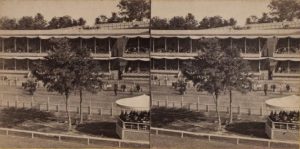
Photo: The Miriam and Ira D. Wallach Division of Art, Prints and Photographs: Photography Collection, The New York Public Library. “Jerome’s Park. Grand Stand, front view.” New York Public Library Digital Collections.
Not many residents of the Bronx are aware that, at one point, there was a racetrack in Jerome Park. The American Jockey Club and Leonard W. Jerome opened Jerome Park Racetrack on September 25, 1866. The opening of the racetrack in 1866 signified a return to normalcy after the Civil War ended in 1865. The track opened in a section of Westchester County called Fordham, which would become part of the Bronx in 1874.
Opening day at Jerome Park Racetrack drew twenty thousand fans. One of those fans was the legendary United States General Ulysses S. Grant. Three years later, in 1869, Ulysses S. Grant would win the presidency of the United States and serve from 1869 to 1877. The first race on the park’s opening day was won by African American jockey Abe Hawkins.
Opening Day At Jerome Park Racetrack
The New York Times published a list of rules and regulations for patrons on the first day of racing. The rules included a guide for parking horses and carriages. Those horse carriages that were just dropping off passengers were instructed to “pass the park gate and into the woods and beyond.” Patrons who were parking their horses or carriages inside the gate were instructed to pay a one-dollar fee. All patrons had to pay a fee of one dollar upon entering the first gate, which was presumably the grandstand.
The rules posted in the New York Times also explicitly stated that any ladies unaccompanied by a gentleman were not allowed in the grandstand alone. Each male clubhouse member was allowed to bring two ladies into the clubhouse for free. Additional ladies brought in by male clubhouse members had to pay a one-dollar fee. Children under sixteen were allowed in free as long as they were accompanied by a clubhouse member.
The Birth Of The Belmont Stakes
Jerome Park Racetrack’s historic significance in New York Thoroughbred racing stems from its racing program, which featured many stakes races, including the first Belmont Stakes. The Belmont Stakes was named after August Belmont, who was the chief financier in the construction of Jerome Park Racetrack.
The legendary Belmont Stakes has since become the third leg of Thoroughbred racing’s Triple Crown series, which starts at Churchill Downs in Kentucky, moves on to the Preakness Stakes at Pimlico Race Course in Baltimore, and concludes with the Belmont Stakes at Belmont Park in New York.
The Jerome Park Racetrack
Jerome Park Racetrack was opened on the Bathgate Estate in the Bronx. The racetrack occupied 230 acres of land. It was a first-rate facility whose clubhouse was designed for the elite, offering top-tier amenities. Historians have written that the clubhouse resembled a first-class luxury hotel.
Jerome Park Racetrack was known for revolutionizing horse racing by introducing many innovations, including pari-mutuel betting and race handicapping. The track was also the first to run races for two-year-olds. The concept of claiming races, in which horses could be claimed by new owners, was also introduced at Jerome Park Racetrack.
Leonard W. Jerome
The racetrack was named after Leonard W. Jerome, who was born in 1817 and died in 1891. Leonard W. Jerome is a fascinating figure in New York history. Jerome’s grandson was Winston Churchill, who rose to fame as the Prime Minister of Great Britain during World War II.
Leonard W. Jerome was a wealthy businessman from Brooklyn who at one time also owned the New York Times. He was also the founder of the American Academy of Music. Jerome was heavily involved in finance and was often called the “King of Wall Street.”
The End Of Jerome Park Racetrack
Jerome Park Racetrack closed for good in 1894. The site would later be used to build a new reservoir to accommodate the growing population of New York City at the turn of the twentieth century. Although the racetrack disappeared from the landscape, its influence on American Thoroughbred racing remains significant. With its innovative concepts and its role as the birthplace of the Belmont Stakes, Jerome Park Racetrack played an important role in the development and success of horse racing in New York City.
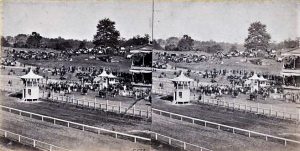
Photo: The Miriam and Ira D. Wallach Division of Art, Prints and Photographs: Photography Collection, The New York Public Library. “Jerome’s Park. Judges and Pooling Stand, front view.” New York Public Library Digital Collections.
Sources
Jackson, K. T. (2011). The Encyclopedia of New York City (Second ed.). New Haven, CT: Yale University Press. p. 677.
The Inauguration Meeting Today at Jerome Park Race Track. The New York Times, September 25, 1866.
New York Public Library Digital Collections.
Photo: The Miriam and Ira D. Wallach Division of Art, Prints and Photographs: Photography Collection, The New York Public Library. “Jerome’s Park. Grand Stand, front view.” New York Public Library Digital Collections. Accessed March 10, 2019. http://digitalcollections.nypl.org/items/510d47e0-1a94-a3d9-e040-e00a18064a99
Photo: The Miriam and Ira D. Wallach Division of Art, Prints and Photographs: Photography Collection, The New York Public Library. “Jerome’s Park. Judges and Pooling Stand, front view.” New York Public Library Digital Collections. Accessed March 10, 2019. http://digitalcollections.nypl.org/items/510d47e0-1a96-a3d9-e040-e00a18064a99
For more New York Racing history, make sure to read our artciels on The History Of Belmont Racetrack, Aqueduct Racetrack, Monticello Raceway, and Roosevelt Raceway.
Article updated June 28, 2026