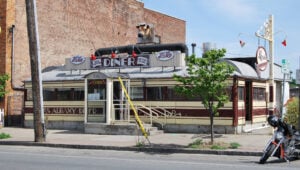
Photo by Matt H. Wade / Wikimedia Commons, licensed under CC BY-SA 3.0. Cropped to 16:9.
There are certain restaurants that become part of the geography of a town. You remember the turn off the highway, the parking lot on a Sunday morning, the familiar counter stools, and the waitress who could recognize regular customers before they even sat down. Across Upstate New York, diners served that role for factory workers, college students, families, highway travelers, and people who simply wanted a hot meal without making an occasion out of it.
Some were traditional prefabricated dining cars, with stainless-steel exteriors and narrow counters. Others were family restaurants that earned the diner name through their menus, hours, and customers. They opened in different decades and disappeared for different reasons. Retirement, rising operating costs, redevelopment, and the pandemic all played roles, but it would be misleading to blame every closing on the same cause.
This collection includes 25 real diner businesses that closed across Upstate New York and the Hudson Valley. In a few cases, the original building survived and another restaurant opened inside it. In others, the diner was demolished, moved, or left vacant. Those differences matter. A place can disappear from a community’s daily life even when its walls remain standing.
25 Diners Upstate New Yorkers Remember
1. Miss Albany Diner — Albany
At 894 Broadway in Albany, the Miss Albany Diner was more than an old-fashioned place to get breakfast. Its 1941 Silk City dining car was a recognizable feature of the city’s northern approach, and it even appeared in the 1987 film Ironweed. The owners’ distinctive brunch service gave the business a following well beyond the surrounding blocks.
Miss Albany ended its run in 2012. But the metal diner was not torn down, despite what some accounts of lost restaurants might imply. Other restaurants took over the historic structure, including Sciortino’s and later Tanpopo Ramen. The Miss Albany name and its menu are gone; the physical diner remains part of the city’s restaurant history.
2. Quintessence — Albany
Few Albany dining rooms looked quite like Quintessence, the silver-sided diner at 11 New Scotland Avenue. Its building dated to the diner era, but the restaurant became known for a more unusual combination of food, nightlife, and a sense of occasion. Longtime customers particularly remembered its chicken teriyaki served with spinach noodles.
Quintessence closed in October 2012 after Albany Medical Center purchased the property for the Park South redevelopment project. Preservation was discussed, and the building was offered to anyone able to move it, but there were no takers. In January 2015, the famous diner was demolished. Unlike some other places on this list, both the restaurant and its original building were lost.
3. Dan’s Place II — Albany
Dan’s Place II on Washington Avenue was the sort of diner that did not need architectural grandeur to become a neighborhood institution. Its counter, close seating, and early breakfasts were familiar to generations of Albany customers. The Deuel family’s operation represented a kind of small, personal restaurant that could be difficult to replace.
The diner closed in July 2025 after the death of co-owner and longtime cook Tom Deuel. The building did not remain empty forever: in 2026 it became Trixie’s Diner, a new business intended to carry on the neighborhood breakfast tradition. That makes Dan’s Place II a lost restaurant name, not a demolished diner. The distinction is important to the story.
4. Saratoga Restaurant and Diner — Saratoga Springs
For decades, the Saratoga Restaurant and Diner on South Broadway served people whose schedules did not fit ordinary restaurant hours. Its late-night and early-morning business made it a familiar stop for the city, especially along one of Saratoga Springs’ main approaches. A diner does not have to be glamorous to become useful to an entire community.
Its closure in early 2012 came quietly. A handwritten notice appeared at the entrance, and local reporting described an institution that had simply stopped serving customers. The absence was felt by people who had counted on a meal at hours when few other kitchens were available. The Saratoga Restaurant and Diner was not the same business as the city’s many newer restaurants bearing a Saratoga name.
5. Johnny B’s Glenmont Diner — Glenmont
The silver dining car near Route 9W was familiar long before it carried the Johnny B’s name. The structure had stood in the Bethlehem area since the early 1960s and previously operated under names including Miss Glenmont. Its history reached across several generations of roadside dining south of Albany.
Johnny B’s closed in June 2020, and its fate became a local preservation issue when neighboring development plans threatened the site. The story did not end with an ordinary demolition. In 2023, crews prepared the historic diner for removal to Queens, where it was intended for reuse. Glenmont lost a restaurant and a landmark, even though efforts were made to preserve the old dining car itself.
6. Steve’s Place — Glens Falls
Steve’s Place on Broad Street was a Glens Falls breakfast fixture operated by the Vamvalis family for more than half a century. Places like this become woven into local routines: an inexpensive morning meal, a table of regulars, and employees who know which customers arrive together. It is often the staff as much as the menu that people remember.
The business closed in March 2024 when longtime owner Chris Vamvalis-Haley retired and the property was sold. Plans for a car wash brought another visible change to the street. Some former employees found a new home at The Tavern in Queensbury, where their breakfast experience was put to use. That offered continuity for the workers, although Steve’s Place itself was gone.
7. Lake Effect Diner — Buffalo
Buffalo’s Lake Effect Diner stood out because it looked like the classic American diner people imagined when they thought of shiny metal cars and roadside breakfasts. Located on Main Street, it served students, residents, and travelers while becoming a well-known part of the city’s dining landscape. Its identity was tied as much to the building as to the business.
Owner Tucker Curtin announced the closure of Lake Effect Diner and the nearby Steer restaurant in August 2021. In local interviews, he discussed staffing shortages, pandemic pressures, supply difficulties, and exhaustion after many years in the industry. Those reported reasons tell a more specific story than the easy claim that fast-food chains simply drove every diner out of business.
8. Golden Fox Restaurant — Rochester
The Golden Fox on Culver Road was a classic Rochester breakfast and lunch destination. Opening in 1973, it built a following over more than five decades, with generations of families returning for familiar food and service. It was the kind of place residents recommended when someone asked for a reliable breakfast rather than a fashionable new restaurant.
Its owner announced a June 30, 2024 closing after 51 years, describing the decision as part of a move into retirement. That ending is worth remembering because it was not primarily a story about a building being cleared for development. A long-running business can reach the end of its life when the people who kept it going decide it is time to step away.
9. Pat’s Coffee Mug — Rochester
Pat’s Coffee Mug at 627 South Clinton Avenue was a small South Wedge institution with a decidedly personal character. Owner Pat Hall operated the diner for more than three decades, and regulars knew the modest dining room as a place for breakfast and conversation rather than elaborate presentations. The restaurant’s scale was part of its appeal.
Hall announced that the restaurant would close in November 2025, after approximately 33 years in business. Coverage of the decision centered on her retirement and health, and on the emotional attachment of its customers. This was not an enormous corporate restaurant; it was a neighborhood place whose continuity depended heavily on the person behind the counter.
10. The Spot Diner — Town of Chenango
The Spot on Upper Front Street, just north of Binghamton, was a familiar stop for Broome County residents and drivers passing through the area. Its roots reached back to the 1960s, making it part of a corridor where diners, motels, and businesses long catered to local travelers as well as people using major roads nearby.
Owner Spyros Dimatos announced in 2023 that the restaurant would close because of difficult business conditions and increasing expenses. The Spot served its final customers that October, and its equipment was later sold at auction. The decision was described as painful by the owner, reflecting the difference between a restaurant that has simply run its course and a place its operators would have liked to sustain.
11. Red Robin Diner — Johnson City
The Red Robin Diner was a recognizable Main Street landmark in Johnson City, with a history that began in Binghamton. The dining car first operated on Conklin Avenue and was moved to the corner of Main and Broad streets in 1959. In that location it became one of the Southern Tier’s memorable surviving old-style diners.
The Red Robin closed in January 2021 after struggling during the pandemic. Rather than being demolished, the building was sold and renovated for a different restaurant concept, 8-Bit Bites, which opened in 2023. The Red Robin business did not return, but its distinctive structure was reused. The survival of the building makes this story different from the fate of a diner lost to a wrecking crew.
12. Manos Diner — Ithaca
Ithaca’s Manos Diner served students and local residents for generations, giving the city another informal meeting place beyond its campus dining halls. The restaurant lasted 52 years, long enough to become part of the personal histories of people who passed through Ithaca for college, work, and family visits.
Manos closed in 2014, a loss later recalled by The Cornell Daily Sun when another late-night restaurant shut down. Ithaca’s diner options had been narrowing, and that change was particularly noticeable to students looking for food outside normal dining hours. This Ithaca restaurant should not be confused with a separate Manos Diner that once operated in Elmira Heights.
13. Manos Diner — Elmira Heights
A separate Manos Diner stood on College Avenue in Elmira Heights, serving Southern Tier customers for breakfast and other familiar diner meals. Though it shared a name with the former Ithaca restaurant, it was a distinct local establishment with its own address and history. The Elmira Heights business closed in 2008.
Years after service stopped, its abandoned building remained along a busy roadway. In 2024, local reporting described a proposal for a Dollar General on the property, including the removal of the old diner building. That report documented a development proposal, not proof that every part of the plan had already been carried out; the diner’s actual closure, however, was long established.
14. Olympic Diner — Kingston
For more than 50 years, the Olympic Diner at 620 Washington Avenue was part of Kingston’s everyday food scene. It was a traditional place for breakfast, lunch, dinner, and conversation, one of those community restaurants whose name could become shorthand for a familiar stretch of road.
The Olympic closed in September 2022. Its building was subsequently demolished, with reporting at the time pointing to a self-storage development planned for the site. For longtime customers, that meant there was no chance of the old dining room reopening under a new owner. Both the business and the recognizable physical reminder were gone.
15. College Diner — New Paltz
The College Diner on Route 299 in New Paltz linked the local community and a village shaped by nearby SUNY New Paltz. Diners around college towns often attract a distinctive mix of students, parents, faculty, residents, and late-night diners. The College Diner became a familiar sight on the eastern approach to town.
The business closed in 2018. Plans were later discussed to turn the property into a credit-union branch, but those plans changed, and the site was put back on the market in 2024. The diner was not accurately described as having been demolished by those developments. The established fact is that the old restaurant closed and the property’s future remained unsettled.
16. Table Talk Diner — Poughkeepsie
The Table Talk Diner on Route 9 offered the sort of wide-ranging menu that made Hudson Valley diners useful to almost everyone in a group. Breakfast dishes, sandwiches, and hearty meals drew customers to its Poughkeepsie location, where families could return for a familiar and unpretentious outing.
The Vanikiotis family announced in June 2020 that Table Talk would close permanently after about a decade, following months of disruption during the pandemic. The closure did not mean the family had left the diner business altogether: its other restaurants, including the Red Line Diner in Fishkill and Daily Planet in LaGrangeville, continued to operate at the time.
17. Acropolis Diner — Poughkeepsie
The Acropolis Diner at 829 Main Street was one of those Hudson Valley establishments where breakfast could turn into lunch and lunch could turn into a late-night meal. Opened in 1951, it earned a following over more than seven decades and became particularly familiar to people who appreciated a diner that could accommodate a wide range of schedules.
The Acropolis served its final meal on Easter Sunday, March 31, 2024. Reports described a closing that surprised some customers, many of whom had known the restaurant and its staff for years. The loss was notable not just for its age but for the ordinary rituals that had taken place there: recurring breakfasts, family visits, and quiet meals after long shifts.
18. Walden Diner — Walden
For more than two decades, the Walden Diner was part of the rhythm of this Orange County village. Located at 23 Orange Avenue, it belonged to the tradition of small-town diners where the people behind the counter could recognize a familiar face and the breakfast crowd could feel like its own community.
The operators closed the diner in September 2021 after 22 years, explaining that they were retiring. Their farewell focused on the customers and relationships built over the years. The reason matters: not every vanished diner was forced out by redevelopment or a chain restaurant. Sometimes the restaurant’s longtime owners simply reached the end of their working lives.
19. Ikaros Diner — New Windsor
The Ikaros Diner on Union Avenue was part of New Windsor’s Greek-American diner tradition. Like many such establishments in the Hudson Valley, it offered a broad menu and a familiar place to stop along a busy commercial road. The regular business of a diner is not only feeding travelers but also serving residents who return week after week.
Ikaros stopped serving customers in the summer of 2025, and the property was put up for sale. Its closure followed the earlier shutdown of a sister restaurant, the Oddyssey Diner in Wappingers Falls. Taken together, the two closures illustrate how even related local restaurants could not count on their established names to guarantee continued operation.
20. Oddyssey Diner — Wappingers Falls
The Oddyssey Diner was a Dutchess County companion to the Ikaros Diner in New Windsor. It belonged to the large-menu, Greek-American style of dining that became a prominent feature of many Hudson Valley commercial corridors. For its regulars, a diner is often a dependable meeting place as much as a destination for a particular dish.
Oddyssey closed in October 2024, according to subsequent regional reporting on Hudson Valley restaurant closures. Its sister Ikaros followed in 2025. The two names deserve their own entries because they were separate restaurants serving different communities, even though there was a business connection between them.
21. Foxy Roxy’s — Potsdam
Foxy Roxy’s on Market Street was a well-known Potsdam breakfast stop in the North Country. Roxanne and Lynn Smith took over the former Carolyn’s Diner in 2006, and the restaurant became a local gathering place that customers associated with its owners. The name changed, but the building continued its diner role for another 16 years.
The Smiths closed Foxy Roxy’s in April 2022 after the property was sold to Stewart’s Shops. Plans called for the restaurant and adjoining properties to be demolished to build a new convenience store. The closing drew strong community reaction, and the sale tied the diner’s fate directly to a specific redevelopment rather than an unsupported general theory about changing American eating habits.
22. Buzzy’s Diner — Manlius
George ‘Buzzy’ Oley opened Buzzy’s Diner in 1970, and for nearly 30 years it served the Manlius area. Customers remembered the Buzzy burger, the Buzzy muffin, and a room where people from different walks of life shared meals. The diner was also remembered for serving customers through difficult weather when other businesses had lost power.
Buzzy’s closed in 1999, but its reputation lasted. Oley’s family and former employees organized a reunion in 2022 that recreated the breakfast experience for a weekend. That gathering says a great deal about a genuinely missed restaurant: people wanted more than a photograph of the place. They wanted to sit down together and eat as they had years earlier.
23. Modern Malt — Syracuse
Modern Malt arrived in Syracuse’s Armory Square in 2014 with a deliberately contemporary take on the American diner. Its breakfast-focused menu went beyond the usual eggs and toast, using playful combinations and a casual downtown atmosphere. It was younger than many other businesses in this collection, but it still became part of local dining routines.
The original restaurant on South Clinton Street closed in February 2025, after roughly a decade. The owners discussed changing downtown business conditions and moved some brunch offerings to a different establishment. Modern Malt shows that a lost diner need not be a 1940s dining car: a modern restaurant can also become a remembered part of a city’s restaurant history.
24. Al’s Diner — East Syracuse
For many East Syracuse customers, Al’s Diner meant a familiar staff and a straightforward place to eat rather than anything fashionable. The restaurant was strongly associated with its longtime owner, Albert Burns Jr., and employees who had worked there for years. It closed in November 2021 after Burns died.
This is another case in which the building and diner tradition survived under a new name. In December 2023, Ellie May’s Diner opened in the former Al’s location, bringing back some former employees. Al’s itself was gone, but the new restaurant tried to recover the welcoming character that customers had missed. That is a more accurate ending than claiming the diner was demolished.
25. Mike’s Diner — Cairo
Mike’s Diner was a longtime roadside institution in Cairo, Greene County, with roots reaching back almost 70 years. Its appeal rested on the same things that sustained countless family-run diners across the Catskills: an approachable menu, familiar service, and conversation among customers who saw one another regularly.
The diner served its last customers on December 29, 2024. The owners had already reduced operating days while dealing with staffing difficulties and declining business. Their final announcement thanked customers for years of support. Mike’s illustrates how a diner can disappear gradually, through shorter hours and growing operating pressure, before the closing sign finally goes on the door.
Why These Diner Closures Still Matter
What these histories have in common is not one universal explanation for closure. Some owners retired after decades at the grill. Some buildings became valuable redevelopment sites. Others struggled through the pandemic or faced higher operating costs. And a few dining cars found second lives in different places or under different names. Treating all of them as victims of a single trend would erase the local circumstances that make each story worth telling.
A diner can hold an astonishing number of individual memories: a first job, an after-game dinner, an early shift before sunrise, or the same breakfast order every Saturday. When one closes, much of that history survives only in photographs and conversations. That is why remembering the specific name, place, owners, and circumstances matters more than romanticizing every old diner as exactly the same.
For a look at restaurants that have survived, read our guide to 15 historic Upstate New York diners worth visiting. You can also explore 25 of the oldest restaurants in Upstate New York still serving customers and our firsthand account of the closing of Duke’s Diner under its longtime Plattsburgh owner, a restaurant that subsequently continued as Mel’s Diner.