Feature Photo: alex lines from brooklyn, usa, CC BY-SA 2.0 <https://creativecommons.org/licenses/by-sa/2.0>, via Wikimedia Commons
Whatever happened to Howard Johnson’s restaurants? The once-dominant American restaurant chain gradually disappeared as fast-food competitors changed the way families ate on the road, its own food and operating standards became harder to maintain, and a series of corporate sales broke apart the business. The final restaurant, in Lake George, New York, closed in 2022. The Howard Johnson name survives on hotels operated under the Wyndham umbrella, but the orange-roofed restaurants that introduced generations of Americans to 28 flavors of ice cream are gone.
For decades, however, that outcome would have been difficult to imagine. Howard Johnson’s was more than a place to stop for lunch. Its bright orange roofs, blue-green accents, and familiar menus became part of the American roadside landscape at a time when more families than ever were discovering the freedom of the automobile. Whether travelers were taking a summer vacation, visiting relatives, or simply driving from one city to another, the chain offered something reassuring: a place where the food, service, and surroundings were supposed to be much the same as the last Howard Johnson’s they had visited.
New York played a particularly important role in that story. The company built a remarkable restaurant in Rego Park, Queens, served theatergoers in Times Square, and eventually operated service-area restaurants along the New York State Thruway. Long after most of the chain had disappeared, two of its final surviving restaurants were located in the Adirondack region. The last of them, in Lake George, would become a destination for people hoping to revisit a piece of the American dining experience that had nearly vanished.
The story begins not in New York but in Massachusetts, with an ambitious businessman who understood that customers would return when they could trust what they were going to get. It ends almost a century later in Upstate New York, where the closing of one restaurant marked the disappearance of an entire national dining institution.
How Howard Johnson’s Began in Massachusetts
In 1925, Howard Deering Johnson took over a struggling pharmacy and soda fountain in Quincy, Massachusetts. Rather than treat the soda fountain as an incidental part of the business, he recognized that its ice cream could become the main attraction. Johnson invested in a richer recipe, using a higher butterfat content than was typical for ordinary commercial ice cream, and developed a growing assortment of flavors that gave customers an unusually wide selection.
By the end of the 1920s, the famous 28 flavors had become central to the Howard Johnson identity. The ice cream drew customers, but Johnson also understood that people wanted something more substantial to eat. He added convenient foods such as hot dogs, sandwiches, and fried clams, broadening a seasonal treat into a business that could serve people looking for a full meal.
He opened his first full-service restaurant in Quincy in 1929. That timing was unfortunate for most entrepreneurs: the stock market crashed that autumn, and the Great Depression soon followed. But Johnson saw an opportunity in the steady growth of automobile travel. He believed motorists would seek familiar, reasonably priced dining establishments along their routes, especially where available alternatives varied widely in quality.
The Orange Roof and the Growth of Restaurant Franchising
Howard Johnson’s became an important early example of how restaurant franchising could work on a large scale. Historical accounts sometimes date the company’s early franchising history differently, but its 1935 partnership with Reginald Sprague in Orleans, Massachusetts, became a particularly influential model. A local operator could run a restaurant under the Howard Johnson name while following the company’s menus, recipes, appearance, and operating standards.
This was not simply a matter of putting the same name on unrelated restaurants. Johnson wanted travelers to recognize the building before they reached its parking lot. The orange roof, contrasting shutters, cupola, and familiar roadside signs were all part of a carefully developed visual identity. Inside, customers expected dependable meals and clean surroundings. That consistency became the chain’s biggest selling point.
Franchising made it possible to expand without personally owning every dining room, although the company also continued to operate many restaurants itself. Standardized supplies and close attention to food preparation helped the growing operation deliver recognizable products across different locations. By the beginning of World War II, the chain had become a notable presence along major eastern travel routes.
How Howard Johnson’s Became a Highway Institution
The rise of American automobile travel and the growth of the restaurant chain were closely connected. As new toll highways were built, motorists needed convenient places to stop without making long detours through unfamiliar towns. Howard Johnson’s won a major early concession contract on the Pennsylvania Turnpike, placing its restaurants along a road that became an influential model for modern highway travel.
After World War II, suburban development, higher automobile ownership, and family vacations helped turn Howard Johnson’s into a national brand. Families came to associate the chain with rest stops, weekend trips, and journeys to vacation destinations. The orange roof was a signal that a predictable meal lay ahead, and parents knew that the menu offered choices likely to appeal to children as well as adults.
The company expanded into lodging in 1954, opening the first Howard Johnson’s Motor Lodge. Restaurants and motor lodges eventually complemented one another, allowing travelers to eat and spend the night under a familiar name. By the late 1970s, the Howard Johnson enterprise encompassed roughly 1,000 restaurants and hundreds of motor lodges. It had become one of the defining brands of American roadside hospitality.
The 28 Flavors, Fried Clams, and Familiar Menu
For many customers, the appeal of Howard Johnson’s was as much about particular foods as it was about convenience. The 28 flavors of ice cream became an enduring advertising symbol, promising a selection far beyond the standard vanilla, chocolate, and strawberry. Ice cream cones, sundaes, and family desserts could turn an ordinary highway stop into something children remembered for years.
The restaurant menu also developed a distinctive identity. Fried clam strips, served as a signature Howard Johnson specialty, joined frankfurters in buttered, toasted rolls, sandwiches, and an assortment of familiar American comfort foods. The chain sought to make a meal feel accessible without losing the sense that customers were dining at a proper restaurant rather than a roadside snack counter.
Behind that apparently straightforward menu was a surprisingly sophisticated food operation. French chefs Pierre Franey and Jacques Pépin worked with Howard Johnson’s during the company’s expansion, helping with food production and recipe development. Pépin later recalled his time working at a Howard Johnson’s on Queens Boulevard as part of his introduction to American mass-market cooking. The goal was not to turn each restaurant into a fine-dining establishment, but to make dependable food possible across a far-flung system.
Howard Johnson’s in Queens and the New York World’s Fair Era
One of the chain’s most remarkable restaurants stood at 95-25 Queens Boulevard in Rego Park. Opened in 1940, during the era of the 1939–1940 New York World’s Fair, it was an elaborate, large-scale version of the familiar Howard Johnson concept. Rather than the modest roadside buildings most people remember, this restaurant resembled a grand Colonial-style establishment, with imposing architectural details and spacious dining rooms.
The Queens restaurant was developed with major financial backing from investor Lydia Pinkham Gove. Historical accounts describe seating for hundreds of guests inside, with additional outdoor accommodation. The restaurant had banquet rooms and became a setting for celebrations as well as everyday meals. For some New Yorkers, Howard Johnson’s was therefore not merely a stop on a trip; it was a place to attend a reception, gather with family, or dine out close to home.
Its connection to the broader food world was also significant. Jacques Pépin, who would later become one of America’s best-known chefs and culinary teachers, worked at the Queens Boulevard Howard Johnson’s during his years with the company. The Rego Park building was eventually demolished in 1974, removing one of the most ambitious restaurants in the chain’s history from the New York landscape.
Howard Johnson’s in Times Square and Along the New York State Thruway
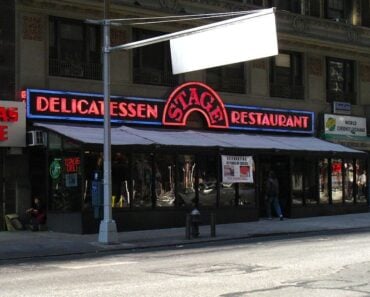
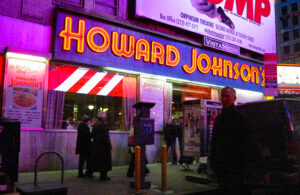
Howard Johnson’s also occupied a very different place in New York City life. At Broadway and West 46th Street, its Times Square restaurant became a familiar stop for theatergoers, visitors, and New Yorkers who wanted a recognizable meal in the middle of one of the city’s busiest districts. The restaurant survived into the 21st century even as the surrounding neighborhood changed dramatically. It closed in July 2005 as the redevelopment of Times Square brought enormous pressure to bear on older businesses and valuable retail properties.
Upstate, the chain became closely identified with highway travel. The New York State Thruway’s service areas were created to serve motorists crossing long distances through the state. According to the New York State Thruway Authority’s history, Howard Johnson’s became the service-area operator in the early 1980s. By 1985, the chain was operating 26 Thruway travel plazas, which Marriott acquired as part of its larger purchase of Howard Johnson’s restaurant business.
The distinction in dates matters. Howard Johnson’s had long been associated with American turnpikes, but it would be inaccurate to suggest that the company opened and controlled the New York Thruway’s service areas from the road’s original mid-1950s development. Its documented role as the Thruway’s service-area operator belongs to a later period, when the company was already a mature national institution.
Together, the Queens, Times Square, and Thruway locations illustrate just how broad the Howard Johnson’s presence in New York had become. It could be an elaborate neighborhood restaurant, a convenient meal in the Theater District, or a familiar stop during a long drive across the state. That ability to serve different kinds of customers was one of the reasons the brand became so deeply embedded in American memory.
Why Howard Johnson’s Restaurants Began to Disappear
The decline of Howard Johnson’s did not come from a single failure. By the 1970s, the market that had helped create the chain was changing quickly. McDonald’s, Burger King, and other fast-food competitors offered meals that were generally quicker and cheaper to serve. Howard Johnson’s relied on dining rooms, waitstaff, extensive menus, and a more labor-intensive service model. That made its familiar approach increasingly difficult to maintain in a business where price and speed were becoming decisive advantages.
Changes in American travel compounded the problem. The oil shocks and economic turbulence of the 1970s put pressure on the road-trip economy. Evolving highway routes, newer commercial developments around exits, and a growing number of competitors also affected the value of individual restaurant locations. It would be too simple, however, to say that the Interstate Highway System alone destroyed Howard Johnson’s. The company had benefited enormously from high-speed road travel and continued to operate in major travel corridors as its broader problems developed.
Quality became another challenge. Howard Johnson’s had built its reputation on making the same food reliably available from one restaurant to the next. As costs rose, efforts to reduce expenses threatened that promise. Former participants in the business and later historical accounts have described deterioration in food quality and difficulties maintaining the standards that had once distinguished the brand. A national network built around consistency could lose its advantage quickly when customers stopped expecting a consistently good experience.
By that point, newer family-dining and fast-food chains had learned many of the lessons Howard Johnson’s had pioneered. Uniform menus, recognizable signs, familiar buildings, and streamlined operations were no longer unusual innovations. They had become everyday expectations, and the older chain faced competitors that were better adapted to a changing marketplace.
The 1979 Sale and the Marriott Breakup
In 1979, the Howard Johnson company was sold to Britain’s Imperial Group. The transaction ended the Johnson family’s control of the restaurant and lodging empire. Imperial took ownership of a major American brand, but the restaurants continued to face difficult economic and competitive conditions. The ownership change did not reverse their decline.
A more consequential restructuring followed in 1985. Marriott acquired Howard Johnson from Imperial and entered into a transaction with Prime Motor Inns that separated much of the lodging business and the restaurant franchising system from the company-operated restaurants Marriott retained. Prime received important rights associated with the Howard Johnson name, while Marriott continued operating and eventually converting or disposing of numerous company-owned restaurants.
The practical consequences for the restaurant chain were severe. Howard Johnson’s was no longer one centrally directed operation combining restaurants, lodging, purchasing, marketing, and a familiar national identity in the way earlier generations had known it. Some restaurants adopted other names, some closed, and independent operators tried to preserve the brand even as its corporate structure changed.
The chain did not disappear overnight in 1985. Franchisees continued operating Howard Johnson’s restaurants for decades. But the breakup removed much of the organizational strength that had once supported the nationwide network. A name that had appeared almost everywhere began surviving only in scattered locations.
The Final Howard Johnson’s Restaurants in Lake Placid and Lake George
New York occupied a special place in the last chapter of the chain’s history. As former Howard Johnson’s locations closed across the country, surviving restaurants in Lake Placid and Lake George continued to carry the name in the Adirondack region. They were no longer everyday examples of a thriving national chain. Instead, they were rare reminders of the era when the orange roof had been one of America’s most familiar commercial landmarks.
The Lake Placid restaurant closed in 2015. The remaining location in Bangor, Maine, closed in 2016, leaving the Howard Johnson’s in Lake George as the last restaurant operating under the historic name. Its continued existence drew attention from longtime customers, restaurant historians, and travelers who wanted one more opportunity to experience a brand that once seemed permanent.
The Lake George restaurant itself had a complicated final decade. It had closed for a period before reopening under a new operator in the mid-2010s, and its service and hours changed over time. By spring 2022, it was no longer functioning as a restaurant. Local reporting confirmed that the property was available for lease and had failed to open for Memorial Day weekend. Reporting published at the beginning of June established that the final Howard Johnson’s restaurant had closed.
The location of that final closing made the story especially meaningful for New York. A restaurant chain that had spread across America, and had played an important part in the state’s highway and dining history, ended its restaurant life in a community visited by generations of New York vacationers.
Does Howard Johnson’s Still Exist Today?
The Howard Johnson’s restaurant chain is gone, but the name has not disappeared from American hospitality. The hotel business survived the separation from the restaurants, passing through different corporate ownership arrangements and eventually becoming part of Wyndham Hotels & Resorts. Properties continue to operate under the Howard Johnson by Wyndham name, including hotels in New York and elsewhere in the United States and abroad.
Those hotels should not be confused with the original restaurant chain. A modern Howard Johnson by Wyndham property does not signify that the old 28-flavor dining room or its fried-clam menu has returned. The two businesses have different histories following the corporate breakup of the 1980s.
For people who remember stopping at Howard Johnson’s with their families, the restaurant’s disappearance represents more than the loss of another national brand. The chain belonged to an era when American highways were changing daily life, and it helped establish the idea that travelers could find something familiar wherever they went. From Queens Boulevard and Times Square to the New York State Thruway and the final Lake George restaurant, Howard Johnson’s left a particularly recognizable mark on New York. The orange roofs have largely vanished, but the memories of what they represented have lasted much longer.