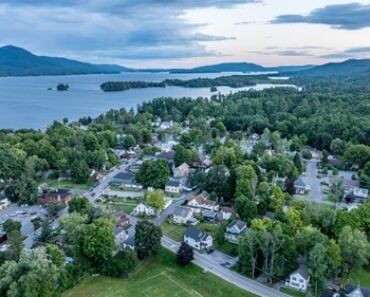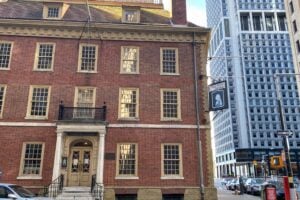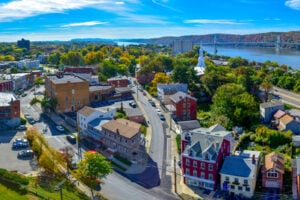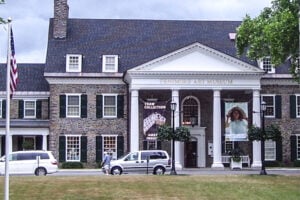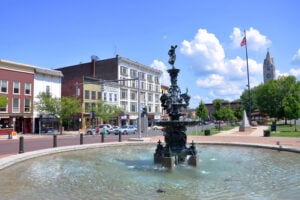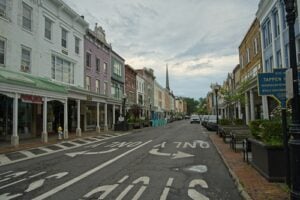
Wall Street in Kingston’s historic Stockade District, photographed in July 2025. Photo: Chris Ferrara / Shutterstock.com
Kingston is one of those New York cities whose history reaches well beyond its size. Its old stone buildings, steep streets, working waterfront, and neighborhoods have witnessed nearly four centuries of change. In 1777, as the Revolutionary War continued, Kingston became New York’s first state capital. The honor was brief. British forces burned much of the settlement that October, leaving a community that would have to rebuild even as the new state struggled for independence. Today, the Stockade District and the Senate House help preserve that extraordinary chapter in New York history.
The Kingston visitors see today also grew from several communities with different economic lives. Uptown Kingston developed around the colonial settlement and its commercial streets. Rondout became a busy waterfront center after the Delaware and Hudson Canal opened in 1828, carrying coal and other goods to the Hudson River. The nearby hamlet of Wilbur prospered through the bluestone trade. In 1872, Kingston, Rondout, and Wilbur combined to form a single incorporated city. The resulting mix of old neighborhoods, port activity, industry, and commerce gave the place an identity unlike that of many other Hudson Valley communities.
That combination of river access and a connection to the wider world helps explain why Kingston’s story is about more than governors, stone houses, and boats. People who began their lives in Kingston or spent important years here eventually entered Hollywood, Broadway, the recording industry, major museums, television networks, professional sports, journalism, and the federal government. Some carried the experience of a Hudson Valley childhood into fields that seemed a world away from Ulster County. Others settled in Kingston later and helped build the local cultural life that continues today.
Consider the range. A Kingston-born painter created one of the United States Capitol’s enormous historical canvases. Another local boy made the fortune that helped establish a Smithsonian art museum. A future film director grew up to become a defining figure in 1970s American cinema, while a Kingston-educated playwright went on to create television dramas watched around the world. A Civil War officer from the city helped create a new military intelligence system, and a Kingston soldier received the Medal of Honor for his actions in World War II. Those are very different careers, yet they connect to this small Hudson River city.
The following 25 biographies include people born in Kingston, people raised or educated there, and a few whose substantial work or residence tied them directly to the city. The distinction matters. Someone who arrived in Kingston as an established artist should not be described as a native, and a person born nearby should not be given a Kingston birthplace simply because it makes for a better headline. The stories below focus on the real connections, along with the achievements that made each individual notable.
1. Peter Bogdanovich (1939–2022)
Kingston connection: Born in Kingston.
Peter Bogdanovich was born in Kingston in 1939, the son of European immigrants who had escaped the growing dangers of Nazi-era Europe. His birthplace is an easily overlooked detail in a career so closely associated with Hollywood and New York’s film culture. Bogdanovich would become both a passionate student of classic American movies and one of the most recognizable directors of the New Hollywood era.
Long before he directed major films, Bogdanovich made his reputation as an actor, theater director, critic, and historian of cinema. He championed filmmakers such as John Ford, Howard Hawks, and Orson Welles at a time when many older Hollywood directors were being reassessed. His first notable directing work included the 1968 thriller Targets, which featured Boris Karloff in one of his final important screen performances.
His breakthrough arrived with The Last Picture Show in 1971, a portrait of small-town Texas life that became one of the decade’s acclaimed films. He followed it with What’s Up, Doc? and Paper Moon, showing an ability to move between wistful drama and fast-paced comedy. Although most audiences connect him with the movies, his Kingston birthplace places one of the central figures of 1970s American cinema firmly on this Ulster County list.
2. John Vanderlyn (1775–1852)
Kingston connection: Born and died in Kingston.
John Vanderlyn was born in Kingston in 1775, just before the American Revolution transformed life in the Hudson Valley. He developed an early gift for drawing, eventually going to New York City and coming to the attention of the portrait painter Gilbert Stuart. Through the support of Aaron Burr, Vanderlyn traveled to France for artistic training at a time when American artists generally looked to Britain for instruction.
In Europe, he embraced the ambitious style of neoclassical history painting. Vanderlyn won recognition at the Paris Salon and produced portraits, landscapes, and panoramas, though success overseas did not always translate into financial security at home. His international career is remarkable when considered against the circumstances of his beginnings in the small Hudson Valley community that had only recently endured the burning of 1777.
His best-known national commission was Landing of Columbus, completed for the Rotunda of the United States Capitol and installed in 1847. The work remains part of the Capitol’s historical-art program, even as modern viewers consider its representation of the encounter between Europeans and Indigenous peoples critically. Vanderlyn died in Kingston in 1852. Few local artists have left a more visible work in a federal landmark.
3. Molly Smith Metzler
Kingston connection: Raised in Kingston.
Molly Smith Metzler was born overseas while her parents taught abroad, but she grew up in Kingston. Her family returned to the city before she began school, and she remained there until college. Metzler has spoken about the contrasts she saw in Kingston’s different economic circumstances, experiences that later shaped her interest in class, families, and the pressures facing ordinary people.
She discovered playwriting as a college student at SUNY Geneseo and went on to study the craft more deeply, including at Juilliard. Her theatrical work includes Elemeno Pea, Cry It Out, and The May Queen. These plays explore how personal relationships are affected by social expectations and money, themes that connect naturally to her interest in the economic divisions she noticed while growing up.
Television brought Metzler to a much larger audience. She created the Netflix limited series Maid, adapted from Stephanie Land’s memoir, and later created Sirens. For a reader following the careers of prominent Kingston residents, hers is a particularly good example of a childhood in the Hudson Valley contributing to the concerns of a writer whose work eventually reached a national and international audience.
4. Ezra Hasbrouck Fitch (1865–1930)
Kingston connection: Practiced law and worked in real estate in Kingston.
The Fitch name became famous through Abercrombie & Fitch, but Ezra Hasbrouck Fitch’s New York story extends well beyond the fashionable retailer. He was born in Coxsackie, not Kingston, and developed an early enthusiasm for outdoor pursuits. Before entering the retail business, however, he practiced law and worked as a real estate developer in Kingston, establishing a substantial professional tie to the city.
An eager customer of David Abercrombie’s outdoor-goods business in Manhattan, Fitch became a partner in 1900. The two men differed over the company’s direction. Abercrombie favored a specialized outfitter serving serious outdoor customers, while Fitch saw opportunities to broaden the business and its appeal. By 1907, Fitch had taken control, and the firm developed into an influential name in American sporting and outdoor retail.
The Abercrombie & Fitch most Americans recognize today is very different from the outfitting enterprise of Fitch’s generation. Nevertheless, his story offers a surprising connection between Kingston’s professional community and the history of a national retail brand. This is not a claim that the company began in Kingston; rather, Kingston was one of the places where Fitch worked before making his name in business.
5. John Glover (born 1944)
Kingston connection: Born in Kingston.
Actor John Glover was born in Kingston in 1944, although he grew up in Salisbury, Maryland. The distinction is important because his theatrical education and early career developed outside the Hudson Valley. His Kingston birthplace nevertheless connects a celebrated stage and screen performer to Ulster County, even if many audiences know him primarily through his later television roles.
Glover established himself as an unusually flexible character actor. His stage credits include a Tony Award-winning performance in Love! Valour! Compassion!, a play that required him to create two contrasting characters. That kind of range also carried into his movie work, including Scrooged and Gremlins 2: The New Batch, films in which he could be sharply comic and unsettling at the same time.
A new generation discovered Glover as Lionel Luthor, the calculating father of Lex Luthor on Smallville. The long-running television role introduced his distinctive voice and ability to play complicated antagonists to millions of viewers. His Broadway career, however, remains just as important as his television fame, making him one of Kingston’s notable connections to American theater.
6. Jervis McEntee (1828–1891)
Kingston connection: Born in Rondout, now part of Kingston.
Jervis McEntee was born in Rondout in 1828, when the waterfront community was still separate from Kingston. Rondout later became part of the modern city, giving his birthplace a direct connection to Kingston’s municipal history. As a young man he developed artistic ambitions and studied with Frederic Edwin Church, one of the most influential painters associated with the Hudson River School.
McEntee initially tried his hand at business before committing himself more fully to painting. In New York City he became one of the early occupants of the Tenth Street Studio Building, a gathering point for artists and cultural figures. His landscapes often favored the subdued colors and emotional atmosphere of autumn rather than the theatrical grandeur associated with some other Hudson River School painters.
He kept close ties to his home region throughout his life. His papers and diaries, now preserved through the Smithsonian’s Archives of American Art, offer an unusually rich record of nineteenth-century artistic life and relationships. McEntee also belongs to Kingston’s story because his paintings reflected the Hudson Valley landscape at a time when the region was influencing how Americans imagined their own country.
7. Charles Lang Freer (1854–1919)
Kingston connection: Born and raised in Kingston.
Charles Lang Freer was born in Kingston in 1854 to a family of modest means. His early life bears little resemblance to that of the wealthy art collector he later became. He went to work at fourteen, including time in a cement factory and as a clerk for a local railroad. Those jobs provided an entry into the commercial world that would eventually take him far from the Hudson Valley.
Freer followed opportunities in railroad-car manufacturing to Detroit, where he made a substantial fortune. That wealth gave him the freedom to pursue an increasingly ambitious interest in art. He collected work by James McNeill Whistler and became deeply engaged with Asian painting, ceramics, and other objects, developing a collection that reflected his sense of connections among artistic traditions.
In 1906, Freer arranged to give his collection and funding to the Smithsonian Institution. The Freer Gallery of Art opened in Washington in 1923, after his death, and helped establish a lasting public home for Asian and American art on the National Mall. It is a remarkable legacy for someone whose working life began as a teenage laborer and railroad clerk in Kingston.
8. Anne Sweeney (born 1957)
Kingston connection: Raised and educated in Kingston.
Anne Sweeney was born in Hudson, New York, but her family moved to Kingston shortly afterward, and she grew up there. In an extended oral-history interview, Sweeney recalled attending John A. Coleman Catholic High School and growing up in a household where both parents worked in education. Her connection to Kingston is therefore much stronger than an incidental visit or a brief adult residence.
She initially considered working with children in education before becoming fascinated by television as a college student. After earning degrees from the College of New Rochelle and Harvard’s Graduate School of Education, she joined the developing world of children’s cable television. Her early career included Nickelodeon, when the idea of a television channel built entirely around children was still new.
Sweeney ultimately became one of the most influential executives in American television, leading major operations at Disney and ABC. The rise of children’s cable networks, changes in family programming, and the increasing importance of digital distribution all formed part of the industry she helped guide. Kingston was where her educational interests and early ambitions first took shape.
9. Robert Craft (1923–2015)
Kingston connection: Born in Kingston.
Robert Craft was born in Kingston in 1923 and became fascinated with contemporary classical music while still young. His musical education eventually took him to Juilliard and into the professional world of conductors and composers. Craft developed a special interest in music that many concert audiences of his time found challenging, particularly the work of Igor Stravinsky and other twentieth-century innovators.
Craft met Stravinsky in the late 1940s, beginning an extraordinary professional partnership that continued until the composer’s death in 1971. He worked as a conductor, assistant, editor, and collaborator, sharing an unusually close view of the composer’s late career. Craft also helped introduce Stravinsky to musical ideas that influenced the direction of his later compositions.
His accomplishments extended beyond that famous association. Craft conducted performances and recordings of Stravinsky, Schoenberg, Webern, and other composers and published a large body of writing about music. The Library of Congress preserves his collection relating to Stravinsky, making his archives valuable to scholars long after his death. His story links a Kingston birthplace to the history of modern classical music.
10. Tom Hart (born 1969)
Kingston connection: Born in Kingston.
Cartoonist and graphic novelist Tom Hart was born in Kingston in 1969. His career belongs to a side of American arts culture that can be overlooked in lists of actors and musicians: independent comics. Working in a field where creators often write, draw, publish, and distribute their own projects, Hart developed a personal approach to visual storytelling.
His Hutch Owen stories attracted attention in the alternative-comics community, and he received a Xeric grant in 1994, an award designed to help independent cartoonists publish their work. Hart later produced the graphic memoir Rosalie Lightning, a deeply personal work that demonstrated how comics could carry complex emotional material as effectively as conventional prose.
Hart also became an educator, helping to establish the Sequential Artists Workshop, an institution devoted to teaching cartooning and visual narrative. His career provides an especially interesting Kingston connection because it runs through small-press publishing, a creative tradition built largely outside Hollywood studios and major entertainment corporations.
11. Robert Hutton (1920–1994)
Kingston connection: Born in Kingston.
Hollywood actor Robert Hutton was born Robert Bruce Winne in Kingston in 1920. He spent his early years in Ulster County and attended Blair Academy in New Jersey. Before reaching the movies, he gained acting experience in regional theater, including work at the Woodstock Playhouse, an important summer-theater institution in the Catskills.
Hutton became a Warner Bros. contract player during the 1940s, appearing in films such as Janie and Hollywood Canteen. The wartime years offered considerable opportunities for young leading men, and Hutton’s screen persona fit a variety of youthful and romantic roles. His film credits later stretched into different genres as studio tastes changed.
He remained active in entertainment beyond his early studio-era leading roles, taking parts in science-fiction pictures and other productions, including The Slime People. While his name is less familiar today than those of the biggest studio stars, his career offers another direct connection between Kingston and the movie industry of the 1940s and 1950s.
12. Howard Koch (1901–1995)
Kingston connection: Raised in Kingston.
Howard Koch was born in New York City but raised in Kingston, where he also developed an early connection to the law. As a teenager he crossed the Hudson to attend what is now Bard College, then known as St. Stephen’s. His background hardly suggested that he would one day help write two of the most enduring dramatic works of his generation.
Koch wrote the script for Orson Welles’s famous 1938 radio production of The War of the Worlds. The broadcast became a landmark in radio history and later acquired a mythology about the extent of the public alarm it caused. Koch moved from radio into motion pictures, where his writing brought him to some of the major Hollywood studios of the period.
His best-known film credit is Casablanca, for which he shared an Academy Award for screenplay with Julius and Philip Epstein. Koch’s later life also included political pressure during Hollywood’s blacklist era, a reminder that even successful writers faced deep professional and ideological conflicts. His Kingston upbringing is well documented by Bard College’s own archival account of his career.
13. Pauline Oliveros (1932–2016)
Kingston connection: Longtime Kingston resident and arts institution founder.
Pauline Oliveros was born in Houston, Texas, and built her early reputation in experimental music on the West Coast. She later moved to Kingston, where she lived and worked for decades. Her presence in the city mattered because she did more than settle there: she helped develop a lasting local center for artistic exploration and music-making.
An accordionist, composer, and major pioneer of electronic and improvised music, Oliveros challenged the assumption that music was only about notes performed for a silent audience. Her idea of Deep Listening encouraged attention to sound, silence, environmental noise, and the act of hearing itself. The practice influenced musicians, performers, educators, and artists working in many media.
In Kingston she founded the organization that became the Deep Listening Institute, extending the city’s connection to innovative music far beyond the Hudson Valley. Kingston’s municipal government has recognized her work with a public exhibition devoted to her life and legacy. For a history of people associated with the city, Oliveros is important not as a native but as a resident whose creative work helped shape Kingston’s cultural identity.
14. Josh Eppard (born 1979)
Kingston connection: From Kingston.
Josh Eppard grew up in the Kingston music scene and became known internationally as the drummer for Coheed and Cambria. His Ulster County background is an important part of the story because the band’s earliest activity emerged from the wider Hudson Valley music community, not from the conventional major-label centers of Los Angeles or Nashville.
Coheed and Cambria developed a distinctive musical identity that combined intricate rock arrangements, energetic drumming, and science-fiction-inspired storytelling. Eppard’s playing became an important component of that sound. His career also included time away from the band and a return, experiences that added another chapter to the group’s long history.
Outside Coheed and Cambria, he recorded rap music as Weerd Science and participated in other projects. Eppard has spoken about his experiences with addiction and recovery, and Kingston has remained part of his personal account of his early career. His success illustrates how a musician can move from a relatively small local scene into a band with a dedicated international audience.
15. Robert H. Dietz (1921–1945)
Kingston connection: Born in Kingston; commemorated in the city.
Robert H. Dietz was born in Kingston in 1921 and later served in the United States Army during World War II. His name has a particularly visible place in local memory because Kingston’s Dietz Stadium honors him. Unlike the entertainers and business leaders on this list, his national recognition came from one act of extraordinary courage during combat.
On March 29, 1945, Dietz was serving with an armored infantry unit advancing in Germany. Under enemy fire, he attacked positions defending bridges and helped clear a route for American forces. His Medal of Honor citation recounts that he crossed dangerous ground, fought enemy defenders, and entered water beneath a bridge to remove demolition charges.
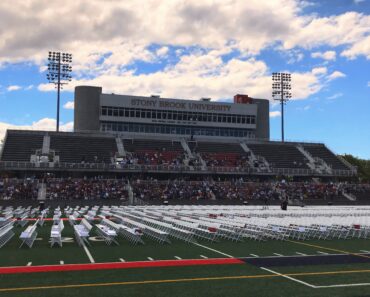
Dietz was killed as he completed the mission. His Medal of Honor was awarded posthumously, and he was buried in Kingston. The stadium bearing his name keeps his story connected to everyday life in the city: generations of residents have passed through a public landmark commemorating a man whose service ended before he reached his twenty-fifth birthday.
16. Henry Paul (born 1949)
Kingston connection: Born in Kingston; early childhood in nearby Hurley.
Henry Paul was born in Kingston in 1949 and spent part of his early childhood in nearby Hurley before his family moved south. The Hudson Valley connection can be surprising to listeners who associate him with Southern rock and country music. His later career unfolded largely through Florida-based bands, but his origins were in Ulster County.
Paul became an original member of the Outlaws, a band that helped define Southern rock in the 1970s with songs such as “There Goes Another Love Song.” His work combined country influences, guitar-driven arrangements, and close vocal harmonies. The band’s rise eventually placed Paul on the road with major touring acts at a time when arena rock was becoming a national institution.
After his first period with the Outlaws, Paul formed the Henry Paul Band and later helped launch BlackHawk, bringing his songwriting and harmonies to contemporary country music. It was an unusual career that crossed several related musical traditions. His connection to Kingston also makes an interesting point: the label ‘Southern rock’ describes a musical world, not necessarily the birthplace of everyone who helped create it.
17. Margaret Floy Washburn (1871–1939)
Kingston connection: Educated at Ulster Academy in Kingston.
Margaret Floy Washburn was born in New York City, but a formative part of her education took place in Kingston. She attended Ulster Academy during the 1880s before going on to Vassar College. That educational connection gives Kingston a place in the story of a scholar who would break one of the major academic barriers facing American women in the nineteenth century.
After studying at Vassar, Washburn pursued psychology at a time when leading universities restricted women’s access to graduate study. She was allowed to attend some classes at Columbia without full admission, then entered Cornell University. In 1894 she became the first woman in the United States to earn a Ph.D. in psychology, a landmark achievement in the history of the discipline.
Washburn’s career later returned her to the Hudson Valley, where she taught at Vassar and conducted important research on animal behavior, sensation, and mental processes. She authored The Animal Mind and served as president of the American Psychological Association. Kingston should be credited accurately as an important place in her schooling, not her birthplace, but that connection is meaningful enough to belong in the city’s educational history.
18. Zack Short (born 1995)
Kingston connection: Born in Kingston and attended Kingston High School.
Zack Short was born in Kingston in 1995 and played baseball at Kingston High School before continuing his career at Sacred Heart University in Connecticut. For a city with a long tradition of local sports, Short represents a newer generation of athletes who reached the major leagues after developing their skills in the Hudson Valley.
The Chicago Cubs selected Short in the 2016 Major League Baseball draft. After time in the minor leagues, he made his MLB debut in 2021. His career has included major-league opportunities with several organizations, while his ability to play different infield positions has made versatility a defining characteristic of his professional work.
Short’s biography adds a more contemporary baseball connection to this list alongside earlier Kingston-born Yankees players. The details are unusually easy to verify because Major League Baseball’s official records identify Kingston as his birthplace and document his professional path. The city can count him as a native rather than merely a player who spent time in the region.
19. George H. Sharpe (1828–1900)
Kingston connection: Born and educated in Kingston.
George H. Sharpe was born in Kingston in 1828, studied locally, and entered the legal profession. He became one of the most significant military figures to come out of Ulster County. His contribution was not confined to battlefield command: during the Civil War he helped develop a systematic way for the Union Army to gather, compare, and use information about Confederate forces.
In 1863, under General Joseph Hooker, Sharpe took charge of the Army of the Potomac’s Bureau of Military Information. The bureau combined intelligence from scouting, prisoners, reports, captured documents, and other sources. That approach anticipated methods later associated with professional intelligence agencies and made Sharpe an important figure in the history of American military analysis.
Sharpe’s public service continued after the war. He held offices in New York and served in the state legislature, eventually becoming Speaker of the Assembly. His legal training and Kingston beginnings are part of the story, but the larger significance is that a man from this Hudson Valley city helped transform how an army organized and understood the information available to it.
20. Paul Kreppel (born 1947)
Kingston connection: Born in Kingston.
Paul Kreppel was born in Kingston in 1947 and went on to build a career that crossed television comedy, Broadway, and theatrical production. He is perhaps most familiar to television viewers as Sonny Mann, the pianist and wisecracking regular on the sitcom It’s a Living. The character helped make him a familiar face to audiences in the 1980s.
Kreppel’s theater work is just as important as his sitcom fame. He helped conceive and direct Jay Johnson: The Two and Only!, a one-person theatrical performance that developed from earlier productions into a Broadway engagement. The show won the 2007 Tony Award for Best Special Theatrical Event. Kreppel’s involvement should be credited as directing and creating, rather than incorrectly saying he personally won a producing award in 2003.
His Broadway credits extend into later productions, showing a career with a much longer arc than one television part might suggest. For readers who remember the sitcom, discovering that its wisecracking pianist was a Kingston native with a substantial theater career is exactly the sort of surprise this series aims to deliver.
21. Ron Suskind (born 1959)
Kingston connection: Kingston native.
Journalist and author Ron Suskind is identified by the Pulitzer Prizes organization as a native of Kingston. His career took him from the Hudson Valley into major newspaper journalism and national reporting. He studied at the University of Virginia and Columbia University’s Graduate School of Journalism before working for several publications and eventually joining The Wall Street Journal.
Suskind won the 1995 Pulitzer Prize for Feature Writing for his reporting on talented students trying to succeed in a difficult Washington, D.C., school environment. His work explored social obstacles and the ambitions of students whose academic achievements could be overshadowed by their surroundings. That reporting helped lead to his book A Hope in the Unseen.
He later wrote widely discussed books examining politics, national security, and the inner workings of government. His success is another example of Kingston’s connection to fields outside entertainment or professional sports. Reporting built around close observation and carefully reconstructed human stories gave him a nationally recognized career in nonfiction.
22. Joe Ausanio (born 1965)
Kingston connection: Born in Kingston; attended local Catholic high school.
Joe Ausanio was born in Kingston in 1965 and attended John A. Coleman Catholic High School in the area. His journey to the major leagues involved years of development rather than an immediate step from high school into a major-league uniform. He went on to play college baseball at Jacksonville University and entered professional baseball through the Pittsburgh Pirates organization.
After working through the minor leagues, Ausanio reached the New York Yankees in 1994. He pitched in relief for the club during the 1994 and 1995 seasons, an era of considerable change for the franchise. Although his time in the majors was comparatively brief, playing for the Yankees made him part of a New York sports institution known far beyond his hometown.
Ausanio later became involved in baseball and sports in the Hudson Valley, maintaining a regional presence after his major-league appearances ended. His inclusion alongside fellow Kingston-born player Mike Ferraro shows how the city has contributed people to different generations of Yankees baseball. Importantly, his local school should be identified correctly rather than automatically described as Kingston High School.
23. Chick Chandler (1905–1988)
Kingston connection: Born in Kingston.
Chick Chandler, born Fehmer Christy Chandler in Kingston in 1905, became a familiar character actor during Hollywood’s studio era. His early life included an interest in performing, and he appeared in stage entertainment while still young. After leaving the Hudson Valley, he developed a professional career built on expressive supporting roles and a talent for quick dialogue and comic timing.
Chandler worked in film for decades, appearing in productions such as Alexander’s Ragtime Band and later taking television roles as the medium expanded. His work also included the syndicated adventure series Soldiers of Fortune. He was never one of the industry’s most famous leading men, but his screen presence made him part of a large body of popular American entertainment.
Lists of Hollywood stars often favor the small number of names that remain famous across generations. Chandler represents the equally important group of working performers whose film and television credits helped sustain the industry. His documented Kingston birthplace gives local readers a connection to that earlier world of American entertainment.
24. Jane Ball (1920–2005)
Kingston connection: Born in Kingston.
Actress Jane Ball was born in Kingston in 1920 and entered motion pictures during the World War II years. Her Hollywood career was short but included parts in major studio productions. Because she did not remain a prominent screen figure for decades, her name is easy to overlook in accounts of Ulster County residents who reached the entertainment industry.
Among her film credits were The Keys of the Kingdom and Winged Victory, both released in 1944, followed by Forever Amber in 1947. These films place her in a period when Hollywood was producing wartime stories, historical melodramas, and large-cast pictures for a national audience. Her work came during a moment of enormous cultural importance for the American movie industry.
Ball eventually left acting and lived a quieter life away from the studios. Her biography is a reminder that the local connections behind a historical list are not limited to household names: even a comparatively brief Hollywood career can provide an interesting link between a Hudson Valley birthplace and a major chapter in entertainment history.
25. Mike Ferraro (1944–2024)
Kingston connection: Born in Kingston; attended Kingston High School.
Mike Ferraro was born in Kingston in 1944 and attended Kingston High School before entering professional baseball. As a young third baseman, he worked his way into the New York Yankees organization and made his major-league debut in September 1966. His professional life later extended far beyond his relatively limited time playing in the big leagues.
Ferraro appeared for the Yankees and for the Seattle Pilots and Milwaukee Brewers franchise. After his playing career, he developed a second career as a coach and manager. He worked with the Yankees during the era of Billy Martin and George Steinbrenner and later managed the Cleveland Indians and Kansas City Royals, making him part of several different chapters of major-league history.
The Kingston connection remained an important biographical detail: both Major League Baseball and Baseball-Reference identify the city as his birthplace, with his high school also located there. Ferraro’s career illustrates how baseball involvement may continue long after a player’s last at-bat, with coaching and managing becoming a second and sometimes even longer professional life.
Kingston’s Place in American History
The careers of these 25 people reflect several different definitions of hometown: a place of birth, an education, an early working life, or a community that became home during an established career. What connects them is not a claim that Kingston alone produced their accomplishments. It is the documented role Kingston played in lives that later intersected with important national stories. That distinction makes the history more accurate and, in many cases, more interesting.
From Rondout’s nineteenth-century waterfront and the colonial streets of Uptown to the contemporary arts community and local ballfields, Kingston has continued to offer points of departure for people pursuing very different ambitions. The people on this list provide one way to see that long and varied history through individual lives.