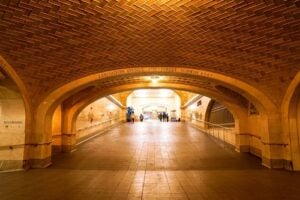
The Whispering Gallery beneath Grand Central Terminal, where voices can travel across the curved Guastavino tile arches. Feature Photo: Hope Phillips / Shutterstock.com
New York City hides some of its strangest history in places that thousands of people pass every day. A Brooklyn townhouse is really part of the subway system. A tiny triangle in a Greenwich Village sidewalk preserves an old property dispute. A forgotten stream still runs beneath the streets, while a sound installation hums from a Times Square grate without a sign announcing what it is.
Some of these places are easy to see once you know where to look. Others are hidden inside buildings, sealed underground, or preserved as remnants of infrastructure that outlived their original purpose. Together, they reveal another New York beneath the familiar one.
1. The Fake Townhouse Subway Vent at 58 Joralemon Street
Location: 58 Joralemon Street, Brooklyn Heights
The Secret: From the sidewalk, 58 Joralemon Street looks like another 19th-century Greek Revival rowhouse. Behind the residential facade, however, the building is part of New York City’s subway infrastructure.
The History: The structure began as a private residence dating to 1847. As the Interborough Rapid Transit Company extended subway service beneath the East River and into Brooklyn, the former house was converted for transit use. Today it contains ventilation equipment and an emergency evacuation stairway serving the subway tunnel below. The unusual facade allows a piece of major transit infrastructure to blend into the surrounding Brooklyn Heights streetscape.
2. The Whispering Gallery at Grand Central Terminal
Location: Lower Level of Grand Central Terminal, near the Grand Central Oyster Bar
The Secret: Two people standing at diagonal corners beneath the tiled arches can speak quietly toward the wall and hear each other from across the gallery, even with the noise of the terminal around them.
The History: Grand Central Terminal opened in 1913, and the nearby Oyster Bar is covered by the distinctive thin-tile vaulting associated with Rafael Guastavino and his company. The curved tiled surfaces create an acoustic effect that carries sound along the arches. What appears to be an ordinary passageway therefore contains one of the terminal’s most famous hidden experiences.
3. A Surviving Survey Bolt From Manhattan’s 1811 Street Grid
Location: Central Park
The Secret: Somewhere among Central Park’s natural-looking rock outcrops is a surviving metal survey bolt connected to the original plan that imposed Manhattan’s street grid across the island.
The History: After the Commissioners’ Plan of 1811 established Manhattan’s future grid, surveyor John Randel Jr. spent years translating lines on a map into physical locations on the ground. His crews set markers, including metal bolts driven into exposed rock. Most disappeared as streets, buildings, and infrastructure transformed Manhattan. The Central Park Conservancy has confirmed that one of Randel’s survey bolts remains in the park, an almost invisible remnant of the grid that would reshape the city.
4. The Federal Reserve Gold Vault Beneath Lower Manhattan
Location: Federal Reserve Bank of New York, 33 Liberty Street
The Secret: One of the world’s great concentrations of monetary gold sits deep below the sidewalks of the Financial District.
The History: The New York Fed’s gold vault was built during construction of its headquarters in the early 1920s. The vault rests on Manhattan bedrock 80 feet below street level and 50 feet below sea level. As of 2024, it held approximately 507,000 gold bars weighing a combined 6,331 metric tons, making it the world’s largest known depository of monetary gold. None of the gold belongs to the New York Fed itself; it is held in custody for account holders that include governments, central banks, and official international organizations.
5. Authentic Berlin Wall Sections in Manhattan
Location: 520 Madison Avenue and Kowsky Plaza in Battery Park City
The Secret: Pieces of the actual Berlin Wall survive in Manhattan, far from the city they once divided.
The History: Five reinforced-concrete slabs from the Berlin Wall, bearing work by artists Thierry Noir and Kiddy Citny, are displayed inside the lobby of 520 Madison Avenue. A separate 12-foot-high, 8-foot-wide section stands in the Battery Park City Authority’s public art collection at Kowsky Plaza. That segment was donated by the German Consulate in 2004 to mark the 15th anniversary of the fall of the wall. These are not replicas: they are surviving pieces of one of the defining structures of the Cold War.
6. New York’s Surviving Cast-Iron Sidewalk Clocks
Location: Among the surviving examples are 200 Fifth Avenue, 522 Fifth Avenue, and 783 Fifth Avenue
The Secret: Several ornate clocks standing directly on New York sidewalks are not decorative reproductions. They are surviving pieces of street furniture from an era when businesses used giant public clocks as both advertisements and practical conveniences.
The History: Cast-iron sidewalk clocks became popular in American cities during the late 19th and early 20th centuries. Businesses installed them outside storefronts so pedestrians could check the time while also seeing the name of the establishment. The clock at 200 Fifth Avenue was installed in 1909 and manufactured by the Hecla Iron Works. The 522 Fifth Avenue clock was manufactured by Seth Thomas in 1907, while the clock at 783 Fifth Avenue was made by E. Howard & Co. The surviving clocks are individually protected New York City landmarks.
7. Pomander Walk’s Hidden Tudor Village
Location: Between West 94th and West 95th Streets, between Broadway and West End Avenue
The Secret: Behind gates on the Upper West Side is a tiny pedestrian residential enclave that looks more like a theatrical English village than Manhattan.
The History: Pomander Walk was built in 1921 and takes its name and inspiration from Louis N. Parker’s stage play Pomander Walk. Developer Thomas Healy created a picturesque group of small Tudoresque residences around a private central walkway. The New York City Landmarks Preservation Commission later designated the enclave a landmark in 1982. Surrounded by much larger apartment buildings, its scale and design still feel almost impossible in modern Manhattan.
8. New York’s Underground Pneumatic Tube Mail Network
Location: Former routes beneath Manhattan and across the Brooklyn Bridge
The Secret: Long before email or overnight delivery, New York sent enormous quantities of mail through underground tubes powered by compressed air.
The History: New York City began using pneumatic tube mail in 1897. By 1898, the system connected 21 Manhattan post offices with the main post office, and a tube route also crossed the Brooklyn Bridge. Canisters could carry as many as 600 letters and travel at about 35 miles per hour. The network eventually stretched for roughly 27 miles beneath the city. Service declined as motor vehicles became faster and more flexible, and the remaining New York pneumatic tube operation was suspended in 1953 and never restored.
9. The Abandoned City Hall Subway Station
Location: Beneath City Hall Park, Lower Manhattan
The Secret: One of the most beautiful stations ever built for the New York subway still survives beneath City Hall even though regular passenger service ended decades ago.
The History: City Hall station opened in 1904 as the showpiece terminus of New York’s first subway line. Designed by Heins & LaFarge, it featured curving platforms, vaulted tilework, skylights, and chandeliers. The station closed to passengers in 1945 as longer subway cars and the sharply curved platform made continued operation increasingly impractical. The loop track remains in use for turning downtown 6 trains, while the New York Transit Museum offers limited members-only tours of the historic station.
10. The Hess Triangle in Greenwich Village
Location: Sidewalk at Seventh Avenue South and Christopher Street
The Secret: A tiny triangular mosaic in the sidewalk preserves the memory of a property dispute created when the city cut Seventh Avenue South through Greenwich Village.
The History: The city condemned and demolished buildings in the area while extending Seventh Avenue and constructing the subway beneath it. A tiny remnant of property once belonging to the Hess family escaped the condemnation process. The family refused to give the sliver to the city and in 1922 installed a mosaic declaring, “PROPERTY OF THE HESS ESTATE WHICH HAS NEVER BEEN DEDICATED FOR PUBLIC PURPOSES.” The family sold the parcel to the adjacent cigar store in 1938, so the wording has not reflected the property’s ownership for decades, but the defiant little mosaic remains.
11. The Windowless Telecommunications Fortress at 33 Thomas Street
Location: 33 Thomas Street, Lower Manhattan
The Secret: One of Manhattan’s most imposing skyscrapers has virtually no conventional windows because it was built primarily for telecommunications equipment rather than ordinary office tenants.
The History: Designed by John Carl Warnecke & Associates and completed in the mid-1970s, the former AT&T Long Lines Building rises roughly 550 feet above Lower Manhattan. Its massive concrete-and-granite exterior, deep floors, oversized structural capacity, and large ventilation openings were shaped by the needs of the telephone switching equipment housed inside. The result is a skyscraper that looks less like an office tower than a fortified piece of urban infrastructure.
12. The Crypt Beneath the Prison Ship Martyrs’ Monument
Location: Fort Greene Park, Brooklyn
The Secret: Beneath the great column in Fort Greene Park is a crypt containing remains associated with thousands of American prisoners who died aboard British prison ships during the Revolutionary War.
The History: During the Revolution, British prison ships anchored in Wallabout Bay held American prisoners in brutal conditions. Thousands died from disease, hunger, overcrowding, and neglect. Their remains were gathered and reinterred over the years, and the present Prison Ship Martyrs’ Monument was dedicated in 1908. Designed by the architectural firm of McKim, Mead & White, with Stanford White responsible for the monument design, the towering Doric column marks a crypt containing the remains of more than 11,000 people remembered as the prison ship martyrs.
13. Max Neuhaus’s Hidden Times Square Sound Installation
Location: Broadway pedestrian plaza between West 45th and West 46th Streets
The Secret: A deep harmonic sound rises from beneath a street grate in Times Square with no conventional sign telling passersby that they are standing inside a work of art.
The History: Sound artist Max Neuhaus installed Times Square in 1977 beneath a pedestrian island at the intersection of Broadway and Seventh Avenue. Electronic equipment below the grate creates a sustained, resonant tone that can easily be mistaken for machinery or subway noise. The work was shut off in 1992 and reactivated in 2002. It is now maintained by Dia Art Foundation as a permanent sound installation, remaining deliberately easy to miss amid the visual and acoustic overload of Times Square.
14. The Buried Drainage Channel That Gave Canal Street Its Name
Location: Beneath and along Canal Street, Lower Manhattan
The Secret: Canal Street is not just a name. The roadway traces an early drainage project created to carry water away from the polluted Collect Pond and surrounding marshland.
The History: After the city began filling the Collect Pond, underground springs continued creating drainage problems. In 1808, officials decided to convert an existing drainage route through Lispenard Meadows into an eight-foot-wide canal leading toward the Hudson River. The canal was built in 1811, soon became an open sewer, and was covered in 1819. The roadway above became Canal Street. Later sewer construction transformed the infrastructure below, but the modern street still follows the historic drainage corridor that gave it its name.
15. The Titanic Memorial Lighthouse and Its Time Ball
Location: Titanic Memorial Park at Fulton and Pearl Streets, South Street Seaport
The Secret: A small lighthouse standing inland from the waterfront once sat high above South Street and used a time ball to give New Yorkers a visible noon signal.
The History: The Titanic Memorial Lighthouse was originally erected atop the Seamen’s Church Institute at 25 South Street and dedicated on April 15, 1913, one year after the RMS Titanic disaster. Its time ball was put into operation later that year and dropped at noon as a public time signal. When the Seamen’s Church Institute building was slated for demolition in 1968, preservationists saved the lighthouse. It was erected at the South Street Seaport in 1976. A major restoration completed in 2026 returned a functioning time-ball demonstration to the landmark.
16. The Atlantic Avenue Tunnel Beneath Brooklyn
Location: Beneath Atlantic Avenue between Boerum Place and Columbia Street, Brooklyn
The Secret: A 19th-century railroad tunnel remains sealed beneath one of Brooklyn’s busiest streets.
The History: Built in 1844 for the Long Island Rail Road, the Atlantic Avenue Tunnel carried trains below street level through what was then a rapidly developing part of Brooklyn. The structure is one of America’s earliest major examples of rail infrastructure built beneath an urban roadway. It was eventually closed and sealed, leaving a long brick tunnel hidden below Atlantic Avenue. The tunnel was listed on the National Register of Historic Places in 1989.
17. The Staten Island Ship Graveyard
Location: Arthur Kill shoreline near Rossville, Staten Island
The Secret: Along Staten Island’s western shore, decaying remains of old tugboats, ferries, and other vessels sit in the tidal mud like a maritime cemetery.
The History: The site has been used for marine salvage since the 1930s and became closely associated with the Witte Marine Equipment Company, later part of Donjon’s marine operations. At one point hundreds of vessels were reportedly gathered there awaiting dismantling. Far fewer remain, but the rusting hulls still create one of New York City’s strangest industrial landscapes. The scrapyard itself is private industrial property and is not open to the public.
18. Fort Totten’s Civil War-Era Water Battery
Location: Fort Totten Park, Bayside, Queens
The Secret: Inside a public park on Little Neck Bay stands a massive unfinished coastal fortress of granite casemates built as part of New York Harbor’s 19th-century defense system.
The History: The federal government acquired the first tract at Willets Point in 1857, and military construction began in 1862. U.S. Army Corps of Engineers records state that plans for the fortifications were designed by Robert E. Lee before the Civil War. The site later became an important Army engineering and training post and eventually took the name Fort Totten. Portions of the old water battery and its vaulted granite defenses remain inside today’s Fort Totten Park.
19. The Buried Route of Minetta Brook
Location: Beneath Greenwich Village and Washington Square Park
The Secret: A stream that once ran openly across Manhattan still influences the ground beneath Greenwich Village, even though streets and buildings have covered its former course for generations.
The History: Minetta Brook once flowed from spring-fed branches north of Washington Square through what became Greenwich Village and toward the Hudson River. As Manhattan developed, the watercourse was diverted into culverts and sewer infrastructure and the land above it was built over. Groundwater continues to follow portions of the old route, contributing to persistent basement-water problems in some locations. The Museum of the City of New York has documented continuous groundwater pumping at the NYU Law School Library near Washington Square, a modern reminder of the buried water system beneath the neighborhood.
20. The High Bridge’s Missing Stone Arches
Location: High Bridge across the Harlem River between Manhattan and the Bronx
The Secret: New York City’s oldest standing bridge looks dramatically different from the Roman-style aqueduct bridge that originally crossed the Harlem River.
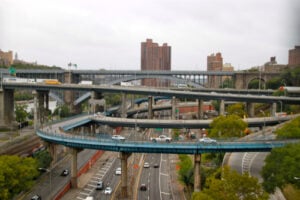
The History: The High Bridge opened in 1848 as part of the Old Croton Aqueduct system, carrying fresh water across the Harlem River on a series of masonry arches. The original bridge had 15 arched openings. In 1927 and 1928, five of the central masonry arches were removed and replaced by the single steel span seen today so larger vessels could navigate the river. The surviving stone arches and the later steel span now stand together as visible layers of New York’s water-supply and transportation history.
Readers interested in more hidden pieces of New York infrastructure and transportation history can continue with our History of Grand Central Terminal: New York’s Greatest Railroad Landmark, 10 Lost New York Transit Lines, Terminals & Ferries That Built the City, 10 Oldest Subway Stations in NYC and Their Stories, and 10 Lost New York Bridges and the Spans That Replaced Them.
Sources
- Willowtown Association — 58 Joralemon Street and the Joralemon Street subway tunnel
- Grand Central Terminal — Whispering Gallery
- Central Park Conservancy — Surviving Randel survey bolt
- Federal Reserve Bank of New York — Gold Vault
- MdeAS Architects — Berlin Wall at 520 Madison Avenue
- Battery Park City Authority — Berlin Wall Segment at Kowsky Plaza
- New York City Landmarks Preservation Commission — Sidewalk Clock, 200 Fifth Avenue
- New York City Landmarks Preservation Commission — Sidewalk Clock, 522 Fifth Avenue
- New York City Landmarks Preservation Commission — Sidewalk Clock, 783 Fifth Avenue
- New York City Landmarks Preservation Commission — Pomander Walk
- Smithsonian National Postal Museum — New York City pneumatic tube mail
- New York Transit Museum — Old City Hall Station
- Village Preservation — Hess Triangle
- SAH Archipedia — AT&T Long Lines Building, 33 Thomas Street
- NYC Parks — Prison Ship Martyrs’ Monument
- Dia Art Foundation — Max Neuhaus, Times Square
- New York City Landmarks Preservation Commission — Collect Pond and Canal Street drainage history
- South Street Seaport Museum — Titanic Memorial Lighthouse
- National Park Service — Atlantic Avenue Tunnel National Register record
- Baruch College/CUNY NYCdata — Staten Island Boat Graveyard
- U.S. Army Corps of Engineers — Fort Totten site history
- Museum of the City of New York — Minetta Brook
- NYC Parks — High Bridge history and 1926–1928 steel-arch alteration