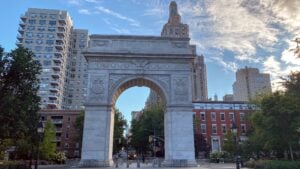
Washington Square Arch in Greenwich Village. Photo by Brian Kachejian.
Greenwich Village is famous because so many different versions of New York history overlap within a relatively small part of Manhattan. Its irregular streets preserve an older city that developed before Manhattan’s numbered grid. Its rowhouses and townhouses recall the 19th century. Its clubs, coffeehouses, theaters, studios, and bars became gathering places for writers, artists, musicians, comedians, political radicals, and LGBTQ+ activists.
For visitors, that history is unusually easy to experience on foot. Washington Square Park, MacDougal Street, the Stonewall Inn and Christopher Park, Jefferson Market Library, Bedford Street, the Village Vanguard, and some of New York’s most famous television locations are all within walking distance of one another.
The Village is not a museum frozen in time. New York University occupies a major presence around Washington Square, restaurants and businesses change constantly, and some once-bohemian blocks have become among the most expensive residential streets in the country. Yet enough of the architecture, street pattern, performance spaces, and public gathering places survive that the cultural history of Greenwich Village can still be read directly from the neighborhood.
What Is Greenwich Village Famous For?
Greenwich Village is best known for its bohemian history, literary culture, folk and jazz scenes, LGBTQ+ history, political activism, historic architecture, unusual street pattern, and Washington Square Park.
The neighborhood became nationally associated with people who challenged mainstream American culture. Writers and artists gathered here in the late 19th and early 20th centuries. The Beat Generation became closely associated with Village coffeehouses and bars in the 1950s. The folk revival transformed MacDougal Street and nearby clubs in the late 1950s and 1960s. The Stonewall Uprising of 1969 became a watershed in the modern LGBTQ+ rights movement.
Greenwich Village is also famous simply for how it looks. Federal and Greek Revival rowhouses, later brownstones, narrow streets, small parks, old churches, hidden courts, former stables, and streets that meet at unexpected angles give the Village a physical character unlike the regular Midtown grid.
Where Is Greenwich Village?
Greenwich Village is on the west side of Lower Manhattan. The neighborhood is generally understood to lie south of 14th Street and north of Houston Street, with Broadway toward the east and the Hudson River toward the west. The exact cultural boundaries can vary, particularly when people distinguish Greenwich Village from the West Village and neighboring NoHo.
Washington Square Park is the neighborhood’s most recognizable eastern center. From there, MacDougal Street, Bleecker Street, Christopher Street, Grove Street, Bedford Street, Greenwich Avenue, and Seventh Avenue South lead visitors deeper into the Village and West Village.
Why Are the Streets in Greenwich Village So Confusing?
Greenwich Village developed before the regular numbered street system that defines much of Manhattan. Roads followed older property lines, farms, lanes, topography, streams, and routes established during the Dutch and English colonial periods.
The Commissioners’ Plan of 1811 established the famous rectangular grid across much of Manhattan, but Greenwich Village already contained established roads and development. Much of that older pattern survived.
The result produces one of New York’s great geographic oddities: West 4th Street, which behaves normally farther east, turns northwest through the Village and eventually crosses West 10th Street and West 12th Street. Visitors expecting Manhattan’s street numbers to behave logically can suddenly discover that the numbers no longer tell them which direction they are walking.
Greenwich Village Was Once a Rural Settlement Outside the City
Before Greenwich Village became part of dense Manhattan, the area contained marshland, farms, estates, and small settlements. Native people used the landscape before European colonization. During the Dutch period, settlers farmed the area, and free and enslaved Africans also lived and worked on land in what would become the Village.
By the 18th century, Greenwich had developed as a country hamlet north of the more densely settled city at Manhattan’s southern tip. The name appears in New York records by the early 1700s.
Yellow Fever Helped Transform Greenwich Village
The draft history of Greenwich Village is sometimes pushed too far back by describing it simply as an 18th-century yellow-fever refuge. Epidemics did drive New Yorkers northward in the late 18th and early 19th centuries, but the most transformative episode came in 1822.
That year’s severe yellow fever outbreak sent residents and businesses fleeing the crowded city farther downtown. Greenwich Village was still considered comparatively rural and healthier. Some newcomers who originally intended to stay only temporarily remained after the epidemic passed.
The resulting population growth accelerated the transformation of farmland and country lanes into an urban neighborhood. New houses, businesses, streets, churches, and institutions appeared, while older property lines helped preserve the irregular street network that still confuses visitors today.
Washington Square Began as a Burial Ground
The land now occupied by Washington Square Park has a history far older than its famous arch.
In the late 18th century, the city used the area as a potter’s field for the burial of poor and unidentified New Yorkers. The land later became the Washington Parade Ground, and the surrounding blocks developed into a prestigious residential district.
By the later 19th century, Washington Square had evolved into a public park and gathering space. It would eventually become one of the most important cultural stages in Greenwich Village, used by musicians, performers, protesters, students, chess players, residents, and visitors.
The Washington Square Arch
The first Washington Arch was a temporary wooden and plaster structure erected in 1889 to commemorate the centennial of George Washington’s inauguration as the first president of the United States.
The temporary arch was so popular that supporters raised money for a permanent version designed by Stanford White. Construction of the marble arch was completed in 1892, and the monument was formally dedicated in 1895.
Today, the arch marks the beginning of Fifth Avenue and remains one of the most recognizable landmarks in Greenwich Village.
How Greenwich Village Became a Bohemian Neighborhood
By the late 19th and early 20th centuries, Greenwich Village had developed a reputation as a place where unconventional people could live, work, perform, organize, and experiment.
Writers, painters, actors, journalists, reformers, political radicals, and theater people were attracted to the neighborhood’s older buildings, smaller streets, cafes, clubs, and relative distance from more conventional uptown society. Edgar Allan Poe and Mark Twain were among the prominent 19th-century writers connected to the Village. Later generations included figures such as Edna St. Vincent Millay, Eugene O’Neill, John Sloan, and many others.
The word “bohemian” became inseparable from the Village. Although the neighborhood’s real population was always more varied than the stereotype suggested, Greenwich Village became a national symbol for artistic independence and nonconformity.
The Beat Generation in Greenwich Village
During the 1950s, Greenwich Village became one of the important New York settings for the Beat Generation and the wider counterculture surrounding it.
Writers including Jack Kerouac and Allen Ginsberg moved through Village bars, apartments, parks, and coffeehouses. The neighborhood offered cheap gathering places where writers, musicians, painters, students, and political outsiders could meet late into the night.
Not every legendary Beat story can be tied neatly to one surviving cafe, but the larger history is unmistakable. The Village coffeehouse culture of the 1950s helped create the environment in which the folk revival would flourish almost immediately afterward.
Greenwich Village and the Folk Music Revival
By the late 1950s and early 1960s, Greenwich Village had become one of the most important folk-music centers in the United States.
MacDougal Street and the surrounding blocks were filled with coffeehouses, clubs, record stores, music shops, and informal gathering places. The Gaslight Cafe, Gerde’s Folk City, Izzy Young’s Folklore Center, and Cafe Wha? became part of a network that nurtured singers, songwriters, poets, and musicians.
Bob Dylan arrived in New York in January 1961 and quickly entered this world. Cafe Wha? records Dylan performing there on January 24, 1961. Dave Van Ronk, Odetta, Joan Baez, and many other musicians were part of the broader scene that made the Village synonymous with folk music.
Cafe Wha? and The Bitter End
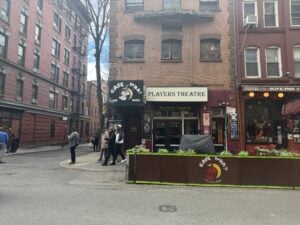
Cafe Wha? Photo by Brian Kachejian
Two historic music venues remain active reminders of the Village’s 1960s cultural explosion.
Cafe Wha? at 115 MacDougal Street traces its history to 1959. Bob Dylan played there shortly after arriving in New York, and Jimi Hendrix later performed there with Jimmy James and the Blue Flames. The club remains an operating live-music venue.
The Bitter End at 147 Bleecker Street opened in 1961 and remains a live-music club. Its stage has been associated with generations of singers, musicians, comedians, and songwriters.
Jimi Hendrix and Electric Lady Studios
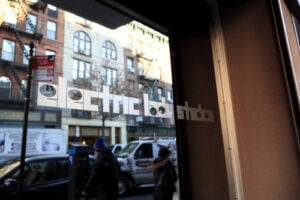
Photo by Osugi / Shutterstock.com
Greenwich Village’s music history did not end with the folk revival.
In 1968, Jimi Hendrix and his manager Michael Jeffery acquired a former nightclub at 52 West 8th Street. Hendrix initially envisioned another performance space, but the project evolved into a professional recording studio.
Electric Lady Studios opened in 1970. Hendrix hosted an opening celebration on August 26, only weeks before his death. The studio survived him and remains an active recording facility.
Visitors can see the exterior from West 8th Street, but Electric Lady is a working studio rather than a conventional public tourist attraction.
The Stonewall Uprising and LGBTQ+ History
Greenwich Village became one of the most important landscapes in American LGBTQ+ history.
In the early hours of June 28, 1969, police raided the Stonewall Inn at 51-53 Christopher Street. Instead of dispersing quietly, patrons and people in the surrounding neighborhood resisted. Demonstrations and confrontations continued over several nights.
The Stonewall Uprising did not create LGBTQ+ activism from nothing. Organizations and activists had been fighting discrimination before 1969. Stonewall instead became a watershed and catalyst that gave enormous momentum and visibility to a broader movement.
In 2016, Stonewall National Monument was established. The monument encompasses Christopher Park, the Stonewall Inn, and parts of the surrounding historic streetscape. It was the first U.S. national monument established to commemorate LGBTQ+ history.
What Should You See in Greenwich Village?
The best Greenwich Village visit combines the neighborhood’s famous landmarks with the streets between them. The Village makes more sense when experienced as a walk rather than as a series of isolated destinations.
Washington Square Park
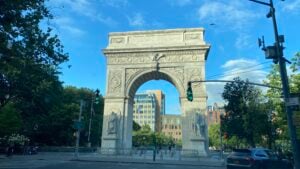
Washington Square Park Entrance Photo by Brian Kachejian
Washington Square Park is the natural starting point. The Washington Square Arch, fountain, chess tables, musicians, performers, students, and constant flow of people make the park one of the best places to understand the Village as a living neighborhood rather than simply a historic district.
The park is also the easiest place to connect layers of Village history: burial ground, parade ground, elite residential square, bohemian meeting place, protest site, university center, and public performance space.
The Stonewall Inn and Christopher Park
The Stonewall Inn remains a private operating bar at 53 Christopher Street. Christopher Park sits directly across the street and forms the public heart of Stonewall National Monument.
Visitors do not need to enter the bar to understand the historic site. The surrounding sidewalks, park, Christopher Street, and nearby blocks were part of the landscape in which the 1969 uprising unfolded.
MacDougal Street and Caffe Reggio
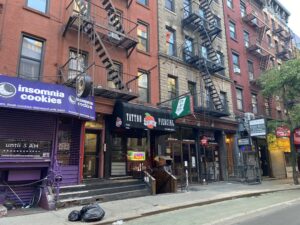
MacDougal Street in Greenwich Village. Photo by Brian Kachejian.
MacDougal Street remains one of the most recognizable streets in Greenwich Village, lined with restaurants, comedy venues, music spaces, and cafes.
Caffe Reggio at 119 MacDougal Street opened in 1927. The cafe describes itself as the first cafe in the United States to serve cappuccino. Its famous espresso machine was manufactured in 1902 and remains prominently displayed inside.
The important correction is that the machine dates to 1902; Caffe Reggio itself did not open until 1927.
Jefferson Market Library
The Jefferson Market Library at 425 Avenue of the Americas is one of the Village’s great examples of historic preservation.
The Victorian Gothic building was constructed between 1875 and 1877 as a courthouse complex and was designed by Frederick Clark Withers and Calvert Vaux. By the late 1950s, the abandoned courthouse faced demolition.
Village preservationists fought to save it, and the building was ultimately converted into a New York Public Library branch. The Jefferson Market Library opened in 1967 and remains an active public library.
Why Greenwich Village Still Looks Historic
One reason visitors can still experience so much historic architecture is the preservation movement that emerged in response to demolition threats across New York.
On April 29, 1969, the New York City Landmarks Preservation Commission designated the Greenwich Village Historic District. At the time, the district covered more than 2,000 buildings across approximately 65 blocks.
The designation protected a remarkable mixture of Federal, Greek Revival, Gothic Revival, Italianate, and later buildings and helped preserve the Village’s small-scale streetscape.
Bedford Street and Historic Village Houses
Bedford Street is particularly rewarding for visitors interested in old New York architecture.
At 75 1/2 Bedford Street stands an extraordinarily narrow house measuring approximately 9 1/2 feet across its exterior. Poet Edna St. Vincent Millay lived there in 1923 and 1924. The house is often described as the narrowest freestanding house in New York City, although claims about the absolute narrowest structure can become complicated depending on how buildings and additions are classified.
The house is a private residence and should be viewed respectfully from the sidewalk.
The Friends Apartment Building
The corner of Bedford and Grove Streets is one of Greenwich Village’s most photographed television locations.
The building at 90 Bedford Street was used for exterior establishing shots of the apartment building in Friends. The sitcom’s interiors were filmed on sets in California, and the real apartments do not resemble the enormous television versions occupied by the characters.
The building is residential. Visitors should take photographs from the public sidewalk without blocking entrances or disturbing residents.
Carrie Bradshaw’s Sex and the City Stoop
Another famous television location is on Perry Street.
The fictional Carrie Bradshaw lived on East 73rd Street, but exterior filming for Sex and the City took place in the West Village. The first seasons used 64 Perry Street before filming shifted next door to 66 Perry Street, which became the exterior most closely associated with Carrie’s apartment.
Both are private homes. No. 66 has experienced years of heavy tourist traffic, so visitors should remain on the public sidewalk and avoid using the stoop as a photo set.
The Village Vanguard
The Village Vanguard at 178 Seventh Avenue South has occupied its basement space since 1935 and remains one of the most celebrated jazz clubs in New York.
The club’s history stretches beyond jazz into cabaret, folk music, poetry, and comedy, but its extraordinary collection of live jazz recordings helped make the Vanguard internationally famous.
It remains an operating venue, so visitors interested in attending should check the club’s current schedule before arriving.
The Comedy Cellar
The Comedy Cellar at 117 MacDougal Street is one of the neighborhood’s best-known contemporary comedy destinations. It continues to host multiple shows, and surprise appearances by prominent comedians remain part of the club’s reputation.
Because shows often sell out, visitors should check the current schedule and reservation availability rather than assuming tickets will be available at the door.
A Simple Greenwich Village Walking Route
- Start at Washington Square Park. See the arch, fountain, and surrounding historic streets.
- Walk south on MacDougal Street. Pass Cafe Wha?, Caffe Reggio, and the Comedy Cellar area.
- Continue west toward Christopher Street. Visit the Stonewall Inn and Christopher Park.
- Walk through Grove and Bedford Streets. See 90 Bedford Street, 75 1/2 Bedford Street, and the surrounding historic rowhouses.
- Continue toward Perry Street. Pass the Sex and the City filming locations while remembering that they are private residences.
- Finish near Greenwich Avenue and Sixth Avenue. Visit Jefferson Market Library, or head north to the Village Vanguard on Seventh Avenue South.
This route is short enough to walk comfortably, but Greenwich Village rewards detours. Commerce Street, Barrow Street, Gay Street, Patchin Place, Washington Mews, and the blocks around Bleecker Street can be as memorable as the famous destinations.
How Do You Get to Greenwich Village by Subway?
West 4 St-Washington Square is the main subway hub for the eastern and central Village and is normally served by the A, C, E, B, D, F, and M lines. Because New York subway service can change for construction and maintenance, visitors should check the MTA’s current service information before traveling.
The Christopher St-Stonewall station on the 1 line is useful for the western Village, including Stonewall, Christopher Park, Bedford Street, and the Hudson River side of the neighborhood.
What Makes Greenwich Village Worth Visiting?
Greenwich Village is worth visiting because its history survives at human scale.
You can walk from a burial ground that became one of New York’s most famous parks to a street where Bob Dylan entered the folk scene, then continue to a national monument marking the Stonewall Uprising, pass 19th-century houses, visit a Victorian courthouse rescued from demolition, and end the evening in a jazz club or comedy cellar.
Few neighborhoods contain so many different chapters of American cultural history within such a walkable area. The Village is famous not because one movement happened here, but because generation after generation found room here to create something new.
More Greenwich Village History
For a deeper look at the neighborhood’s most famous public space, read our History of Washington Square Park. Music fans can continue with our History of New York City’s Famed Cafe Wha?.
Sources
Village Preservation, Greenwich Village Neighborhood History
National Park Service, Greenwich Village Historic District
New York City Landmarks Preservation Commission, Greenwich Village Historic District
New York University Special Collections, Washington Arch Records
National Park Service, Stonewall National Monument
Library of Congress, Greenwich Village Folk Music History
Cafe Wha?, History
Electric Lady Studios, History
Caffe Reggio, History
New York Public Library, Jefferson Market Library History
Village Preservation, Greenwich Village for Friends Fans
Village Preservation, Sex and the City Filming Locations
Village Preservation, 75 1/2 Bedford Street
Village Vanguard
Comedy Cellar.
Greenwich Village History at a Glance
| Period | What Happened |
|---|---|
| 1600s-1700s | Farms, estates, older roads, and settlements develop north of the densely built city. |
| Late 1700s-1822 | Yellow fever epidemics repeatedly encourage New Yorkers to seek refuge farther north; the 1822 outbreak accelerates permanent growth in Greenwich Village. |
| 1811 | The Commissioners’ Plan establishes Manhattan’s famous numbered grid, while much of the Village retains its older irregular street pattern. |
| 1826 | The former potter’s field at Washington Square becomes the Washington Parade Ground. |
| Late 1800s-1920s | The Village develops its national reputation for writers, artists, theater, political radicalism, and bohemian culture. |
| 1892 | Construction of Stanford White’s permanent marble Washington Square Arch is completed. |
| 1950s | Beat writers and the coffeehouse counterculture become closely associated with Greenwich Village. |
| Late 1950s-1960s | MacDougal Street and surrounding clubs become a major center of the American folk revival. |
| June 28, 1969 | The Stonewall Uprising begins after a police raid at the Stonewall Inn. |
| April 29, 1969 | New York City designates the Greenwich Village Historic District. |
| 1970 | Jimi Hendrix’s Electric Lady Studios opens on West 8th Street. |
| 2016 | Stonewall National Monument is established. |
| Today | Greenwich Village remains a major destination for architecture, music, comedy, LGBTQ+ history, restaurants, public life, and New York cultural history. |
Published August 12, 2026.
What Is Greenwich Village Famous For? A History & Visitor Guide article published on ClassicNewYorkHistory.com © 2026