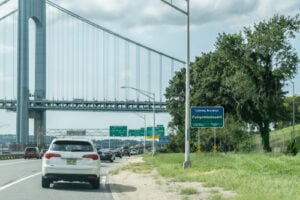
The famous “Leaving Brooklyn — Fuhgeddaboudit” sign, a playful tribute to one of New York City’s most recognizable expressions. Feature Photo: Rosemarie Mosteller / Shutterstock.com
As someone who was born and raised in Manhattan and the Bronx and has lived in New York my whole life, I can tell you I’ve heard the same thing over and over again from people who aren’t from New York: I sound funny, I talk funny, or they have no idea what I just said. Listen, I can’t help it. I’m a New Yorker.
We have our own language, and we have our own ways. Not all of it is 100 percent purely New York. We’ve adopted sayings and expressions from cultures around the world because, basically, New York is one giant melting pot. We say things a certain way, we talk a certain way, we walk a certain way, and yeah, we have a certain attitude.
And there’s nothing mean about it. New Yorkers are probably some of the friendliest people you’ll ever meet. We just need to get somewhere pretty quickly all the time. We’re always in a rush because we’ve always got things to do and bills to pay, just like everyone else in the world. We just tend to do everything a little faster because there’s so much competition here and so much going on around us.
So yeah, we have our own way of saying things. Here are 20 phrases and sayings I’ve heard throughout my life in New York. Maybe we don’t use some of them as much anymore because times change. Some you’ve probably heard before. Others may leave you wondering what in the world we’re talking about. And a few of them? Even I couldn’t tell you exactly where they came from. I just know I’ve been hearing them my whole life.
1. “Forget About It” — “Fuhgeddaboudit”
The Meaning: Depending on the inflection, it can mean “Don’t worry about it,” “Absolutely not,” “Of course,” or “It was incredible.”
The Context: The exaggerated pronunciation became closely associated with New York City speech and especially with Brooklyn and Italian-American vernacular. It became so recognizable that New York City installed “Leaving Brooklyn — Fuhgeddaboudit” signs at exits from the borough. Few New York expressions can change meaning so completely just by changing the tone of voice.
2. “You Good?” / “I’m Good.”
The Meaning: “You good?” can mean “How are you?,” “Do you need anything?,” “Are we okay?,” or, depending on the tone, “Do we have a problem?” “I’m good” can mean “I’m fine” or simply “No thanks.”
The Context: It is quick conversational shorthand that fits the pace of New York. You can hear versions of it at deli counters, on street corners, in stores, at work, and on subway platforms. The words are simple. The tone tells you what they actually mean.
3. “Regular Coffee”
What Outsiders Might Think It Means: Plain black drip coffee.
What It Traditionally Means in New York: Coffee with milk or cream and sugar. In many old-school New York coffee shops and delis, “regular” was commonly understood as milk with two sugars, although the exact convention could vary by counter and generation.
The Cultural Context: The phrase belongs to the fast-moving diner, luncheonette, deli, and Greek coffee-shop culture that became part of everyday New York life. The classic blue-and-white Anthora paper cup, designed by Leslie Buck in 1963 for the city’s Greek-owned coffee shops and diners, became one of the most recognizable symbols of that culture. If you wanted your coffee black, you learned to say so.
4. “Going Into the City”
What Outsiders Might Think It Means: Traveling into any part of New York City.
What It Means to Many New Yorkers Outside Manhattan: Going to Manhattan.
The Cultural Context: Despite New York City consisting of five boroughs, generations of people in Brooklyn, Queens, Staten Island, the Bronx, and nearby Long Island commonly referred to Manhattan simply as “the city.” Growing up in the Bronx, we never called the Bronx “the city.” That’s where we lived. If we said we were going into the city, we meant Manhattan.
5. “Schlep”
The Meaning: To haul or drag something, to make a tiring trip, or to travel somewhere that feels inconveniently far away. The trip itself can also be “a schlep.”
The Cultural Context: The word comes from the Yiddish shlepn, meaning to drag or pull. It spread well beyond New York, but it became a natural part of the city’s vocabulary through New York’s Jewish immigrant culture. In a place where people carry groceries, laundry, instruments, suitcases, and shopping bags through subway stations and up walk-up stairs, the word has always felt useful.
6. “It’s Brick Outside”
The Meaning: It is bitterly, painfully cold outside.
The Cultural Context: “Brick” became strongly associated with New York-area street slang, particularly among younger speakers, as a way to describe brutal winter cold. The exact origin is difficult to pin down, so it is better understood as regional slang that became part of the city’s modern vocabulary rather than as a phrase with one documented inventor.
7. “Going Out to the Country”
What Outsiders Might Think It Means: Traveling to a rural area far from New York.
What It Meant to Us: Going east to Long Island.
The Cultural Context: When I was growing up, if you lived in one of the boroughs and you were heading farther out onto Long Island, you didn’t necessarily say, “I’m going out to Long Island.” You said you were going “out to the country.” To us, Long Island was the country. This probably isn’t used as much anymore, but in the mid- to late 20th century, that’s what we said. Back then, even a trip to Lake Ronkonkoma could feel like going to a resort town.
8. “I’m Going to Hang Out on the Stoop”
The Meaning: Sitting outside, talking, drinking coffee, watching the block, or socializing on the steps and landing in front of a house or apartment building.
The Cultural Context: The word “stoop” comes from the Dutch stoep. New York inherited the word from its Dutch colonial past, and the stoop became a defining part of neighborhood life, especially on blocks lined with brownstones, rowhouses, and tenements. For generations, the stoop functioned as an outdoor living room.
9. “Just a Schmear”
The Meaning: A spread of cream cheese, especially on a bagel.
The Cultural Context: “Schmear” comes from Yiddish and literally refers to a smear or spread. The word became inseparable from New York bagel culture. A schmear doesn’t have to mean a mountain of cream cheese; it means a spread, although New York bagel shops are not always famous for being stingy with it.
10. “The Alternate Side”
The Meaning: Alternate Side Parking, the street-cleaning parking rules that require drivers to move their cars from the side of the street being cleaned during posted hours.
The Context: New Yorkers with cars rarely need to say the whole phrase. “What’s alternate side tomorrow?” or “Alternate side is suspended” is enough. The rules can determine when people wake up, when they move the car, and whether they spend part of the morning waiting for a legal space to reopen. New York City officially calls the system Alternate Side Parking, or ASP.
11. “Gucci”
The Meaning: Good, cool, okay, or settled. “We’re Gucci” means everything is fine.
The Context: This one is not uniquely New York and eventually spread far beyond the city, but it became common street and youth slang in New York. Like a lot of modern slang, it can sound completely natural to one generation and completely foreign to another.
12. “I Got a Guy for That”
The Meaning: “I know somebody who can take care of it.”
The Context: The phrase isn’t exclusive to New York, but the culture behind it is instantly recognizable. Need a mechanic, electrician, plumber, contractor, appliance repairman, accountant, or somebody who knows somebody? Longtime New Yorkers build networks. The recommendation is often more important than the advertisement. “I got a guy” means the search is over.
13. “From Your Mouth to God’s Ears”
The Meaning: “I hope what you just predicted actually happens.”
The Context: The expression is a direct translation of a Yiddish saying and spread well beyond Jewish communities. New York’s enormous Jewish population helped make Yiddish words and expressions part of the city’s everyday English. You didn’t have to know where the phrase came from to know exactly what somebody meant when they said it.
14. “Cross at the Green, Not in Between”
The Meaning: Cross the street with the traffic signal rather than jaywalking between intersections.
The Context: The rhyming traffic-safety slogan became familiar to generations of New Yorkers through municipal safety campaigns and public-service announcements. Its staying power became almost ironic in a city famous for pedestrians crossing whenever they believed they had enough room. Decades later, New Yorkers still remember the line.
15. “Curb Your Dog”
What Outsiders Might Think It Means: Keep your dog under control or on a short leash.
What It Historically Meant in New York: Take the dog to the curb so it relieved itself in the street gutter instead of on the sidewalk.
The Cultural Context: New York City “Curb Your Dog” campaigns date to the late 1930s. By 1946, the Department of Sanitation reported thousands of the signs across all five boroughs. The phrase became so familiar that New Yorkers continued using it even after the city’s waste-removal rules changed and owners were required to clean up after their dogs. What sounds vague to an outsider once carried a very literal New York instruction.
16. “No Standing Anytime”
What Outsiders Might Think It Means: Pedestrians cannot stand on the sidewalk.
What It Means in New York: It is a vehicle restriction. A driver may stop briefly to pick up or drop off passengers, but cannot wait or load or unload merchandise.
The Context: New York’s parking signs have their own vocabulary. Under NYC DOT rules, “No Parking,” “No Standing,” and “No Stopping” are three different levels of restriction. “No Standing” still allows the immediate pickup or discharge of passengers. “No Stopping” is stricter. Learning that distinction is practically a New York driving exam of its own.
17. “Everyone Safe?”
The Meaning: “Have the people close to you been accounted for?”
The Cultural Context: This is less slang than a phrase tied to one of the most painful moments in New York history. In the days after September 11, 2001, many New Yorkers asked some version of “Everyone safe?” when they encountered friends, coworkers, neighbors, and relatives. It allowed people to ask an unbearable question without having to say directly, “Did you lose someone?” For people who lived through those days, two ordinary words could carry enormous weight.
18. “I’m Gonna Go Call for [Name]”
What Outsiders Might Think It Means: Making a telephone call.
What It Meant in New York Neighborhoods: Walking to a friend’s apartment building and calling their name from the sidewalk until they came to the window.
The Cultural Context: Before cellphones, texting, and dependable building intercoms, this was one of the ways neighborhood kids found each other. You walked to the building, looked up toward the apartment window or fire escape, and yelled your friend’s name. Eventually your friend—or somebody in the family—would answer from above.
19. “That’s My Mother’s Whistle”
What Outsiders Might Think It Means: Someone simply whistling on the street.
What It Meant in the Neighborhood: The unmistakable signal that it was time to come home.
The Cultural Context: Before cellphones and pagers, kids could spend hours outside playing on the block. Some mothers called from windows. Others had a particular whistle loud enough to travel down the street. The remarkable part was that everybody seemed to know which call belonged to which family. When you heard yours, you knew it was time to go.
20. “I’m Walkin’ Here!”
What Outsiders Might Think It Means: A famous movie quote.
What It Means in New York: A pedestrian’s angry reminder to a driver that someone is already in the crosswalk.
The Cultural Context: Dustin Hoffman made the line immortal in the 1969 film Midnight Cowboy. Accounts differ over exactly how improvised the famous moment was, but the line became one of the most recognizable pieces of New York dialogue in movie history. The movie didn’t invent the friction between New York pedestrians and drivers. It simply captured it perfectly.
Readers interested in some of the city government behind New York’s street life and sanitation culture can continue with our John Lindsay: History of the New York City Mayor Who Led Through a Time of Change and Ed Koch: History of One of New York City’s Most Influential Mayors.
Sources
- NYC Department of Transportation — “Leaving Brooklyn — Fuhgeddaboudit” signage
- Museum of the City of New York — History of the Anthora coffee cup
- Merriam-Webster — “Schlep” definition and Yiddish etymology
- Merriam-Webster — “Schmear” definition and Yiddish etymology
- NYC Department of Sanitation — Alternate Side Parking and street cleaning
- NYC Department of Transportation — No Parking, No Standing, and No Stopping rules
- NYC Department of Records and Information Services — History of “Curb Your Dog”
- Jewish English Lexicon — “From your mouth to God’s ears”
- GBH — New York’s “Cross at the green, not in between” safety campaign
- American Film Institute — Midnight Cowboy and “I’m walkin’ here!”