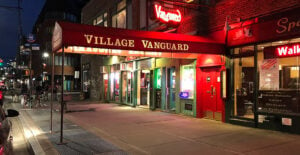
The Village Vanguard in Greenwich Village, one of New York City’s most legendary and enduring jazz clubs. Photo: Alwin Tong, CC BY-SA 4.0, via Wikimedia Commons.
I have spent much of my life as a musician working in New York nightclubs. There were years when I worked full-time, six or seven nights a week. If I tried to do the math and count all those years, I have probably played in thousands of clubs. We always talk about the famous ones, but New York has always been filled with dive bars, neighborhood hangouts, hotel lounges, dance clubs, rock rooms, supper clubs, and countless other places where musicians went to work every night. How many were there? Thousands, probably. I don’t know. We never kept track. We just went to work.
That’s why putting together a list like this is almost impossible if the goal is to cover everything. This is by no means a definitive directory. It’s a highlight list—a starting point. I worked at a lot of places on this list, and some are memorable to me for reasons that go far beyond the music.
If I had to pick the club where I felt the proudest to play, it would probably be the Copacabana. Not simply because of its legendary history, but because my father worked there in the 1950s. That meant something to me. Of course, sitting at a piano on a stage where Frank Sinatra, Dean Martin, Jerry Lewis, and so many other legends had performed was pretty special too. But I could say similar things about a lot of these clubs.
This article isn’t about me, though, and I always feel a little funny talking about myself this much. I’m only trying to make a point. There have been thousands upon thousands of clubs, bars, lounges, dance halls, and music rooms that have come and gone across New York. Many of them meant everything to the people who worked there and to the people who showed up every night. A club didn’t have to be famous around the world to be legendary to the people who called it their place.
So plenty will be missing from this list. There has to be. I also wanted to make sure we covered all of New York, not just Manhattan and the five boroughs. The Long Island rock scene of the 1960s, 1970s, and 1980s—especially the 1970s—was one of the most exciting live-music scenes I ever witnessed.
People have asked me to write more about the Long Island club scene, and maybe someday I will, but one of the problems is that there just isn’t that much documentation left. There aren’t enough photographs, and there certainly aren’t many videos. Back then, people didn’t walk around with cameras in their pockets. We didn’t have phones recording everything we did. Musicians went to the club, played the gig, packed up their equipment, and went home. The people in the audience came to hear the band and have a good time.
That’s the thing about those years: we didn’t document everything. We just lived it.
Upstate New York gets overlooked far too often when people write about New York music history, so I made sure some of those legendary rooms are represented here, too. This is a very, very big subject, and as I said, this list is only a start.
Part I: Manhattan Historic Jazz, Swing & Supper Clubs
1. The Blue Note — Greenwich Village
The Era: 1981–Present
The Location: 131 West 3rd Street, Greenwich Village
The Vibe: Intimate tables, serious listening, late-night jazz, and internationally known performers in a small Greenwich Village room.
The History: Danny Bensusan founded the Blue Note in 1981 with the idea that major jazz artists should be able to perform in an intimate club while still receiving the respect given to concert-hall performers. The club became a Greenwich Village institution, presenting artists including Sarah Vaughan, Dizzy Gillespie, Lionel Hampton, Oscar Peterson, Ray Brown, Stanley Turrentine, Tito Puente, and generations of contemporary jazz musicians. The Blue Note remains active at the same West 3rd Street address.
2. Village Vanguard — Greenwich Village
The Era: 1935–Present
The Location: 178 Seventh Avenue South, Greenwich Village
The Vibe: A narrow triangular basement where the room itself has become part of jazz history.
The History: Max Gordon opened the Village Vanguard in 1935. Its early programming included poets, folk singers, comedians, and other performers before the club became primarily devoted to jazz in the 1950s. The Vanguard’s exceptional acoustics and intimate dimensions made it one of the great live-recording rooms in American music. John Coltrane, Sonny Rollins, Bill Evans, and many others recorded landmark albums there. It remains one of New York’s longest-running and most revered jazz clubs.
3. Birdland — Midtown Manhattan
The Era: 1949–1965 at the original club; revived in 1986 and operating today
The Location: 1678 Broadway at the original location; 315 West 44th Street today
The Vibe: Bebop, big bands, late-night sets, and the room that proudly called itself “The Jazz Corner of the World.”
The History: Birdland opened in December 1949 and took its name from Charlie “Bird” Parker, who was one of its opening headliners. The original Broadway club became a headquarters for modern jazz, with Count Basie, John Coltrane, George Shearing, and many other major artists associated with the room. The original Birdland closed in 1965. The name was revived in 1986, and the current Birdland continues the tradition on West 44th Street.
4. The Cotton Club — Harlem
The Era: 1923–1936 in Harlem; 1936–1940 in Midtown
The Location: Lenox Avenue at West 142nd Street during the legendary Harlem era
The Vibe: Lavish Prohibition-era revues, nationally broadcast big bands, and one of the most famous contradictions of the Harlem Renaissance.
The History: The Cotton Club became one of Harlem’s most famous nightclubs after Owney Madden took over the former Club Deluxe and renamed it in 1923. Duke Ellington led the house band from 1927 to 1931, and Cab Calloway later became another defining bandleader. The club showcased extraordinary Black musicians, singers, and dancers while maintaining a discriminatory whites-only audience policy during much of its Harlem era. National radio broadcasts carried performances far beyond New York. The Harlem club closed in 1936 and relocated to Midtown, where it operated until 1940.
5. Cafe Society — Greenwich Village
The Era: 1938–1948
The Location: 1 Sheridan Square, Greenwich Village
The Vibe: Integrated audiences, jazz, political satire, cabaret, and a deliberate rejection of the racial barriers common in American nightlife.
The History: Barney Josephson opened Cafe Society in 1938 as one of the country’s most important racially integrated nightclubs. Billie Holiday introduced “Strange Fruit” to Cafe Society audiences in 1939, making the song inseparable from the club’s history. Holiday later recorded the song for Commodore Records; it was not recorded at Cafe Society itself. The club also presented artists including Sister Rosetta Tharpe, Hazel Scott, Lena Horne, and Josh White. Its slogan, “The Wrong Place for the Right People,” captured its combination of music and social defiance.
6. The Copacabana — Manhattan
The Era: 1940–Present through multiple locations and incarnations
The Location: 10 East 60th Street at the original club
The Vibe: Supper-club glamour, Latin music, celebrity nightlife, and generations of New Yorkers saying they were going to “the Copa.”
The History: The Copacabana opened in 1940 and quickly became one of Manhattan’s best-known nightspots. The original East 60th Street club mixed dinner, dancing, floor shows, comedy, and major musical performers. Frank Sinatra, Sammy Davis Jr., Dean Martin and Jerry Lewis, and many others appeared there. Sam Cooke recorded his celebrated 1964 live album Sam Cooke at the Copa at the club. The Copacabana name survived repeated moves and changes in ownership and remains part of New York nightlife today.
7. The Stork Club — Midtown Manhattan
The Era: 1929–1965
The Location: 3 East 53rd Street from 1934 until closing
The Vibe: Café society, celebrities, politicians, gossip columnists, and the feeling that getting into the right room mattered almost as much as being in New York.
The History: Sherman Billingsley opened the Stork Club in 1929, and the nightclub operated at several addresses before settling at 3 East 53rd Street in 1934. Its famous Cub Room became a gathering place for entertainers, socialites, politicians, and other prominent guests. Newspaper and radio columnist Walter Winchell held court at Table 50. The Stork Club closed in 1965, bringing an end to one of the defining institutions of mid-century New York café society.
Part II: Manhattan Rock, Folk, Punk & New Wave Proving Grounds
8. CBGB & OMFUG — The Bowery
The Era: 1973–2006
The Location: 315 Bowery
The Vibe: Loud, stripped-down, sticker-covered, and built around original music rather than polish.
The History: Hilly Kristal founded CBGB in 1973. The initials stood for Country, BlueGrass, Blues, while OMFUG meant “Other Music for Uplifting Gourmandizers.” The club became one of the defining incubators of American punk and new wave as the Ramones, Blondie, Talking Heads, Television, Patti Smith Group, the Dead Boys, and other downtown acts built audiences there. In the 1980s, CBGB also became central to New York hardcore. The club closed in October 2006 after a long dispute over its lease.
9. Max’s Kansas City — Union Square
The Era: 1965–1974; reopened 1975–1981
The Location: 213 Park Avenue South
The Vibe: Rock musicians, painters, poets, punks, glam stars, and Andy Warhol’s circle sharing the same rooms.
The History: Mickey Ruskin opened Max’s Kansas City in 1965, creating a restaurant, bar, and performance space where the downtown art world collided with rock music. Andy Warhol and members of his Factory circle became closely associated with the club, while the Velvet Underground, New York Dolls, Patti Smith, Ramones, and many other artists passed through its stages and back room. Max’s first incarnation ended in 1974, and the club reopened under new ownership in 1975 before closing for good in 1981.
10. The Bottom Line — Greenwich Village
The Era: 1974–2004
The Location: 15 West 4th Street
The Vibe: A serious listening room where major stars could still feel close enough to touch.
The History: Allan Pepper and Stanley Snadowsky opened The Bottom Line in 1974. The approximately 400-seat room became one of New York’s most important showcase clubs, hosting artists across rock, jazz, folk, blues, comedy, and pop. Bruce Springsteen’s 10-show stand in August 1975 became part of the mythology surrounding Born to Run, while Lou Reed recorded Live: Take No Prisoners there. The Bottom Line closed in 2004 after a rent dispute with New York University.
11. The Bitter End — Greenwich Village
The Era: 1961–Present
The Location: 147 Bleecker Street
The Vibe: Brick walls, a low stage, singer-songwriters, rock bands, comics, and Greenwich Village history packed into one narrow room.
The History: Fred Weintraub opened The Bitter End in 1961, and the club became a crucial stop for musicians and comedians developing material in Greenwich Village. Its long history includes appearances by artists such as Bob Dylan, Neil Diamond, Billy Joel, Stevie Wonder, Joni Mitchell, George Carlin, and many others. More than six decades later, The Bitter End remains active on Bleecker Street.
12. Hurrah — Upper West Side
The Era: 1976–Early 1981
The Location: 36 West 62nd Street
The Vibe: New wave, post-punk, art-school style, dancing, and video screens before music video became an everyday part of popular culture.
The History: Hurrah opened in 1976 and became one of New York’s important transition points between disco, punk, new wave, and post-punk. The club pioneered the use of video monitors as part of the nightlife environment and became known for booking emerging American and British acts. Ruth Polsky’s work as a talent booker helped make Hurrah an important New York stop for adventurous new music. The club closed in early 1981.
13. The Ritz — East Village and Midtown
The Era: 1980–1989 at Webster Hall; 1989–1995 at the former Studio 54
The Location: 119 East 11th Street during the classic Webster Hall era; later 254 West 54th Street
The Vibe: Big rock-club energy, emerging MTV culture, enormous video projection, and major bands in a room smaller than an arena.
The History: Jerry Brandt opened The Ritz in 1980 inside historic Webster Hall. The club became known for integrating large-scale video into live rock performances and for hosting artists including Prince, U2, Tina Turner, Sting, Guns N’ Roses, and many others. During the cable channel’s early years, MTV broadcast concerts from the room. In 1989, The Ritz moved to 254 West 54th Street, the former Studio 54 building, while the East 11th Street venue eventually returned to the Webster Hall name.
14. Wetlands Preserve — Tribeca
The Era: 1989–2001
The Location: 161 Hudson Street
The Vibe: Environmental activism downstairs, marathon jams upstairs, and a community that treated concerts as gatherings rather than quick sets.
The History: Larry Bloch founded Wetlands Preserve in 1989 and combined environmental activism with live music. The venue became one of the central rooms of the 1990s jam-band scene, hosting Phish, Blues Traveler, Dave Matthews Band, Spin Doctors, moe., and many other improvisation-heavy acts. The club’s political and environmental mission was as much a part of its identity as the music. Wetlands closed in September 2001.
15. The Peppermint Lounge — Midtown Manhattan
The Era: 1958–1965 at the original West 45th Street club
The Location: 128 West 45th Street
The Vibe: Packed dance floor, celebrities shoulder to shoulder with regular customers, and the Twist taking over New York nightlife.
The History: The Peppermint Lounge became internationally famous in the early 1960s when Joey Dee and the Starliters became its house band and the Twist craze exploded. Their recording “Peppermint Twist” reached number one, turning the small Midtown club into a destination for celebrities, tourists, and dancers. Chubby Checker also appeared there, but it was Joey Dee and the Starliters whose identity became inseparable from the club. The original Peppermint Lounge closed in 1965; the name was later revived at another Manhattan club in the 1980s.
Part III: Manhattan Disco, Megaclubs & Underground Dance Culture
16. Studio 54 — Midtown Manhattan
The Era: 1977–1986 as the famous nightclub
The Location: 254 West 54th Street
The Vibe: Celebrity spectacle, theatrical excess, disco, velvet ropes, and one of the most famous doors in nightlife history.
The History: Steve Rubell and Ian Schrager opened Studio 54 in April 1977 inside a former theater and television studio. The club quickly became synonymous with late-1970s celebrity nightlife, elaborate theatrical effects, and selective admission. The Rubell-Schrager era ended in 1980 after their tax-evasion convictions. Studio 54 reopened under different ownership in 1981 and continued as a nightclub until 1986. The building later returned to theatrical use and is now a Broadway theater.
17. Paradise Garage — Hudson Square
The Era: 1977–1987
The Location: 84 King Street
The Vibe: Music first, dancing until morning, a legendary sound system, and a community built around resident DJ Larry Levan.
The History: Michael Brody developed Paradise Garage at 84 King Street, with financial support from record executive Mel Cheren and musical direction centered on Larry Levan. The membership-based club did not operate like a conventional bar, allowing the music and dance floor to become its entire reason for being. Levan and sound engineer Richard Long created a system that became legendary among DJs and dancers. Paradise Garage had a profound influence on dance music, club culture, and what came to be known as garage music before it closed in 1987.
18. The Loft — Downtown Manhattan
The Era: 1970–Present through changing locations
The Location: 647 Broadway at the original location
The Vibe: Private house party, audiophile sound, long musical journeys, and no conventional nightclub door policy.
The History: David Mancuso held his first “Love Saves the Day” party at his Broadway loft on Valentine’s Day 1970. The Loft was not a conventional commercial nightclub; it grew from invitation-only house parties centered on music, sound quality, dancing, and community. Its approach influenced generations of DJs and clubs, including Paradise Garage. The original Broadway location lasted until 1974, but The Loft continued through later spaces and gatherings.
19. The Saint — East Village
The Era: 1980–1988
The Location: 105 Second Avenue, former home of the Fillmore East
The Vibe: Immersive sound, a giant planetarium-like dome, all-night dancing, and one of the most ambitious gay nightclubs ever built in New York.
The History: Bruce Mailman and Charles Terrell transformed the former Fillmore East into The Saint, which opened in September 1980 after a reported $4.5 million renovation. Its circular dance floor, enormous perforated dome, sophisticated lighting, and projection effects created an environment unlike nearly any other club in the city. The Saint became one of the central institutions of New York gay nightlife during the 1980s before closing in 1988.
20. Danceteria — Flatiron and Midtown
The Era: 1980–1986 in its original New York run; classic West 21st Street era 1982–1986
The Location: 30 West 21st Street at its best-known location
The Vibe: New wave, hip-hop, video art, fashion, performance, and several different cultures happening on different floors at the same time.
The History: Danceteria moved through several New York locations, but its four-floor home at 30 West 21st Street became the club’s defining address. The room brought together live bands, DJs, visual artists, fashion, and early video culture. Madonna gave an early public performance of her own music there in December 1982, singing “Everybody,” and the venue became closely associated with artists including New Order, Duran Duran, Depeche Mode, the Beastie Boys, Sonic Youth, and many others. The club also appeared in Desperately Seeking Susan.
21. The Limelight — Chelsea
The Era: 1983–2003 as Limelight; later nightclub use continued under other names until 2007
The Location: 656 Sixth Avenue at West 20th Street
The Vibe: Gothic architecture, stained glass, dance music, rock, Club Kids, and nightlife staged inside a former church.
The History: Peter Gatien opened the New York Limelight in 1983 inside the former Church of the Holy Communion, a landmark Gothic Revival building designed by Richard Upjohn. The contrast between a former Episcopal church and a high-volume nightclub gave Limelight an atmosphere no purpose-built dance club could duplicate. It became a major home for new wave, rock, techno, and later the 1990s Club Kid scene. The building continued in nightclub use after the Limelight era before nightlife ended there in 2007.
22. The Tunnel — Chelsea
The Era: 1986–2001
The Location: 220 Twelfth Avenue
The Vibe: Huge industrial rooms, remnants of railroad infrastructure, house music, hip-hop, and the scale of a warehouse rave.
The History: Tunnel opened in 1986 inside the massive former Terminal Warehouse freight complex. The building’s industrial proportions and railroad history gave the club its name and physical character. Later associated with Peter Gatien’s nightclub empire, Tunnel became a major venue for house, techno, hip-hop, and large-scale parties during the 1990s. Its enormous rooms made it one of the defining megaclubs of the era. Tunnel closed in 2001.
23. The Palladium — East Village
The Era: 1985–1997 as a nightclub
The Location: 126 East 14th Street
The Vibe: Monumental architecture, downtown art, enormous dance floors, and nightclub design treated as a serious visual experience.
The History: The building had already spent decades as the Academy of Music and later the Palladium concert hall when Steve Rubell and Ian Schrager converted it into a nightclub in 1985. Architect Arata Isozaki redesigned the interior, while artists including Keith Haring, Jean-Michel Basquiat, Kenny Scharf, and Francesco Clemente created work for the space. The Palladium combined the scale of a theater with the visual ambition of an art installation. It closed in 1997 and was later demolished for an NYU residence hall.
24. The Roxy — Chelsea
The Era: 1978–2007
The Location: 515 West 18th Street
The Vibe: Roller disco, hip-hop, breakdancing, dance music, and later one of New York’s great gay Saturday-night clubs.
The History: The Roxy opened in 1978 as a roller rink and roller disco. As skating faded, the enormous floor evolved into a dance club that brought together downtown artists, early hip-hop culture, DJs, breakdancers, and later a major gay dance audience. The venue changed with New York nightlife repeatedly rather than remaining frozen in one era. After nearly three decades in different forms, The Roxy closed permanently in March 2007.
25. Area — Tribeca
The Era: 1983–1987
The Location: 157 Hudson Street
The Vibe: A nightclub rebuilt as an art installation over and over again.
The History: Area was founded by Eric Goode, Christopher Goode, Shawn Hausman, Darius Azari, and Zwi Wasserstein in a former American Express stable building. The club became famous for completely changing its visual theme roughly every six weeks. Themes such as Suburbia, Art, Food, and Science transformed the entire environment and blurred the line between nightclub, theater, installation art, and celebrity spectacle. Area lasted only four years, but few clubs packed as many visual ideas into such a short life.
26. Nell’s — West 14th Street
The Era: 1986–2004
The Location: 244 West 14th Street
The Vibe: Dark wood, sofas, dinner, conversation, jazz, dancing, and an intentionally intimate alternative to the cavernous megaclub.
The History: Nell’s opened in 1986 with actress and singer Nell Campbell as its namesake and longtime hostess. Keith McNally and Lynn Wagenknecht were among the original ownership group. Designed with the atmosphere of a slightly faded English club rather than a futuristic disco, Nell’s offered a place to eat, sit, socialize, and hear music. Its aesthetic helped define a different strain of late-1980s New York nightlife. The club closed in 2004.
Part IV: Brooklyn, Queens & Staten Island Powerhouses
27. 2001 Odyssey — Bay Ridge, Brooklyn
The Era: 1970s–1980s
The Location: 802 64th Street, Bay Ridge
The Vibe: Working-class Brooklyn disco culture permanently fused with the image of Tony Manero dancing under colored lights.
The History: 2001 Odyssey became world-famous as the nightclub used in the 1977 film Saturday Night Fever. One of the most important corrections to the club’s mythology is that its celebrated illuminated floor was created and installed for the movie production rather than being the ordinary pre-film dance floor. The film transformed a neighborhood disco into an international symbol of the disco era. The space later operated under other club names, including Spectrum.
28. L’Amour and L’Amour East — Brooklyn and Queens
The Era: 1978–2004 for the Brooklyn club; L’Amour East operated in Queens during the 1980s
The Location: 1546 62nd Street, Brooklyn; L’Amour East operated on Queens Boulevard in Elmhurst
The Vibe: Heavy metal, hard rock, hardcore, leather jackets, denim, and bands playing close enough for the audience to feel the amplifiers.
The History: L’Amour opened as a disco in 1978 and shifted decisively toward hard rock and heavy metal in 1981. Billing itself as “The Rock Capital of Brooklyn,” it became one of the most important American club stops for metal, hosting artists including Iron Maiden, Metallica, Anthrax, Slayer, Megadeth, Kiss, Type O Negative, and countless touring and local bands. A Queens offshoot, L’Amour East, extended the name into Elmhurst during the 1980s. The original Brooklyn L’Amour closed in 2004.
29. Pastels — Bay Ridge, Brooklyn
The Era: 1980s–1997
The Location: 437 88th Street, near Fourth Avenue, Bay Ridge
The Vibe: Dressed-up Brooklyn nightlife, disco’s afterlife, freestyle, dance music, and the unmistakable social scene of 1980s Bay Ridge.
The History: Pastels occupied the long-running nightclub space at 437 88th Street that had previously been known as the Penthouse. During the 1980s and 1990s it became one of Bay Ridge’s best-remembered dance clubs, drawing a fashionable local crowd and reflecting the borough’s transition from disco into freestyle and later dance sounds. Pastels closed in 1997, and the space later operated under other nightclub names.
30. Paramount Theatre — Stapleton, Staten Island
The Era: 1979–Late 1980s as a multipurpose hall and rock venue
The Location: 560 Bay Street, Stapleton, Staten Island
The Vibe: An old movie palace suddenly filled with punk, new wave, and heavy metal.
The History: The Paramount opened as a grand movie theater in 1930 and stopped regular film exhibition in 1977. It reopened as a multipurpose hall in 1979 and soon became a significant Staten Island rock venue. New York City planning documents record performances by bands including the B-52s, Squeeze, the Ramones, Dead Kennedys, and Metallica. Metallica played the Paramount during its early 1983 New York appearances. The theater closed again by the end of the 1980s, leaving Staten Island with memories of an unlikely period when a former movie palace became one of the borough’s most adventurous rock rooms.
Part V: Long Island Rock Clubs, Beach Rooms & Suburban Nightlife
31. The Action House / Speaks — Island Park
The Era: Mid-1960s–1970s under several club names
The Location: 50 Austin Boulevard, Island Park, in period listings
The Vibe: Hammond organs, psychedelic rock, hard rock, enormous local followings, and a South Shore room where bands could become stars before they ever reached an arena.
The History: The Action House became one of the essential rooms of the late-1960s Long Island rock scene. The Vagrants, featuring Leslie West, the Hassles with Billy Joel, Vanilla Fudge, the Illusion, and many touring acts played there. The same Island Park nightlife property went through several later identities, including Rock Pile and Speaks. The Long Island Music and Entertainment Hall of Fame now recognizes Action House/Speaks as part of the island’s legendary club era.
32. My Father’s Place — Roslyn
The Era: 1971–1987 at the original Bryant Avenue club; later revived in Roslyn
The Location: 19 Bryant Avenue at the original club
The Vibe: Small-room intensity, table seating, live radio, and artists on the way up playing almost within arm’s reach.
The History: My Father’s Place opened in 1971 in a building that had once housed a bowling alley. Michael “Eppy” Epstein turned the approximately 400-seat club into one of Long Island’s most important listening rooms, and its relationship with WLIR helped bring live broadcasts to a much larger audience. Bruce Springsteen, Billy Joel, the Police, Tom Petty, the Ramones, reggae artists, blues performers, comedians, and countless others appeared there. The original club closed in 1987. Epstein later revived the My Father’s Place name at another Roslyn location.
33. Hammerheads — West Islip
The Era: Late 1970s–1980s
The Location: 135 Sunrise Highway, West Islip
The Vibe: Big crowds, loud guitars, multiple sets, and the demanding Long Island club circuit that could turn a regional band into a local institution.
The History: Hammerheads became one of the essential South Shore rock rooms of the late 1970s and early 1980s. Twisted Sister played the club repeatedly, and recordings from Hammerheads preserve the sound of the band during its relentless Long Island years. The room is also remembered in the history of other local rock bands that worked the Island circuit night after night. The club eventually disappeared, but its name remains closely tied to Long Island hard-rock culture.
34. The Mad Hatter — Stony Brook
The Era: 1970s–Early 1980s
The Location: Brooktown Plaza, 2191 Nesconset Highway (Route 347) at Hallock Road, Stony Brook
The Vibe: College crowds, drink specials, local bands several nights a week, and a North Shore stage where working rock groups built enormous followings.
The History: The Mad Hatter was a major club near Stony Brook University during the height of Long Island’s live-rock circuit. Contemporary advertisements in the university newspaper place the club at Brooktown Plaza on Route 347 and show bands including Twisted Sister, the Stanton Anderson Band (whose members used to sit in with my band at a club called Riddles on Thursday nights) and other regional acts working regular nights. The location later operated under other nightclub names, but the Mad Hatter remains one of the clubs most frequently remembered from the era. For me, seeing Zebra on Sunday nights in the 70s as a 15-year-old with a fake ID is a memory I will never forget.
35. The Oak Beach Inn — Oak Beach and Other Long Island Locations
The Era: 1969–1999 at the original OBI era
The Location: Oak Beach on Jones Beach Island, with later OBI locations elsewhere on Long Island
The Vibe: Waterfront crowds, rock bands, summer traffic, bumper stickers, and a nightclub that became almost as famous for its battles with local government as for its parties.
The History: Robert Matherson bought the Oak Beach Inn in 1969 and developed it into one of Long Island’s most famous nightclubs. The original OBI at Oak Beach was followed by other locations carrying names such as OBI East, OBI North, and OBI West. The club’s “Save the OBI” campaigns and long-running disputes over parking, traffic, zoning, and government regulation became part of its identity. One widely repeated origin story also credits OBI bartender Robert “Rosebud” Butt with creating the Long Island Iced Tea during the 1970s, although the cocktail’s origin remains disputed. The original Oak Beach property was sold in 1999. My band Phase IV used to play there on Sunday Nights in the summertime. Our dressing room was where they stored the beer. Those Sunday crowds were insane. The stories I could tell.
36. Uncle Sam’s / Spit — Levittown
The Era: 1978–1992
The Location: Hempstead Turnpike, Levittown
The Vibe: Large suburban dance floor, new wave, rock, radio nights, and an audience that could go from club music to a live band without leaving Nassau County.
The History: The Levittown nightclub remembered as Uncle Sam’s and later Spit became one of the area’s important dance and live-music rooms. Duran Duran played its first North American concert there in September 1981, and WLIR broadcasts helped connect the club with Long Island’s new-wave audience. The room also hosted rock, alternative, metal, and pop acts during its long run. It closed in 1992.
37. Sparks — Deer Park
The Era: 1970s–1980s
The Location: Commack Road, Deer Park
The Vibe: Loud regional rock, crowded weekends, and another stop in the circuit that kept Long Island bands working constantly.
The History: Sparks belonged to the network of suburban clubs that made Long Island an unusually strong live-rock market during the 1970s and 1980s. Fans remember it alongside rooms such as Hammerheads, the Mad Hatter, Speaks, and Sundance as part of a circuit where regional groups could play multiple nights and develop intensely loyal followings. Its surviving paper trail is thinner than that of some clubs on this list, but Sparks remains part of the oral history of Long Island rock nightlife.
38. Malibu — Lido Beach
The Era: Late 1970s–1990s
The Location: Malibu Shore Club complex, Lido Beach
The Vibe: Beach-club atmosphere, dance music, alternative rock, new wave, and the sound of WLIR-era Long Island nightlife.
The History: Malibu became one of Nassau County’s most recognizable beachside music and dance venues. During the 1980s it was closely connected to the alternative and new-wave audience that listened to WLIR, while also functioning as a large summer party destination. The Long Island Music and Entertainment Hall of Fame includes Malibu in its exhibition devoted to the island’s legendary club scene, placing it alongside My Father’s Place, Hammerheads, Action House/Speaks, the OBI, and the Mad Hatter.
39. Summers Beach Club — East Quogue
The Era: 1960s–1980s
The Location: Dune Road, East Quogue
The Vibe: Daytime rock bands, packed summer crowds, beach culture, and the Hamptons before luxury nightlife became the dominant image.
The History: Summers Beach Club was one of the great Dune Road party rooms of its era, part of a group of beach clubs where live bands performed during the day and at night. Billy Joel’s early band the Hassles played there, and the club remained a destination through the 1970s and 1980s. My band had a steady getting there for a few years playing every Wednesday afternoon. I think it might have been the only Club I ever played where the owners wanted the band drunk so they would just get completely nuts because that’s what they went for at that place, just total pandemonium.
40. Sundance — Bay Shore
The Era: 1970s–1991
The Location: Bay Shore
The Vibe: Country and oldies in one period, then hard rock and metal as the room evolved with Long Island’s changing audience.
The History: Sundance went through several musical identities before becoming an important rock venue during the 1980s. Promoter Jim Cariola booked both established artists and developing bands, and Guns N’ Roses played Sundance in 1987 while still building its national reputation. The club was also important to the early history of Dream Theater, which performed there repeatedly before becoming an international progressive-metal band. Sundance closed in 1991 after Southside Hospital acquired the property.
Part VI: Hudson Valley, Capital Region, Central New York & Western New York
41. The Chance — Poughkeepsie
The Era: 1980–2023 as the regular Chance era; special event held in 2026
The Location: 6 Crannell Street, Poughkeepsie
The Vibe: Old theater architecture, club-sized crowds, heavy rock, metal, punk, and touring acts that normally played much larger rooms.
The History: The building began life as a theater in 1912 and returned to live music use around 1970. It became The Chance in 1980 and grew into one of the Hudson Valley’s best-known rock venues. The Police, Ramones, Twisted Sister, Guns N’ Roses, Stevie Ray Vaughan, and generations of hard-rock and metal acts appeared there. The regular club run ended in October 2023 after the building was sold. The room was opened again for a special one-night WPDH 50th-anniversary benefit concert on June 26, 2026, showing how strongly the name still resonates in the Hudson Valley.
42. Saratoga Winners — Latham / Colonie
The Era: 1980s–2000s
The Location: Route 9, Town of Colonie near Latham
The Vibe: A roadside rock club where alternative, metal, punk, and touring bands could pull audiences from across the Capital Region.
The History: Saratoga Winners became one of the Capital Region’s best-known rock clubs and a useful touring stop between New York City, New England, and Canada. During its active years it hosted artists ranging from developing alternative bands to nationally known metal and rock acts. The club had already been closed for several years when the building was destroyed by fire on April 30, 2009. The fire permanently erased a venue that remained important in the memories of Albany-area concertgoers.
43. The Lost Horizon — Syracuse
The Era: 1975–Present, with periods under other names
The Location: 5863 Thompson Road, Syracuse
The Vibe: Low ceiling, loud room, metal, punk, hard rock, and the feeling that a national band had somehow landed in a neighborhood club.
The History: The building had previously operated as Wanda’s Restaurant and later as the Yellow Balloon before Greg Italiano renamed it The Lost Horizon in 1975. The club developed a national reputation for hard rock, punk, and metal, hosting artists such as AC/DC, the Ramones, Guns N’ Roses, and many others at various points in their careers. The venue spent periods under other names in the 2000s but later returned to the Lost Horizon identity and continues to host shows.
44. The Penny Arcade — Rochester
The Era: 1973–2009
The Location: 4785 Lake Avenue, Rochester
The Vibe: Lakeside neighborhood bar turned long-running rock club, with local bands sharing the calendar with touring acts.
The History: The Penny Arcade opened in 1973 near Rochester’s Charlotte and Lake Ontario waterfront. It became one of the city’s longest-running rock clubs, presenting local musicians alongside national touring artists for more than three decades. Contemporary college coverage in 2009 still described the club as an active venue with a history dating back to 1973. Its final shows came later that year, closing a remarkably long chapter in Rochester nightlife.
45. The Continental — Buffalo
The Era: Late 1970s–2005
The Location: 212 Franklin Street, Buffalo
The Vibe: Punk, new wave, goth, industrial music, alternative culture, and a room where outsiders could find their crowd.
The History: The Continental became one of Buffalo’s defining alternative nightclubs. During the 1980s and 1990s it was closely associated with the city’s punk, new wave, goth, and industrial scenes, while live bands and DJs shared the building’s two floors. The Goo Goo Dolls were among the local musicians connected to the club early in their career. The Continental closed in 2005, and the building was demolished in 2009, but reunions and local histories continue to keep the club’s identity alive.
Readers interested in more New York music and nightlife history can continue with our 10 Legendary Lost New York Music Venues and Clubs, our History of the Studio 54 Theater on Broadway, our History of New York City’s Famed Cafe Wha?, and our firsthand look back at When Summers Beach Club Was the Hottest Place in the Hamptons.
Sources
- Blue Note New York — Club history
- Village Vanguard — History and current club information
- Birdland Jazz Club — Birdland history
- New York City Landmarks Preservation Commission — Jazz in Harlem historic district report
- Library of Congress — “Strange Fruit” and Billie Holiday at Cafe Society
- The Copacabana — Current club and historical identity
- CBGB — Hilly Kristal’s history of CBGB & OMFUG
- The Bottom Line Archive — Venue history and performances
- Village Preservation — Webster Hall and The Ritz history
- NYC Department of Records and Information Services — Historic New York music venues
- New York University — Larry Levan and Mel Cheren Collection on Paradise Garage
- The Loft — David Mancuso and the history of The Loft
- New York City — Stapleton strategic sites report and Paramount Theatre history
- Long Island Music and Entertainment Hall of Fame — Long Island’s Legendary Club Scene
- Roslyn Landmark Society — My Father’s Place, 19 Bryant Avenue
- SUNY Stony Brook Statesman archive — Mad Hatter of Stony Brook advertisement, 1980
- Long Island Press — Jim Cariola and the history of Sundance
- WPDH — 2026 one-night return to The Chance in Poughkeepsie
- Syracuse Nostalgia — History of The Lost Horizon
- Times Union — Saratoga Winners and the 2009 fire
- Monroe Community College Monroe Doctrine — Penny Arcade history, 2009
- Buffalo Stories — History of The Continental
- Brooklyn Home Reporter — Pastels and the former Bay Ridge nightclub building
- The Bowery Boys — 2001 Odyssey and Saturday Night Fever