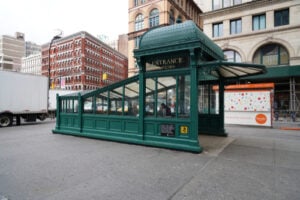
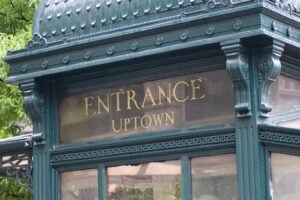
The distinctive cast-iron subway entrance kiosk at Astor Place, a recreation of the ornamental entrance structures used by New York’s original IRT subway. Photo: Mariusz Lopusiewicz / Shutterstock.com.
In New York City, the subway entrance is the portal between two worlds. It marks the point where the noise, traffic, and daylight of the street give way to platforms, tunnels, tracks, and the underground rhythm of the subway system.
When the original Interborough Rapid Transit subway opened in October 1904, some entrances were treated as pieces of civic architecture rather than simple stairways in the sidewalk. Heins & LaFarge designed ornamental control houses, while cast-iron and glass kiosks gave early riders distinctive gateways to the new system. Most of those structures eventually disappeared as streets were widened and sightlines became more important to automobile traffic.
More than a century later, New York’s subway entrances range from surviving early control houses and a carefully recreated 1904-style kiosk to stone structures built into Manhattan’s rocky landscape and huge modern glass transit centers. Here are 10 of the most iconic subway entrances in New York City and the stories behind them.
1. The Astor Place Cast-Iron Kiosk
Xackery Irving / Shutterstock.com
- Location: Astor Place and Lafayette Street, Manhattan
- Original Design: Heins & LaFarge
- Current Kiosk: 1980s reconstruction completed in 1986
- Station: Astor Place, 6 train
The northbound entrance at Astor Place offers one of the best glimpses of what entering New York’s original subway once looked like. The first IRT stations used elaborate cast-iron and glass entrance kiosks whose designs were influenced by European transit architecture, including the Budapest underground. The originals were eventually removed, but during the renovation of Astor Place in the 1980s, architect Rolf Ohlhausen of Prentice & Chan, Ohlhausen pushed for the return of a historic-style entrance. A new cast-iron kiosk was fabricated from old photographs, surviving fragments, and historic design information, and the project was completed in 1986. Today, the ornate structure stands in dramatic contrast to the ordinary steel-railed subway stairs found throughout the city and serves one of the stations that opened with New York’s first subway in 1904.
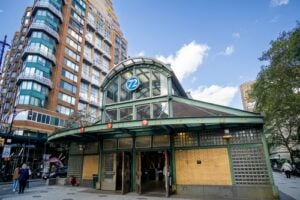
2. The 72nd Street Control House
Brian Logan Photography / Shutterstock.com
- Location: Broadway and West 72nd Street, Sherman Square, Manhattan
- Architects: Heins & LaFarge
- Completed: 1904
- Station: 72nd Street, 1, 2, and 3 trains
Standing on the traffic island where Broadway meets West 72nd Street is one of the great surviving buildings from the original IRT. Heins & LaFarge designed the one-story control house in a fanciful Flemish Renaissance style, using buff-colored Roman brick, limestone details, decorative gables, and a copper roof. Unlike a simple sidewalk entrance, the building originally contained station functions at street level before passengers descended to the platforms. The control house has survived more than a century of changes to Broadway and remains in active use even after a much larger modern station entrance was built nearby. For more on the earliest era of the system, see our 10 Oldest Subway Stations in NYC Still Operating.
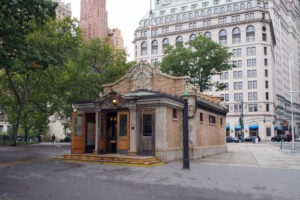
3. The Bowling Green Control House
ARK NEYMAN / Shutterstock.com
- Location: State Street near Battery Place, Lower Manhattan
- Architects: Heins & LaFarge
- Completed: 1905
- Station: Bowling Green, 4 and 5 trains
At the southern end of Manhattan, the Bowling Green Control House is another remarkable survivor from the first years of subway construction. Designed by Heins & LaFarge and completed in 1905, the small brick-and-stone building served as a formal entrance to the Bowling Green station. Its architecture belongs to the same family of ornamental early IRT control houses as the structure at 72nd Street, but its setting beside Bowling Green and the former U.S. Custom House gives it a character of its own. The building was restored during the 1970s and continues to serve as an entrance to the station, preserving a piece of the subway’s original street-level architecture at one of the oldest sections of Lower Manhattan.
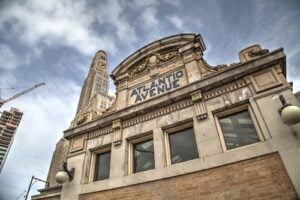
4. The Atlantic Avenue Control House
Fernando Garcia Esteban / Shutterstock.com
- Location: Times Plaza, Atlantic and Flatbush Avenues, Brooklyn
- Architects: Heins & LaFarge
- Completed: 1908
- Current Use: Restored historic structure and skylight for the station below
The Atlantic Avenue Control House once welcomed subway passengers at one of Brooklyn’s most important transportation crossroads. Built in 1908, the buff-brick structure featured limestone and terra-cotta details and large gables carrying the words “Atlantic Avenue.” It served as a subway entrance until 1971 and later deteriorated as the surrounding transportation complex changed. During the reconstruction of Atlantic Terminal in the early 2000s, the historic control house was temporarily moved, restored, and returned to its original site. It no longer functions as a passenger entrance; instead, its interior was adapted as a skylight that brings natural light into the subway station below. Few subway entrance structures have had a stranger second life.
5. The Italian Villa Entrance at East 180th Street
- Location: 481 Morris Park Avenue, the Bronx
- Architects: Fellheimer & Long, with Allen H. Stem associated
- Completed: 1912
- Station: East 180th Street, 2 and 5 trains
East 180th Street has an entrance that looks more like a country villa than a subway station. The building was completed in 1912 as both a station and administrative headquarters for the New York, Westchester & Boston Railway. Fellheimer & Long, with Allen H. Stem associated, designed the structure in an Italian villa style with an arcaded entrance, red-tile roof, balanced towers, and classical details. The railroad ceased operations in 1937, but the building survived. It was incorporated into New York City’s transit system in 1941 and has served as the entrance to the East 180th Street subway station ever since. Its reuse gave the Bronx one of the most architecturally distinctive station entrances anywhere in the system.
6. The Stone Entrance at 190th Street and Fort Tryon Park
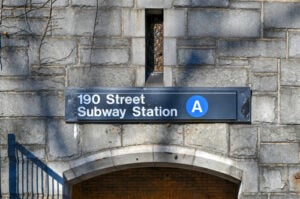
Felix Lipov / Shutterstock.com
- Location: Fort Washington Avenue at Margaret Corbin Circle, Manhattan
- Opened: 1932
- Station: 190th Street, A train
- Other Access: Passageway to Bennett Avenue
The 190th Street station was built deep inside the rocky ridge of Washington Heights, and its unusual setting produced one of New York’s most distinctive subway entrances. At the upper end of Fort Washington Avenue, beside Fort Tryon Park, passengers enter through a substantial stone headhouse rather than a conventional sidewalk stair. Elevators descend from this upper entrance to the station below, while a long passageway reaches Bennett Avenue at the lower elevation of the neighborhood. The station opened with the IND in 1932 and is listed on the National Register of Historic Places. Its stone entrance, tucked against the landscape near Fort Tryon Park, makes the subway feel almost like part of the terrain itself.
7. The Coney Island–Stillwell Avenue Portal Building
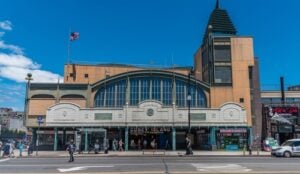
Adam Calaitzis / Shutterstock.com
- Location: Surf Avenue and Stillwell Avenue, Brooklyn
- Major Reconstruction: 2000s
- Station: Coney Island–Stillwell Avenue, D, F, N, and Q trains
- Architectural Team: di Domenico + Partners and project collaborators
At Coney Island, the subway entrance had to do more than lead passengers to trains; it had to announce their arrival at one of New York’s great amusement districts. During the terminal’s major reconstruction in the early 2000s, the new Stillwell Avenue Portal Building was designed as a three-story gateway facing the neighborhood. Historic terra-cotta elements from the older structure were restored and incorporated into the new building, while painted steel, cast stone, and other modern materials were used to evoke the character of Coney Island’s amusement architecture. Behind the entrance rises the enormous train shed and solar-panel canopy covering the platforms. The rebuilt terminal began reopening in 2004 and remains one of the grandest above-ground entrances in the subway system.
8. The Glass Headhouse at 96th Street
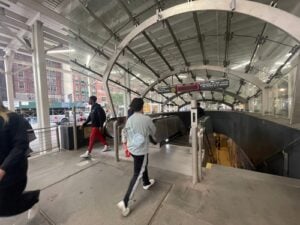
Xackery Irving / Shutterstock.com
- Location: Broadway at West 96th Street, Manhattan
- Architect: Urbahn Architects
- Project Completion: 2012
- Station: 96th Street, 1, 2, and 3 trains
The modern station house in the Broadway median at 96th Street shows how a subway entrance can become a piece of contemporary streetscape architecture. Instead of forcing passengers to enter through narrow sidewalk stairs on opposite sides of Broadway, the reconstruction created a new central station house that improved circulation and accessibility. Urbahn Architects designed the structure with a titanium-clad vaulted roof, curved glass skylights, and extensive transparent surfaces that bring daylight into the entrance. The form deliberately recalls a 19th-century train shed while remaining unmistakably modern. More than a century after the original 96th Street station opened in 1904, its new street entrance became an architectural landmark of its own.
9. The Fulton Center Glass Oculus
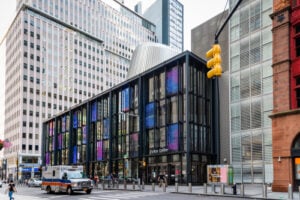
JJFarq / Shutterstock.com
- Location: Broadway and Fulton Street, Lower Manhattan
- Opened: 2014
- Station Complex: Fulton Street and connecting downtown subway lines
- Design Team: Grimshaw, Arup, and project collaborators
Fulton Center transformed the idea of a Lower Manhattan subway entrance. The glass-and-steel transit building rises above Broadway and Fulton Street with a slanted domed atrium that pulls daylight deep into a complex linking historic subway lines below. Suspended inside is the Sky Reflector-Net, a cable structure lined with reflective panels that redirects sunlight toward the lower levels. The project also restored the neighboring 19th-century Corbin Building and incorporated new subway access through it. Opened in 2014, Fulton Center replaced the image of the subway entrance as little more than a hole in the sidewalk with a monumental public room built around light, movement, and the connections beneath Lower Manhattan.
10. The Green and White/Red Subway Globe Lamps

DenisProduction.com /Shutterstock
- Location: Subway entrances throughout New York City
- Modern Color System: Standardized during the late 20th century
- Purpose: Identify subway entrances and indicate hours of access
Sometimes the most iconic subway entrance is not a building at all. The illuminated globe lamps mounted beside subway stairs have become one of the most recognizable pieces of New York street furniture. The modern system uses color as a practical signal: green globes identify entrances open 24 hours a day, while red globes indicate entrances with limited access. Earlier versions of the system carried additional meanings tied to token booths and turnstile arrangements, but those details changed as station operations evolved. What has not changed is the visual power of the glowing globe. On a crowded avenue or a dark side street, spotting one from a distance still tells a New Yorker exactly where the subway begins.
NYC’s 10 Iconic Subway Entrances at a Glance
| Entrance | Location | Era | Architectural Character | Notable Feature |
|---|---|---|---|---|
| Astor Place Kiosk | Astor Place, Manhattan | 1904 style / 1986 reconstruction | Ornamental cast iron and glass | Recreation of an original IRT-style entrance kiosk |
| 72nd Street Control House | Broadway & 72nd Street | 1904 | Flemish Renaissance | Surviving Heins & LaFarge control house |
| Bowling Green Control House | State Street & Battery Place | 1905 | Early IRT brick-and-stone control house | Historic entrance still serving the station |
| Atlantic Avenue Control House | Times Plaza, Brooklyn | 1908 | Brick, limestone, and terra cotta | Former entrance restored as a station skylight |
| East 180th Street Station House | Morris Park Avenue, Bronx | 1912 | Italian villa style | Former railroad headquarters reused as a subway entrance |
| 190th Street Entrance | Fort Tryon Park, Manhattan | 1932 | Stone headhouse | Elevator entrance built into Washington Heights terrain |
| Coney Island–Stillwell Portal | Surf & Stillwell Avenues, Brooklyn | 2000s reconstruction | Modern transit gateway with restored historic elements | Entrance to the huge Coney Island terminal |
| 96th Street Headhouse | Broadway & 96th Street | 2012 | Titanium, steel, and glass | Vaulted median station house with curved skylights |
| Fulton Center | Broadway & Fulton Street | 2014 | Glass-and-steel transit center | Daylight redirected underground through the Sky Reflector-Net |
| Green and Red Globe Lamps | System-wide | Late 20th century | Standardized transit street furniture | Green indicates 24-hour access; red indicates limited access |
For more on the history and architecture of the city’s transit system, see 10 Oldest Subway Stations in NYC Still Operating, explore the History of the Second Avenue Subway Project, and visit Union Square Station, Crossroads of NYC’s Subways.
Sources
- AIA New York — Astor Place Station Restoration
- New York City Landmarks Preservation Commission — 72nd Street Subway Kiosk (Control House)
- National Park Service — IRT Subway Control Houses Thematic Resources
- National Park Service — Atlantic Avenue Control House
- New York City Landmarks Preservation Commission — East 180th Street Administration Building
- MTA Construction & Development — 190th Street Station Renewal Project
- di Domenico + Partners — Stillwell Avenue Station
- Urbahn Architects — 96 Street Station
- Arup — Fulton Center
- New York City Department of City Planning — Subway Sidewalk Interface Study
Published September 10, 2026.