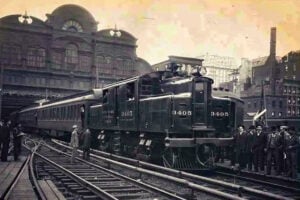
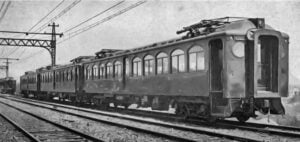
Electric railway cars of the New York, Westchester and Boston Railway in 1912. Public domain, via Wikimedia Commons.
Long before interstate highways and modern commuter rail reshaped travel across New York, Westchester County, the Hudson Valley, and the Catskills were crossed by an extraordinary collection of railroads. Electric interurbans carried suburban commuters, mountain railways delivered vacationers to grand hotels, rural branches hauled milk and agricultural freight, and long-distance lines connected small towns with New York City and markets hundreds of miles away.
Some of these railroads disappeared completely. Others survive only in fragments, tourist operations, abandoned grades, station buildings, or rail trails that now carry walkers and cyclists where passenger and freight trains once ran. This third installment in our Lost Railways of New York series looks at 10 vanished railroads and abandoned railroad corridors from Westchester through the Hudson Valley and into Upstate New York, explaining why they disappeared and what remains today.
1. The New York, Westchester and Boston Railway
Counties Served: The Bronx and Westchester
Original Route: From the Harlem River terminal at East 132nd Street and Willis Avenue in The Bronx north through Mount Vernon and New Rochelle, with branches serving White Plains and Port Chester.
Years of Operation: 1912-1937
Operating Company: New York, Westchester and Boston Railway, controlled by the New York, New Haven and Hartford Railroad.
Why It Vanished: The NYW&B was one of the most ambitious electric railways ever built in the New York metropolitan area. It featured high-speed electric operation, extensive grade separation, and substantial concrete and stone stations. Yet its southern terminal was in The Bronx rather than Midtown Manhattan, forcing many riders to transfer before reaching the city’s central business districts. The railroad also paralleled established New Haven routes in Westchester. Heavy construction debt, competition, and the Great Depression ultimately overwhelmed the company. Service ceased just after midnight on December 31, 1937.
What Remains Today: New York City purchased part of the abandoned Bronx right-of-way, which ultimately became today’s IRT Dyre Avenue Line used by the 5 train. The former NYW&B administration building at East 180th Street also survives as part of the subway complex, while several former station structures and pieces of railroad infrastructure remain in Westchester.
2. The Putnam Division of the New York Central Railroad
Counties Served: The Bronx, Westchester, and Putnam
Original Route: From the Sedgwick Avenue area in The Bronx north through Yonkers, Ardsley, Elmsford, Briarcliff Manor, Yorktown Heights, Mahopac, and Brewster, with additional connections around Lake Mahopac.
Years of Operation: The route developed through 19th-century predecessor railroads; regular Putnam Division passenger service ended May 29, 1958.
Operating Companies: New York City & Northern Railroad; New York & Putnam Railroad; New York Central Railroad; later Penn Central and Conrail on surviving freight portions.
Why It Vanished: Nicknamed the Old Put, the line offered a scenic but increasingly uncompetitive route through Westchester and Putnam Counties. Unlike the parallel Harlem and Hudson divisions, it lacked direct service to Grand Central Terminal, extensive electrification, and the growing commuter-parking infrastructure that favored suburban automobile users. Passenger ridership fell steadily after World War II, and the final regular passenger trains ran on May 29, 1958. Freight service survived on portions of the route for decades after passenger service disappeared.
What Remains Today: Large portions of the former right-of-way have been transformed into recreational trails, including the Putnam Trail through Van Cortlandt Park and the South County and North County trailways through Westchester. The conversion preserved much of the railroad’s path even after the tracks vanished.
3. The New York, Ontario and Western Railway
Regions Served: The lower Hudson Valley, Catskills, Central New York, and connections into northeastern Pennsylvania
Original Route: From the New York metropolitan area through Cornwall, Middletown, Sullivan County, the western Catskills, and Central New York to Oswego on Lake Ontario, with several important branch lines.
Years of Operation: The predecessor New York & Oswego Midland was organized in 1868; the New York, Ontario and Western Railway operated under that name from 1880 until 1957.
Operating Company: New York, Ontario and Western Railway.
Why It Vanished: Often nicknamed the Old and Weary, the O&W built an important business carrying coal, dairy products, freight, and passengers. Its trains also became closely associated with vacation travel to the Catskills and the resort communities of Sullivan County. By the mid-20th century, declining anthracite coal traffic, growing automobile ownership, improved highways, and long-term financial weakness left the railroad unable to recover. A federal court ordered operations discontinued at 11:59 p.m. on March 29, 1957.
What Remains Today: Most of the 541-mile system was dismantled after abandonment, but former stations, bridge abutments, tunnels, grades, and railroad buildings remain scattered across New York. Portions of former O&W corridors have also become local recreational trails. Its 1957 liquidation made the O&W the first major Class I railroad in the United States to be abandoned in its entirety.
4. The Ulster and Delaware Railroad and Catskill Mountain Branch
Counties Served: Ulster, Delaware, Schoharie, and Greene
Original Route: From Kingston on the Hudson River west through the Catskills by way of Phoenicia, Shandaken, Highmount, and Stamford toward Oneonta, with branches serving additional mountain resort communities.
Years of Operation: The railroad’s predecessor dates to the 1860s; regular passenger service ended March 31, 1954, and the last through mountain freight operations ended in 1976.
Operating Companies: Rondout & Oswego Railroad; Ulster and Delaware Railroad; New York Central Railroad; Penn Central.
Why It Vanished: The Ulster and Delaware was built into one of New York’s great mountain railroads, carrying freight and generations of vacationers deep into the Catskills. It helped support the region’s hotels, boarding houses, farms, quarries, and resort economy. As automobiles and improved highways transformed Catskill tourism, passenger traffic declined. New York Central ended regular passenger service on March 31, 1954. Freight survived for more than two additional decades, but declining business and deteriorating infrastructure left the mountain line with little future under Penn Central and Conrail. The last freight movement over the mountain route took place in 1976.
What Remains Today: This railroad did not disappear completely. The Catskill Mountain Railroad operates heritage excursions from Kingston on part of the historic corridor. Another 11.5-mile section beside the Ashokan Reservoir has become the Ashokan Rail Trail, while portions farther west form other recreational and heritage rail corridors.
5. The Upper Harlem Line to Chatham
Counties Served: Dutchess and Columbia
Original Route: North from the modern Harlem Line territory through Wassaic, Millerton, Copake Falls, Hillsdale, and on to Chatham.
Years of Operation: The New York & Harlem Railroad reached Chatham in the 19th century; passenger service north of Dover Plains ended March 20, 1972.
Operating Companies: New York & Harlem Railroad; New York Central Railroad; Penn Central.
Why It Vanished: The northern Harlem route once connected rural Columbia and Dutchess County communities with New York City while carrying milk, agricultural freight, and passengers through the Harlem Valley. By the Penn Central era, ridership had fallen and service had been reduced to a single daily round trip north of Dover Plains. After regulatory and legal disputes over whether the service was commuter or intercity transportation, the final passenger service between Dover Plains and Chatham ended on March 20, 1972.
What Remains Today: The track north of Wassaic was removed beginning in 1979. Much of the former corridor is now being preserved as the Harlem Valley Rail Trail. More than 26 miles have been paved in Dutchess and Columbia Counties, with the long-term goal of creating a continuous trail between Wassaic and Chatham.
6. The Wallkill Valley Railroad
Counties Served: Orange and Ulster
Original Route: North from the Montgomery area through Walden, Gardiner, New Paltz, Rosendale, and Kingston.
Years of Operation: 19th-century origins; passenger service ended in 1937 and freight service ended December 31, 1977.
Operating Companies: Wallkill Valley Railroad; New York Central Railroad; Penn Central; Conrail.
Why It Vanished: The line served farms, communities, and the once-important Rosendale cement industry while also carrying visitors into the Shawangunk and Catskill region. Passenger service ended in 1937, but freight kept the railroad alive for another 40 years. By the 1970s, many customers had disappeared or switched to trucks, and the aging Rosendale Trestle required repairs that cost more than the shrinking railroad could justify. Freight service ended at the close of 1977.
What Remains Today: Much of the former corridor is preserved as the Wallkill Valley Rail Trail. Its most spectacular surviving structure is the 940-foot Rosendale Trestle, which carries trail users approximately 150 feet above Rondout Creek.
7. The Newburgh, Dutchess and Connecticut Railroad
County Served: Dutchess
Original Route: From the Hudson River side of Dutchess County through Hopewell Junction, Millbrook, Pine Plains, and Millerton, with connections to other railroads heading east and west.
Years of Operation: The first predecessor segment opened in 1869. Passenger service on the remaining Beacon-Pine Plains route ended September 9, 1933; most of the line north of Hopewell Junction was abandoned by 1938.
Operating Companies: Dutchess & Columbia Railroad; Newburgh, Dutchess and Connecticut Railroad; Central New England Railway; New York, New Haven and Hartford Railroad.
Why It Vanished: The railroad was built to connect Hudson River traffic with farms, mines, villages, and connecting railroads across Dutchess County. But competing east-west railroad routes, changing freight patterns, difficult grades, aging bridges, and the growth of road transportation steadily weakened the line. Passenger service disappeared in stages, with the final Beacon-Pine Plains passenger trips ending in 1933. Most of the former route between Hopewell Junction and Pine Plains was abandoned in 1938.
What Remains Today: The restored Hopewell Depot survives at the historic railroad junction and now operates as a museum. The modern Dutchess Rail Trail begins at Hopewell Junction, but it follows the former Maybrook Line rather than the abandoned ND&C route north toward Pine Plains. Portions of the old ND&C grade can still be traced through rural Dutchess County, while the Beacon-Hopewell Junction segment survived much longer as part of the later Beacon Line.
8. The Abandoned Piermont End of the Erie Railroad
County Served: Rockland
Original Route: From the Erie Railroad’s enormous pier at Piermont west through Sparkill, Blauvelt, Nanuet, and toward Suffern.
Years of Operation: The route opened as the eastern end of the New York & Erie Railroad in 1841. Piermont lost its role as the railroad’s principal eastern terminal after the Erie obtained access to New Jersey waterfront terminals in the 1850s, although portions of the old route remained in railroad use much longer.
Operating Companies: New York & Erie Railroad; Erie Railroad; Erie Lackawanna Railroad and later operators on surviving portions.
Why It Vanished: Piermont was chosen as the Erie’s original Hudson River terminal because the railroad’s New York charter initially kept the route within the state. Passengers and freight transferred between trains and steamboats at the long Piermont Pier. Once the Erie gained a more practical route to terminals in Jersey City, Piermont’s importance collapsed. Over time, the eastern waterfront railroad became a secondary route and portions were abandoned as traffic patterns changed.
What Remains Today: This is another railroad whose entire alignment did not vanish. Portions farther west remained in railroad use, while abandoned sections in Orangetown became recreational corridors including parts of the Joseph B. Clarke Rail Trail and related paths near Sparkill and Piermont. Piermont’s historic railroad pier remains one of Rockland County’s most visible reminders of the Erie’s original Hudson River terminus.
9. The Catskill Mountain Railway and Otis Elevating Railway
County Served: Greene
Original Route: The narrow-gauge Catskill Mountain Railway ran from Catskill Landing toward Palenville. At Otis Junction, passengers could transfer to the cable-operated Otis Elevating Railway for the dramatic climb up the Catskill Escarpment toward the Catskill Mountain House and connecting mountain railroads.
Years of Operation: Catskill Mountain Railway, 1882-1918; Otis Elevating Railway, 1892-1918.
Operating Companies: Catskill Mountain Railway; Otis Elevating Railway Company.
Why It Vanished: These railroads belonged to the golden age of Catskill tourism, when travelers arrived by Hudson River steamboat and continued into the mountains by rail. The Otis Elevating Railway was a remarkable 7,000-foot cable railway that climbed approximately 1,630 vertical feet, with a maximum grade of about 34 percent. Its primary purpose was carrying guests toward the great mountaintop hotels. By the late 1910s, changing vacation patterns and the growing automobile undermined the elaborate rail-and-resort transportation system. The Catskill Mountain Railway, the Otis incline, and connecting mountain railroad operations closed in 1918.
What Remains Today: The railroads themselves are gone, but traces of their grades remain in the Catskills. Hikers can still encounter portions of the old Otis route and the landscape associated with the Catskill Mountain House, preserving one of the most unusual chapters in New York railroad history.
10. The Mount Beacon Incline Railway
County Served: Dutchess
Original Route: From the base of Mount Beacon near Wolcott Avenue up the western face of the mountain to the summit attractions overlooking the Hudson River.
Years of Operation: 1902-1978, with interruptions and rebuilding during its later years.
Operating Company: Mount Beacon Incline Railway Company and later owners.
Why It Vanished: The approximately 2,200-foot funicular climbed toward a summit roughly 1,540 feet above sea level and reached a maximum grade of about 74 percent, making it one of the steepest passenger incline railways in the world. Millions of visitors rode it to a casino, hotel, dance hall, observation areas, and later recreational attractions. Fires repeatedly damaged summit structures, while automobiles changed the excursion-travel patterns that had once delivered crowds to the base of the mountain. Financial problems and deteriorating infrastructure eventually ended operations in 1978.
What Remains Today: The railway was further devastated by fire in 1983. Today, hikers in Mount Beacon Park can still follow the old incline corridor and encounter ruins and remnants associated with the railway and its mountaintop attractions. The route remains one of the Hudson Valley’s most dramatic pieces of abandoned transportation history.
For more New York railroad and transportation history, read our History of New York’s Empire State Express Train, History of the Erie Canal, and Visiting the Just Opened New York State Thruway Rest Stops.
Sources
Ardsley Historical Society — Putnam Division and Ardsley Station History
Federal Register — Discontinuance of New York, Ontario and Western Railway Operations
Catskill Mountain Railroad — History of the Ulster and Delaware Corridor
Ulster County — Ashokan Rail Trail and Ulster & Delaware Corridor History
New York State Parks — Harlem Valley Rail Trail and Upper Harlem Line History
Wallkill Valley Land Trust — Wallkill Valley Railroad and Rosendale Trestle
Hopewell Depot Museum — Newburgh, Dutchess and Connecticut Railroad History
Village of Piermont — Erie Railroad and Piermont History
Scenic Hudson — Otis Elevating Railway and Catskill Mountain Tourism
Scenic Hudson — Mount Beacon Incline Railway History
10 Lost Railroads of Westchester, the Hudson Valley & Upstate New York article published on ClassicNewYorkHistory.com © 2026