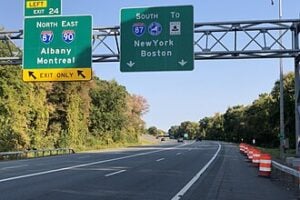
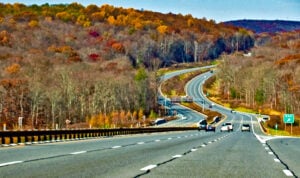
Taconic State Parkway north of the Bear Mountain Parkway exit in Yorktown, New York. Photo by Phillip Capper; cropped and color-corrected by Daniel Case, CC BY 2.0, via Wikimedia Commons.
For anyone living downstate, whether packing up the car in New York City, Westchester, or Long Island. heading “Upstate” often comes down to one basic question before hitting the road: do we take the New York State Thruway or the Taconic State Parkway? Now that’s the question that we used to ask ourselves before GPS. However, most people don’t even think about where they’re going or how they’re getting there; they just follow GPS. Well, let me tell you something, my friends: if you’re following GPS driving upstate most of the time, it’s going to put you on the Taconic. I usually use GPS just to help me figure out when I’ll get somewhere. And every time I plug in my destination upstate, it puts me on the Taconic, and when I get close to the exit to the Taconic, I ignore it, and I take the New York State Thruway. But please don’t let my personal choice of roadway determine which one you choose. Instead, I’ve laid it all out for you. The pros and the cons. Maybe this article will help you decide.
Both routes carry drivers north through the Hudson Valley, but they were built for very different purposes. The New York State Thruway is a modern interstate toll road designed for long-distance traffic, commercial vehicles, regular service areas, and high-volume travel. The Taconic State Parkway is a historic scenic parkway whose winding alignment was shaped to follow the landscape and reveal views of the Hudson Highlands, Catskills, and Taconic region.
The better route depends on where you are going, what you are driving, the weather, the time of day, and how much you value scenery over convenience. Here is a practical comparison of the two roads for anyone heading north from the New York metropolitan area.
1. The Route Personalities: Interstate Highway vs. Historic Parkway
The New York State Thruway (I-87): The Thruway begins at the New York City line in Yonkers, runs north through Westchester County, crosses the Hudson River on the Governor Mario M. Cuomo Bridge, and then continues north on the west side of the river toward Newburgh, New Paltz, Kingston, and Albany. It is a controlled-access interstate built for long-distance travel, with broad lanes, shoulders, major interchanges, commercial traffic, and 65 mph speed limits on much of the corridor.
The Taconic State Parkway: The Taconic begins at Kensico Circle near Kensico Dam in Westchester County and runs approximately 104 miles through Westchester, Putnam, Dutchess, and Columbia counties before ending at the Berkshire Section of the New York State Thruway near Chatham. Franklin D. Roosevelt was instrumental in its creation, and landscape architect Gilmore Clarke helped shape its winding, hilly route around the scenery rather than forcing the landscape into an interstate-style design. The National Register of Historic Places listed the entire parkway in 2005.
The difference is obvious within minutes. The Thruway feels like a major interstate. The Taconic feels like a road built to make the drive itself part of the trip.
2. Commercial Traffic and Trucks
Advantage: Taconic State Parkway if you want to avoid trucks.
This is one of the clearest differences between the two routes. New York State prohibits commercial vehicles, trucks, and tractor-trailers from the Taconic State Parkway. That means you will not spend the drive passing long lines of eighteen-wheelers or getting caught beside tractor-trailers in heavy rain.
The Thruway, by contrast, is one of New York’s major commercial transportation corridors. Trucks and other commercial vehicles are permitted and are a normal part of traffic on I-87. For some drivers that makes no difference. For others—especially anyone who dislikes driving beside large trucks—the Taconic can feel far more comfortable.
3. Tolls and Travel Cost
Advantage: Taconic State Parkway.
The Taconic itself is toll-free from its southern terminus near Kensico Dam to its northern end near Chatham. The New York State Thruway uses cashless tolling, and the amount depends on where you enter, where you exit, your vehicle class, and whether you have a New York E-ZPass.
As one useful example, the 2026 Thruway toll for a standard two-axle passenger vehicle traveling from Exit 15 near the New Jersey line to Exit 24 in Albany is $5.51 with a New York E-ZPass and $9.64 with a non-New York E-ZPass or Tolls by Mail. Drivers using the Governor Mario M. Cuomo Bridge should also remember that the bridge toll is collected only in the southbound, Westchester-bound direction.
For someone making the trip regularly, the Taconic’s lack of tolls can add up to meaningful savings over the course of a year.
4. Rest Stops, Gas, Food, and EV Charging
Advantage: New York State Thruway.
This is where the Thruway has the clearest practical advantage. Its 27 service areas are positioned roughly every thirty to forty miles across the system, and the redeveloped plazas include combinations of restaurants, 24-hour Applegreen convenience stores, fuel, restrooms, dog-walking areas, nursing rooms, tourism kiosks, and other services. The Thruway Authority has also installed high-speed EV chargers at every service area, with four to twelve Applegreen fast chargers at most locations.
Along the I-87 corridor between the lower Hudson Valley and Albany, major stops include Sloatsburg, Plattekill, Modena, Ulster, Malden, and New Baltimore. Drivers can pull directly into a service area without leaving the highway system.
The Taconic has nothing comparable to the Thruway’s full-service plaza network. The best-known service point is the Taste NY Market at Todd Hill in Dutchess County, located in the median of the parkway. It sells New York-made products and has restroom facilities, but it is not a full gasoline-and-restaurant travel plaza. For most fuel, restaurant, and convenience-store stops along the Taconic, drivers need to leave the parkway and use nearby local roads and businesses.
5. Speed Limits and Driving Pace
The two roads encourage very different driving styles.
On the Thruway, the posted speed limit is 65 mph on much of the I-87 corridor north of the lower Hudson Valley. The road was designed for interstate travel, with long sightlines, controlled-access interchanges, and shoulders that make the pace relatively consistent when traffic is moving normally.
The Taconic demands more attention. Posted limits vary, with 55 mph common on much of the parkway, and the road includes curves, hills, older entrance and exit designs, and remaining at-grade intersections in the northern counties. Some sections have little or no usable shoulder. It is not a road where a driver should assume that the next mile will look like the last one.
That does not make the Taconic a bad road. In many ways, the active driving experience is part of its appeal. It simply rewards a more attentive style than the Thruway.
6. Weather, Darkness, and Winter Driving
Advantage for most drivers in poor conditions: New York State Thruway.
The Thruway Authority maintains a large year-round maintenance operation across its system, and the I-87 corridor offers broad shoulders, controlled access, frequent service areas, traffic cameras, variable-message signs, weather monitoring, and a road geometry designed for interstate traffic. Those features can make the Thruway the more forgiving choice during heavy rain, snow, freezing conditions, or long nighttime drives.
The Taconic can be a much more demanding road after dark or in poor weather. Long sections are unlit, the roadway passes through heavily wooded country, curves and grades are more pronounced, and some stretches provide limited shoulder space. Deer are also a real concern on a road that runs directly through rural and forested landscapes.
In either case, severe weather can make any highway dangerous. Before a winter trip, checking current road conditions through New York’s 511 system is more useful than relying on what either road is usually like.
7. Which Route Is More Scenic?
Advantage: Taconic State Parkway.
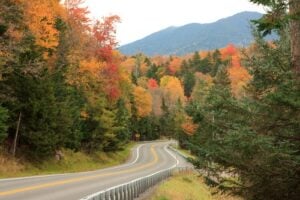
The Taconic was deliberately designed as a scenic road. NYSDOT describes Franklin D. Roosevelt’s vision of a parkway through the eastern Hudson Valley and credits landscape architect Gilmore Clarke with creating a route that offered views of the Hudson Highlands, Catskills, and Taconic regions. Stone bridges, wooded medians, rock cuts, rolling farmland, and long stretches without commercial billboards preserve much of that original parkway character.
The Thruway has attractive sections of its own, particularly through the Hudson Valley, but scenery was never its primary mission. The road is designed first to move large volumes of traffic efficiently.
On a clear autumn morning when there is no need to rush, the Taconic can turn the drive north into part of the destination.
8. Which Route Works Better for Different Upstate Destinations?
The destination matters more than almost any other factor.
The Thruway generally makes more sense for: New Paltz, Kingston, Woodstock and the central Catskills, Albany destinations approached from the west side of the Hudson, and anyone continuing west on I-90 toward Utica, Syracuse, Rochester, or Buffalo.
The Taconic generally makes more sense for: eastern Dutchess County, Millbrook, parts of Columbia County, Hudson-area destinations reached from the east, Chatham, and trips continuing east toward the Massachusetts Berkshires. Cross routes also provide access toward Rhinebeck, Cold Spring, and other Hudson Valley destinations.
If the destination is Albany itself, either road can work depending on the starting point. The Taconic ends at the Berkshire Section of the Thruway near Chatham rather than continuing directly into downtown Albany, so the final portion of the trip still requires I-90 or connecting roads.
Which One Should You Drive?
Take the New York State Thruway when:
- You want the most straightforward interstate-style drive.
- You are traveling at night or during poor weather and prefer broad shoulders and frequent services.
- You need reliable food, fuel, restrooms, or EV charging without leaving the highway.
- You are heading to New Paltz, Kingston, the central Catskills, Albany, or continuing west on I-90.
- You are driving a commercial vehicle that is prohibited from the Taconic.
Take the Taconic State Parkway when:
- You want a toll-free route.
- You prefer to avoid commercial truck traffic.
- The weather is good and you want the more scenic drive.
- Your destination is in eastern Dutchess County, Columbia County, Chatham, or the Berkshires.
- You enjoy a road that requires more active driving and rewards you with historic parkway scenery.
There is no single right answer for every Upstate trip. The Thruway is the practical workhorse: faster-feeling, predictable, well supplied, and designed to keep moving. The Taconic is the scenic alternative: toll-free, truck-free, historic, and far more connected to the landscape. The best choice is the one that matches the trip you are actually taking.
For more help planning a New York road trip, read Visiting the Just Opened New York State Thruway Rest Stops, The Story of E-ZPass in New York and How to Sign Up, and Where Does Upstate New York Begin? Defining New York State’s Regions and Boundaries.
Taconic State Parkway vs. New York State Thruway at a Glance
| Factor | New York State Thruway (I-87) | Taconic State Parkway |
|---|---|---|
| Road Character | Modern interstate toll road | Historic scenic parkway |
| Commercial Trucks | Permitted | Prohibited |
| Tolls | Cashless tolling | No tolls on the parkway |
| Typical Mainline Speed Limit | 65 mph on much of the corridor | 55 mph on much of the parkway; obey posted limits |
| Service Areas | Full-service plazas approximately every 30–40 miles | No comparable full-service plaza network; Todd Hill is the principal on-parkway market/rest stop |
| EV Charging | High-speed chargers at every Thruway service area | Plan charging off the parkway |
| Driving Style | Long-distance interstate cruising | More curves, grades, older geometry, and active driving |
| Scenery | Hudson Valley views but transportation-focused | Designed specifically around scenic Hudson Valley landscapes |
| Best Geographic Fit | West side of Hudson, Catskills, Albany, I-90 west | East Hudson Valley, Columbia County, Chatham, Berkshires |
Sources
New York State Department of Transportation — Taconic State Parkway Scenic Byway
New York State Department of Transportation — Parkway Commercial Vehicle Restrictions
Taste NY Todd Hill — Location and Hours
New York State Thruway Authority — Service Areas
New York State Thruway Authority — Electric Vehicle Charging
New York State Thruway Authority — Maintenance and Operations
New York State Thruway Authority — Toll and Distance Calculator
New York State Thruway Authority — Governor Mario M. Cuomo Bridge Visitor Information
Updated September 19, 2026.