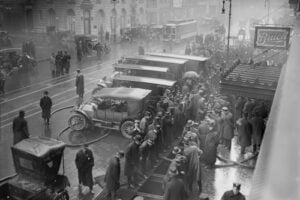
Feature Photo: Detroit Public Library collection, via Wikimedia Commons. Public domain.
The old movie theaters of Upstate New York were once landmarks of everyday life. Downtown movie palaces filled the sidewalks of Buffalo, Rochester, Syracuse, and Albany. Smaller houses in places such as Saranac Lake, Geneva, Oneonta, and Watertown offered the same excitement on a different scale. A theater could be a family’s Saturday afternoon destination, a teenager’s first date, or a place where the town gathered for a film everyone was talking about.
Theaters also tell a story about the changing geography of New York State. Many were built when people shopped and socialized in city centers; others arrived later, as wide screens, automobile access, and multiple auditoriums changed the business. Some disappeared during urban renewal. Others burned, closed because of economic pressures, or were converted to different uses. A few historic buildings survive even though their original moviegoing function has ended.
This collection focuses on lost indoor movie theaters, not drive-ins or historic performance halls that still operate in their traditional roles. “Lost” does not mean that every building has been demolished; where a former theater survives, that distinction is made explicit. It also matters that theater names changed. What seems to be two or three buildings in old advertisements may have been one house that passed through several operators.
The following twenty-five theaters span Western New York, the Finger Lakes, the Southern Tier, the Capital Region, the North Country, the Mohawk Valley, and the Hudson Valley. Their histories are drawn from local historical societies, libraries, preservation studies, public records, and historical reporting, with specialty theater databases used only where other records are limited.
1. The Century Theatre — Buffalo
The Century was one of the defining movie houses of Buffalo’s Main Street. Opened as Loew’s State Theatre in 1921, the immense auditorium held more than 3,000 people. Its later names reflected changing operators, including the Shea organization, but the central attraction remained the same: a film could be experienced in a setting designed to impress long before the first frame appeared on the screen.
As downtown theater attendance changed, the building took on another role. During the 1970s, concert promoters brought rock audiences into the former movie palace. Preservation Ready, a Buffalo architectural-history project, records the theater’s demolition in 1984. The site became part of a downtown landscape where parking and smaller commercial uses replaced some of the city’s most ambitious entertainment buildings. The Century was not simply a cinema that went out of business; it was a public gathering place that served more than one generation and more than one kind of audience.
2. The RKO Palace Theater — Rochester
The RKO Palace was among the grand theaters that once made Rochester’s downtown a destination for an evening out. It opened in 1928, when a movie might share the bill with live entertainment and a theater organ was part of the spectacle. The lavish interior was not an incidental luxury: it was a reason to choose the Palace over another screen, and it gave the Clinton Avenue entertainment district a landmark that generations of moviegoers remembered.
The Rochester Theater Organ Society preserves an especially revealing account of the end. On July 21, 1965, a retrospective vaudeville-and-film program featured the Palace organ. Its regular business ended on August 2, with Von Ryan’s Express on the screen. The building was demolished, but the Society purchased its Wurlitzer and eventually installed it in the Auditorium Theatre. When people hear that instrument today, they are hearing something salvaged from a movie palace the city could not save.
3. RKO Keith’s Theatre — Syracuse
South Salina Street once supported an extraordinary concentration of theaters. B. F. Keith’s New Theatre, which opened in 1920, belonged to the vaudeville era, but it continued into the age when movies became the principal attraction. Its enormous auditorium and stage showed how entertainment businesses expected audiences to gather downtown rather than travel to a suburban complex. Later generations knew the house as RKO Keith’s.
The theater disappeared during Syracuse’s urban-renewal period in 1967. A New York State Department of Transportation historical assessment identifies Keith’s among the Salina Street theaters swept away as downtown blocks were redeveloped. Its Wurlitzer organ was saved and relocated to the New York State Fairgrounds, a striking contrast between the survival of a valuable instrument and the loss of the room in which it originally sounded. Keith’s story is part of a larger question about what Syracuse sacrificed in the name of modernization.
4. The Winter Garden Theater — Jamestown
Jamestown’s Winter Garden was a familiar presence on North Main Street for much of the twentieth century. Opened in 1913, it became one of those movie houses whose name could serve as a meeting place as easily as an entertainment listing. For patrons who visited it across decades, each new film arrived in a building that was itself part of the town’s everyday routine.
The Winter Garden stopped showing movies in the 1990s. The vacant structure remained for years and was finally taken down in 2010. Its former site became Winter Garden Plaza, but the city did not leave the history completely unmarked. Jamestown dedicated a historical marker there in 2022. That marker and the plaza offer a useful way to understand “lost”: the building is gone, yet the city has made a deliberate effort to preserve its place in public memory.
5. The Hellman Theatre — Albany
Albany’s Hellman represented a later generation of movie theater construction. Neil Hellman opened the Washington Avenue house in 1960 as a memorial to his father, Harry, who had helped establish the family’s film-exhibition business. The auditorium seated more than a thousand people, and its generous screen and carefully planned public spaces were intended to offer a high-quality experience at a time when theaters were competing for customers with television.
A 2025 Times Union history of the Hellman family traces the theater’s transition to United Artists management, its division into two screens in 1983, and its closing in 1989. The building was subsequently demolished. The changes make the Hellman an important counterpoint to the 1920s movie palaces: it was built for a modern moviegoing market, adapted when the business changed, and nevertheless became another vanished Albany theater.
6. The Pontiac Theatre — Saranac Lake
The Pontiac was part of the working downtown of Saranac Lake, not an entertainment district in a major city. Built in 1917 on Broadway, it combined the moviegoing experience with the social life of an Adirondack community. Historic Saranac Lake records that its building once had a substantial organ and that its screen was considered exceptionally large for the region. Its history also included stage entertainment; the theater was not limited to showing films.
A fire destroyed the Pontiac in 1978. The local historical organization now includes the theater among its models of lost Saranac Lake buildings, alongside nearby commercial properties. That context matters. The Pontiac’s disappearance did not remove just one business; it changed the short stretch of Broadway where residents could see a film, meet friends, and then stop elsewhere downtown. Its site is now a parking lot.
7. Loew’s Rochester Theatre — Rochester
Rochester once had more than one downtown cinema built on a spectacular scale. The Rochester Theatre opened in 1927 and later carried the Loew’s name. Its South Clinton Avenue auditorium held well over 3,000 patrons and featured ornate decorative work and a powerful pipe organ. The theater stood within a downtown business district in which film, shopping, and other entertainment brought crowds onto the sidewalks.
The Loew’s building was torn down in 1964. Rochester Subway, a local history and preservation publication, documents the theater’s interiors and identifies the demolition as part of development for Xerox’s headquarters. The building’s disappearance came just a year before the end of the RKO Palace, an especially compressed period of loss for Rochester moviegoers. What survives in photographs is not merely a marquee but a sense of the extraordinary scale on which cinemas once operated in the city.
8. The Eckel and Biograph Theatre — Syracuse
Syracuse’s Eckel was a downtown movie house that repeatedly changed with its audience. It stood on East Fayette Street, and by the 1920s was part of a regional theater network associated with Nathan Robbins. Its defining later chapter began in 1958, when This Is Cinerama reached the Eckel. Three synchronized projectors created an enormous, curved-screen presentation that theaters promoted as something home television could never match.
Detailed film-engagement research by Michael Coate and Robert Throop, compiled from Syracuse newspapers and Variety, traces Cinerama programs at the Eckel through the 1960s. Later the theater operated as the Biograph before closing in the 1970s and being demolished. The changing name is important: the Eckel and Biograph were successive identities of the same cinema, not two separate places to be counted twice. This was a theater that invested in technical reinvention but could not preserve its place in the downtown market indefinitely.
9. The Ritz Theatre — Albany
The Ritz at 21 South Pearl Street belonged to Albany’s dense former theater district. It opened in 1926 under the Mark Ritz name and became a familiar picture house on a street where filmgoers had several choices. A surprising part of its history concerns what stood there before the movies: local historical research places an earlier municipal building on the site. The Ritz was built after that older government building had been removed; it was not simply the same jailhouse converted into a cinema.
The Albany Times Union archive includes photographs of the Ritz in August 1964 and of its demolition on October 15 of that year. Such images document more than an old building’s last days. They capture a moment when Pearl Street’s busy theater landscape was being erased, even as the city continued to invest in large downtown redevelopment projects. Unlike the later modern Hellman, this Ritz had belonged to the movie-palace generation.
10. The Teck Theatre — Buffalo
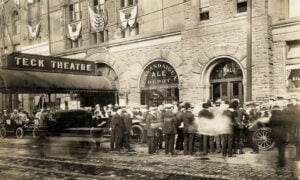
The Teck’s history began long before the arrival of wide-screen movies. Its Main Street location had housed Buffalo Music Hall, and a late-nineteenth-century theater building eventually took on the Teck name. The venue went through major changes in ownership and presentation over the decades. Buffalo Place’s historical account explains that the older performance hall was substantially transformed into a movie theater during the 1940s. It is therefore misleading to treat every name or remodeling as the construction of a completely new building.
The movie house later became a Buffalo destination for Cinerama presentations, which required a different screen and projection arrangement from ordinary films. As the theater’s commercial life ended, pieces of the structure disappeared in stages. Preservation Ready records the removal of the auditorium area during the 1980s and demolition of the remaining frontage in 1992. The Teck’s history demonstrates how a landmark can be lost gradually—first its original program, then its interior, and finally its face on the street.
11. The Capitol Theater — Binghamton
Binghamton’s Capitol stood on Exchange Street and opened in 1927, when motion pictures and live performances could still share an elaborate downtown theater. The Capitol was important not only for movies but for civic music. Local historian Gerald Smith has documented how the Binghamton Civic Music Association used the large auditorium for concerts during the mid-twentieth century, making the building part of the city’s wider arts life.
The Capitol ultimately disappeared in the 1960s, with its site cleared for a bank-related parking area. Smith’s account explains that the concert series moved to a school auditorium after losing the theater, a practical consequence that nostalgia alone might miss. A building could be replaced by a parking lot, but its seating capacity, acoustics, and usefulness to several different organizations could not be replaced so easily. The Capitol’s closure affected more than ticket buyers for Hollywood films.
12. The Paramount Theatre — Rochester
The Paramount at North Clinton Avenue was one of Rochester’s older picture palaces, though the Paramount name arrived well after the building opened. It began as the Piccadilly in 1916, became the Century in 1931, and took the Paramount name in 1948. To residents of different generations those names could evoke different theaters, but they referred to the same downtown location. The building’s changing identity reflected the fierce competition among Rochester’s large cinemas.
In the late 1960s the theater’s layout was altered to create a second viewing space, Studio 2, out of its lobby area. The original theater closed in 1974 and was demolished. A Cambridge University Press history of Rochester’s downtown development confirms that the Paramount was among the major cinemas lost by the mid-1970s. Rochester’s story is not one isolated demolition: several large houses closed in succession, changing the commercial character of a once-busy theater district.
13. The Paramount Theatre — Glens Falls
The Paramount once gave Glens Falls a movie theater with room for approximately 1,200 people. Opened in 1932, it stood near the Queensbury Hotel, an especially recognizable position in the city’s downtown. The theater offered not just films but a place for entertainment and gatherings over decades. The Arts District of Glens Falls identifies it as one of the city’s major twentieth-century social destinations.
The Paramount closed in April 1978. Although its days as a cinema ended, one especially tangible piece of the old experience survives: the original box office has been preserved and displayed in the lobby of the Wood Theater. That preservation gives younger visitors a chance to see a fragment of a movie house they may never have known. It also shows why an article about lost theaters should distinguish a theater’s closure from the loss of every object associated with it.
14. The Sattler Theatre — Buffalo
The Sattler opened on Broadway in Buffalo in 1914. It was commissioned by department-store businessman John Sattler, and its Beaux-Arts terra-cotta frontage made the building a neighborhood landmark. Later it was known as the Broadway Theatre and Basil’s Broadway, reflecting changes in management and audience. The movie house eventually stopped operating, and the property served other community and religious purposes before years of vacancy.
Unlike many theaters in this article, the Sattler’s building has survived. Western New York Minority Media Professionals acquired it in 2008 and has pursued plans for a new performing-arts and educational role. The National Park Service confirms that the theater was listed on the National Register of Historic Places on November 18, 2024. It is a lost cinema, not a demolished building. That distinction matters especially here, because the surviving architecture may yet support a new kind of public activity.
15. The Olympic Theatre — Watertown
The Olympic on State Street gave Watertown residents a large local picture house at a time when the city’s downtown supported several competing entertainment venues. The theater opened in 1917 and remained associated with both films and the older tradition of stage programs. Trade-paper histories quoted in later theater research record an ownership change during the 1920s and plans to expand its ability to present live attractions.
The Olympic was still showing movies during the 1970s, but it later closed and was demolished. Its significance is regional rather than merely architectural. For North Country residents, a downtown theater allowed families to participate in the movie culture of their time without traveling to Syracuse or other cities. As with many smaller-market theaters, accessible surviving records do not establish every detail of the final years; it is better to leave those gaps visible than supply an invented closing-night story.
16. The Stratford Theatre — Poughkeepsie
Poughkeepsie’s Stratford opened in January 1918 on Cannon Street, close to the Liberty Theatre. The Poughkeepsie Public Library’s local-history staff has reconstructed the two houses through newspapers, photographs, and architectural records. The Stratford was part of a downtown scene where movies were marketed through elaborate advertising and where theaters competed with the still-surviving Bardavon for audiences.
The library’s research notes that the Stratford and Liberty remained in business into the late 1950s before closing, and that the location is now a parking lot. Its history also captures technological change: local advertising announced the arrival of Vitaphone sound at the Stratford in 1928. That was more than a change to the sound system. It marked the transformation of moviegoing from an experience accompanied by live musicians to one dominated by synchronized dialogue and recorded music.
17. The Utica Theatre — Utica
The Utica Theatre began life with another name. Opened as the Lumberg in 1911, it was later known as the Gaiety before carrying the Utica name. A 1925 history of the Mohawk Valley describes the Gaiety as a well-equipped house associated with Keith vaudeville and the local theater network. That contemporary account is valuable because it documents how the building was regarded while it was still an active entertainment destination.
The venue later became part of Utica’s moviegoing history and finally closed during the 1960s; the building was demolished. It should not be confused with the Stanley Theatre, which remains a prominent performing-arts landmark in the city. The successive Lumberg, Gaiety, and Utica names refer to a single location, a point worth explaining whenever old newspaper advertisements make it appear that the community had more separate theater buildings than it actually did.
18. The Ithaca Theater — Ithaca
The Ithaca Theater was one of the city’s later downtown cinemas, a different kind of space from the great vaudeville palaces. In its mid-twentieth-century form, the house belonged to a period when a purpose-built movie auditorium could serve audiences without extensive stage facilities. Its State Street location made it part of downtown Ithaca’s commercial life, alongside several older and more ornate theaters.
An official National Register nomination for Ithaca’s State Theatre provides a useful comparison. It identifies the Ithaca Theater as a postwar building that still stood at the time of the study, while several older city movie houses had already been demolished. The Ithaca Theater ceased regular cinema operations and later found other commercial uses. It belongs on a list of lost moviegoing experiences, but not on a list claiming that all twenty-five buildings were razed. The State Theatre, by contrast, was preserved and remains a major performance venue.
19. The State Theatre — Niagara Falls
At East Falls Street and Portage Road, Niagara Falls had a movie house first known as the Falls Theatre and later as the State. It served residents of a city whose entertainment economy could not be reduced to tourists visiting the falls. Films shared the program with live appearances, especially as operators sought ways to make a downtown theater attractive in the age of television.
The venue’s concert history includes appearances by Johnny Cash and Jerry Lee Lewis in the late 1950s and early 1960s; set-list archives document several of these dates. Regular movie exhibition ended, and the building later suffered a destructive fire before being demolished. Records about the final period are uneven, so a precise demolition year should not be asserted without stronger documentation. What can be said is that the State represented both filmgoing and popular music in Niagara Falls—and that both functions were lost when the theater ceased operating.
20. Elmira Theatres 1-2-3 — Elmira
Elmira Theatres 1-2-3 was not a golden-age picture palace. It opened in 1977 with three screens and became a familiar destination for audiences who grew up with the movies of the late 1970s, 1980s, and 1990s. The College Avenue complex shows how quickly the definition of a “classic theater” changes: for one generation the memory is an enormous balcony; for another it is a triplex with several films to choose from on a Friday night.
A detailed firsthand local remembrance identifies the theater’s closure in 2002 and the start of demolition on March 19, 2007. That distinction is important. Closing a cinema does not necessarily mean its building immediately disappears; the vacant structure can remain as an uncomfortable reminder for years. The Elmira site eventually became parking, a fate shared by much older movie houses elsewhere in New York.
21. The Plaza Theatre — Schenectady
Schenectady’s Plaza opened in 1931 near State Street and Veterans Park. Designed by John Eberson, it belonged to the atmospheric-theater tradition, in which the auditorium evoked an outdoor setting under a simulated night sky. That theatrical architecture gave visitors a sense of departure from daily life even before the film started. The Plaza was one of the city’s substantial downtown houses, and its street frontage helped define the park’s surrounding urban space.
Its life was comparatively short. A local historical study, Shovel Ready: Razing Hopes, History, and a Sense of Place, recounts how the building was removed in 1964 after the city pressed the owner over its condition. The cleared site remained empty for years before it became part of a parking-centered landscape. That sequence reveals a recurring irony of twentieth-century redevelopment: removing an aging theater did not automatically create a thriving replacement downtown destination.
22. Loew’s Strand Theatre — Syracuse
The Strand at South Salina and Harrison Streets belonged to the downtown theater network that existed before television and suburban shopping centers reshaped Syracuse. Opened in 1915, it later carried the Warner, RKO Schine, and Loew’s names as operators changed. The same auditorium could therefore appear under several names in historical accounts and movie advertisements, even though patrons were entering the same building.
The Strand closed in 1959 and was demolished. The New York State Department of Transportation’s historical study of Syracuse explicitly places it among the Salina Street theaters lost to redevelopment. Its absence is especially evident when considered alongside Keith’s and other demolished houses nearby. Rather than treating each closure as an isolated business failure, the shared geography reveals the disappearance of a whole downtown entertainment district.
23. The Broadway Theatre — Newburgh
Newburgh’s Broadway Theatre was remembered for the films it showed and, tragically, for the way it ended. The theater stood along the city’s principal commercial street, among other movie houses that gave residents a range of choices within a small downtown area. It had already experienced fire damage earlier in its history, but the event of 1965 was much more destructive.
The City of Newburgh’s own fire-history account records that the theater was showing the Beatles film Help! when a fire destroyed it in 1965. A photograph of the burning marquee, still advertising the movie, appeared in Life magazine. A later Mid Hudson Times historical feature recounts the theater’s importance and the extraordinary irony of the marquee. This is one of the few entries for which a single image has become almost as memorable as the theater’s decades of movies.
24. The Palace Theatre — Oneonta
On Main Street in Oneonta, the Palace was originally the Maxey Theatre. It opened in 1922 and later acquired the Palace name, joining a regional theater business that brought new movies and stage attractions to smaller Upstate communities. The theater’s location made it a visible part of Oneonta’s commercial center: a place where people could combine shopping, meeting friends, and an evening’s entertainment without leaving the downtown blocks.
A City of Oneonta planning study records that the building was demolished in 1966 for expansion of the Wilber National Bank. That documented land-use change tells the central story more clearly than a general explanation about declining movie attendance would. A valuable Main Street parcel became more useful to another institution, and the theater disappeared. The Maxey and Palace names survive in old advertisements and local memories, while the original movie house does not.
25. The Temple Theatre — Geneva
Geneva’s Temple Theatre on Exchange Street opened in 1912, offering both vaudeville and motion pictures. For part of the early twentieth century it operated alongside other theaters within a few blocks, including the Smith Opera House and the Regent. Historic Geneva’s research describes a busy local entertainment environment in which residents could choose between stage acts and films without leaving the city center.
The Temple closed during the Depression, reopened for a period in the 1940s, and later served as a teenage dance club. Its building deteriorated and was torn down in the mid-1970s after a roof collapse. Sources differ on whether the demolition occurred in 1975 or 1976, so a precise year would give more confidence than the available records warrant. Geneva’s preserved Smith Opera House offers a vivid contrast: one historic gathering place has survived, while the Temple has become a subject of photographs, archival research, and memory.
What Upstate New York Lost When Its Movie Houses Closed
The theaters on this list did not all disappear for the same reason. Jamestown chose to commemorate a demolished house with a plaza and a historical marker. Newburgh lost its Broadway to a dramatic fire. Binghamton sacrificed a large performance space to a parking-centered redevelopment, and the Rochester theater district experienced several losses within a decade. Some spaces, including the Sattler in Buffalo, have survived as buildings without surviving as regular cinemas.
Those differences are more interesting than an easy explanation that television alone killed the old movie palace. Owners made financial decisions. Cities removed blocks of buildings. Audiences moved toward different neighborhoods and newer theaters. Preservation groups sometimes saved organs, box offices, or entire buildings, even when they could not preserve a familiar Saturday-night ritual.
The Stanley Theatre in Utica, the Landmark Theatre in Syracuse, the State Theatre in Ithaca, and Proctors in Schenectady demonstrate that some historic venues found a way forward. The lost movie houses remind us what was at stake wherever that did not happen.
For more New York theater history, see our 25 Lost Drive-In Theaters Across Upstate New York and 25 Lost Movie Theaters New York City Residents Still Remember.