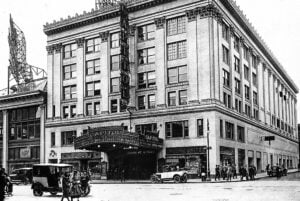
The Capitol Theatre on Broadway at West 51st Street in Manhattan in 1920. The legendary movie palace opened in 1919 and was demolished in 1968. Photo: American Studio / Library of Congress, public domain.
New York City once had movie theaters that were landmarks in their own right. Their marquees lit up neighborhood shopping streets, their lobbies featured marble and chandeliers, and their auditoriums could hold thousands for an afternoon at the movies. Enormous palaces lined Times Square, luxurious theaters lined the Grand Concourse, and neighborhood houses in Queens and Brooklyn let families walk to a double feature. Going to the movies meant more than watching the screen. The theater itself was part of the occasion.
The picture-palace boom peaked in the 1920s and early 1930s, when architects such as Thomas W. Lamb, John Eberson, and Charles Howard Crane designed buildings meant to transport audiences to another world. Some imitated Renaissance palaces. Others created the illusion of an outdoor courtyard beneath a star-filled sky. With large stages and elaborate organs, many offered vaudeville and live music alongside the feature presentation. Later generations knew them as the places where they first saw Hollywood epics, musicals, science-fiction pictures, and rock-and-roll concerts.
Times changed. Television altered family entertainment, neighborhood shopping districts evolved, and maintaining a building designed for several thousand moviegoers became increasingly expensive. Some theaters were divided into smaller screening rooms. Others became churches, stores, schools, restaurants, or apartments. A number were demolished altogether. The loss was not always just architectural. Every closing also ended a familiar part of the neighborhood’s social life.
I have lived long enough to see New York City reinvent itself over and over again, and the disappearance of these theaters is one of the clearest examples of how much of the old city has changed. The 25 places below are all gone as movie theaters. That distinction matters: several of their buildings or recognizable exterior features survive, even though the original filmgoing experience is no longer there. Here are 25 lost New York City movie theaters whose names and histories are still worth remembering.
1. The Ziegfeld Theatre (Midtown Manhattan)
Former movie theater location: 141 West 54th Street, Manhattan.
The Ziegfeld opened on December 17, 1969, with the premiere engagement of Marooned. It was not the original Ziegfeld Theatre, the Broadway house built for Florenz Ziegfeld in 1927 and demolished in 1966. The new Ziegfeld, at 141 West 54th Street, was a Walter Reade flagship designed by Emery Roth & Sons, with interiors by John J. McNamara. Its 1,100-plus seats, stage curtains, wide screen, and single auditorium deliberately recalled the scale of older film palaces at a time when they were fast disappearing.
The theater became a favorite location for gala premieres and extended film presentations, not simply a neighborhood cinema. Its survival into the 21st century gave Manhattan a rare place where one movie could fill an entire luxurious auditorium. The final screenings took place in January 2016. The space was converted into the Ziegfeld Ballroom, so the address and famous name survive but the moviegoing experience does not. That distinction makes the Ziegfeld one of the most recent and personal losses on this list.
2. RKO Keith’s Theatre (Flushing, Queens)
Former movie theater location: 135-35 Northern Boulevard, Flushing.
Opened on Christmas Day in 1928, RKO Keith’s in Flushing was designed by Thomas W. Lamb as one of Queens’ great atmospheric movie palaces. The auditorium created the illusion of an outdoor Spanish courtyard with a darkening sky overhead. The New York City Landmarks Preservation Commission documented its elaborate Mexican Baroque, or Churrigueresque, decoration in the 1984 designation report. The building served both stage entertainment and movies, turning Northern Boulevard into a destination for audiences from well beyond Flushing.
The movie theater closed in 1986, but its most painful history followed. After changes of ownership, damage, and decades of uncertain redevelopment plans, the auditorium was demolished while the landmark-protected ticket lobby and grand foyer were the focus of preservation efforts. The New York Landmarks Conservancy described the difficulties of conserving the deteriorated interior and a proposal to incorporate it into a residential tower. This is not a case in which an intact theater simply became condominiums: the landmark lobby and the lost movie auditorium have different histories, and the struggle to save them lasted for decades.
3. The Roxy Theatre (Midtown Manhattan)
Former movie theater location: 153 West 50th Street, Manhattan.
Opening on March 11, 1927, the Roxy offered a scale of entertainment that sounds almost impossible today. Samuel L. “Roxy” Rothafel’s theater near Seventh Avenue was promoted as the “Cathedral of the Motion Picture.” The New York Public Library’s Roxy records describe an establishment with three pipe organs, a large orchestra, a ballet corps, and disciplined teams of ushers. A movie ticket could mean an entire program of music, precision dancing, and stage entertainment in addition to the feature film.
An especially revealing account survives in the New York Public Library’s papers of John Joseph North, a Roxy usher in 1951. He remembered the elaborate presentations, performers including Josephine Baker, and the complex backstage organization required to maintain the illusion of effortless glamour. The Library also preserves costume designs from the Roxyettes era that connects the Roxy with the later Rockettes at Radio City Music Hall. By the late 1950s, the theater operated without its famous live stage shows. It was demolished in 1960 during Rockefeller Center’s expansion, taking with it one of the fullest expressions of the movie-palace age.
4. Loew’s Triboro Theatre (Astoria, Queens)
Former movie theater location: 28-04 Steinway Street, Astoria.
Loew’s Triboro opened on February 21, 1931, with Marie Dressler in Reducing and six vaudeville acts. Its late construction date was striking: New York was already in the Depression, yet Loew’s built an enormous new theater on Steinway Street. Thomas W. Lamb designed a Mayan Revival exterior and an atmospheric auditorium resembling an Italian Renaissance courtyard. Historical theater photographs show the kind of elaborate interior that could make an ordinary trip to the movies feel like a visit to another country.
Organ histories preserve an unusually specific detail about the Triboro. In 1931, a Wurlitzer theater organ was transferred to Astoria from Loew’s Canal Street Theatre in Manhattan. That instrument connected the new movie palace with an older period when live accompaniment and vaudeville were vital parts of a movie program. The Triboro lasted only until June 1974 and was demolished later that year. Although it was among the last giant palaces built in the city, it became one of the early casualties of their decline.
5. The Paramount Theatre (Times Square)
Former movie theater location: 1501 Broadway, at West 43rd Street, Manhattan.
The Paramount Theatre opened in November 1926 at 1501 Broadway as part of Paramount Pictures’ new Times Square headquarters. Its 3,600-plus-seat auditorium was built for major pictures, elaborate stage shows, and the big entertainers of the day. Frank Sinatra’s performances in the 1940s gave the building an entirely different kind of fame as excited young fans crowded Times Square. The Paramount was both a cinema and an entertainment destination in an age when film studios were closely tied to theater ownership.
The Paramount Building’s own historical account preserves details still visible above Broadway. Its four-faced clock uses stars in place of conventional hour markers, echoing the Paramount Pictures emblem. During World War II, the clock and rooftop globe were darkened under blackout precautions; the features were restored in 1996. Inside, however, the theater did not survive. Movie operations ended in 1966 and the great auditorium was dismantled for other commercial uses. Tourists can admire the clock tower today without realizing that one of Times Square’s most famous movie palaces once occupied the building below it.
6. Brooklyn Fox Theatre (Downtown Brooklyn)
Former movie theater location: 20 Flatbush Avenue, near Nevins Street, Brooklyn.
The Brooklyn Fox opened in 1928 on a triangular block bordered by Flatbush Avenue, Nevins Street, and Livingston Street. It was one of the “big four” Downtown Brooklyn movie palaces, alongside Loew’s Metropolitan, the RKO Albee, and the Brooklyn Paramount. A Brooklyn Public Library study based on Brooklyn Daily Eagle clippings describes an astonishing undersea decorative theme, with a domed ceiling and green-and-tan marble intended to make the auditorium feel like an underwater palace. Period reporting put its audience capacity at approximately 5,000, making it the largest Brooklyn theater of its day.
The Fox had its own place in the history of changing technology. A 1930 newspaper account found by Brooklyn Public Library described special wired seats that allowed patrons with hearing difficulties to control the volume of movie sound through headpieces. In November 1949, about 4,000 schoolchildren attended a televised United Nations Assembly presentation in the theater, an early experiment in educational broadcasts for large audiences. The Fox also became a center for live music and rock-and-roll concerts. Its final movie screening was on February 6, 1966. After a few years of occasional performances, it was demolished in 1971 for a Consolidated Edison building.
7. The Astor Theatre (Times Square)
Former movie theater location: 1531 Broadway, at West 45th Street, Manhattan.
The Astor Theatre opened in 1906 as a legitimate Broadway stage and later became a major Times Square cinema. Its location near the Hotel Astor placed it in the middle of the district where tourists, theatergoers, and movie audiences crossed paths. By the middle of the 20th century, the house was identified with long first-run engagements and significant film premieres, including East of Eden in 1955. The theater underwent alterations as changing technology and audience tastes transformed the business.
What ultimately erased the Astor was not a gradual conversion into a store but one of the most contentious redevelopment decisions in Times Square history. By the early 1980s, the theater had ceased presenting films and stood on the site planned for the Marriott Marquis hotel. The New York Preservation Archive Project documents protests, legal action, and alternative proposals to retain historic theaters, including the Astor and neighboring houses. Demolition went ahead in 1982. The dispute became an important chapter in the campaign for Broadway theater preservation.
8. Loew’s Pitkin Theatre (Brownsville, Brooklyn)
Former movie theater location: 1501 Pitkin Avenue, Brownsville.
Opened in November 1929, Loew’s Pitkin stood on one of Brownsville’s most important shopping streets. Thomas W. Lamb designed an elaborate neighborhood palace with a large auditorium and an organ, providing entertainment at a scale rarely associated with modern local cinemas. As with other Loew’s houses, patrons came not only for the feature picture but also for the surroundings and the sense of occasion attached to an evening on Pitkin Avenue.
The Pitkin stopped showing movies in 1971 and later served as a church before suffering years of deterioration. Its eventual rescue is unusually well documented. In September 2012, developer POKO Partners announced completion of a $43 million adaptive-reuse project, converting the building into a school and street-level retail. Brownsville Ascend Charter School occupied seven of the eight floors. This saved a major structure on the avenue, but the original picture-palace auditorium and its moviegoing purpose were gone. The Pitkin’s fate shows how preservation of a building can still involve the loss of the theater inside it.
9. The Rivoli Theatre (Times Square)
Former movie theater location: 1620 Broadway, Manhattan.
The Rivoli opened in December 1917 and eventually became a centerpiece of the roadshow era, when a major film might receive a reserved-seat engagement at one specially equipped theater for months. On October 11, 1955, the motion-picture version of Oklahoma! premiered there. Rodgers & Hammerstein’s official production history identifies the picture as the first film photographed and presented in the Todd-AO 70mm widescreen format, requiring extensive modifications to theaters that could exhibit it.
That kind of presentation made the Rivoli much more than a place to watch whatever film happened to be playing. Its huge curved screen and carefully engineered sound helped give movies such as West Side Story and The Sound of Music the scale of theatrical events. The Rivoli was divided into two screens in 1981, a compromise that removed much of its original identity. After closing in June 1987, it was demolished for a commercial tower. Its disappearance was another blow to New Yorkers who remembered films as shared events in enormous single-screen auditoriums.
10. The Beekman Theatre (Upper East Side)
Former movie theater location: 1254 Second Avenue, Manhattan.
The Beekman Theatre opened in April 1952 on Second Avenue, at a time when architects were no longer trying to recreate Renaissance palaces inside movie houses. This was a modern cinema designed to show films in comfort, with carefully planned sightlines and a reputation for superior presentation. Film critic Bosley Crowther described it as a “class theater” when it opened. The Beekman became particularly important to audiences interested in serious films and long first-run engagements, and Woody Allen later used the theater in Annie Hall.
The decision to close was not the result of an abandoned building slowly falling into disrepair. Contemporary coverage of the June 2005 closing reported that the landlord exercised an option to reclaim the site. Its final film was The Interpreter, and the building was demolished for a medical facility. The subsequent use of the Beekman name at a different cinema should not obscure the loss of the original auditorium. For generations of East Side filmgoers, it was one of those theaters whose character mattered as much as what appeared on the screen.
11. RKO Chester Theatre (West Farms, Bronx)
Former movie theater location: 1938 Boston Road, the Bronx.
The Chester opened on Boston Road in 1927, near the Bronx Zoo and the older neighborhoods of West Farms. Operated as a Keith-Albee and later RKO house, it was both a place to watch movies and a familiar landmark on the surrounding shopping streets. The Chester has an unusual place in film and television memory because Paddy Chayefsky referred to it in Marty, placing a real Bronx movie house within the everyday romantic uncertainties of the story.
The Chester stopped showing movies in 1968. The auditorium was adapted for warehouse use and later automobile-related businesses, a transformation that preserved portions of the building for a time while erasing its original purpose. Local preservation photographs and accounts document its final demolition in May 2010. The name now survives mostly in theater histories, photographs, and the memories of people who knew the Boston Road neighborhood when going to a movie could mean walking just a few blocks from home.
12. Loew’s 72nd Street Theatre (Upper East Side)
Former movie theater location: 180 East 72nd Street, Manhattan.
Loew’s 72nd Street Theatre opened on February 20, 1932, with Marie Dressler in Emma. It was a grand undertaking during the Depression, with 2,673 seats and an extraordinary atmospheric auditorium designed by Thomas W. Lamb and John Eberson. Historic theater documentation describes an interior inspired by architecture associated with Siam, now Thailand, including temple and pagoda motifs. For audiences entering from a Manhattan street, the effect was meant to be a journey into an elaborate imagined landscape.
The palace had a relatively brief life. Contemporary advertisements reproduced in theater archives document the final engagement, The World of Suzie Wong, shown before its closing on December 31, 1960. The theater was demolished in 1961 and replaced by a residential building. It was one of the last great palaces constructed in New York and one of the many whose demolition came before the modern preservation movement had the power to protect it.
13. Loew’s Capitol Theatre (Times Square)
Former movie theater location: 1645 Broadway, at West 51st Street, Manhattan.
Loew’s Capitol opened on Broadway in 1919 and became one of the most important movie palaces associated with the Metro-Goldwyn-Mayer era. The Capitol was built for an experience that blended features with orchestral and stage presentations. It was also connected with radio: broadcasts associated with the theater carried its musical identity beyond the auditorium. Its prestige reflected an age when movie exhibitors tried to distinguish themselves as much through elaborate programming and presentation as through the films they booked.
The Capitol was later equipped for Cinerama and the wide-screen spectacles of the 1960s. Its final film engagement was Stanley Kubrick’s 2001: A Space Odyssey, which opened there in April 1968 before transferring to another theater. The Capitol closed in September 1968 with a farewell benefit and was demolished for an office development. The ending was especially symbolic: the very technology that made the Capitol an exciting place to see an ambitious modern film could not save the building from the economics of Midtown real estate.
14. Loew’s Delancey Street Theatre (Lower East Side)
Former movie theater location: 140-146 Delancey Street, Manhattan.
Loew’s Delancey Street Theatre opened in 1912 on a busy Lower East Side thoroughfare. Its location near Ratner’s restaurant placed it amid the theaters, stores, and gathering places serving immigrant families and later generations of neighborhood residents. Stage presentations and silent pictures originally depended on live musical accompaniment, an aspect of moviegoing easily forgotten in the age of recorded sound.
The New York City chapter of the American Guild of Organists preserves a concrete trace of that history: a three-manual M. P. Möller theater organ, opus 2307, installed in 1917. The venue continued as a movie house through decades of enormous neighborhood change, closing around the mid-1970s. Commercial adaptation kept portions of its structure in use, but its organ, screen, audience, and the experience of a movie house on Delancey Street became part of local history.
15. The 8th Street Playhouse (Greenwich Village)
Former movie theater location: 52 West 8th Street, Manhattan.
The 8th Street Playhouse began as the Film Guild Cinema in 1929, an unusually forward-looking Village venue associated with experimental film presentation. It was not simply a smaller version of a Times Square palace. Greenwich Village’s artistic culture supported theaters where audiences came for difficult foreign films, revivals, and work outside the major studios. Under the 8th Street Playhouse name, the theater later developed an identity closely tied to late-night screenings.
Village Preservation documents the Playhouse’s 11-year association with Friday and Saturday screenings of The Rocky Horror Picture Show. That audience-participation tradition had begun at the nearby Waverly and moved to the 8th Street Playhouse in 1978. Regulars dressed as characters, learned the dialogue, and turned the viewing into a performance shared by the room. The theater closed in 1992, leaving behind a particularly vivid example of a movie house whose community was created by the audience rather than by the film industry.
16. RKO Kenmore Theatre (Flatbush, Brooklyn)
Former movie theater location: 2101 Church Avenue, Flatbush.
RKO Kenmore opened in 1928 as the Keith-Albee Kenmore, a large vaudeville-and-movie house on Church Avenue in Flatbush. The Center for Brooklyn History’s archival description identifies Eugene DeRosa as the architect and children’s-book illustrator Willy Pogany as the artist behind murals in the balcony. The building had an auditorium with roughly 3,000 seats beneath a broad dome. Those details make clear why the Kenmore was more than another storefront cinema in the neighborhood.
It became a full-time single-screen movie theater in 1932 and remained a cinema for decades before Cineplex Odeon divided it into four screens in the late 1980s. The archival account also records the violent incident that preceded its final closing in 1999, when a shooting during a screening left one person dead and others injured. The building subsequently became a Modell’s Sporting Goods store and later other retail space. The shell survives, but Pogany’s decorative theater and the moviegoing life of Church Avenue are lost.
17. The Criterion Theatre (Times Square)
Former movie theater location: 1514 Broadway, Manhattan.
The Criterion opened in 1936 at 1514 Broadway and offered Times Square audiences a sleek modern theater in place of an earlier cinema on the same site. It later became associated with wide-screen blockbusters and large opening engagements, including The Ten Commandments. As the square grew more commercial and the film business shifted toward multiple screens, the enormous old auditoriums that had made such premieres special became increasingly difficult to operate.
The Criterion was subdivided into five screens in March 1980 and then expanded to six, a major change documented in detailed theater histories. By the time it closed in May 2000, the original single-screen identity had long since been lost. The space was stripped and absorbed into a large Times Square Toys “R” Us, complete with an indoor Ferris wheel. Later businesses occupied the property after the toy store closed. The Criterion’s changing use reveals how a movie palace could be divided, commercially repurposed, and effectively erased without the surrounding Times Square block vanishing.
18. Loew’s Kameo Theatre (Crown Heights, Brooklyn)
Former movie theater location: 530 Eastern Parkway, Brooklyn.
The Cameo Theatre opened at 530 Eastern Parkway in 1924 and became Loew’s Kameo after its purchase by the chain the following year. Architectural research by the Historic Districts Council identifies Harrison Wiseman as the designer and describes an Egyptian-inspired, Art Deco facade decorated with polychrome terracotta and a repeated ornamental muse. An extraordinary feature of the property was a rooftop auditorium and screen used for open-air presentations.
The Kameo stopped operating as a movie house in 1974, when the Philadelphian Sabbath Church acquired the property. Unlike many conversions that completely erased the old auditorium, the Historic Districts Council reported the survival of much of its interior fabric, along with remnants of the rooftop arrangement. The site remains important to Crown Heights because it demonstrates both what a neighborhood cinema once looked like and how a former theater can continue serving a community in an entirely different role.
19. The Boulevard Theatre (Jackson Heights, Queens)
Former movie theater location: 82-22 Northern Boulevard, Jackson Heights.
The Boulevard Theatre opened in November 1926 on Northern Boulevard as one of the neighborhood theaters developed by the Grob & Knobel circuit. Designed by Herbert J. Krapp, it differed from simpler movie houses because it had proper stage facilities. Its early programming included plays and musicals arriving from Broadway, with vaudeville and films presented on other days. The Boulevard offered the residents of Jackson Heights a blend of live theater and cinema without a trip to Manhattan.
As movies became its main business, the house eventually adapted to a changing market by dividing into smaller auditoriums. It later became a restaurant and live-entertainment venue catering to the area’s Latin American community. Reports from its final years document both the persistence of the old theater building and its closure during the COVID-19 period. The building was demolished in 2021. For Jackson Heights, the loss meant that a former stage, movie theater, and neighborhood gathering place disappeared from Northern Boulevard altogether.
20. The Baronet and Coronet Theatres (Midtown East)
Former movie theater location: 993 Third Avenue, Manhattan.
The Baronet and Coronet were unusual because they became a pair of intimate cinemas arranged one above the other on Third Avenue. The address had a theatrical history going back well before the twin-theater name: an earlier cinema had operated as the Queen’s and then the Arcadia. By the early 1950s it was known as the Baronet, and in 1962 the Coronet opened above it. This combination attracted audiences seeking more selective first-run bookings and a relatively refined cinema experience compared with crowded multiplexes.
The two theaters went through changes of management and were later promoted as the Coronet I and II. Their location became a familiar stop for Midtown East residents and office workers who valued a proper movie theater close to home or work. Both closed in September 2001 and the building was demolished for residential construction. Even though they were never as large as the Roxy or Paramount, their loss mattered for a different reason: Manhattan had fewer and fewer intimate cinemas with their own names and personalities.
21. Loew’s Fairmount Theatre (Tremont, Bronx)
Former movie theater location: 708 East Tremont Avenue, the Bronx.
Loew’s Fairmount opened on East Tremont Avenue in 1928 as one of the Bronx’s large neighborhood palaces. Architect Joseph Orlando designed a French Renaissance-style exterior and a semi-atmospheric interior, with suggestions of sky overhead rather than the full simulated heavens found in some other theaters. A Robert Morton organ accompanied silent films and stage entertainment. The New York City chapter of the American Guild of Organists retains historical information about the instrument.
The building changed hands and uses as Loew’s withdrew from the property. It was later operated again as the Fairmount Cinemas, with smaller screens, before the last movie theater closed in the early 1990s. Commercial use followed, including a supermarket. The Fairmount therefore belongs among lost movie theaters even though its former structure remained in the streetscape. The familiar rhythm of movie patrons arriving on East Tremont Avenue was replaced by the routines of an ordinary retail property.
22. RKO Albee Theatre (Downtown Brooklyn)
Former movie theater location: 1 DeKalb Avenue, Brooklyn.
The E. F. Albee Theatre opened on January 19, 1925, in Downtown Brooklyn, named for the vaudeville impresario Edward Franklin Albee. A Theatre Historical Society archival inventory records opening attractions that included Houdini, Bill Robinson, and the comedy duo Smith and Dale. Architect Thomas W. Lamb designed the Beaux-Arts building, while its immense decorative interiors reflected the status of the Fulton Street and DeKalb Avenue shopping district. The Museum of the City of New York’s archival description records a vast 2,800-square-foot Czech carpet, marble columns, and crystal chandeliers.
After decades as the RKO Albee movie palace, the theater closed in September 1978 and was demolished in November to make way for Albee Square Mall. That mall did not survive either; it was demolished in 2008 during later redevelopment. The mixed-use City Point complex includes a modern movie theater, but it is a different experience at a different kind of site. The Albee name has remained in the geography of Downtown Brooklyn even as the original palace and its successor mall disappeared.
23. The Victoria Theatre (Harlem)
Former movie theater location: 233 West 125th Street, Manhattan.
The Victoria Theatre opened in 1917 on West 125th Street near the Apollo, during a period when Harlem had a busy concentration of stage and movie venues. It began as a Loew’s house, showing films alongside live entertainment, and later changed with the surrounding neighborhood and the broader film industry. For residents of Harlem, the Victoria was part of the commercial and cultural life of 125th Street, not just an architectural landmark.
The original movie theater no longer exists as such, but describing the Victoria simply as an abandoned or destroyed theater would miss an important later chapter. New York State announced the reopening of the restored Victoria complex in March 2024. The project preserved historic elements including the street facade, marquee, ticket booth, and lobby while creating two flexible performance spaces managed by the Apollo Theater Foundation. The old cinema auditorium was lost, but the Victoria returned to active cultural use. Its story is one of substantial change and partial preservation, not total disappearance.
24. The Plaza Theatre (Midtown Manhattan)
Former movie theater location: 42 East 58th Street, Manhattan.
The Plaza Theatre opened in January 1930 at 42 East 58th Street, a relatively intimate movie house of roughly 500 seats. It stood apart from the giant palaces around Times Square, serving an audience that valued a smaller room and carefully chosen films. The Theatre Historical Society’s archival index identifies Harry Creighton Ingalls as the architect and supplies an unexpected earlier chapter in the address’s history: the site had been associated with a Vanderbilt family stable before its conversion into entertainment uses.
The Plaza subsequently became familiar to viewers of foreign and independent films, including those who preferred a quiet side-street cinema to a bustling Broadway multiplex. It closed on February 1, 1996. The address was later adapted for other attractions and restaurant use. Its history is unusual because the space changed functions several times across more than a century, with the movie theater representing one particularly memorable chapter rather than the building’s entire life.
25. The Embassy Theatre (Times Square)
Former movie theater location: 1560 Broadway, Manhattan.
The Embassy Theatre opened in 1925 at 1560 Broadway, designed by Thomas W. Lamb with decorative work that included the Rambusch Studio and murals by artist Arthur Crisp. The Historic Districts Council and the Landmarks Preservation Commission have documented the refined French-inspired interior. Its early presentation was intimate and unusually attentive to decor compared with some larger Times Square theaters. From the start, it was intended to feel like an elegant setting for moviegoers.
In November 1929 the Embassy became a pioneering all-newsreel theater, screening filmed accounts of public affairs and major events before television news was common. It returned to feature films in 1949 and stopped operating as a cinema in 1997. The interior received city landmark protection in 1987 and was later adapted as the Times Square Visitors Center and then as retail. A key distinction is that the theater’s movie function ended, but important elements of its protected interior survived, making the Embassy an example of adaptive reuse rather than complete destruction.
Theaters did not all disappear in the same way. Some, like the Roxy and the Brooklyn Fox, were torn down. Others, like the Pitkin and the Kameo, remain recognizable buildings with entirely different uses. The Ziegfeld survives as an event venue, and the Embassy’s protected interior still recalls its unusual history. What each has lost is its original role as a place where New Yorkers bought tickets, settled into their seats, and watched a movie together.
For more about the entertainment history of the city, read our articles on the history of Radio City Music Hall, the history of Times Square, and 10 lost Long Island drive-in theaters we grew up with.