David Dinkins made history in 1989 when he became New York City’s first African American mayor. Serving during one of the city’s most challenging periods, Dinkins worked to reduce crime, strengthen neighborhoods, promote racial healing, and expand economic development. His administration left a lasting mark on New York through initiatives that continue to influence the city decades later.
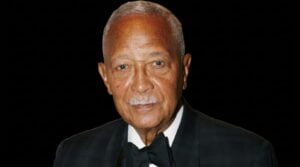
Feature Photo: stocklight / Shutterstock.com
Most New York citizens have heard the name Mayor David Dinkins. Some people may remember him as New York City’s first African American mayor. Others may work in or walk by the municipal building in Manhattan that bears his name. Mayor David Dinkins had one of the shortest terms as New York mayor, but it was also one of the most memorable. David was born on July 10, 1927, in Trenton, New Jersey, to William Harvey Dinkins Jr. and Sarah Lucy Dinkins. His father worked as a real estate agent and a barber, and his mother was a domestic servant for several years. Dinkins’ parents separated when he was six years old. William raised his son in Harlem for a time before heading back to Trenton. David graduated from Trenton Central High School in 1945.
Dinkins tried to join the U.S. Marine Corps after graduating from high school. However, he was informed that the office in question had already met its racial quota. David was disappointed but not discouraged. He later found another recruiting office that accepted him. Dinkins wasn’t active in World War II because the conflict had already concluded by the time he finished boot camp. David served in the Marines from July 1945 through August 1946. He was eventually promoted to the rank of private first class. Dinkins was also awarded the Congressional Medal of Honor by the U.S. House of Representatives and Senate.
David attended college at Howard University in Washington, D.C. He graduated with a bachelor’s degree in mathematics in 1950. He would go on to attend Brooklyn Law School and receive his Bachelor of Laws degree in 1956. Dinkins had his own private law office from 1956 to 1975. David Dinkins joined the Carver Democratic Club while he was practicing law. He, Charles Rangel, Basil Paterson, and Percy Sutton would later be recognized as the “Harlem Clubhouse” or the “Gang of Four,” because they were members of the same political group in Harlem that would eventually be named to prominent political positions in New York City.
Mayor David Dinkins’ first political duties were serving as a member of the state assembly representing New York’s 78th district in 1966. David was president of the New York City Board of Elections in 1972 and 1973. Mayor Abraham D. Beame nominated Dinkins as deputy mayor, but unfortunately he was never appointed to that position. He would instead become the city clerk and held that office from 1975 to 1985. Mayor David Dinkins won the election for borough president of Manhattan in 1985, after two prior unsuccessful attempts. Four years later, Dinkins was elected mayor of New York City. He defeated the Republican nominee, Rudolph Giuliani, and the incumbent Mayor, Ed Koch.
Mayor David Dinkins took office shortly after a corruption scandal in the Democratic Party. The New York City Board of Estimate was the root of the problem due to its many patronage appointments. Several of the patronage appointees were linked to the organized crime network headed by Amadeo Henry “Meade” Esposito. The Board of Estimate was found unconstitutional by the U.S. Supreme Court under the Equal Protection Clause of the 14th Amendment in March 1989. The board was eventually eliminated by the newly-formed New York City Charter Revision Commission. A referendum in November of that year reassigned most of the board’s duties to the New York City Council. One of the primary reasons David won the election was that these events largely changed how much of the voting public thought about the patronage positions he had previously held.
Mayor David Dinkins admired the diversity of New York City. He frequently referred to it as a “gorgeous mosaic.” Dinkins worked on racial healing and reducing the city’s crime rate. Homicides had reached a peak of 2,245 cases in 1990. However, the rates for all violent crimes decreased significantly after David’s first year in office. They would continue to drop after he left office.
Mayor David Dinkins was able to add a tax that allowed for the hiring of several thousand new police officers in New York City. He was also able to devote a portion of anti-crime dollars toward programs that kept local schools open later in the evening hours and kept many at-risk youth off of the streets at night.
Mayor David Dinkins negotiated an agreement with the city’s sanitation workers and signed a fee arrangement and a 99-year lease with the United States Tennis Association’s National Tennis Center to increase the city’s annual revenue. Dinkins worked out arrangements with the Disney Corporation to renovate Times Square. He also created the popular Broadway on Broadway, Fashion Week, and Restaurant Week. All of these arrangements were designed to attract more visitors and revitalize the city’s economy.
Not everything went well during David’s mayoral term. He had to deal with lower tax revenue because of a declining economy. This led to stricter budgeting at times. The Crown Heights riots occurred in 1991 while Dinkins was in office. Racial unrest ensued when Lemrick Nelson Jr., an African American man, stabbed Hasidic student Yankel Rosenbaum during the riots. Nelson was acquitted of Rosenbaum’s murder in October 1992. (He would be convicted of violating Rosenbaum’s civil rights in a federal court trial five years later.) David also had to navigate additional racial tensions during the Flatbush boycott (also known as the Family Red Apple boycott or the Church Avenue boycott), when Korean-owned stores were targeted in the early 1990s.
Mayor David Dinkins lost his bid for re-election in 1993. The race was a rematch pitting him against his former opponent, Rudolph Giuliani. This time, Giuliani came out on top. Giuliani’s followers in Staten Island and David’s assumed lack of caring for the Jewish community during the Crown Heights riots were key contributing factors in the election’s outcome.
After leaving the mayor’s office, Mayor David Dinkins was employed by Columbia University. He was a professor of professional practice at the school’s International and Public Affairs department in New York City. He also served on the boards of directors of the Nelson Mandela Children’s Fund, the Association to Benefit Children, the Children’s Health Fund, and the New York City Global Partners.
Mayor David Dinkins had a radio program called Dialogue with Dinkins on contemporary gospel radio station WLIB in New York City. The program ran from 1994 to 2014. He also wrote his memoirs, A Mayor’s Life: Governing New York’s Gorgeous Mosaic, with author Peter Knobler in 2013. David never ran for political office again, but he did support several Democratic candidates in various local and national campaigns.
Mayor David Dinkins married Joyce Burrows in 1953. Together they raised their children David Jr. and Donna. Joyce worked at the New York State Department of Taxation and Finance. She retired from that position when her husband took office as mayor in January 1990. Joyce passed away on October 11, 2020, at age 89. David died on November 23rd of that year from unknown causes at 93 years of age.
Mayor David Dinkins was a music lover and enjoyed supporting the arts. He served on the board of directors of the Jazz Foundation of America and was listed on its Honorary Founders Board in 2013. David was happy to work with that group in assisting elderly blues and jazz musicians. Mayor David Dinkins was also a strong believer in education. He sat on the board for the Posse Foundation, a group that provides college scholarships, after his political career ended. Dinkins wanted to ensure that every interested youth in his city had access to college or vocational/trade schools if they wanted to attend.
Mayor David Dinkins accomplished a lot during his brief time as mayor of New York City. He faced rising crime, a shrinking economy, and racial unrest while in office. He worked diligently to resolve those and other pressing issues. Many people remember him for his efforts in expanding the city’s police force. Others view him as an inspiration for aspiring African American politicians. Whatever you may think of him, the impact that David Dinkins made on the city he revered is undeniable. He set in stone policies and standards that have helped New York City for generations.
Updated July 2, 2026.
If you enjoyed learning about David Dinkins, continue exploring the history of New York City’s mayors with our features on Fiorello La Guardia, Robert F. Wagner Jr., John Lindsay, Abraham D. Beame, Ed Koch, and Michael Bloomberg. As New York City’s first African American mayor, David Dinkins brought a message of unity that he described as the city’s “gorgeous mosaic.” His administration tackled difficult issues ranging from public safety to racial tensions, making his years in office an important chapter in the continuing story of New York City’s leadership.