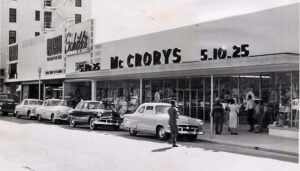
Photo: Florida Keys–Public Libraries / Wikimedia Commons, CC BY 2.0. Cropped from original.
If I remember one store I went to almost every time I visited Smith Haven Mall in the 1970s, it was McCrory’s. Long before food courts, the reason I went there was simple. I went for one of their fantastic-tasting pretzels. And even their hot dogs were pretty good. They had a little snack bar near the entrance. Another thing I remember about McCrory’s at Smith Haven Mall was that you could enter through one of the mall’s long corridors and come out into another. It was a huge store. And I always found a lot of fun stuff in there, too.
For much of the twentieth century, the five-and-dime store was the beating heart of downtown American commerce. Long before sprawling big-box retailers dominated the suburban landscape, local residents relied on variety stores like McCrory’s for their everyday needs. These well-stocked retail environments let shoppers buy sewing notions, inexpensive toys, basic housewares, and popular seasonal candy, all under one familiar roof. Many locations also had lunch counters where customers could sit down for coffee, sandwiches, hot dogs, and other inexpensive food. McCrory’s was more than just a retail business. It was a familiar part of everyday life for generations of American families.
Whatever happened to McCrory’s? The once-mighty variety-store chain ultimately closed in 2002 after decades of acquisitions, mounting financial difficulties, and increasingly intense competition from larger discount retailers. No single event caused its disappearance. The company had endured financial troubles before, including a bankruptcy during the Great Depression, but corporate debt and fundamental changes in American shopping habits eventually proved too much to overcome.
The Golden Age of the McCrory Five-and-Dime Store
McCrory’s history began in 1882, when John Graham McCrorey opened his first five-and-dime store in Scottdale, Pennsylvania. McCrorey, later known as John Graham McCrory, recognized the appeal of selling everyday merchandise at prices working families could afford. The five-and-ten-cent business model relied on inexpensive goods, substantial sales volume, and store locations that attracted regular pedestrian traffic.
McCrory’s developed during the same period that F.W. Woolworth was building his own retail empire. The two men were competitors, not business partners. One of McCrory’s important early business relationships was actually with Sebastian S. Kresge, who later founded the chain that carried his name. In 1897, McCrory and Kresge opened stores together in Memphis, Tennessee, and Detroit, Michigan. Their partnership ended in 1899, when Kresge took control of the Detroit operation and began building his own business.
McCrory’s continued expanding across the eastern and southern United States. By the late 1920s, the chain had become one of the country’s largest five-and-dime retailers. Its stores offered inexpensive clothing, candy, toys, household necessities, and other merchandise that shoppers could purchase without spending much money.
The stores also served an important social purpose. A customer might stop in for something small and end up spending much longer browsing the aisles or meeting friends at the lunch counter. In many communities, McCrory’s occupied a central location in the downtown shopping district, bringing regular foot traffic to neighboring businesses.
McCrory’s First Bankruptcy During the Great Depression
Although McCrory’s survived to become a major twentieth-century retailer, its early history included serious financial trouble. In January 1933, during the Great Depression, McCrory Stores Corporation entered bankruptcy. A federal court record from 1935 confirms that the business had been operating under a bankruptcy trustee and was attempting to reorganize its affairs.
This was an important turning point. The financial collapse of the original corporation demonstrated that even a successful discount-retailing formula could become vulnerable when economic conditions changed. The company eventually reorganized and continued operating, rebuilding its position in the variety-store industry during the following decades.
By the postwar period, five-and-dime stores were familiar fixtures in American cities and towns. McCrory’s benefited from the demand for inexpensive merchandise and continued expanding its retail network. But the same decades that brought renewed prosperity also introduced a new challenge: Americans were increasingly leaving downtown shopping districts for suburban neighborhoods and shopping centers.
McCrory’s Expands into Shopping Malls and Suburban Communities
As shopping habits changed during the 1950s, 1960s, and 1970s, McCrory’s adapted by operating in suburban shopping centers as well as traditional downtown locations. These newer stores introduced the five-and-dime experience to shoppers who were more accustomed to driving to enclosed malls than walking along downtown shopping streets.
The McCrory’s at Smith Haven Mall on Long Island was one of those stores. My own memories of the location revolve around the snack bar, the pretzels, and the ability to walk through the store from one mall corridor to another. That arrangement made McCrory’s a convenient place to visit even when I wasn’t necessarily planning to buy anything.
These mall locations also reflected something important about the chain. McCrory’s was not simply an old-fashioned downtown retailer that refused to follow customers into the suburbs. It did make the transition into shopping centers. The difficulty was that the company eventually faced competitors with much larger stores, broader merchandise selections, and financial resources that the traditional variety-store business struggled to match.
Meshulam Riklis and the McCrory Corporation
The corporate history of McCrory’s changed considerably after financier Meshulam Riklis became involved with the business in 1960. Through his financial interests and the Rapid-American Corporation, Riklis became a central figure in the company’s development. Instead of operating only as a traditional chain of five-and-dime stores, McCrory became part of a much larger collection of retail businesses and corporate holdings.
Riklis was known for using complicated financial arrangements, acquisitions, and corporate restructuring to expand his business interests. McCrory’s became increasingly connected to these activities, particularly as the company purchased other established variety-store chains.
The strategy greatly increased the number of stores under the McCrory corporate umbrella. However, the acquisitions also created financial obligations and management challenges. Some of the businesses acquired were already experiencing difficulties, and combining them into one large organization did not necessarily make them more competitive.
Corporate borrowing became particularly important during the 1980s. Contemporary financial reporting described McCrory’s as carrying substantial debt while attempting to maintain and expand an aging retail network. The company needed money for modernization, inventory, and store improvements at the same time that its financial structure placed increasing demands on available cash.
McCrory’s Purchases J.J. Newberry, S.H. Kress, and TG&Y
McCrory’s expansion included several prominent names from American retail history. In 1972, the company purchased J.J. Newberry, another established five-and-dime chain. Newberry continued operating under its own familiar name, giving McCrory a much larger network of stores across the country.
In 1981, McCrory acquired S.H. Kress, a longtime competitor known for its downtown variety stores and distinctive commercial buildings. Like McCrory’s and Woolworth’s, Kress had built its reputation around affordable merchandise and convenient shopping locations.
One of the most difficult acquisitions involved TG&Y, a discount-retailing chain with a substantial presence in the southern and western United States. McCrory acquired TG&Y in the mid-1980s, but the two businesses did not fit together as smoothly as management had hoped.
Many TG&Y stores were significantly larger than traditional McCrory locations. Their merchandise mix and operating requirements were different, and some locations were already struggling against larger discount competitors. In March 1986, McCrory announced plans to sell or convert hundreds of TG&Y stores, illustrating how quickly the acquisition had become a problem.
The corporation continued acquiring other chains, including remaining Kresge and Jupiter stores and, in 1989, G.C. Murphy. By the end of the decade, McCrory had operated a retail organization that reached approximately 1,300 stores at its peak. On paper, it represented an enormous retail empire. But operating so many different stores and formats was becoming increasingly difficult.
How Walmart, Kmart, and Target Changed the Retail Business
While McCrory’s struggled with its growing financial obligations, the American retail industry was undergoing a major transformation. During the 1970s and 1980s, discount retailers such as Walmart, Kmart, and Target expanded their operations and competed aggressively for customers who had traditionally relied on department stores and variety stores.
These larger retailers offered broad merchandise selections, extensive parking, and increasingly sophisticated purchasing and distribution systems. Their size allowed them to negotiate favorable terms with suppliers and move large quantities of merchandise efficiently.
Specialty retailers created another challenge. Stores such as Toys “R” Us focused on particular merchandise categories and offered far more choices than most five-and-dime stores could provide. Discount drugstores, supermarkets, and other retailers were also selling products that had once been important parts of the McCrory business.
McCrory’s therefore faced competition from several directions. Larger discount chains could compete on price and selection, while specialty stores could offer greater depth within individual product categories. The company was still operating stores designed around an older retail model, even as the economics of that business were changing.
Not every McCrory location was an outdated downtown store. Some were in suburban malls and shopping centers, including the Smith Haven Mall location I remember. However, the corporation as a whole faced the expensive task of maintaining a large collection of stores with different sizes, layouts, and merchandise requirements.
Why McCrory’s Filed for Bankruptcy in 1992
By the beginning of the 1990s, McCrory’s financial position had become increasingly precarious. Sales were weakening, debt payments were difficult to meet, and management began closing unprofitable locations. In December 1991, reports indicated that the company planned to close 229 stores as part of a major restructuring effort.
On February 26, 1992, McCrory Corporation filed for Chapter 11 bankruptcy protection. At the time, the company had approximately 819 remaining retail locations. Contemporary reporting identified several causes of the crisis, including declining sales, substantial debt, and competition from discount and specialty retailers.
The bankruptcy did not immediately end the business. Under Chapter 11 protection, McCrory continued operating while attempting to reorganize its finances and close stores that were losing money. The company spent several years trying to develop a smaller, more sustainable retail operation.
In January 1997, McCrory announced another major round of closings affecting approximately 300 stores nationwide. The company emerged from its lengthy bankruptcy proceedings that year under a reorganized ownership structure connected to Riklis. However, emerging from bankruptcy was not the same as restoring the business to profitability.
McCrory’s Second Bankruptcy and Final Store Closings
The company’s problems continued after the 1997 reorganization. By September 2001, McCrory was again unable to meet its financial obligations and filed for Chapter 11 bankruptcy protection for a second time in less than ten years.
According to contemporary Associated Press reporting, the company was operating approximately 200 stores when it entered bankruptcy in 2001. These locations carried several familiar retail names, including McCrory, Dollar Zone, G.C. Murphy, J.J. Newberry, and TG&Y.
Attempts to preserve the remaining business were unsuccessful. In late November 2001, McCrory announced that it would liquidate its remaining stores. The decision affected approximately 1,700 employees and brought an end to a retail enterprise that had begun almost 120 years earlier.
The final closings continued into 2002. An Associated Press report dated March 19, 2002, confirmed that approximately half a dozen locations were still operating in Pennsylvania, Maryland, and Virginia, with their closings expected within the following two weeks. The last remnants of the McCrory retail empire disappeared that spring.
The chain had outlasted many competitors, including the original Woolworth variety stores, but it could not survive the financial pressures and retail transformation that had reshaped the industry.
Why People Still Remember McCrory’s
For people who grew up shopping at McCrory’s, the memories are often about things that had very little to do with the company’s financial history. They remember the candy counters, inexpensive toys, holiday decorations, and lunch counters. They remember walking through the store with their parents or stopping in after school. And they remember being able to find all sorts of inexpensive merchandise in one place.
My memories will always go back to the McCrory’s at Smith Haven Mall in the 1970s. I can still remember going there for those pretzels and looking around the store to see what else I could find. At the time, I wasn’t thinking about the history of American retailing or the future of five-and-dime stores. It was simply a place I enjoyed visiting.
That’s probably why stores like McCrory’s remain so memorable decades after their disappearance. They were part of our everyday lives. We didn’t necessarily think of them as special while they were still around. But once they were gone, we realized how much we remembered about them.
For more stories about the stores New Yorkers grew up with, read our histories of Woolworth’s, Times Square Stores (TSS), and Caldor Discount Stores.