 Featured photo: Tyler A. McNeil / Wikimedia Commons, licensed under CC BY-SA 4.0.
For generations of Upstate New Yorkers, a bowling alley was far more than a place to knock down ten pins. On winter evenings, workers from factories and offices met their league teammates after a shift. Parents brought children to Saturday morning programs. Teenagers gathered for birthday parties, and serious bowlers practiced on the same lanes where neighbors played a casual game. Many towns had several bowling centers, each with its own regulars, food counter, and Friday-night crowd.
The decline of those establishments did not happen all at once. Rochester’s bowling centers lost some of the industrial league business that had helped support them. In Albany and its suburbs, valuable real estate and aging buildings complicated the finances of independent operators. Other venues were damaged by fire, converted to new uses, or left empty after their owners retired. The names can still bring back vivid memories even when the buildings have disappeared.
The twenty places in this article were not all demolished, and in some cases a building still stands even though the lanes are gone. Their stories reflect different kinds of loss: a neighborhood business closing, a change of use, a property redevelopment, or a disaster. Where a closure has been described as indefinite, the possibility of a future reopening remains distinct from the loss already experienced by local bowlers.
1. Playdium Bowling Center — Albany, Albany County
For almost eight decades, the Playdium was part of the everyday life of Albany’s Pine Hills neighborhood. It opened in 1940 at 363 Ontario Street, offering league bowling, open play, and the familiar rituals of a neighborhood recreation center. Neil Luther purchased the business in 1983. By the time he considered retirement, the Playdium had outlasted other bowling centers within Albany’s city limits.
The alley closed in April 2018. Longtime customers returned that month for an auction of everything from bowling equipment to fixtures, a striking final gathering in a building associated with birthdays, school teams, and weekly leagues. A redevelopment proposal called for apartments and commercial space on the site. The closing mattered beyond the loss of one business: at the time, the Playdium was Albany’s last operating public bowling alley.
2. Voelker’s Bowling Center — Buffalo, Erie County
At the corner of Amherst Street and Elmwood Avenue, Voelker’s grew out of a family business rooted in Buffalo’s nineteenth-century history. The Voelker family operated a saloon at the site beginning in the 1890s; bowling was added in 1941. Over time, the business became known for its lanes, leagues, and its place in North Buffalo neighborhood life. The history of the building was older than the bowling operation itself, a distinction often lost in nostalgic accounts.
Voelker’s closed in 2021, and efforts to preserve the aging property became the subject of public debate. Demolition started in March 2025. A development proposal announced in 2026 included the possibility of a smaller bowling operation in a new mixed-use building, but that proposal does not mean the old Voelker’s has returned. Its long-established lanes, neighborhood setting, and historic structure are gone.
3. Solvay Recreation Alleys — Solvay, Onondaga County
Solvay Recreation Alleys at 1737 Milton Avenue was one of Central New York’s remarkable small bowling centers. The business dates to the late 1920s and remained closely associated with the Zollo family after John Zollo’s grandfather acquired it in 1940. It began with six lanes and expanded to fourteen in the 1950s. Its modest scale made it different from the enormous automated centers that appeared during bowling’s postwar boom.
The alley stopped admitting the public while proprietor John Zollo was ill, and he died in May 2025. Family members subsequently discussed the uncertainty of reopening and offered equipment for sale. State labor reporting in 2026 continued to describe the business as closed indefinitely. No definitive announcement ruled out reopening, although the bowling center remained closed. Its absence has nevertheless been deeply felt by generations of Solvay bowlers.
4. State Bowling Center — Binghamton, Broome County
The State Bowling Center once operated on Binghamton’s North Side at 530 State Street. For decades, it gave neighborhood residents a place for organized league play and recreation. By the early 2020s, however, the bowling operation had been gone for roughly twenty years, and the former recreational property stood at the center of an entirely different set of community plans.
A proposed Salvation Army facility on the property did not materialize. Broome County later acquired the land as part of a veterans-housing initiative, with plans for a series of small homes and support services. Reporting in 2024 documented construction at the former alley site. That transformation makes the old State Bowling Center a particularly clear example of how a place once identified with recreation can become associated with an entirely new public purpose.
5. Bowl-O-Drome — Ithaca, Tompkins County
Ithaca’s Bowl-O-Drome occupied 401 Third Street, away from the city’s more heavily traveled downtown blocks. It was the sort of practical recreation center where families, students, and league bowlers could share the lanes. The old bowling business is now gone, but its property remained part of local discussions about the city’s future well after the last bowling games were played.
In April 2025, Ithaca’s Common Council approved purchasing the former Bowl-O-Drome site for approximately $1.37 million as a possible location for a new police headquarters or broader public-safety facility. In August 2026, city officials were considering whether alternatives involving the existing police and court buildings might save money. The purchase did not establish that a new station had been built. It established that the former bowling alley had become an important piece of municipal real estate.
6. Bowlers Club — Latham, Albany County
The Bowlers Club stood at 1210 Troy-Schenectady Road in Latham, a busy corridor of suburban shopping and recreation. It was associated for a time with local bowling businessman Bob Daubney, who owned the center in the early 1980s and spent decades in the bowling-equipment trade. The Bowlers Club’s leagues and regular customers were part of a Capital Region scene in which competitive bowling once supported numerous independent centers.
The alley closed in May 2007 and remained vacant for years. By 2014, local planning discussions centered on converting the site to retail and office uses and removing a substantial portion of the former bowling building. Its closure came well before the losses of the Playdium and Sunset Recreation, illustrating that the disappearance of neighborhood bowling was a long process rather than a sudden consequence of the pandemic.
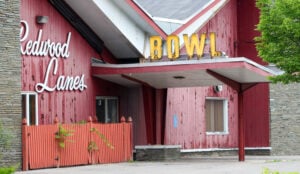
7. Redwood Lanes — Colonie, Albany County
Redwood Lanes on Central Avenue has a special place in professional bowling history. In 1962 it hosted the first live Professional Bowlers Association tour telecast carried by ABC, an event that connected a Capital Region bowling center with a nationwide television audience. While league players knew Redwood as a local place to compete, its television history gave it a significance well beyond Colonie.
The business faced serious financial trouble by 2012. Its owner filed for Chapter 7 bankruptcy that July, citing liabilities that exceeded reported assets. Later reporting identified Redwood as having closed in 2012. The financial crisis and the end of the alley became linked in the story of another lost Capital Region bowling center. Its broadcasting distinction remains an important piece of regional sports history.
8. Clover Lanes — Brighton, Monroe County
Built in 1957 on Monroe Avenue in Brighton, Clover Lanes belonged to the generation of large bowling centers that transformed recreation in the Rochester area. Historical accounts describe a fifty-lane operation that served serious league bowlers alongside families and groups of friends. Its size reflected the enormous midcentury demand for bowling, when industrial and neighborhood leagues could fill banks of lanes night after night.
Clover Lanes closed in March 2016, but the building was not demolished that year. Demolition began in May 2019 as part of a redevelopment associated with the Whole Foods project on Monroe Avenue. The three-year gap between closure and demolition gave the vacant property a different place in local memory. For people who bowled there, the loss was not just a change in the shopping landscape; it was the disappearance of a large and familiar social space.
9. Olympic Bowl — Chili, Monroe County
Olympic Bowl, also known as Olympic Lanes or AMF Olympic Bowl, stood on Scottsville Road in Chili in the Rochester area. Opened in the 1950s, the center eventually became famous for its eighty lanes and its place in professional competition. The Professional Bowlers Association visited Olympic repeatedly, and area bowlers remembered both its big tournaments and the ordinary youth leagues and weekend outings that filled the building between major events.
The center closed in July 2008 after its corporate operator judged the business no longer financially sustainable. Its loss was particularly striking in a region where employees of companies such as Kodak, Xerox, and Rochester Products had once helped support a large league-bowling culture. This was not Olympic Lanes in Menands near Albany; the two were separate establishments in different parts of Upstate New York.
10. Sunset Recreation — Colonie, Albany County
Sunset Recreation, widely called Sunset Lanes, opened on July 8, 1940, at 1160 Central Avenue in Colonie. The Hoffman family operated it across generations, and by the 2010s George Hoffman was looking toward retirement. The thirty-two-lane center had a loyal league population, but its long-term finances depended on maintaining a level of organized participation that had become increasingly difficult for older independent alleys.
Plans to sell the property circulated for several years, and one proposed new use involved an Asian supermarket. The business continued longer than some expected before finally closing in 2017. Later photographs and accounts documented the vacant, deteriorating bowling interior. Although sometimes associated with nearby Albany, Sunset stood in the town of Colonie. A separate Sunset Lanes still operates in Western New York.
11. Rossi Lanes — Elmira, Chemung County
Rossi Lanes started in 1936 when Tony Rossi established bowling lanes behind his bakery on West Washington Avenue in Elmira. The idea initially troubled some neighbors who worried about noise, according to accounts preserved by the Chemung County Historical Society and later local reporting. Over the following decades, the business became a familiar recreation site for Elmira bowlers and local leagues.
The lanes closed during the COVID-19 pandemic in 2020 and never resumed bowling operations. The building changed hands through tax-foreclosure and auction proceedings, and reports in 2024 described equipment still present inside in various states of disrepair. Prospective redevelopment was discussed, but the property was not returning as a bowling alley. For a business that began in 1936, its final years involved not only the loss of bowling but also difficult decisions about the future of the property.
12. Alpha Lanes — Troy, Rensselaer County
Alpha Lanes opened in 1937 as Alpha Recreation Bowling Lanes on Fifth Avenue in the Lansingburgh section of Troy. The eighteen-lane center hosted school teams, local leagues, and tournaments, including events associated with the Scaccia family. At the time of its destruction, it was still active, and Lansingburgh High School’s successful bowling program had made use of the building.
On May 8, 2019, a devastating fire destroyed the eighty-two-year-old bowling center. Firefighters worked to protect nearby buildings while the flames brought down the alley’s familiar bowling-pin sign. Subsequent investigations could not conclusively establish the cause of the blaze. This was not a business gradually fading into vacancy; it was an active neighborhood institution abruptly lost in a disaster. The remains required demolition, ending the physical history of Alpha Lanes.
13. Rolling Greens — Scotia, Schenectady County
Rolling Greens at 217 Mohawk Avenue in Scotia was a twenty-lane bowling center closely associated with Frances N. Lawyer. She operated an earlier Rolling Greens in Rotterdam from the late 1970s until 1999, then owned the Scotia establishment from 2000 to 2017. The two locations served different communities and represent separate chapters in the same family’s involvement with bowling.
The Scotia center closed in 2017, during a wave of losses among Capital Region bowling venues. There was later an attempt to reopen the property as Tartan Lanes, but reporting at the end of 2019 said that effort had failed. This makes Rolling Greens a particularly instructive entry: even when a closed bowling property attracted interest from new operators, bringing back league play and a viable business was far from guaranteed.
14. Olympic Lanes — Menands, Albany County
Olympic Lanes in Menands was another large Capital Region center, with fifty lanes in a building erected in 1959. It had previously been known as Tri-City Lanes before John Oureilidis and George Vafiadis bought it in 1993. Located near Route 378 at 5 Elmwood Road, it became a recognizable destination for leagues and larger bowling events in the Albany area.
By late 2017, its owners were discussing closure as redevelopment plans emerged for the property. Early proposals involved apartment buildings, but those plans did not proceed as first reported. In 2025, the direct-mail company The Mailworks sought approval to turn the vacant former bowling center into a production facility; the proposed purchase fell through that November. The building’s future remained unsettled after the Mailworks deal fell apart. Olympic Lanes in Menands was also a different business from the long-gone Olympic Bowl near Rochester.
15. Bowling Green Lanes — North Syracuse, Onondaga County
Bowling Green Lanes once operated at 445 South Main Street in North Syracuse. It was a familiar local bowling address, with a bar and food service as well as the lanes. Records show that portions of the business remained active during the pandemic period, although bowling itself was disrupted. By 2023 the property was being marketed and sold as a former bowling alley rather than an operating recreation center.
Plans initially called for a plasma-donation center to occupy the remodeled building. Renovations proceeded, but the expected tenant did not open as originally anticipated. In September 2026, local television reporting documented another sale and efforts to attract a medical tenant. The building’s changing plans help explain the distinction between a lost business and a demolished building: the structure survived, but its bowling identity did not.
16. Falcon Lanes — Auburn, Cayuga County
Falcon Lanes on Pulaski Street was one of Auburn’s well-known bowling centers, associated with open play, leagues, and community gatherings. Its modern operation also had a connection to professional bowler Michelle Feldman, whose achievements were highlighted in the center’s own promotional materials. The alley was more than a recreational option: it helped maintain an organized bowling community in a city that had once supported multiple centers.
The business closed in early January 2024 after problems with its heating system. Subsequent building-code issues made reopening difficult, and in February the operator announced that Falcon Lanes would not return because the necessary work was unaffordable. Unlike closures attributed loosely to changing tastes, this was a specific documented combination of facility problems and financial constraints. By early 2026, local coverage noted that Auburn itself had no remaining bowling alley.
17. AMF Pin-O-Rama Lanes — Utica, Oneida County
AMF Pin-O-Rama on Genesee Street was a substantial bowling center for the Utica area, offering league programs, youth bowling, open play, and the familiar mix of a snack bar and arcade entertainment. Many local families associated the building with school outings and weekend recreation. Records from Utica Academy of Science even document a student bowling trip to Pin-O-Rama in January 2023.
Reports surfaced in early 2023 that the bowling center might lose its lease as the property was offered for sale. Local news could not initially confirm an exact closing date or the rumored replacement use, so neither should be stated as fact. Later business listings identify Pin-O-Rama as permanently closed. Reports about a possible car wash should not be mistaken for evidence that such a replacement was completed.
18. Maiden Lanes — Greece, Monroe County
Maiden Lanes belonged to the wave of modern bowling centers that expanded through the Rochester suburbs after World War II. A history published by the Greece Historical Society places its opening in 1960, after other new bowling operations had already demonstrated the appeal of automated pinsetting and larger suburban buildings. It served the Town of Greece during a period when bowling was a regular social activity for families and organized leagues.
The center closed in 2005, according to a retrospective by former Democrat and Chronicle reporter Alan Morrell. Its disappearance was one piece of a broader local contraction: the Rochester Bowling Association counted seventy-six Monroe County centers in 1956, compared with far fewer by the early twenty-first century. Maiden Lanes offers a distinct suburban example of that decline, rather than simply another story about an old downtown neighborhood alley.
19. North Park Lanes — Irondequoit, Monroe County
North Park Lanes was one of the former bowling halls remembered by residents of Irondequoit and the wider Rochester area. It had the kind of neighborhood clientele that supported youth bowling, amateur competition, and regular league schedules through the sport’s midcentury popularity. The Rochester area’s abundance of these centers once reflected the reach of bowling into both city neighborhoods and surrounding towns.
North Park closed in 1995, a year in which several other Rochester-area centers also disappeared. The site was later occupied by an auto-parts business, according to the Democrat and Chronicle‘s retrospective on lost bowling halls. For former customers, the lasting details are its Irondequoit location, the 1995 closing, and the replacement of its bowling use by ordinary retail.
20. Brighton Bowl — Rochester, Monroe County
Brighton Bowl opened on East Avenue in 1955 and was described as a showplace for the rapidly expanding bowling industry. With thirty-two lanes and an underground ball-return system, it represented the newer generation of bowling centers that made the sport easier to operate at a large scale. Its position near the Winton Road area placed it within reach of Rochester-area workers, families, and league players.
The establishment even appears in a 1977 New York appellate court decision concerning parking rights at its East Avenue property, an unusually concrete piece of evidence about the practical demands of running a busy bowling business. Brighton Bowl closed in 1995, alongside other Rochester-area venues. A gym later occupied the location. Its history shows both the optimism of the 1950s bowling boom and the changing economics that affected those large facilities decades later.
Why So Many Upstate Bowling Alleys Disappeared
The histories of these twenty establishments do not fit a single explanation. Some centers closed when their buildings became more valuable for housing or retail. Others depended on aging owners or faced expensive repairs. Alpha Lanes was destroyed by fire. In Rochester, the decline of industrial bowling leagues was particularly significant: factories and large employers had once provided a steady stream of teams, and shrinking participation weakened an important part of the business model.
It would also be misleading to say that bowling itself disappeared from Upstate New York. Modern centers still operate, sometimes with restaurants, games, music, and other attractions intended to draw people who may not join a traditional weekly league. What has become harder to find is the old neighborhood alley whose identity was bound up with a particular block, family, and set of regular customers.
That is why the loss of the Playdium, Voelker’s, Olympic Bowl, Solvay Recreation Alleys, and the other places in this list resonates beyond the number of lanes they contained. Each was part of a town’s shared routine. Their names bring back the sounds of pinsetters, conversations at the counter, and the satisfaction of seeing familiar faces on the next pair of lanes.
The disappearance of neighborhood bowling alleys is part of a much larger story about the New York places that generations grew up visiting. Readers interested in that history can explore our articles on 10 Lost NYC Sports Arenas and What Replaced Them, 10 Famous Lost New York Racetracks and What Replaced Them, and 25 Lost Restaurants Upstate New Yorkers Wish Were Still Open. Each recalls places that were once part of everyday life for New Yorkers and the memories that remain after those establishments have disappeared.