Featured Photo: Associated Press, Public domain, via Wikimedia Commons
My Uncle Harry and my father used to take me to Yankee games in the Bronx, and to see the New York Football Giants when they played their home games at Yankee Stadium too. I was just a boy then, and some of my clearest memories are of sitting in those stands listening to the two of them talk about the ballparks they had loved before I was ever born.
The Polo Grounds and Ebbets Field came up again and again in those conversations. What struck me, even as a kid, was that they were never really mourning the buildings. They missed the teams that had once filled them, and they missed the version of the city to which those places belonged.
I took all of this in from behind a steel support pole at the old Yankee Stadium because that was the seat we had, and back then an obstructed view was simply the price of admission. You sat where you sat, and you counted yourself lucky to be there at all.
More than fifty years later, I catch myself doing the very thing my father and my uncle once did. I find myself reminiscing about that old ballpark, about those poles, about sitting beside my dad and working through one too many hot dogs because the excitement of the day had gotten the better of me.
I can still picture players like Bobby Murcer out on that grass. Those afternoons are gone now, and they are not coming back.
These days, I bring my own sons to the new Yankee Stadium, and I feel the pull of both directions at once. I miss the old ballparks and the old rituals, but I also understand that a city cannot stand still, and that the newer stadiums were built to be safer and more comfortable than anything my father knew.
What softens the loss, at least in the Bronx, is what took the old Stadium’s place. Rather than another apartment tower, the site became Heritage Field, where local children play ball on the same ground where Babe Ruth, Lou Gehrig, and Joe DiMaggio once stood. There is something right about that, children running across the footprint once occupied by the immortals. Most of the other lost arenas were not so fortunate, and today they survive only as housing complexes, office towers, parking lots, and the occasional bronze plaque.
So, if you have ever wondered what became of these vanished cathedrals of New York sports, or if you are young enough that a few of these names are new to you, this article is for you. What follows are ten of the most famous arenas and ballparks that no longer stand, yet remain a permanent part of New York City history.
1. Ebbets Field
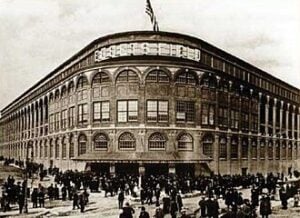
Photo: See page for author, Public domain, via Wikimedia Commons
Location: Flatbush, Brooklyn
Opened: 1913
Demolished: 1960
Primary Sports: Baseball and football
What Replaced It: Ebbets Field Apartments
For 45 National League seasons, Ebbets Field was the emotional heart of Brooklyn. Dodgers owner Charles Ebbets assembled the site from numerous parcels on land that had once included a refuse area known as Pigtown. The finished ballpark greeted arriving fans with an Italian Renaissance-style rotunda and a brass chandelier formed from baseball bats.
It became one of the most intimate ballparks the game has ever known. The right-field wall carried the famous Abe Stark “Hit Sign, Win Suit” advertisement, organist Gladys Goodding played for the crowd, and the ragtag Dodgers Sym-Phony band roamed the stands. Hilda Chester rang her cowbell so loudly that players and broadcasters knew her by name.
Ebbets Field was the home of the beloved Boys of Summer and the site where Jackie Robinson broke Major League Baseball’s modern color barrier on April 15, 1947. It was also where Brooklyn celebrated its only World Series championship, when the Dodgers defeated the Yankees in 1955 behind Johnny Podres and his Game 7 shutout.
Walter O’Malley moved the Dodgers to Los Angeles after the 1957 season, and the ballpark spent its final years without its principal tenant. Demolition began in February 1960, with a wrecking ball painted to resemble a giant baseball.
The Ebbets Field Apartments now occupy the site. A modest home plate marker remains at the complex, offering visitors one small physical connection to the place where Brooklyn baseball history was made.
2. The Polo Grounds
Bain News Service, publisher, Public domain, via Wikimedia Commons
Location: Coogan’s Bluff, Upper Manhattan
Major-League Use at the Final Site: 1890–1963
Final Structure Opened: 1911
Demolished: 1964
Primary Sports: Baseball, football, boxing, and auto racing
What Replaced It: Polo Grounds Towers
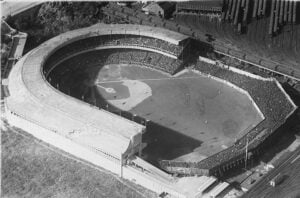
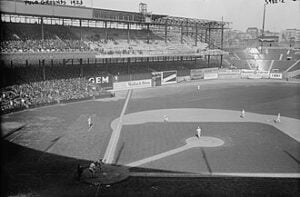
Tucked beneath the steep cliffs of Coogan’s Bluff along the Harlem River, the Polo Grounds was one of the strangest major-league ballparks ever built. Its bathtub-shaped configuration produced extremely short foul lines, approximately 279 feet in left field and 258 feet in right, while the deepest portion of center field stretched toward 483 feet.
The ballpark served as the longtime home of the New York Giants, the home of the New York Yankees from 1913 through 1922, and the first home of both the New York Mets and the New York Jets during the early 1960s. The New York Football Giants also played there for three decades.
Two of the most famous plays in baseball history happened on this field. In 1951, Bobby Thomson hit the Shot Heard ‘Round the World to win the National League pennant for the Giants. Three years later, during Game 1 of the 1954 World Series, Willie Mays turned his back to the plate and ran down Vic Wertz’s tremendous drive in deep center field, producing the play remembered simply as The Catch.
The Mets left for Shea Stadium after the 1963 season, and the Polo Grounds was demolished in 1964. The same baseball-painted wrecking ball used at Ebbets Field took part in the demolition.
The Polo Grounds Towers, a New York City public housing complex, opened on the former stadium site later in the decade. The name survives, but the oddly shaped field beneath Coogan’s Bluff exists now only in photographs, film, and memory.
3. The Original Yankee Stadium
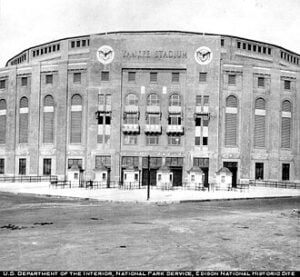
Photo: Yankee Stadium, Public domain, via Wikimedia Commons
Location: The Bronx
Opened: 1923
Final Game: 2008
Demolished: 2009–2010
Primary Sports: Baseball, football, boxing, and soccer
What Replaced It: Heritage Field at Macombs Dam Park
After years of sharing the Polo Grounds, Yankees owners Jacob Ruppert and Tillinghast L’Hommedieu Huston bought land across the Harlem River and constructed a stadium of their own. Sportswriter Fred Lieb called it the House That Ruth Built, and the description was fitting. Babe Ruth hit the first home run in the building on opening day, April 18, 1923.
Yankee Stadium was the country’s first three-tiered baseball park. It became instantly recognizable for its copper frieze, immense grandstands, deep left-center field, and the monuments that once stood within the field of play.
Across 85 seasons, the building hosted 26 Yankees World Series championships, Lou Gehrig’s Luckiest Man farewell in 1939, Don Larsen’s perfect game in the 1956 World Series, and the 1938 heavyweight rematch in which Joe Louis knocked out Max Schmeling.
The stadium belonged to more than the Yankees. The New York Football Giants played there from 1956 through 1973, including the 1958 NFL Championship Game against the Baltimore Colts. Popes celebrated Mass there, Nelson Mandela addressed a packed crowd in 1990, and some of boxing’s greatest champions fought beneath its lights.
After the new Yankee Stadium opened across East 161st Street in 2009, the original building was dismantled. Heritage Field now occupies the former stadium site, providing public baseball and softball diamonds within the rebuilt Macombs Dam Park.
Of all the replacements on this list, Heritage Field may be the most comforting. Children still play baseball where generations of Yankees once did, allowing the ground itself to remain connected to the game.
I did an episode of Revealed for News 12 in which I talk about the history of Yankee Stadium.
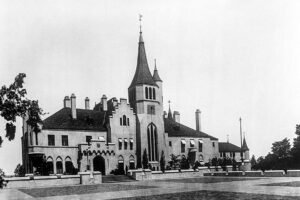
4. Madison Square Garden II
Location: Madison Avenue and East 26th Street
Opened: 1890
Demolished: 1925
Architect: Stanford White
What Replaced It: The New York Life Building
Long before Madison Square Garden moved to Eighth Avenue and then above Penn Station, its second incarnation rose beside Madison Square Park. It was arguably the grandest building ever to carry the Garden name.
Designed by Stanford White, the Moorish-inspired entertainment palace was crowned by a tower modeled after the Giralda in Seville. At its summit stood a gilded figure of the goddess Diana created by sculptor Augustus Saint-Gaudens.
The complex included the main arena, a theater, exhibition halls, restaurants, a concert garden, and a rooftop entertainment space. It hosted horse shows, political conventions, indoor track meets, bicycle races, concerts, and prizefights.
In June 1906, White was shot and killed in the rooftop theater by Harry K. Thaw, who was enraged over White’s past relationship with actress Evelyn Nesbit. The resulting criminal proceedings became one of the most sensational trials of the era.
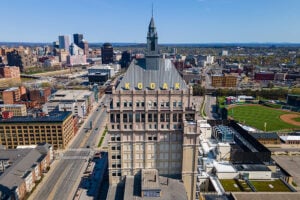
The Garden was never consistently profitable, and the New York Life Insurance Company acquired the site. The arena was demolished in 1925, and the Cass Gilbert-designed New York Life Building opened there in 1928.
Saint-Gaudens’ Diana survived. The statue now stands above the Great Stair Hall at the Philadelphia Museum of Art, one of the few major pieces of the lost Garden still visible to the public.
5. Madison Square Garden III
Location: Eighth Avenue between West 49th and 50th Streets
Opened: 1925
Demolished: 1968
Primary Sports: Boxing, basketball, hockey, wrestling, and track
What Replaced It: Worldwide Plaza
The third Madison Square Garden was built by boxing promoter Tex Rickard on Eighth Avenue between West 49th and 50th Streets. It lacked the architectural splendor of Stanford White’s Garden, but for more than four decades it stood at the center of New York sports.
Professional prizefighting became so closely associated with the building that boxers and fans simply called it the Garden. The New York Rangers began play there in 1926, and the New York Knicks followed in 1946.
Between fights and games came the circus, rodeos, six-day bicycle races, track meets, rallies, and political conventions. The building’s poor ventilation and cigar smoke produced a permanent haze that became part of its atmosphere.
By the 1960s, the arena was outdated. The fourth Madison Square Garden opened above Penn Station in February 1968, and the third Garden was demolished later that year.
The site remained underused for years before the Worldwide Plaza office and residential complex was completed during the late 1980s.
6. Washington Park
Location: Park Slope, Brooklyn
Used for Major-League Baseball: 1898–1912 and 1914–1915
Principal Structures Removed: By 1922
Primary Sport: Baseball
What Replaced It: A Consolidated Edison facility, with part of the old wall surviving
Before Ebbets Field existed, the Brooklyn franchise that became the Dodgers played at Washington Park, a ballpark complex between Third and Fourth Avenues in Park Slope. The grounds stood near the Old Stone House, the reconstructed Vechte-Cortelyou House associated with the Battle of Brooklyn.
During the years surrounding Washington Park, the Trolley Dodgers nickname became increasingly attached to Brooklyn baseball. The name referred to the dangers faced by pedestrians navigating the borough’s expanding electric streetcar system, and it was eventually shortened to Dodgers.
The National League club left Washington Park for Ebbets Field after the 1912 season. The Federal League’s Brooklyn Tip-Tops revived the grounds for the 1914 and 1915 seasons before that league collapsed.
A long concrete-and-brick wall associated with the Washington Park ballpark complex still stands along Third Avenue beside a Consolidated Edison facility. It is one of the oldest surviving physical remnants connected to professional baseball in New York City.
Washington Park is therefore not entirely gone. The field and grandstands disappeared, but the surviving wall still gives Brooklyn baseball fans something tangible to touch.
7. Hilltop Park
Location: Broadway between West 165th and 168th Streets
Opened: 1903
Final Major-League Season: 1912
Demolished: 1914
Primary Sport: Baseball
What Replaced It: NewYork-Presbyterian and Columbia University Irving Medical Center
Officially known as American League Park, Hilltop Park earned its familiar name because it stood on one of Manhattan’s highest points. From the wooden grandstand, fans could look west across the Hudson River toward the Palisades.
The ballpark was the original home of the New York Highlanders, the American League club that adopted the Yankees name after leaving Hilltop Park for the Polo Grounds in 1913.
Its greatest individual performance belonged to Hall of Fame pitcher Jack Chesbro, who won 41 games in 1904, a modern Major League record that still stands. In a cruel conclusion to that season, Chesbro’s wild pitch during the final series helped deliver the pennant to Boston.
The wooden park was demolished after the Highlanders departed, and the site eventually became part of the Columbia-Presbyterian medical complex, now NewYork-Presbyterian and Columbia University Irving Medical Center.
A home plate-shaped plaque on the medical center grounds marks the former location of Hilltop Park’s home plate, connecting modern Washington Heights with the earliest years of Yankees history.
8. Shea Stadium
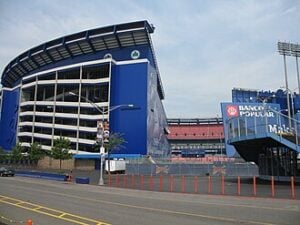
Photo by Mr. Kjetil Ree., CC BY-SA 3.0 <http://creativecommons.org/licenses/by-sa/3.0/>, via Wikimedia Commons
Location: Flushing Meadows, Queens
Opened: 1964
Final Game: 2008
Demolished: 2008–2009
Primary Sports: Baseball and football
What Replaced It: Citi Field parking areas, with bronze markers showing the former diamond
Shea Stadium opened in 1964 as the new home of the New York Mets and the New York Jets. It was named for attorney William A. Shea, whose efforts helped bring National League baseball back to New York after the Dodgers and Giants moved to California.
For Mets fans, Shea became the setting for two World Series championships and generations of unforgettable moments. The Miracle Mets celebrated their 1969 title there, the 1986 team survived one of the most dramatic World Series ever played, and Tom Seaver, Dwight Gooden, Keith Hernandez, Darryl Strawberry, Mike Piazza, and David Wright all created lasting memories within its circular concrete walls.
The Jets played at Shea from 1964 through 1983. The building also hosted major boxing and wrestling events, papal visits, and the 1965 Beatles concert that helped establish the modern stadium concert.
Citi Field opened immediately beside Shea in 2009. The old stadium was dismantled piece by piece, and its former footprint became part of Citi Field’s parking complex.
Bronze markers embedded in Parking Lot B identify the former locations of Shea Stadium’s home plate, pitcher’s mound, and bases. They offer Mets fans a quiet place to stand where some of the franchise’s greatest celebrations unfolded.
9. Celtic Park
Location: Sunnyside, Queens
Opened: 1898
Closed and Sold: 1930
Primary Sports: Track and field, soccer, hurling, and Gaelic football
What Replaced It: Celtic Park Apartments
Celtic Park was an eight-acre athletic ground developed by the Irish-American Athletic Club. The club’s athletes competed beneath a winged-fist emblem and turned the Queens facility into one of the most productive training grounds in American Olympic history.
The club’s powerful throwers became known as the Irish Whales. Along with runners and jumpers, they won numerous Olympic medals for the United States during the early years of the modern Games.
Celtic Park also hosted soccer matches, hurling, Gaelic football, and large gatherings for New York’s Irish-American community. It was both an elite athletic center and an important neighborhood institution.
The club declined during the years surrounding the Great Depression and sold the property in 1930. The Celtic Park Apartments rose on the site, preserving the old athletic ground’s name even as its track and playing fields disappeared.
10. St. Nicholas Arena
Location: 69 West 66th Street, Upper West Side
Opened: 1896
Final Boxing Event: 1962
Building Demolished: 1986
Primary Sports: Boxing, ice skating, hockey, and wrestling
What Replaced It: ABC television facilities; the former ABC campus is now being redeveloped
St. Nicholas Arena opened on November 7, 1896, at West 66th Street and Columbus Avenue. It began as an indoor ice rink using one of the earliest mechanical ice-making systems in North America and played an important role in the development of indoor skating and hockey.
Boxing arrived in 1906 and became the building’s defining attraction after prizefighting was legalized in New York under the Frawley Law in 1911. St. Nick’s developed into one of the busiest boxing clubs in the country, where generations of contenders fought before reaching the larger stages of Madison Square Garden.
By the 1950s, weekly televised boxing cards carried the arena’s name into homes throughout the country. The final main event took place on May 28, 1962.
The building remained part of ABC’s production operations before being demolished in 1986 for an expansion of the network’s Lincoln Square television campus. That larger former ABC and Disney property was itself undergoing redevelopment during the middle of the 2020s.
St. Nicholas Arena therefore experienced two New York transformations. A pioneering rink became a legendary boxing room, then a television facility, and now the broader site is changing once again.
Classic New York City Sports History Fact
Where did the Brooklyn Dodgers get their name? During the late 19th century, electric trolley lines crossed Brooklyn’s crowded streets, and pedestrians frequently had to dodge the fast-moving streetcars. Newspaper writers and rival fans began referring to Brooklyn residents and the baseball club as Trolley Dodgers. Over time, the nickname was shortened to Dodgers.
Continue exploring New York sports history on ClassicNewYorkHistory.com with our in-depth features on the Polo Grounds, Yankee Stadium, Shea Stadium, and Madison Square Garden. You can also read Brian Kachejian’s personal story, The Night I Saw Bobby Murcer Hit Three Home Runs in One Game.
10 Lost New York City Sports Arenas at a Glance
| # | Lost Arena or Stadium | Opened | Building Lost | What Occupies the Site Today |
|---|---|---|---|---|
| 1 | Ebbets Field | 1913 | 1960 | Ebbets Field Apartments |
| 2 | The Polo Grounds | 1911 final structure | 1964 | Polo Grounds Towers |
| 3 | Original Yankee Stadium | 1923 | 2010 | Heritage Field |
| 4 | Madison Square Garden II | 1890 | 1925 | New York Life Building |
| 5 | Madison Square Garden III | 1925 | 1968 | Worldwide Plaza |
| 6 | Washington Park | 1898 | 1922 | Con Edison facility and surviving wall |
| 7 | Hilltop Park | 1903 | 1914 | NewYork-Presbyterian and Columbia medical campus |
| 8 | Shea Stadium | 1964 | 2009 | Citi Field parking areas and bronze field markers |
| 9 | Celtic Park | 1898 | 1930 | Celtic Park Apartments |
| 10 | St. Nicholas Arena | 1896 | 1986 | Former ABC campus under redevelopment |