For millions of people, New York Penn Station has been much more than a railroad station. It has been the gateway to Manhattan, the center of the nation’s busiest transportation network, and, for generations of New Yorkers, the place where countless journeys began. From the grandeur of the original Pennsylvania Station to today’s bustling transit hub beneath Madison Square Garden, Penn Station has remained one of New York City’s most recognizable landmarks.
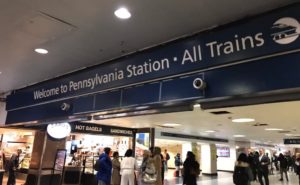
New York Penn Station. Photo: Brian Kachejian ©2019
For New Yorkers who grew up in one of the boroughs of New York City, Penn Station was the arrival point for the subway train that you would take from the Bronx, Queens, or Brooklyn into Manhattan. Funny, but for us native New Yorkers, we never said we were taking the train into Manhattan; we always said we were taking the train into the city. We took the train to Penn Station for various reasons. Many of us were kids being dragged by our moms to Macy’s on 34th Street, right across the street from Penn Station. For most of us, Penn Station was a spot where you could transfer to any other subway line to go uptown, downtown, crosstown, or wherever you needed to go. You could do it from Penn Station. That was before New York became the tourist destination it is now. Of course, New York City has always been a destination for travelers, but it was different back in the 1950s, 1960s, and 1970s.
One cannot write the history of Penn Station from a book, although we do use them to get the historical facts right. Nonetheless, if you want to learn about the history of Penn Station, you need to talk to the people who used the station every day of their lives. Those who used it to commute to work, those who transferred through it, those who ate there, worked there, and even slept there. We will get to that later in this article.
The Original Pennsylvania Station
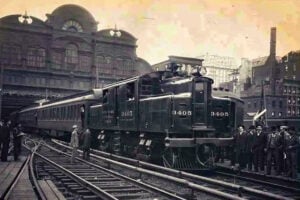
The original Pennsylvania Station opened in 1910. The reason it was called Pennsylvania Station, not New York Station, was that it was built for and by the Pennsylvania Railroad. Although it was often referred to as New York’s Pennsylvania Station, the station was built by the Pennsylvania Railroad Company to compete with New York’s Grand Central Terminal. The station was designed by the American architectural firm of McKim, Mead & White. The firm utilized the Beaux-Arts style of architecture in many of the buildings it designed in the United States during the late nineteenth and early twentieth centuries. The Beaux-Arts style mixed elements of French Neoclassicism with Gothic and Renaissance traditions.
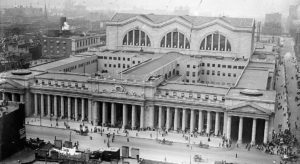
The Original Penn Station. Photo: Bain News Service, Public Domain.
The Pennsylvania Railroad had to buy a great deal of land to build its station. In the process, it also had to demolish hundreds of buildings. That’s the story of New York City. Buildings go up, and fifty years later, they come down to make way for something bigger. Sometimes it’s a skyscraper, and other times it’s an expressway or some other type of roadway. Just ask the sons, daughters, and grandchildren of the millions of families displaced in the Bronx when Robert Moses and Mayor Wagner built the Cross Bronx Expressway.
The Pennsylvania Railroad purchased seventy-five acres of land for the construction of Penn Station. It was all bought in an area that was known as the Tenderloin. It was a nickname given to the area by a New York City police captain at the time because of all the bribes the police received from the so-called underground in that section of the city’s red-light district.
While the Pennsylvania Railroad was building Penn Station, it was also awarded the contract to construct a glorious United States Post Office on the station’s grounds. That building would become the James A. Farley Post Office. All in all, it was a massive building project. Pennsylvania Station would host twenty-one railroad tracks. Between the tracks, eleven platforms were built. The same tracks and platforms are still in place at the current station.
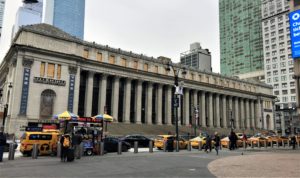
James A. Farley Post Office. Photo: Brian Kachejian ©2019
The Pennsylvania Railroad was not only tasked with building a monumental train station; it also had to dig the tunnels that trains would need to enter and exit the island of Manhattan. This would encompass sixteen miles of underground tunnels. It was obvious that constructing tunnels beneath the rivers surrounding Manhattan would be much cheaper than building bridges. The North River Tunnels were two tunnels built under the Hudson River connecting New Jersey and the west to Manhattan. The East River Tunnels were four tunnels connecting Manhattan and Pennsylvania Station beneath the East River to the borough of Queens on Long Island. Penn Station became the ultimate railroad hub, with connections that allowed trains to travel in every direction. For many people during the first half of the twentieth century, railroads were the preferred method of transportation. That would all change during the second half of the century.
During the 1950s and 1960s, more and more Americans began using automobiles for transportation. The airline industry also convinced travelers to fly rather than take the train. Competition in the travel industry grew fierce. For many reasons, the Pennsylvania Railroad decided in 1962 to replace the grand Greek and Roman-style building of Penn Station with a new one. Despite opposition from preservationists, the grand columns came down, and a new Penn Station was in place by 1968. Some portions of the original station and artwork were incorporated into the new Penn Station as a tribute to its past.
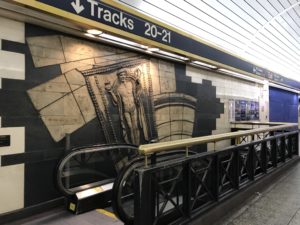
New York Penn Station. Photo: Brian Kachejian ©2019
The station was placed underground while office buildings were constructed above it. A new Madison Square Garden was also built on top of Penn Station. The sports and concert arena would become the world’s most famous, hosting the New York Rangers and the New York Knicks as its permanent tenants. Every musical performer’s dream of making it big ended with the dream of performing at Madison Square Garden. If you could play there, you could play anywhere. Sorry, Frank.
Penn Station Facilities
Penn Station is currently used by travelers riding the Long Island Rail Road, Amtrak, New Jersey Transit, and the New York City Subway system. Over the years, the massive crowds passing through the station each day have taken a toll on the aging facility. It has probably the worst restrooms in the city. As a musician who has worked in many nightclubs over the years and seen some pretty horrible bathrooms, Penn Station’s bathrooms, especially the one in the Long Island Rail Road section by the escalator, are among the worst. Many scary people can be seen going in and out of the restrooms. The restrooms in the Amtrak section of Penn Station are not much better. The best place to use the bathrooms at Penn Station is in the Pennsy Food Hall located right next to the station.
Penn Station And The Homeless
There are many homeless panhandlers walking throughout the station. Many people can be found sleeping in various corners. Most native New Yorkers, like myself, always ignore those men and women sleeping in the station. Not because we don’t care or have no empathy, but because we know they can be dangerous. Not all of them, but I have seen some lash out violently at people. It’s not an issue reserved just for Penn Station or New York City, for that matter. I have seen many homeless people sleeping in train stations from Boston to Philadelphia and almost every other major urban train terminal. I have seen the same in many of Europe’s grand train stations. It’s sad, and I wish we could do more to help those in need. But that’s a topic far beyond the scope of this article.
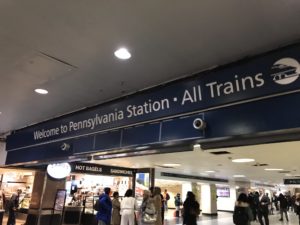
New York Penn Station. Photo: Brian Kachejian ©2019
Penn Station In The 1970s
Penn Station in the 1970s was a far different place than it is today. One of the main reasons behind the differences was the lack of police presence in the 1970s. The city was broke during the decade and simply did not have the funding to patrol Penn Station like it does today. The aftermath of September 11, 2001, increased the police presence in Penn Station tenfold. Today, it is common to observe police officers in SWAT gear carrying automatic weapons while patrolling the station. Several police mini-stations have also been established throughout the station. There was nothing like that back in the 1970s and 1980s.
The food selection for travelers has dramatically improved since the 1970s. The station used to be filled with pizzerias, Orange Julius, Nathan’s, and a few other choices. Today, there are countless places to eat and drink throughout Penn Station. The station has familiar chains such as Starbucks, Dunkin’, Krispy Kreme, and Shake Shack. It also has places that many visitors may never have heard of, including Pret A Manger, Jamba Juice, and Magnolia Bakery. Our favorite will always be Rose Pizza & Pasta. There is a large seating area in the back where you can enjoy a slice while waiting for your train. Just be careful, as it can get pretty sticky back there.
Penn Station Present-Day Issues
The biggest issue facing Penn Station is overcrowding. The place is busy seven days a week, twenty-four hours a day. Its busiest times are weekdays during the late afternoon and evening hours as thousands of commuters wait for their trains to take them home after work. The rush continues into the late evening whenever the crowds from Madison Square Garden spill out after a concert or sporting event.
At the time this article was originally written, Penn Station was once again undergoing a major renovation. Although renovation may be an understatement. For the entrance alone, New York State was spending 600 million dollars to build a new entrance with direct access to the Long Island Rail Road and the New York City Subway system.
Penn Station’s concourse surrounding the Long Island Rail Road was widened and the ceiling raised. The widening of the concourse forced many of the restaurants mentioned above to close in order to create additional space. A major part of the project transformed the James A. Farley Post Office into the Moynihan Train Hall, greatly expanding passenger space while remaining connected to Penn Station via an underground tunnel.
For millions of people, Penn Station has become part of everyday life. They have spent years waiting in frustration for delayed trains in overcrowded hallways while holding a cup of coffee or a folded slice of pizza and staring at the departure board, waiting to find out which track their train will arrive on. The mad dash down the escalator begins as soon as the track number appears on the board. It’s a way of life, and most commuters have become numb to it.
For millions of travelers arriving at Penn Station in New York City for the first time, their experience begins with trying to find their way out. As most step onto Seventh Avenue for the first time, their jaws drop. The smell, the noise, the traffic, the enormous video screens, the street hustlers, the crowds, and the towering buildings combine to create an unforgettable first impression. They have never seen anything quite like it.
Welcome to Penn Station. Welcome to New York!
Related New York History Articles
If you enjoyed this article, be sure to explore our other features on ClassicNewYorkHistory.com, including stories on Grand Central Terminal, Madison Square Garden, Robert Moses, and other iconic New York City landmarks.
Article updated on June 26, 2026